From the Library · Spellcraft & Practical Magick
Creating Your Altar
A complete guide to setting up, arranging, and maintaining an altar for witchcraft practice. Covers working and devotional altars, choosing elements, consecration, seasonal upkeep, and solutions for limited space or privacy.
An altar is the physical centre of a magickal practice. It is the place where sacred space is established, where tools are kept and charged, where offerings are given, and where intention is gathered and focused before a working. It does not need to be elaborate, expensive, or permanent. What it needs to be is deliberate: a space set aside from ordinary domestic life and dedicated, consciously, to practice.
Altars appear in virtually every religious and magickal tradition that has ever been documented. The forms vary enormously, from the vast stone structures of ancient temples to a single candle and a cup of water on a windowsill, but the underlying principle is consistent. You are making a place where the ordinary and the sacred meet. You are telling yourself, and the forces you work with, that this space has a different quality from the rest of the room.
Working Altars and Devotional Altars
It is useful to distinguish between two related but distinct altar functions, because understanding the difference will help you design yours with more clarity.
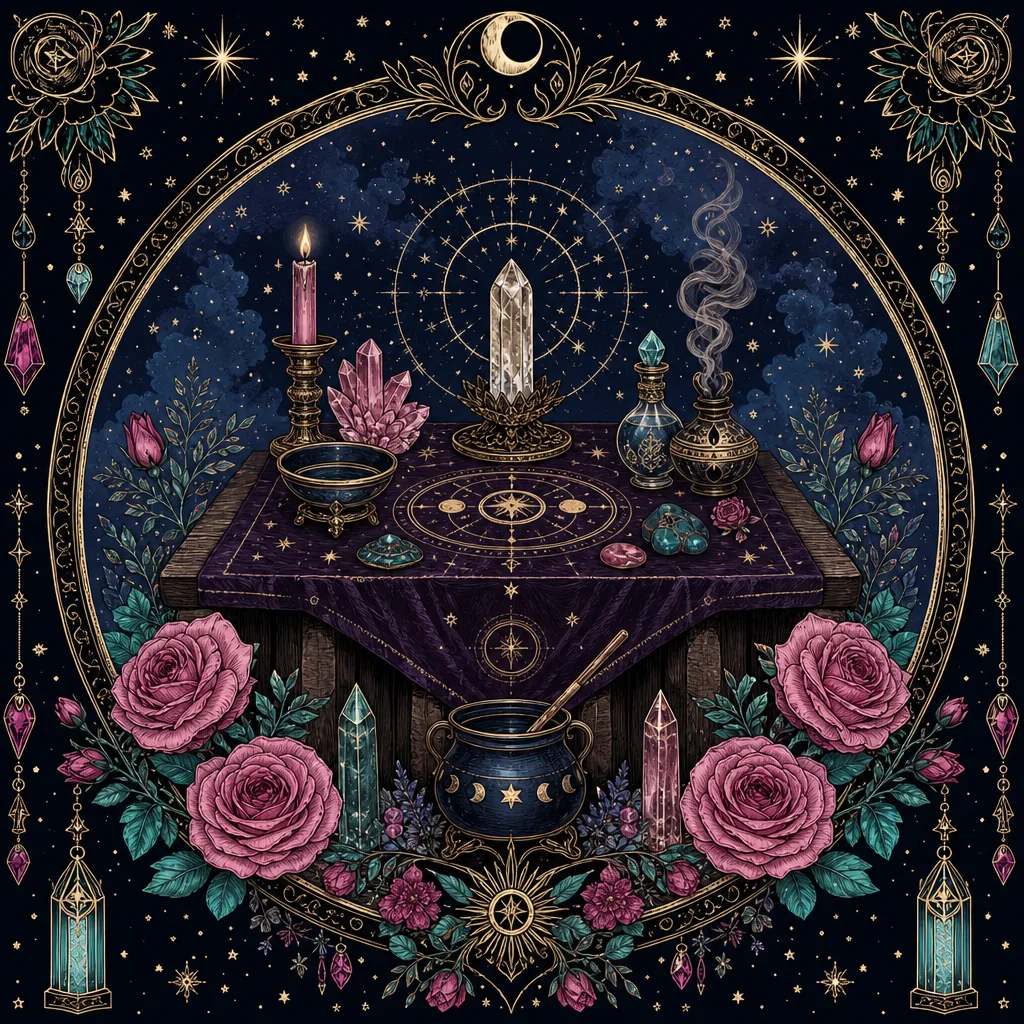
A working altar is an active space, the table where you do the work. It holds the tools you use in spells and rituals: candles, a blade or wand for directing energy, a chalice, your Book of Shadows, the materials for the current working. It may be rearranged frequently as different spells require different configurations. Think of it as a workshop bench as much as a shrine.
A devotional altar is a shrine to a deity, an ancestor, or a spirit. It holds an image or statue, offerings, flowers, incense, and items associated with the being honoured. It tends to stay more stable over time, with offerings refreshed rather than the whole arrangement changed.
Many practitioners keep a single altar that serves both functions. Others maintain a permanent devotional altar and use a separate table, a section of the floor, or an outdoor spot for active workings. There is no rule here; the question is what works in your space and your practice.
Choosing a Location and Surface
Your altar can be placed almost anywhere you have regular access. A dedicated table is the most common choice: a small side table, a bookcase with a cleared top, or a low wooden chest all work well. Height is a practical matter. If you will be standing during ritual, a surface between waist and chest height is comfortable. If you sit during practice, a lower surface or even a tray on the floor works fine.
The location matters mostly in terms of your own access and attention. Some practitioners prefer to face north during working, associating that direction with earth energy and stability. Others face east toward the rising sun, or orient toward a cardinal direction associated with a chosen deity. You may find an orientation feels right, or you may not, and either outcome is fine.
Consider privacy and practicality. If you share your home with people who are not part of your practice, a bedroom altar is often easier to maintain than one in a shared living space. If you have children or curious housemates, fragile or potentially dangerous items like glass containers and lit candles need to be placed where they are safe.
The Elements of an Altar
There is no single correct arrangement, but most practitioners working in the Wiccan or contemporary Western witchcraft tradition include representations of the four classical elements: earth, air, fire, and water. These anchor the space energetically and connect it to the natural world.
Earth is commonly represented by a dish of salt, a stone, a crystal, or a small pot of soil. Air is represented by incense, a feather, a bell, or simply the smoke from a lit incense stick. Fire is most naturally a candle, and the flame on the altar serves double duty as elemental representation and as a source of light and focal point. Water is represented by a small cup, bowl, or chalice holding water, which can be refreshed regularly.
A focal point for the altar is useful even if you work without deity imagery. This might be a central candle in the colour most associated with your current work, a meaningful stone, a symbol drawn or painted on a piece of paper, or a deity statue. The focal point is where your eye and attention naturally land when you stand before the altar.
If your practice involves working with specific deities, their imagery, symbols, and preferred offerings belong on the altar. A small printed image works as well as a carved statue. Place deity representations toward the back of the surface, in a position of honour, with working tools and offering vessels in front.
Your tools live on the altar when not in use: the wand or blade in the centre or toward the relevant quarter direction, the chalice toward the west, the pentacle disk in the centre or the north. These attributions come from Wiccan convention and are sensible starting points, though many experienced practitioners adapt them freely.
Arranging the Altar with Intention
Rather than following a diagram of someone else’s arrangement, take time to place each object consciously. Hold each item before setting it down. Consider what it is for and what it represents. Place it where it feels balanced and accessible. Step back and look at the whole arrangement. Move things until the altar feels right to you, meaning until your attention settles on it comfortably rather than snagging on something that feels off.
This process of deliberate arrangement is itself a form of practice. You are not decorating a shelf; you are constructing a sacred space. The attention and intention you bring to the arrangement is part of what makes it an altar rather than a collection of objects.
Keep the surface uncluttered enough to actually work on it. An altar piled so full of collected items that there is no room to light a candle or open a book has drifted toward display and away from function. Review the altar periodically and remove anything that has stopped serving a purpose.
Consecrating a New Altar
Once your altar is arranged to your satisfaction, consecrating it formally marks the transition from arrangement to sacred space. This does not need to be elaborate.
Begin by cleansing the space. Pass smoke from incense or a cleansing herb bundle around the surface and through the air above it. Alternatively, use sound, a bell, a singing bowl, or three firm claps, to break up and clear stale energy. You can also wipe the surface with a cloth lightly dampened with salted water.
Light the central candle. Stand before the altar, take a few slow breaths, and ground yourself, imagining your energy settling downward into the earth. Then speak your intention aloud. A simple statement works well: you are dedicating this space to your practice, to the forces or deities you work with, and to your own growth and integrity. Say what is true for you, in your own words. If you have a patron deity or work with particular elements, name them.
Pass each tool through the candle”s light, through the incense smoke, and near the water vessel, connecting it to the four elements. Set it back in its place.
Close by expressing gratitude, to the elements, to any deities invoked, or simply to the practice itself. Let the candle burn for at least a few minutes before extinguishing it. The altar is now dedicated.
Maintaining and Changing the Altar
A living practice calls for a living altar. Refresh offerings regularly, removing them before they decay past the point of respect. Change water, replace wilted flowers, and clear candle stubs. This maintenance is not mere housekeeping; it is practice. Each time you tend the altar, you are in relationship with it.
The altar can and should change with the seasons and with the focus of your current work. At Samhain, ancestor photographs and autumn offerings are appropriate. At Imbolc, a white cloth and early spring flowers reflect the season”s energy. At midsummer, the altar might be bright with flowers and warm colours. Allowing the altar to reflect the Wheel of the Year connects your practice to the natural cycles it draws meaning from.
When a spell is complete, remove the working materials from the altar. When you move through a difficult period or shift the focus of your practice, take time to refresh and re-dedicate the altar. A fresh arrangement and a renewed statement of intention re-energises the space.
Portable, Hidden, and Improvised Altars
Not every practitioner has the space, privacy, or security to maintain a permanent dedicated altar. This is common, and it is surmountable.
A portable altar fits in a small box, tin, or fabric pouch. A birthday-cake candle serves for fire. A thimble of water serves as the water element. A pebble and a pinch of salt cover earth. A small feather or a stick of incense covers air. An image printed on paper covers deity representation. This kit can be set up on any flat surface in a few minutes, used for a working, and packed away again.
A hidden altar can look entirely mundane to an uninformed observer. Books arranged with meaningful care, a collection of stones that appear to be decoration, a houseplant with a crystal buried in the soil, a candle and a bowl that might simply be home decor. The intention behind the arrangement is invisible, and the altar functions because of what you know about it.
An improvised altar outdoors requires nothing beyond the natural world itself. A flat rock, a clearing, a tree root, a spot at the base of a particular tree. Many practitioners find that working outdoors, with no altar beyond a found surface, produces some of the most immediate and grounded results they experience. The land itself is the altar, and it requires no arrangement at all.
Moving Forward
An altar is not a finished object. It is an ongoing relationship between you and your practice, changing as you change, accumulating meaning over time, and reflecting where you are right now. Begin simply. A single candle, a cup of water, an object that holds meaning for you, and the intention to begin is enough to start. The altar will grow into what it needs to be as your practice grows with it.