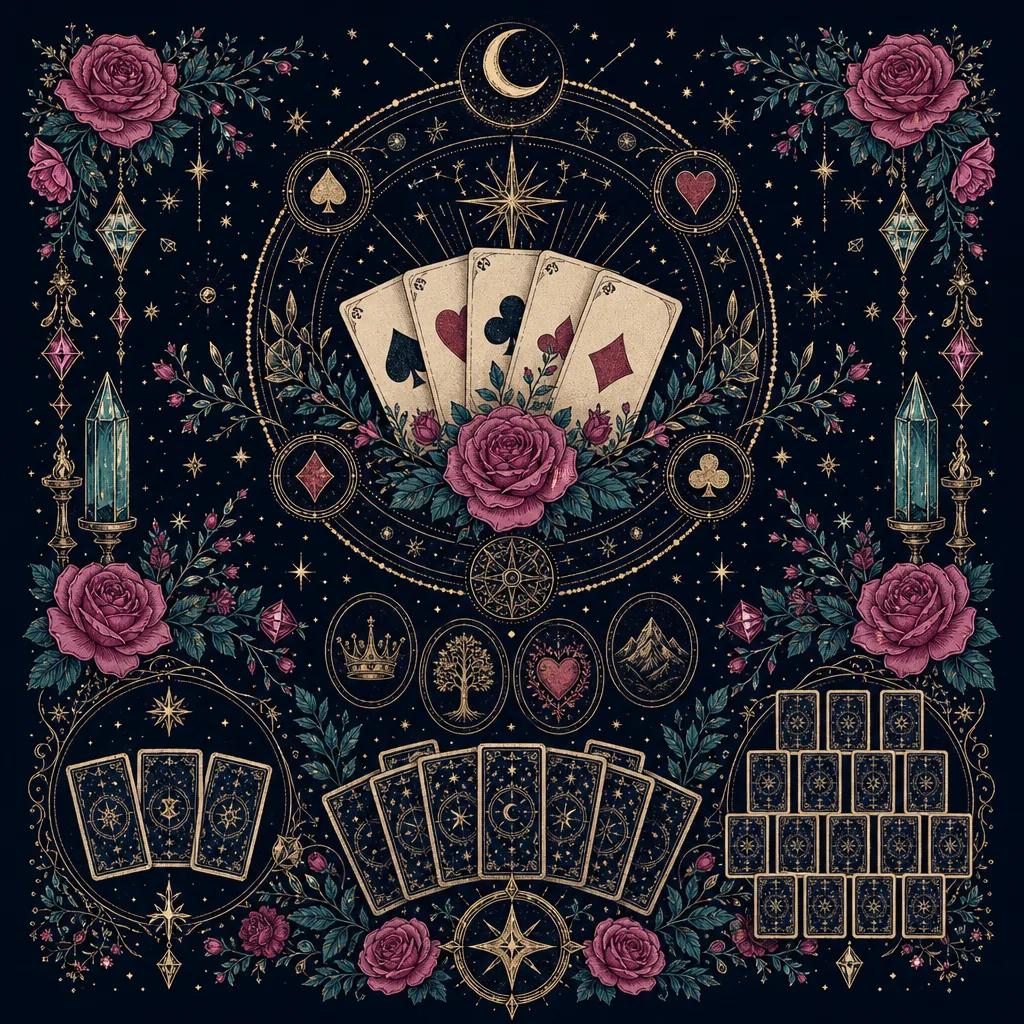
From the Library · Divination & Oracles
Cartomancy with Playing Cards: A Tutorial
A thorough guide to reading fortunes with a standard 52-card deck, covering suit meanings, number and court card interpretations, the significator, and three complete spreads from the three-card draw to the 21-card grand spread.
Cartomancy is the practice of divination using a deck of cards. When the deck in question is a standard 52-card playing deck, the practice has an exceptionally long documented history and one of the most accessible entry points of any divinatory art: the tool is already in most households, and its structure, four suits of thirteen cards each, is a coherent symbolic system that rewards serious study.
This tutorial covers everything you need to conduct a full cartomancy reading, from the meanings of each suit through three complete spread methods, with notes on how experienced readers combine and contextualize the cards they draw.
Historical background
Playing cards reached Europe from the Islamic world during the fourteenth century, probably through Mamluk Egypt, and spread rapidly across the continent. The Mamluk deck, like the European one that descended from it, had four suits and court cards, though the suits and figures were different. By the late fifteenth century, the French suit system of hearts, diamonds, clubs, and spades had emerged and was widely adopted for the mass-produced cards that printing made possible.
The use of playing cards for divination is documented from at least the seventeenth century in Europe. Early references appear in Italian and French sources, and by the eighteenth century cartomancy was sufficiently widespread that it generated both instruction manuals and satirical commentary. The French fortune-teller Mademoiselle Marie-Anne Lenormand, active in the late eighteenth and early nineteenth centuries and said to have read for Napoleon and Josephine, did much to raise the social respectability of cartomancy, though the deck she used and the methods attributed to her have been subject to considerable embellishment over the centuries since.
The standard cartomantic meanings that most readers work with today represent a synthesis that developed primarily in England and France between roughly 1750 and 1900, refined through countless printed guides and oral transmission. These meanings are not fixed dogma; they are a living interpretive vocabulary that each practitioner adapts through experience.
Understanding the four suits
Each suit governs a domain of human experience. These domains parallel those of the tarot’s Minor Arcana suits, which is not coincidence: the tarot and the playing card deck share a common ancestry in the same Italian card-making tradition.
Hearts correspond to the emotional and relational domain. Hearts cards address love, friendship, home, family, and inner life. A spread heavy with hearts is a spread deeply concerned with feeling, connection, and the quality of relationships. Hearts are associated with water and with the intuitive, receptive aspects of experience.
Diamonds correspond to the material and practical domain. Diamonds address money, commerce, property, practical affairs, and tangible outcomes in the world. A spread heavy with diamonds is a spread concerned with resources, work, and the physical conditions of life. Diamonds are associated with earth and with concrete, measurable reality.
Clubs correspond to the domain of energy, ambition, and action. Clubs address work, enterprise, creativity, travel, and the will to accomplish. A spread heavy with clubs suggests a period of movement, effort, and the pursuit of goals. Clubs are associated with fire and with the driven, expansive aspects of experience.
Spades correspond to the domain of challenge, conflict, and transformation. Spades address difficulty, loss, grief, opposition, and the hard lessons that precede growth. A spread heavy with spades warrants honest attention rather than alarm; difficulty in cartomancy is not a verdict but a description of the terrain. Spades are associated with air and with the sharp, clarifying aspects of intellect and adversity.
The number cards: Ace through Ten
Each number carries a meaning that combines with the suit to produce the card’s full significance. The following meanings are traditional and broadly consistent across most cartomantic systems.
Aces represent beginnings, initiating forces, and the essential energy of their suit. The Ace of Hearts indicates new love, a new friendship, or a home. The Ace of Diamonds indicates a letter, message, or new financial opportunity. The Ace of Clubs indicates a new enterprise, good news about a project, or a gift. The Ace of Spades indicates major change, endings, and sometimes a difficult truth that must be faced.
Twos represent balance, partnership, and the meeting of two forces. The Two of Hearts indicates a happy partnership or reconciliation. The Two of Diamonds indicates a change or disagreement in financial matters. The Two of Clubs indicates a disappointment or obstruction to plans. The Two of Spades indicates separation, a parting of ways, or an impasse.
Threes represent growth, expansion, and the first fruits of effort. The Three of Hearts indicates emotional abundance, a celebration, or a fortunate resolution. The Three of Diamonds indicates legal matters or financial disputes. The Three of Clubs indicates successful enterprise and promising prospects. The Three of Spades indicates a removal or loss, and sometimes parting from a loved one.
Fours represent stability, consolidation, and rest. The Four of Hearts indicates a change in love affairs or a journey taken for emotional reasons. The Four of Diamonds indicates financial stability inherited or earned through past effort. The Four of Clubs indicates a change of plans or a false start. The Four of Spades indicates illness, enforced rest, or a period of withdrawal from active life.
Fives represent disruption, instability, and the energy that breaks a fixed pattern. The Five of Hearts indicates jealousy or regret, often self-generated. The Five of Diamonds indicates a prosperous period, sometimes unexpectedly so. The Five of Clubs indicates new acquaintances, sociability, and favorable introductions. The Five of Spades indicates reversal, an unexpected setback, or opposition from someone with power.
Sixes represent movement, progress, and reconciliation after difficulty. The Six of Hearts indicates generosity, nostalgia, or a gift from the past. The Six of Diamonds indicates a caution about early marriage or premature commitment. The Six of Clubs indicates financial aid or assistance arriving from outside. The Six of Spades indicates gradual improvement and movement away from a difficult period.
Sevens represent reflection, inner work, and sometimes deception. The Seven of Hearts indicates someone unreliable, or an emotional illusion the querent needs to see clearly. The Seven of Diamonds indicates a disagreement in a professional context, or criticism that must be weighed carefully. The Seven of Clubs indicates a challenge to plans from competition or stubbornness. The Seven of Spades indicates advice that should be carefully considered before acting; also, a loss that may be recovered.
Eights represent movement, arrival, and shifting circumstances. The Eight of Hearts indicates a choice to be made, often involving departure or a change of priorities. The Eight of Diamonds indicates a late-in-life marriage or a union connected to financial interests. The Eight of Clubs indicates hasty decisions with unforeseen consequences, advising slowing down. The Eight of Spades indicates caution, a warning against proceeding without more information.
Nines represent fulfillment, wish-granting, and climax. The Nine of Hearts is the traditional “wish card,” indicating that the querent’s strongest desire is likely to be granted. The Nine of Diamonds indicates a surprise, usually financial in nature. The Nine of Clubs indicates a new friendship or the successful completion of a project. The Nine of Spades indicates anxiety, misfortune, or a difficult period requiring endurance.
Tens represent completion, endings, and the full expression of the suit’s energy. The Ten of Hearts indicates great happiness, family harmony, and a fortunate culmination. The Ten of Diamonds indicates a journey or change of home, usually favorable and connected to financial improvement. The Ten of Clubs indicates a long journey or a large undertaking; success is likely but effort is real. The Ten of Spades indicates worry, a significant challenge, or an event that brings a chapter definitively to a close.
The court cards
The Jack, Queen, and King of each suit traditionally represent people, and many cartomancers use physical appearance as one of several identifying factors.
Jacks represent young people of either gender, messengers, and in some readings the querent’s own youthful or aspirational self.
The Jack of Hearts is a warm, affectionate young person, often a close friend or an admirer. The Jack of Diamonds is a young person connected to financial matters or messages of a practical nature; traditionally associated with fairer coloring. The Jack of Clubs is a reliable young person with good intentions and energy; a trustworthy ally. The Jack of Spades is a young person whose motives may not be transparent; the card warrants careful attention to who is acting behind the scenes.
Queens represent mature feminine energy or women of significance in the querent’s life, but in modern practice they are equally applicable to anyone who embodies their qualities.
The Queen of Hearts is a loving, supportive person, often the querent’s closest emotional ally. The Queen of Diamonds is a practical, socially adept person with financial competence; someone whose advice on material matters is worth taking. The Queen of Clubs is a confident, energetic person with strong opinions and the capacity to make things happen. The Queen of Spades is a sharp, independent, sometimes difficult person; often a widow in traditional readings, but more broadly someone whose strength comes from having endured considerable hardship.
Kings represent mature masculine energy or figures of authority, again applicable across genders in contemporary practice.
The King of Hearts is a kind, emotionally generous leader; fair in judgment and warm in support. The King of Diamonds is a financially powerful person, successful in business and practical affairs. The King of Clubs is a bold, enterprising person with natural authority and creative force. The King of Spades is a person of high ambition and considerable force of will, associated with professional achievement but sometimes with ruthlessness.
Choosing a significator
The significator is a card set aside before the reading to represent the querent. Choosing it grounds the reading in the querent’s specific perspective and gives you a reference point throughout.
The traditional method assigns significators based on the court card that best matches the querent’s apparent temperament and the suit associated with their coloring. In modern practice, coloring is treated as one minor factor among several, with temperament and life circumstances carrying more weight.
Many contemporary cartomancers choose the significator based on the querent’s sun sign or on which court card they feel most accurately represents the querent at the time of the reading. The most practical approach for a beginning reader is to ask the querent to choose their own significator from the court cards, selecting the one that feels most representative of who they are right now.
Remove the significator from the deck and place it face-up at the top of your reading area before shuffling. It is not included in the drawn cards; it serves only as the fixed point of reference.
Preparing for the reading
Have the querent shuffle the deck thoroughly while holding their question in mind. The question can be general (“What do I need to know about my situation right now?”) or specific (“What is the likely outcome of this business decision?”). Specific questions tend to yield more directly applicable readings.
After shuffling, the querent cuts the deck once with the left hand and reassembles it. You then take the deck and deal from the top.
The three-card spread
This is the simplest complete cartomancy spread and the best one for beginners to master before moving to more complex layouts.
Deal three cards face-down in a row from left to right, then turn them over simultaneously or one at a time.
Card one (left): the past or the background. This card shows what has led to the present situation, the root causes, prior circumstances, and energies that have shaped the ground the querent is standing on.
Card two (center): the present. This is the heart of the reading and typically the most immediately recognizable card for the querent. It describes the central energy, challenge, or opportunity active right now.
Card three (right): the path forward or potential outcome. This card shows what is likely to develop if current patterns continue, or what the querent should move toward. Hold it as a tendency rather than a fixed result.
Read the cards individually first, then look at all three together. Note whether any suits repeat, which indicates a concentrated energy in that domain. Note whether the suits suggest tension (a Heart flanked by Spades, for instance) or harmony (three Clubs, all in the domain of action and enterprise).
The nine-card spread
The nine-card spread provides considerably more detail about the querent’s situation and is suitable for readings with a specific, significant question.
Deal nine cards face-down in a three-by-three grid. Number the positions as follows:
1  2  3
4  5  6
7  8  9
Turn all cards face-up after dealing.
Position 1 (top left): Past influences; what has recently passed or is currently concluding. Position 2 (top center): The immediate present; the central energy or challenge. Position 3 (top right): The near future; what is approaching within weeks. Position 4 (middle left): What is working against the querent; obstacles or opposing forces. Position 5 (center): The core of the matter; the fundamental issue underlying the question. Position 6 (middle right): What is working for the querent; helpful forces and resources. Position 7 (bottom left): The querent’s own attitude and approach; how they are engaging with the situation. Position 8 (bottom center): The environment and circumstances; external factors shaping the outcome. Position 9 (bottom right): The outcome or likely resolution if the current trajectory continues.
Read each position individually, then read the rows and columns. The center column (positions 2, 5, 8) gives the reading’s spine: past, present, future in sequence. The center row (positions 4, 5, 6) shows the balance between opposition and support. The diagonals often produce an interesting narrative of their own.
The 21-card grand spread
The grand spread is the most comprehensive cartomancy layout in the traditional Western system. It requires practice to read fluently but offers a remarkably complete picture of the querent’s circumstances across multiple areas of life.
From the shuffled deck, deal seven cards face-down in a row. This is the first row. Deal a second row of seven below it, and a third row of seven below that, so you have 21 cards in a seven-by-three grid.
Turn all cards face-up. The three rows are read as three temporal zones: the top row addresses the past and foundational matters; the middle row addresses the present and active circumstances; the bottom row addresses the future and developing tendencies.
Within each row, the seven positions are read thematically:
Column 1: The querent themselves, their character and current state. Column 2: Home and domestic life. Column 3: Current desires, hopes, and wishes. Column 4: What the querent does not expect; surprises and what lies outside their current awareness. Column 5: Relationships, partnerships, and significant people. Column 6: Near future circumstances. Column 7: The outcome of the matter.
Reading all three rows through each column gives you a past-present-future thread for each thematic area. The card at position row 2, column 7 (present, outcome) is typically the most significant single card in the spread and is read with particular attention.
Look for clusters of the same suit across columns, for court cards that appear multiple times (they often represent real people who are influential throughout the situation), and for Aces, which in the grand spread indicate new beginnings being seeded in each temporal zone where they appear.
Combining cards
Cartomancy’s real depth comes not from individual card meanings but from reading cards in combination. A few guiding principles:
Two or more cards of the same suit amplify that suit’s energy and confirm its domain as central to the reading. Three or more of the same number in a row carries special significance: three Aces together indicate extraordinary beginnings or a major life reset; three Kings indicate powerful authority figures converging; three Nines suggest multiple wishes reaching fulfillment simultaneously.
The Nine of Hearts is the most powerful positive card in cartomancy and modifies neighboring cards toward favorable outcomes. The Ten of Spades is the most challenging card in the deck, but its significance diminishes when surrounded by positive suits; it rarely stands alone as a verdict.
The Four of Spades followed by any Heart card in the same spread indicates recovery after illness or difficulty. The Seven of Spades adjacent to a court card suggests that the person represented by that court card is not being fully honest. The Ace of Spades adjacent to any court card draws attention to that person as significant to the matter under discussion in an intense or fated way.
Court cards in combination with each other indicate relationships between people: proximity in the spread suggests proximity in the situation. Two court cards of opposing suits (a Queen of Hearts beside a King of Spades, for instance) suggest a relationship complicated by fundamental differences in temperament or values.
Common mistakes and how to correct them
Reading each card in isolation and losing the narrative. The most common beginner error is treating a spread as a list of separate messages. Train yourself to tell the story the spread is telling: what is happening, to whom, and where is it going? The cards interact with each other as much as they speak independently.
Fixating on the Ace of Spades or Ten of Spades as signs of doom. These are challenging cards, not death sentences. In context, the Ace of Spades frequently indicates an ending that makes room for necessary new beginnings. The Ten of Spades often marks the close of a difficult chapter rather than an ongoing state. Read every difficult card in the company of its neighbors.
Ignoring court cards that the querent does not immediately recognize. Court cards represent significant people even when the querent initially draws a blank. Note them, describe what the card suggests about the person’s character, and let the querent sit with it. Recognition often comes after the reading.
Choosing positions arbitrarily when the reading is not flowing. If a position’s card feels unreadable, state its traditional meaning clearly and move on rather than inventing a connection. It is better to say “the Eight of Clubs in the near future position traditionally advises slowing down before acting” and let the querent apply that than to force an interpretation that does not fit.
Building a cartomancy practice
Cartomancy rewards regular, low-stakes practice. Draw a single card each morning, note its meaning in relation to your day, and review your record weekly. The meanings will cease to be external facts you look up and become an internalized language you think in.
When you are ready to read for others, begin with people who approach the reading with genuine openness and a real question. The quality of the querent’s engagement shapes the quality of the reading considerably; cartomancy is a conversation between the cards, the reader, and the person being read for, and all three parties contribute to what emerges.