From the Library · Ritual, Ceremony & High Magick
Casting a Circle and Creating Sacred Space
A thorough guide to casting a ritual circle for witchcraft practice. Covers the purpose of the circle, when to use one, a complete step-by-step method with and without tools, and how to close the circle properly.
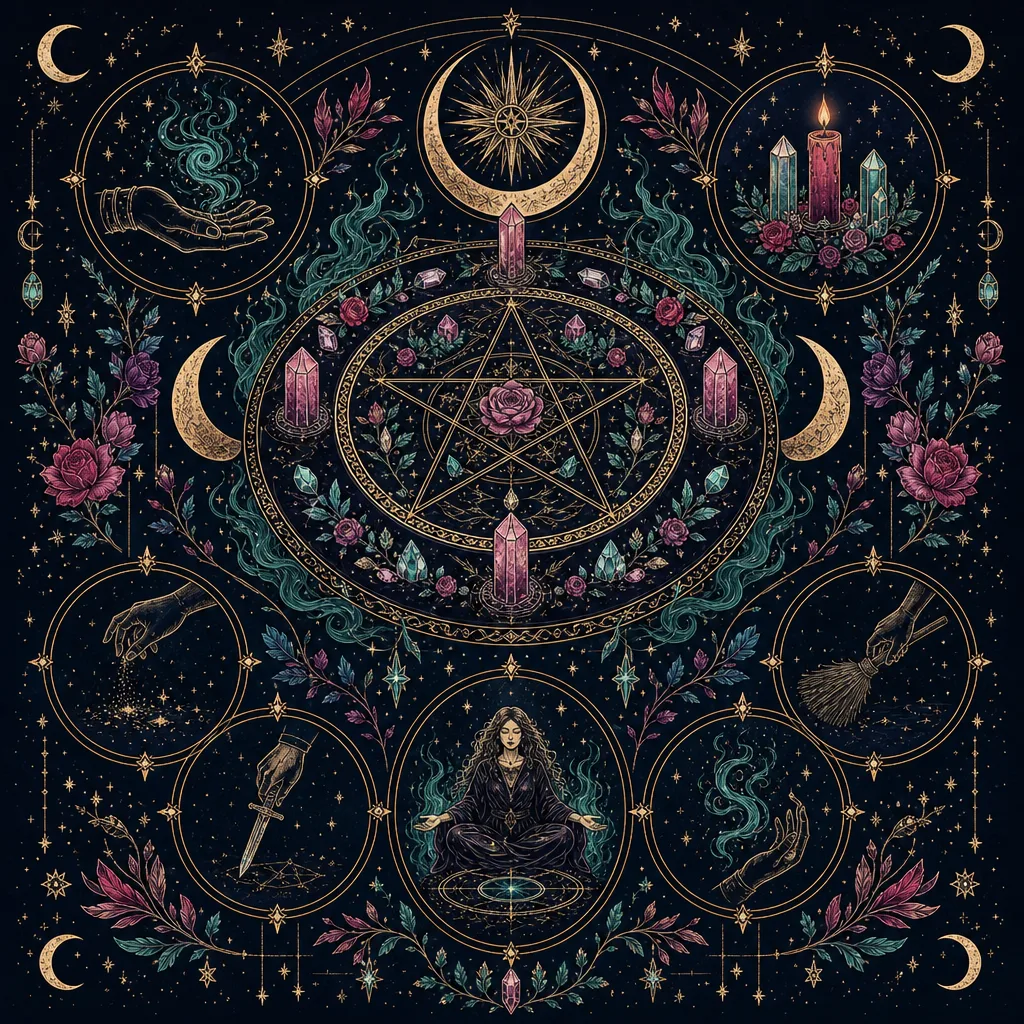
A cast circle is a sphere of concentrated, intentionally bounded energy that a practitioner creates around their working space before ritual or spellwork. It serves three purposes simultaneously: it defines and contains the energy raised during the working so that it builds to full strength rather than dissipating; it marks the boundary between ordinary space and sacred space, shifting the practitioner”s consciousness into a more focused and receptive state; and it provides a degree of protection from external interference or disturbance during the work. When the ritual is complete, the circle is dissolved and the energy released.
Circle-casting in something close to its current form is associated primarily with Wicca as codified by Gerald Gardner in the 1950s, drawing on earlier ceremonial magick practices from the Hermetic Order of the Golden Dawn and the Key of Solomon tradition. Earlier European grimoires describe circles in similar terms: an enclosed space marked and protected by symbols, divine names, or natural materials. The specific Wiccan method, which calls the four quarters and typically invokes the Goddess and God within the circle, is a twentieth-century synthesis, and it is worth knowing that so you can adapt it freely to your own tradition and deities.
When to Cast a Circle
A full cast circle is not required for every piece of magickal work. Understanding when it is warranted and when it is not will save you time and let you work more naturally.
Cast a circle when you are raising a significant amount of energy, performing a formal ritual, working with spirits or entities, doing any work that calls for strong containment, or observing a sabbat or esbat with full ceremony. The circle provides a defined container for all of this.
You do not need a full cast circle for brief spells, daily practice, simple candle workings, divination, meditation, or working with your altar in a casual and ongoing way. Many experienced practitioners cast circles only for their most significant workings, relying on cleansed and warded space for everything else. The circle is a tool, and like any tool it should be used when it serves the work rather than applied by rote.
Preparing the Space
Before casting the circle, prepare the physical space. Move furniture or objects that will interfere with the working. If you plan to work indoors, ensure you have enough room to physically mark the circle and to move within it. The circle should be large enough to contain your altar and all the tools you will use, with comfortable room to move.
Cleanse the space before casting. Pass smoke from a cleansing herb through the area, use a sound method such as a bell or clapping, or sweep the space with a besom if you use one. Energetic cleansing before circle-casting clears whatever was present in the space so that the circle is built on a clean foundation.
Gather everything you will need for the working and bring it inside the area where the circle will be cast. Once the circle is up, passing in and out disrupts the boundary. It is possible to cut a doorway in the circle if necessary, but planning well and bringing everything in before you start is simpler.
Mark the circle if you wish. Many practitioners define the circle physically, using chalk on a wood floor, a cord laid in a ring, a ring of stones, or candles at the four cardinal directions. This is not strictly necessary but it is useful for beginners because the physical boundary supports the visualized one. The standard size is nine feet in diameter, a traditional measurement, but you can work in any size that fits your space.
The Method: Casting the Circle
The following is a complete working method. Adapt the words and the specific deities or elemental calls to your own practice and tradition.
Ground and centre yourself. Stand quietly in the space that will become the circle. Take several slow breaths. Feel your feet on the ground and let your energy settle. This takes one to two minutes and it is not optional: a scattered or hurried practitioner builds a scattered circle.
Define the boundary. Beginning at the north (or east, depending on your tradition), walk slowly clockwise around the perimeter of your circle three times. On the first pass, you are clearing and establishing the boundary. Point your dominant hand, a wand, or your athame toward the edge of the space and visualize a line of clear blue or white light tracing the circle as you walk. On the second pass, visualize this line building into a wall of light, expanding upward above your head and downward below your feet until it forms a complete sphere. On the third pass, seal the sphere and feel it become solid and contained.
Speak your intention as you walk, in words that feel true to you. A simple declaration serves well: “I cast this circle as a sacred space, a boundary between the worlds. It is a place of protection and of power. Only love and truth may enter here.”
Call the quarters. The quarters are the four cardinal directions and the elemental energies associated with them: earth in the north, air in the east, fire in the south, and water in the west. (Some traditions invert the earth and air associations, or place earth in the south depending on hemisphere; use whatever resonates with your path.) Beginning in the east and moving clockwise, face each direction in turn and call the element or its guardians. Light the candle at that quarter if you are using them.
An example call for the east: “Guardians of the east, powers of air, I call you to witness this rite and lend your clarity and wisdom to this circle. Hail and welcome.” Repeat for each direction in turn, adjusting the element and its qualities. After calling all four quarters, face the centre of the circle or look upward and call to spirit, the divine, or the specific deities of your practice, inviting them to be present.
Acknowledge the circle as cast. Stand in the centre of your space, take a breath, and feel the difference. The circle is between the worlds: neither fully in the ordinary world nor in any other, but in a state of heightened possibility. State simply: “The circle is cast. We are between the worlds.”
Conducting the Working
Everything you have planned for the ritual now takes place inside the circle. Follow your spell, observe your ritual, raise and direct your energy, call up what you have come to call up. The circle holds the space stable and the energy contained while you work.
If you need to leave the circle during the working, cut a doorway rather than simply stepping through the boundary. Use your hand, wand, or blade to trace a door-sized opening in the circle wall with intention, step through, and then close it behind you by retracing the cut. Reverse this process when you return.
Releasing the Circle
When the working is complete and you are ready to close:
Thank and dismiss the quarters. Working counterclockwise from north (or from wherever you began), face each direction in turn, thank the element and its guardians for their presence and assistance, and release them: “Guardians of the north, powers of earth, I thank you for your presence in this rite. Hail and farewell.” Snuff the quarter candles as you dismiss each one.
Then release the deities or spirit you called, thanking them with sincerity before you close.
Walk counterclockwise around the circle three times, drawing the energy of the boundary back into your hand, wand, or blade as you go, or simply visualizing the sphere of light dissolving and returning to the earth. Speak your release: “This circle is open, but never broken. The love we have shared here remains with us. Merry meet, merry part, and merry meet again.” These traditional words are optional, of course; what matters is the intentional dissolution of the boundary.
Ground yourself thoroughly after closing. Eat and drink something if you can. Energy raised in a circle and not fully grounded out remains in your system and can produce restlessness, agitation, or disturbed sleep.
Casting a Circle with No Tools
You do not need physical tools to cast a circle. The circle is a structure of focused energy and intention, and the hand and the voice are sufficient instruments for building it.
Walk the perimeter while pointing your index finger of your dominant hand toward the boundary. Visualize the light clearly and hold it consistently as you walk. Call the quarters using only your voice and your attention directed to each direction. State your invocations plainly and with full engagement. The circle will be exactly as strong as your focus and intention make it.
Beginning practitioners sometimes find that tools help them concentrate, and that is a good reason to use them. Experienced practitioners often find that tools become less necessary over time as the mental skill of holding and directing focused attention develops. Both approaches are correct for where you are.
Common Difficulties
A circle that feels weak or porous usually means one of three things: the space was not cleansed before casting, the practitioner was not sufficiently grounded and centred before beginning, or the visualisation was not held consistently through the full three passes. These are all correctable. Recast with more care the next time.
If you lose track of where you are or feel the circle slip during the working, pause, reground, and re-walk the boundary with intention before continuing. A circle can be reinforced mid-working.
If you cannot remember all the words of your quarter calls during ritual, say what is true. “Guardians of the south, I call to you and ask your presence” is as effective as a memorised invocation, because what the quarters respond to is your genuine attention and intention, not a particular script.
Integrating Circle Work into Practice
The cast circle is one of the most powerful structures in contemporary witchcraft, and it repays the effort of learning it well. Practise casting in low-stakes situations, perhaps a simple meditation or a quiet observation of the moon, so that the mechanics become comfortable before you use the circle for major workings. A circle you cast fluently and confidently creates a noticeably different quality of space than one cast while consulting notes, though even an imperfect circle serves its purpose.
Over time, your circles will become fuller and more immediate. The sense of the boundary, of being between the worlds, will become recognisable and repeatable. This reliability is one of the great strengths of regular ritual practice, and the circle is a sound place to build it.