From the Library · Divination & Oracles
Coffee Ground Reading: A Tutorial
A complete guide to reading fortunes in coffee grounds, covering the Turkish and Greek cup-and-saucer flip method, regional interpretation of the cup, common symbols, and the cultural roots of the practice.
Reading fortunes in coffee grounds, practiced under the Turkish name “tasseomancy” or more specifically “kahve falı,” is one of the most widely practiced forms of divination in the world. It is alive today in Turkey, Greece, the Balkans, the Arab world, and in diaspora communities throughout Europe and North America. Unlike many divinatory traditions that have been codified primarily through printed texts, coffee ground reading has survived largely through direct transmission: one person watching another, asking questions, and learning to see.
This tutorial teaches the complete practice as it is performed in the Turkish and Greek traditions, the form in which the method is most fully developed and most thoroughly documented.
Cultural roots and historical context
Coffee arrived in the Ottoman Empire during the sixteenth century, reaching Istanbul from Yemen and quickly spreading to coffeehouses, the qahvakhane, which became centers of intellectual and social life. The practice of reading grounds appears to have developed not long after coffee became widespread; the earliest references to kahve falı in Ottoman literature date to the seventeenth century, though the practice was almost certainly established before those written records.
In Greece, coffee ground reading, known as “kafemanteia,” became deeply embedded in domestic culture, practiced primarily by women within households rather than by professional diviners. The Greek tradition places particular emphasis on the relationship between the left and right sides of the cup, a distinction that the Turkish tradition shares but weights somewhat differently. Both traditions traveled extensively through migration and trade, reaching communities in Egypt, Lebanon, Syria, and across the Balkan peninsula.
It is important to approach this practice with genuine respect for its living cultural origins. Coffee ground reading is not merely a quaint historical curiosity; it is an active part of daily life for many people in these communities, treated as seriously as any other form of meaningful inquiry. That context should shape how you learn and teach the practice.
What you need
The tools for coffee ground reading are specific, and substitutions significantly affect the quality of the result.
Turkish or Greek coffee: This is finely ground, unfiltered coffee prepared by boiling the grounds directly in water. It is available in most Middle Eastern, Mediterranean, and specialty grocery stores, and widely online. The grounds must be fine enough to suspend in the liquid during preparation and then settle after drinking. Standard drip coffee grounds are too coarse and do not produce usable patterns. Espresso grounds are closer but still not ideal; the authentic product is noticeably finer.
A small, tall-sided demitasse cup with a saucer: The traditional cup for coffee ground reading is narrower than a tea cup and taller in proportion. This shape causes the grounds to stack more dramatically and produce bolder patterns on the sides. A white or cream interior is preferable for the same reason it is preferred in tea leaf reading: contrast allows the grounds to be read clearly.
A cezve or small saucepan: Turkish coffee is prepared in a long-handled small pot called a cezve (also spelled ibrik in some traditions). If you do not have one, a small heavy-bottomed saucepan will work, though the cezve’s shape makes it easier to control the foam and prevent boiling over.
Preparing and drinking the coffee
Combine one heaped teaspoon of finely ground coffee per person with cold water in the cezve. Add sugar now if the drinker takes it: the traditional quantities are “sade” (no sugar), “az şekerli” (a little sugar), “orta” (medium sugar), or “çok şekerli” (very sweet). Do not stir after this point.
Heat over a low flame, allowing the coffee to warm slowly. A foam will form on the surface as it approaches boiling. When the foam rises, remove from the heat and allow it to settle, then return to the heat. Repeat this process two or three times to develop a rich, consistent foam. The foam, called “köpük,” is considered essential; a cup without foam is sometimes said to be unreadable, though in practice it simply indicates the coffee was prepared hurriedly.
Pour the coffee carefully into the demitasse cup, foam first. Allow it to sit undisturbed for three to five minutes so the grounds settle to the bottom. The querent should drink the coffee while holding a question or concern in mind, drinking slowly and finishing to within the last few sips of liquid. Do not use a strainer.
Before inverting the cup, some practitioners ask the querent to make a wish silently. Others ask the querent to press their right thumb into the bottom of the cup and twist slightly, leaving a thumb impression in the grounds, which is said to personalize the reading. Both customs are traditional and optional rather than obligatory.
The cup-and-saucer flip
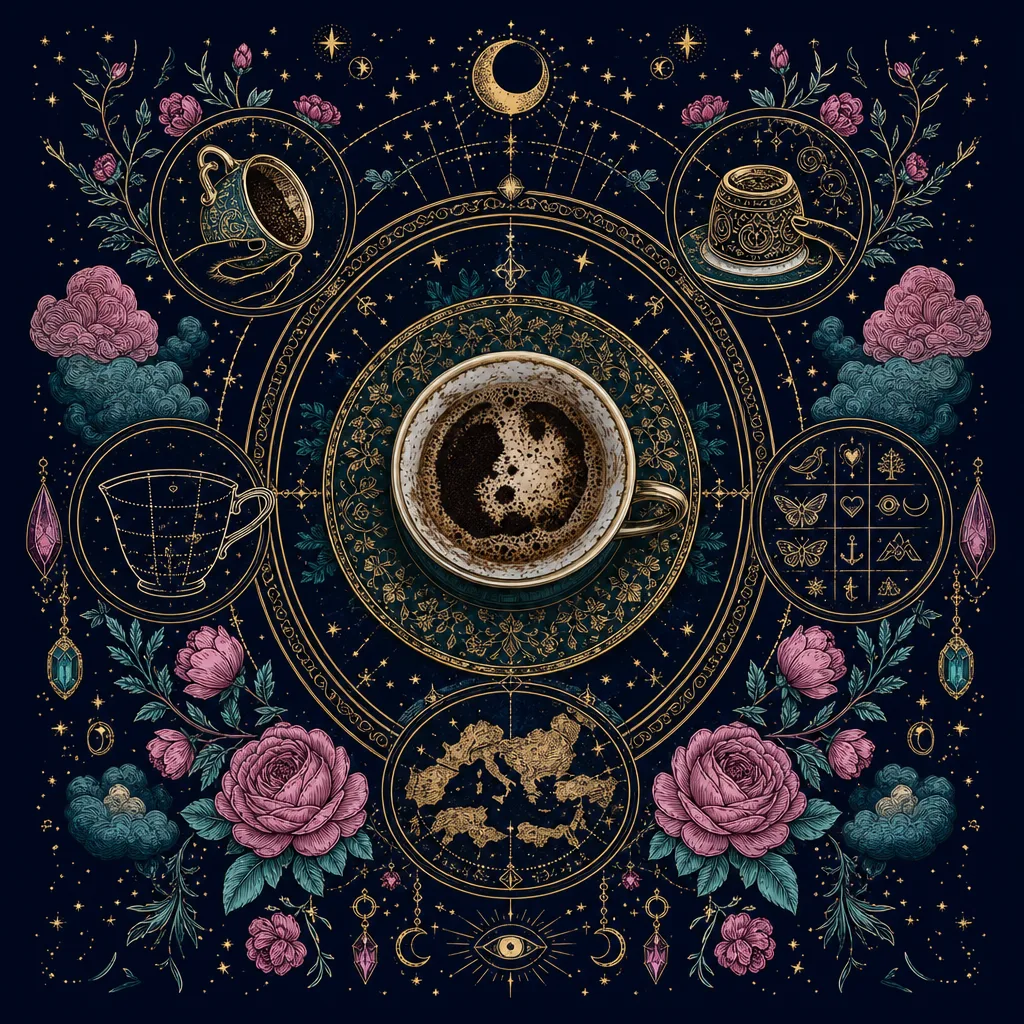
When the coffee is finished, the querent places the saucer on top of the cup and holds both together firmly, pressing their right hand over the saucer as they flip the entire assembly upside-down with one decisive motion. The cup now rests inverted on the saucer.
Allow the cup to sit inverted for at least five minutes, and ideally ten. The grounds need time to slide down the inside of the cup (which is now facing down) and dry slightly into their settled positions. Some traditions also read the ring of grounds left on the saucer, which is treated as a secondary reading.
When you lift the cup, hold it by the handle and right it slowly. The grounds will have formed patterns on the inside walls, the base (now the bottom of the visible interior), and sometimes the rim. Some readers check the temperature of the cup: if it is still warm, the reading begins; if it has cooled completely, it is sometimes taken to mean the querent’s concerns are already resolving on their own.
The regions of the cup
Coffee ground reading divides the cup’s interior into regions that carry distinct interpretive meanings. The handle, as in tea leaf reading, represents the querent.
The cup versus the saucer: The cup itself represents the querent’s inner life, emotions, and personal circumstances. The saucer represents the external world, public life, and practical affairs. A saucer with heavy grounds and a relatively clear cup suggests the querent’s main challenges are in the outer world rather than within.
The base of the cup: The bottom circle, which was the top of the cup before the flip, represents the home and the foundations of the querent’s life. Symbols here relate to family, living situation, and deeply rooted circumstances. A clear base suggests domestic stability; heavy, dense grounds here can indicate entrenched circumstances, positive or difficult depending on other symbols present.
The lower half of the sides: This region covers the present and the near future, from roughly now through the next one to three months. It is typically where the reading is most densely populated with grounds.
The upper half of the sides: This region relates to the medium-term future, roughly three to six months out. Symbols here are coming rather than present.
The rim: Whatever grounds remain near the opening of the cup (which was the base before the flip) relate to the distant future or to matters that are in their very early stages.
Left side versus right side: This distinction is central to the Greek tradition and important in the Turkish one as well. The right side of the cup, with the handle at the top, represents positive influences, favorable events, and things moving toward the querent. The left side represents challenges, losses, or things moving away. A reading heavy on the right side is generally favorable; one heavy on the left warrants more careful discussion of what may be departing or what obstacles lie ahead. This division is applied fluidly rather than mechanically, however; a symbol with inherently positive meaning on the left side does not become negative simply by position.
Reading the grounds
Lift the cup and rotate it slowly in your hands, examining all the interior surfaces in good light. Natural light is preferable; artificial overhead light can flatten the texture of the grounds and make subtle shapes harder to distinguish.
Begin at the handle and work clockwise. Name what you see before you interpret it. “I see a shape like a bird near the rim on the right side” is more useful than immediately saying “this means good news.” Separating observation from interpretation prevents you from talking yourself out of genuine perceptions.
The grounds produce two distinct types of readable information: shapes formed by clumped grounds, and light areas formed by the absence of grounds on the cup wall. Both are equally meaningful. A clear oval space on the left side, for instance, might suggest an emptiness or absence in that area of the querent’s life. A dense, dark mass on the right suggests intensity and concentration of positive energy.
Common symbols in coffee ground reading
The symbolic vocabulary of coffee ground reading overlaps considerably with that of tea leaf reading, reflecting their shared European and Middle Eastern cultural inheritance. The following symbols are among the most frequently encountered.
Angel or winged figure: Protection, divine favor, and a guardian presence. Near the base, it suggests long-standing spiritual support; near the rim, immediate assistance arriving from an unexpected source.
Arrow: Direction, intention, and decisive movement. An arrow pointing toward the handle suggests something aimed at the querent; one pointing away suggests the querent needs to aim toward something. A downward arrow is traditionally a warning to proceed with care.
Butterfly: Transformation, a change in circumstances, and social ease. The butterfly is generally positive, especially near the rim where it suggests a transformation about to become visible.
Camel: Endurance, a long journey, and patient progress toward a distant goal. In the Middle Eastern origin tradition, the camel also carries associations with reliable provision and steady commerce.
Candle: Enlightenment, clarity, and help from others. A burning candle suggests active assistance; a blown-out candle suggests that outside help is not available right now and the querent must rely on their own resources.
Chain: A bond or obligation. Whole and unbroken, it suggests a strong commitment or partnership in good standing. Broken links suggest a rupture or release from an obligation.
Clock or watch: Time pressure, a deadline, or the importance of acting promptly. The closer to the rim, the more immediate the time sensitivity.
Coin or circle with a dot: Money, financial matters, and material resources. The size of the shape is sometimes read proportionally: a large coin suggests a significant financial development; a small one suggests a minor transaction.
Curved line: A change of direction, flexibility, and a path that bends. In contrast to a straight line, which suggests direct and unimpeded progress, a curved line suggests the route will require adaptability.
Dog: Loyalty, a faithful friend or ally, and trustworthy support. On the left side, it may indicate a friend who has drifted away or a loyalty that is being tested.
Ear: Listen carefully; important information is coming that the querent should pay close attention to. It can also suggest that the querent is not hearing something they need to hear.
Elephant: Wisdom, long memory, and protective strength. The elephant is an auspicious symbol, particularly in readings relating to business, legal matters, or situations requiring patience and strategic thinking.
Face: If clear and upright, it represents a specific person relevant to the querent’s question. If unclear or inverted, it suggests confusion about someone’s true character or intentions.
Flower: Happiness, a celebration, and the flourishing of something the querent has cultivated. Multiple flowers suggest a particularly joyful period.
Fork: A decision point, a divergence of paths. The querent will need to choose between two real options rather than finding a single clear route forward.
Hand: Cooperation, an offer being extended, and help from another person. An open hand suggests generosity; a closed fist near a difficult symbol warrants caution.
Heart: Love and affection in their many forms. In combination with other symbols, the heart colors their meaning with emotional significance, suggesting that feelings are central to the matter at hand.
Horse: Speed, freedom, and passionate energy. In the context of relationships, it traditionally suggests a passionate suitor or a dynamic, energetic connection.
Horseshoe: Good fortune and luck, particularly in practical and material matters. One of the most broadly positive symbols in the cup.
House: The home, domesticity, and security. A clear, upright house suggests stability in the domestic sphere; a house that appears to lean or crumble suggests that foundation needs attention.
Key: A solution, access, and the power to open what has been closed. Multiple keys suggest multiple opportunities opening simultaneously.
Knife: Conflict, severance, and sometimes a necessary cut that, while difficult, clears the way. The position and context determine whether this is a painful loss or a liberating separation.
Letter: News, communication, and an important message. Near dots, the communication has financial implications. Near a heart, the communication concerns love or an important relationship.
Mountain: An obstacle or ambition, depending on context. A mountain with a clear path around or over it suggests the obstacle is navigable. A mountain that fills the entire lower half of the cup suggests a period of sustained effort ahead.
Owl: Wisdom, caution, and sometimes a warning that something hidden requires exposure. The owl is not an omen of misfortune but of the need for careful, clear-eyed attention.
Ring: Partnership, commitment, and completion. A complete ring is favorable; a broken ring suggests a disruption to a partnership or plan.
Scales: A legal matter, a decision requiring careful weighing of evidence, or a situation in which fairness is the central concern.
Ship: A voyage or transition, and the safe completion of a journey. Ships near the rim suggest the journey’s end is approaching; ships near the base suggest an undertaking just beginning.
Spider: Patience, craft, and the building of something intricate over time. The spider is generally positive for creative and business readings, less so if the surrounding symbols suggest deception.
Star: Hope, guidance, and a favorable trajectory. Multiple stars are particularly auspicious, suggesting that the querent is moving in alignment with larger forces rather than against them.
Tree: Growth, vitality, and the development of something that will last. A fully branched tree is more positive than a bare or broken one.
Waves: Emotional turbulence, the influence of the subconscious, and the ebb and flow of a situation that does not remain stable for long.
Reading the saucer
After the cup has been read, place it back on the saucer and lift the saucer to examine the ring of grounds left by the draining coffee. In the Greek tradition in particular, this is treated as a reading in its own right rather than a supplement.
The saucer grounds represent the querent’s external life, their social world, professional circumstances, and the practical conditions surrounding the matter. Read the saucer as you would the cup: light areas and dark shapes both carry meaning, and proximity to the handle of the cup (now lying sideways on the saucer) gives directional context.
Common mistakes and how to address them
The grounds slid to one side when the cup was lifted. This happens when the cup is lifted too quickly or at an angle. Tip the cup steadily and hold it upright immediately. If the grounds have pooled dramatically, the reading can still proceed, but note the pool’s position as significant concentration of energy in that region.
The interior is almost completely dark with grounds. This can happen with very finely ground coffee or with a particularly heavy pour. Look for light areas and shapes within the dark mass rather than trying to read shape outlines. The light patches are the meaningful forms.
You cannot identify anything with certainty. Uncertainty is normal, especially in early practice. Describe what you observe descriptively rather than symbolically, and ask the querent if anything resonates. Coffee ground reading has always been participatory; the querent’s response to your observations is itself informative and helps calibrate the reading.
The querent asks about a specific person. Identify any face shapes in the cup and note their position relative to the handle. Right side suggests someone favorable or approaching; left side suggests someone who has moved away or whose influence is declining. The querent can often recognize which person is represented once you describe the symbol’s location and character.
Deepening the practice
Coffee ground reading is most effective when the reader has spent time with the symbols outside of readings, building a personal relationship with the vocabulary before applying it under the mild pressure of a live session. Work with your own cup daily for several weeks. Read the grounds without judgment, naming what you see and writing it down. Review those notes over time.
When reading for others, maintain the tone of a thoughtful conversation rather than a performance. The most respected coffee ground readers in the Turkish and Greek traditions are known for their gentleness, their precision, and their honesty. They do not dramatize alarming symbols, and they do not soften difficult truths into meaninglessness. That balance, between compassion and candor, is the mark of a mature reader in any tradition.