From the Library · Traditions & Paths
Coming Out of the Broom Closet
A guide to the real and weighted decision of disclosing a witchcraft practice to family, employers, and communities. Covers safety assessment, degrees of openness, and how to practise discreetly when disclosure is unwise.
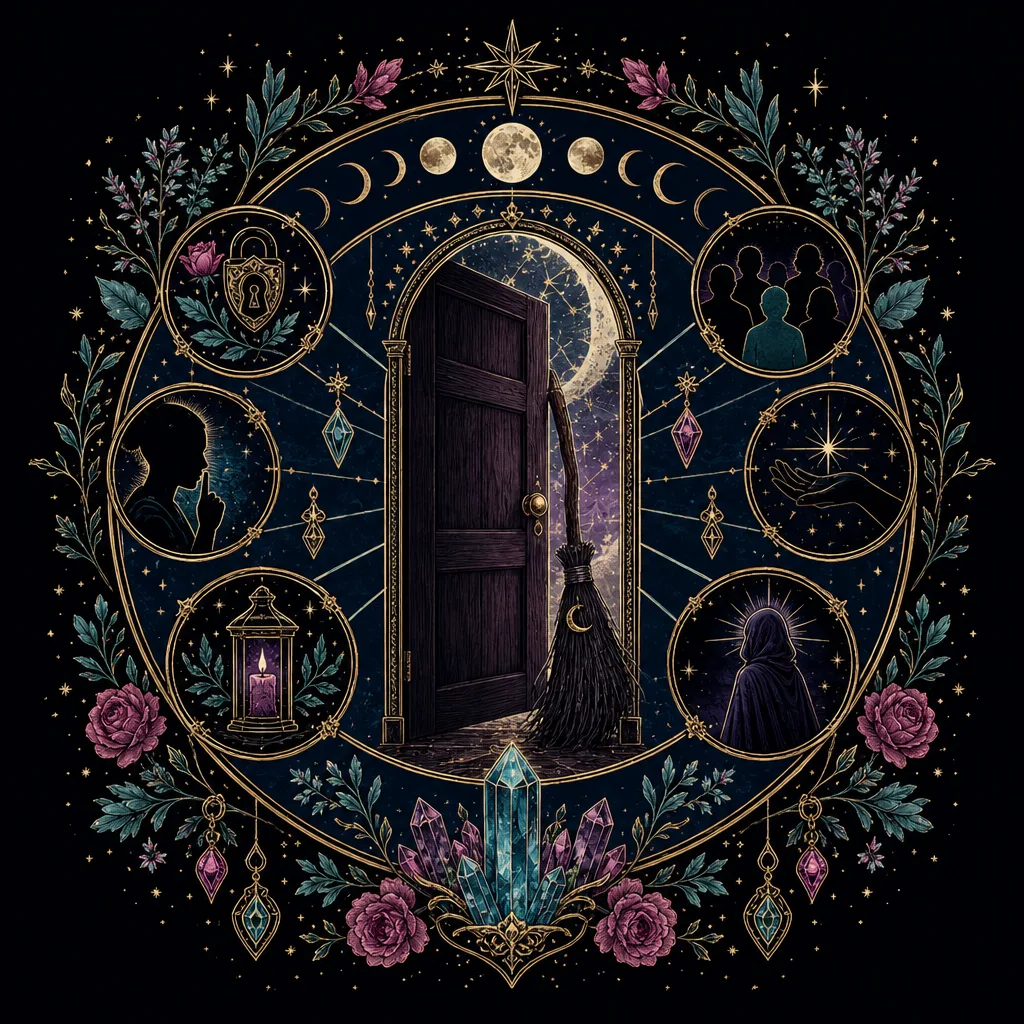
The phrase “broom closet” has been used in the witchcraft community since at least the 1980s, borrowed from gay culture and adapted to describe the experience of concealing a spiritual practice that the wider world might misunderstand, fear, or condemn. Coming out of the broom closet means choosing to disclose your practice to one person, to a small circle, or to the world at large. It is not a single event with a single right answer. It is a decision you make repeatedly, in different contexts, for different audiences, and with different levels of risk at stake.
This guide does not tell you to come out. It does not tell you to stay in. It lays out what the decision actually involves, helps you assess your own situation honestly, and gives you practical tools for whichever path you choose. Your safety and wellbeing come first. A private practice is a complete practice.
Why Disclosure Is a Weighted Decision
Witchcraft still carries genuine social risk in many parts of the world, and in many families and workplaces. In some communities, disclosure can result in family estrangement, loss of custody of children, termination of employment, housing insecurity, or physical danger. These are not hypothetical concerns from an earlier era. They are reported experiences in contemporary witchcraft communities, and they deserve to be taken seriously rather than minimised with reassurances about progress.
At the same time, concealment has its own costs. Maintaining a hidden practice requires constant vigilance. It limits the depth of conversations you can have with people you love. It can produce a persistent low-level shame that the practice itself does not deserve to carry. People who are able to be open about their practice often report a profound relief, an alignment between who they are and how they present themselves to the world.
Neither of these realities cancels the other. The question is not whether openness is good and concealment is bad; the question is what is true and wise in your specific situation.
Assessing Your Safety Honestly
Before you decide anything, assess the actual landscape of your life. This requires honesty rather than optimism or catastrophising.
Consider your family situation. Are you financially dependent on family members who might withdraw support? Do you have children, and could disclosure affect custody arrangements? If you are a minor, are your parents or guardians likely to respond with restriction, punishment, or coercion toward religious deprogramming? These are practical questions, and the answers matter more than any principle about authenticity.
Consider your employment. Some workplaces are genuinely inclusive and would not care. Others operate in environments where religious and cultural conservatism is common among clients, colleagues, or management, and visible paganism could be used as a pretext for discrimination even where it is technically illegal. Research your legal protections if you are uncertain, but also be realistic about the gap between legal protection and lived experience.
Consider your religious community, if you are part of one. For practitioners who grew up in or still nominally belong to a faith tradition with strong prohibitions against witchcraft, disclosure can rupture important social networks, access to community support, and relationships with clergy who provide pastoral care.
Consider your physical environment. In some geographic or cultural contexts, being publicly known as a witch brings social ostracism, harassment, or in extreme cases physical danger. You are the only one who can judge this for your own location.
The Spectrum of Openness
Being open about your practice is not binary. There is a wide range of positions between fully private and fully public, and most practitioners occupy somewhere in the middle.
You might choose to tell one or two trusted friends while keeping the practice private from family. You might be open with pagan community members and online, while maintaining professional discretion at work. You might use neutral language in some contexts, describing yourself as interested in herbalism, astrology, or nature-based spirituality, without using the word witch. You might be fully public, with a social media presence, visible symbols, and no concealment in any direction.
All of these are valid positions. The position that is right for you is the one that keeps you safe and allows you to practise with integrity.
Approaching Conversations with Family
If you do decide to disclose to family members, especially those you expect to be skeptical or hostile, preparation makes the conversation more likely to go well.
Choose the timing deliberately. A quiet, private moment is better than a family gathering or a period when someone is already stressed or in conflict. You want the person to have the mental space to actually take in what you are saying rather than react defensively in public.
Prepare for the most likely misconceptions. Many people who have no context for contemporary witchcraft will immediately associate it with Satanism, human sacrifice, cursing, or mental illness. None of these associations are accurate, and it is worth thinking through how you will address them calmly, without making the other person feel foolish for having them. These misconceptions come from decades of popular culture and religious teaching; they are understandable even when they are wrong.
Explain what your practice actually is rather than arguing about what it is not. If your practice involves working with herbs, honouring seasonal cycles, and developing your intuition, say so. If you have a devotional relationship with a deity, describe it in terms that are honest and that your listener can begin to understand. Specificity is more persuasive than generality.
Set realistic expectations for the conversation. You are probably not going to resolve deeply held religious objections in a single afternoon. You may plant a seed and need to let it grow slowly. You may need to give someone time to do their own research and come back to you. A first conversation that goes poorly is not necessarily the final word.
Know your limits before you begin. If the conversation becomes abusive, you are allowed to end it. You do not owe anyone an extended defence of your spiritual life under hostile conditions.
Practising Discreetly When Disclosure Is Not Wise
A private practice is a full and complete practice. Many of the most powerful and experienced practitioners in history worked in private or near-private conditions. There is nothing second-class about a practice that does not advertise itself.
If you share a home with people who do not know about your practice, create systems that work within that reality. A small kit of tools that fits in a box or bag can be retrieved and put away without comment. Digital Books of Shadows are completely private if properly secured. Practices that look mundane from the outside, lighting a candle, tending a houseplant, sitting quietly for a few minutes, are indistinguishable from ordinary life.
Online community can provide substantial support without requiring any disclosure in person. There are witchcraft forums, Discord servers, and social media communities where practitioners share experience and knowledge, and your real name never needs to appear.
Some practitioners use a craft name in community spaces, maintaining a complete separation between their witchcraft identity and their legal one. This is a longstanding tradition in many streams of the craft, not a workaround or a compromise.
Being Out at Various Scales
For practitioners who are out to family and close friends but not more widely, the question of how much visibility to hold in public is separate from the question of personal disclosure. Wearing a pentagram pendant, having public social media content about witchcraft, or identifying as a witch in professional contexts involves a different kind of exposure than a private conversation with someone who knows you.
Each of these choices is yours to make. Some practitioners find that visible symbols invite connection with other practitioners and feel like an expression of identity worth making. Others prefer to keep their practice private from strangers even when they are fully open with the people in their lives. Both approaches are coherent.
If you are publicly out as a witch, you will likely encounter occasional hostility from strangers, whether online or in person. Having thought through in advance how you want to respond, including whether you want to engage or disengage, makes these moments easier to navigate.
Building Community Without Full Disclosure
One of the genuine costs of staying in the broom closet is the sense of isolation that comes from not being able to speak openly about a meaningful part of life. Community addresses this, and community does not require full disclosure.
Open pagan events, moots, festivals, and meetups are generally spaces where practitioners expect and respect varying levels of personal disclosure. You can participate fully, form genuine friendships, and share your practice in those spaces without those relationships extending into your professional or family life. The witchcraft community at large is, in most cases, both welcoming and practiced at respecting boundaries.
Online community has already been mentioned, but it bears emphasis. Some practitioners have maintained rich, long-term relationships with other witches entirely through online spaces, without ever meeting in person or exchanging real names. These relationships are real, and the community they provide is real.
Moving Forward at Your Own Pace
The broom closet is not a place you leave once and never think about again. As your life changes, your calculation may change. A practitioner who stayed private during a difficult family situation may find years later that the situation has shifted and some disclosure has become safe and meaningful. A practitioner who was fully open may move to a new workplace or community and choose more discretion there. These adjustments are not inconsistency; they are wisdom applied to changing circumstances.
Whatever your current position on the spectrum, the most important thing is that your practice is sustainable, safe, and genuinely yours. The craft does not require an audience. It asks only that you show up for it, honestly and consistently, in whatever conditions your life provides.