From the Library · Divination & Oracles
Fire and Candle Scrying: A Pyromancy Tutorial
A complete guide to pyromancy and its branches, covering safe fire setup, reading candle flame height, color, and movement, interpreting spell-candle burns and wax pools, wax-drop divination, and smoke reading.
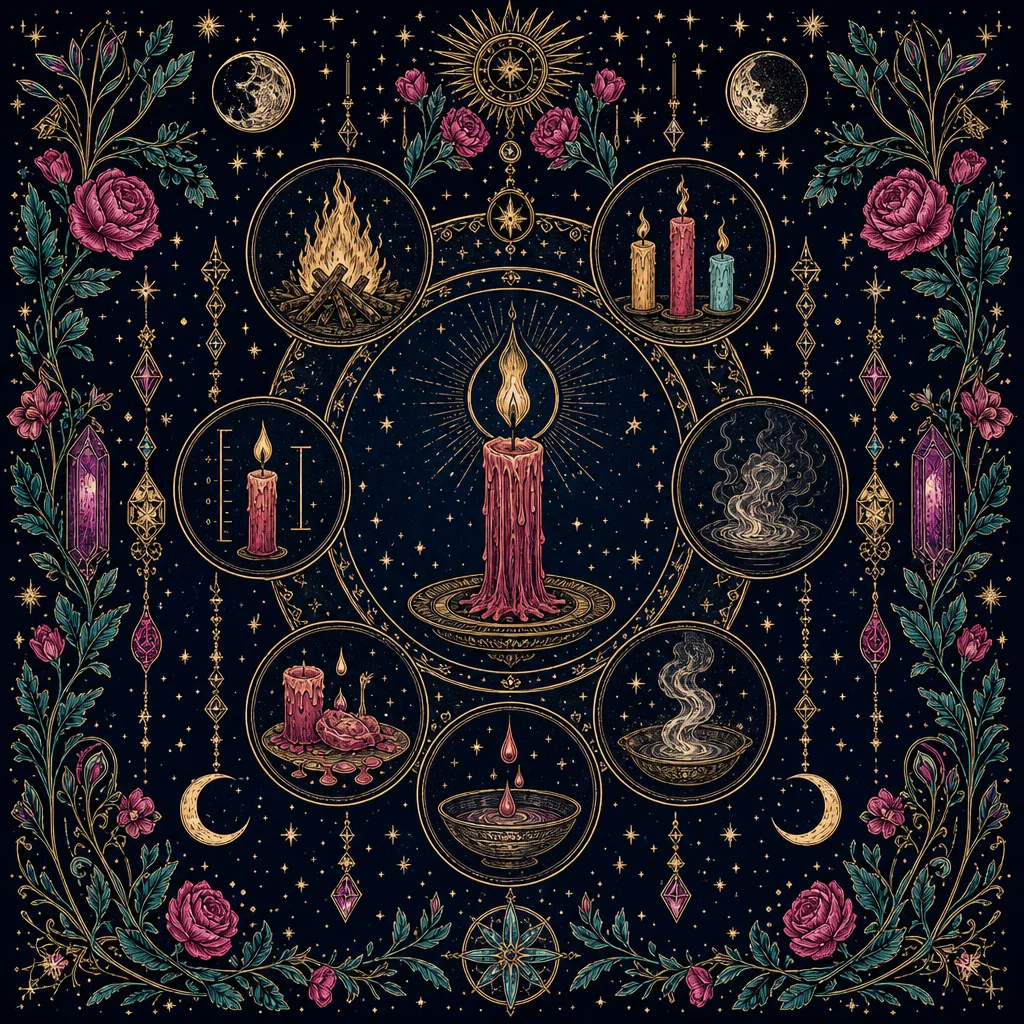
Fire has served as an oracular medium for as long as human beings have made it. The observation of flames, coals, and burning materials for omens and divination is documented across ancient Greek, Roman, Persian, Celtic, and Mesoamerican sources, and it continues in folk practice throughout the world today. The general term for fire divination is pyromancy, from the Greek words for fire and prophecy, and it encompasses several distinct techniques: reading a free flame, reading the burn of a dedicated candle, interpreting the shapes formed by melted wax, and reading the patterns made by smoke. This tutorial covers each of these branches, with clear instructions for safe setup and practice.
Pyromancy and its branches
Pyromancy in the broadest sense is any divination that uses fire as its primary medium. Classical sources describe practitioners gazing into bonfires, observing the behavior of sacrificial fire, and reading the flight of flames from torches or oil lamps. These older forms of fire reading required no prepared tools and could be practiced wherever fire was present. Modern practitioners most commonly work with candles, which are controllable, safe for indoor use, and available in a range of colors and sizes suited to different magical purposes.
Within pyromancy, the specific technique of reading flame behavior is sometimes called lychnomancy or lampadomancy when applied to lamp or candle flames. Reading the shapes and patterns of melted wax is called ceromancy. Reading the patterns and direction of smoke is called capnomancy. This tutorial addresses all three, beginning with the most foundational skill: understanding what a candle flame is telling you while it burns.
Safe fire setup
Fire safety is not a disclaimer to skim past; it is the first and most important part of any fire-based practice. A divination session cut short by a small domestic fire, or terminated by smoke inhalation from an improperly ventilated room, produces no useful readings and significant inconvenience. The following precautions should be treated as non-negotiable.
Work on a non-flammable surface. Place candles on ceramic plates, stone tiles, metal trays, or purpose-made candle holders with wide bases. Never place a lit candle directly on wood, fabric, paper, or plastic. If you are working with multiple candles, ensure that none of their flames can be caught by air currents caused by the others.
Keep the working area clear. Remove all fabric, paper, and flammable materials from an arm’s reach of any lit candle. This includes altar cloths, loose papers, and loose clothing. Tie back long hair before working with open flame.
Do not leave candles unattended. This includes leaving the room to answer a door or a phone. Extinguish candles before leaving the space for any reason.
Ensure adequate ventilation without drafts. The room should have enough fresh air circulation to prevent the buildup of combustion byproducts and candle smoke, particularly if you are working with multiple candles for an extended session. However, direct drafts from open windows, air conditioning vents, or electric fans will interfere with flame reading by producing artificial flame movement. The correct balance is a room with a comfortable air supply but without any directed airflow.
Keep water within reach. A glass of water on the table is not adequate fire safety for a dedicated candle-working session. A small bowl of water or a spray bottle of water kept nearby provides a first-response option if a flame catches something unexpectedly.
Use appropriate holders. Taper candles should be in holders that grip them firmly at the base and catch drips. Pillar candles should stand on plates or trays large enough to catch any wax that runs outside the natural pool. Jar candles are the safest option for unattended burning but limit the ability to read the flame and wax, as the glass obscures the lower part of the candle.
Reading a candle flame: height
A candle flame’s height is the first and most straightforward quality to read. It varies naturally depending on the size of the wick, the composition of the wax, and the ambient air conditions, so what you are reading is not an absolute value but the behavior of this particular flame in these particular conditions compared to what is normal for it.
A tall, strong, consistently burning flame, one that rises clearly above the wick without wavering, is widely read as a favorable sign when the flame behavior aligns with the intention or question the candle is burning for. It is associated with strong, clear energy around the matter in question, with forthright action, and with the path ahead being clear of significant obstruction.
A short or weak flame, one that struggles to rise from the wick or that barely maintains itself, is read as the opposite: limited energy, difficulty, delay, or resistance in the matter. It may indicate that the situation is more complex or blocked than it appears, or that conditions are not yet right for what is being sought.
A flame that starts low and then strengthens over the course of a session is read as a sign of building momentum: what begins with difficulty gains power as the working progresses or as the situation develops.
A flame that starts strong and gradually weakens is read as energy dissipating or as enthusiasm outpacing actual resources. It is worth examining whether the effort being applied to the situation is being misdirected or exhausted.
Reading a candle flame: color
Candle flames burn primarily within a narrow range of yellow-orange-white, but variations in color can be observed and carry conventional meanings in most pyromantic systems.
A yellow flame is the most common and is generally read as neutral or positive, indicating active, engaged energy in the matter. The particular shade of yellow, from warm amber through to a clear, bright gold, may vary depending on the wax composition and dye.
A blue base to the flame is considered an especially favorable sign by many practitioners. The blue portion of a candle flame is the hottest part of combustion and appears at the very base of the flame cone. A pronounced blue coloration in the base, visible as a distinct blue ring or blue root of the flame, is often read as indicating the presence of spiritual energy, as a sign that the working is connected to non-material forces, or as confirmation that the intention is being received and amplified.
A white or very bright yellow tip is associated with clarity, truth, and the higher aspects of the intention in play.
Unusual coloration, a greenish or reddish cast to the flame, is relatively rare in ordinary candle burning and when it occurs is treated as significant. Green is associated with healing, growth, and material concerns; red with passion, conflict, or intensity. These associations derive from broader color symbolism rather than empirical flame observation, and practitioners working within different magical color systems may use different correspondences.
Reading a candle flame: movement
Flame movement is the most dynamic and therefore the most information-rich quality to observe. A candle flame in a properly ventilated but draft-free room will naturally have some movement, as convection currents from the flame itself cause a gentle pulsing or swaying. What you are reading is the character and direction of movement beyond this baseline.
A steady, upright flame with minimal lateral movement is read as clarity, directness, and the absence of hidden opposition. The matter proceeds in a straightforward fashion.
A flame that bends consistently toward you, the direction the practitioner is facing, is read as the energy or outcome of the matter moving in your direction, as something coming toward you or arriving. Bending away from you is read as the energy of the situation pulling away or as an outcome moving out of your direct sphere.
A flame that bends to the left is associated in many systems with the past, with unconscious material, or with the receptive, inner dimension of a situation. Bending to the right is associated with the future, with outward action, and with the active dimension. These directional correspondences, like most pyromantic conventions, vary across traditions; the associations given here are common in British and American folk practice.
A flame that splits into two distinct points is read as a significant sign: division, a choice that must be made, two possible outcomes or two forces in tension. Some traditions read a split flame as indicating a second person is involved in the matter or is working against the primary intention.
A dramatically flickering, erratic, or dancing flame in the absence of any air current is read as agitation, active energy, or the presence of spirit activity. It can indicate that the matter is in flux, that there are many competing forces at work, or that the situation is more alive and changeable than it appears from outside.
A flame that self-extinguishes, going out without any deliberate act on the practitioner’s part, is widely read as a significant sign that the working should be paused, that the timing is not right, or that the question cannot be answered in the direction being pursued. It is not automatically an ill omen for the matter itself, but it does call for a pause and reassessment.
Reading the burn of a spell candle
When a candle is dedicated to a specific magical working or question, the entire pattern of its burn, from first lighting to final extinction, carries information. Many practitioners use taper candles or short ritual candles, which burn completely in one session, for this purpose, allowing a complete read of the candle’s life in a single sitting.
Tunneling, in which the candle burns down through the center of the wax leaving a high ring of unmelted wax around the outside, is generally read as incomplete results: the energy of the working is concentrated but does not reach all aspects of the situation. Some of what needs to shift is not shifting.
Even burning, in which the wax pool extends to the outer edge of the candle in a symmetrical, even manner, is read as the working proceeding cleanly and completely, with the energy reaching all relevant aspects of the matter.
One-sided burning, in which the wax runs heavily to one side, is read directionally. If the heavier side is toward you, the matter bears on you personally more than you have acknowledged. If it is away from you, the primary dynamics are in the external world or with others rather than internal.
A candle that burns very quickly, faster than its size would suggest, is read as intense, urgent energy around the matter, sometimes as a favorable sign of rapid movement but also as a caution that things may be moving too fast for careful navigation.
A candle that takes much longer than expected to burn down, or that requires relighting repeatedly, is read as delay, resistance, or the need for greater patience with the situation than originally anticipated.
Wax-pool and wax-drop divination
Ceromancy, the reading of wax shapes, can be practiced in two primary ways: by reading the patterns formed in the wax pool at the base of a burning candle, and by deliberately dropping molten wax into cold water and reading the forms it makes.
Reading the wax pool requires examining the pool of melted wax around the base of a candle flame while it is burning. The wax pool will naturally assume irregular shapes as it grows, and these shapes can be read for imagery in the same way one reads clouds or water surface patterns: with a relaxed attention that allows the image-making intelligence to perceive forms and figures. Common symbolic images, an animal, a heart, a letter, a human form, an arrow, can all appear in wax pools and are interpreted through their conventional symbolic associations combined with the practitioner’s personal resonances.
Wax-drop divination requires a candle that is burning and producing a pool of liquid wax, a bowl of cold water, and a clear question or intention in mind. Tilt the candle and allow several drops of molten wax to fall from the pool into the cold water. The wax will solidify almost immediately on contact with the water and form a shape that you then remove, dry, and read. The three-dimensional forms produced by wax dropped into water can be complex and suggestive; some practitioners read them from a specific orientation (which end was uppermost when the wax hit the water), while others turn the piece in all directions to find the most meaningful perspective.
When performing wax-drop divination, always hold the candle over the water bowl steadily and drop the wax from a distance of no more than a few centimeters above the water surface. Do not hold the candle at a steep angle for extended periods; molten wax can run unexpectedly. Ensure the bowl is stable and cannot be knocked over.
Capnomancy: reading smoke
Capnomancy, divination by smoke, can be practiced in conjunction with candle reading or as a separate discipline using incense or a fire that produces significant smoke. The primary technique involves observing the direction, behavior, and patterns of smoke rising from a candle, incense stick, or bundle.
Direction of smoke movement is the most straightforward reading. Smoke that rises straight up in an even, unbending column is read as clarity, directness, and favorable conditions: what is sought will proceed without significant deviation. Smoke that bends consistently toward the practitioner is read, like a bending flame, as the matter moving in that direction. Smoke that bends away from the practitioner indicates the matter receding or moving out of direct influence.
Splitting or forking smoke is read similarly to a split flame: a division, a choice, or two forces at work. When smoke splits into two distinct streams that travel in different directions, the reading often concerns two parties or two possible courses of action in the question at hand.
Erratic or circling smoke is associated with confusion, complexity, or the presence of factors that are not yet visible. It can indicate that the question is not yet well-formed, or that the situation is in genuine flux.
Thick, dark smoke from a candle is often a practical rather than divinatory indicator: it suggests the candle is not burning cleanly, possibly because of a wick that is too long, excess fragrance oils, or a draft that is disrupting the combustion. Trim the wick to the recommended length, usually about 6 millimeters, before reading smoke patterns, to ensure that what you are reading is the candle’s natural behavior rather than a technical issue with the burn.
Working with incense smoke for capnomancy follows the same principles as candle smoke reading. Burn a stick or cone of incense in a still room and observe the character of the smoke column: whether it rises straight or bends, whether it remains coherent or disperses quickly, and any shapes or patterns it traces in the air.
Troubleshooting and common mistakes
The flame constantly flickers and you cannot establish a baseline. This almost always indicates a draft. Check windows, doors, and any vents for air movement and adjust until the flame settles. If the room cannot be made draft-free, consider working in a different space; reliable flame reading requires relatively still air.
The wax pool never extends to the edge of the candle. The candle may have too thick a wax wall for its wick size, or the room may be too cold. Allow the candle to burn longer before reading the pool; many candles, particularly thick pillars, need forty-five to sixty minutes before establishing a full pool.
You are not sure if a reading is accurate or if you are projecting what you want to see. Keep a written record of every reading and its date, including what you read and what you predicted or what the reading suggested. Check your records against actual outcomes after two to four weeks. Over time, the patterns in your accuracy will show you which flame behaviors and wax forms you are reading reliably and which you are interpreting through wishful thinking.
The smoke is making the room uncomfortable. You are working with too many candles in too small or too poorly ventilated a space, or you are using incense with a smoke output that requires more ventilation than your working room provides. Reduce the number of candles, choose lower-smoke incense, or work in a larger space.
Wax dripped outside the intended area. This is an occupational hazard of candle working and underlines the importance of appropriate holders and a non-flammable work surface. If wax reaches a surface where it should not be, allow it to cool and harden completely before attempting to remove it; wax is far easier to remove when solid.
Fire divination rewards attentive, consistent practice over many sessions. The practitioner who has observed hundreds of candle burns develops an intuitive fluency with flame behavior that allows quick, reliable readings in a way that no amount of theoretical knowledge can substitute for. Keep notes, work regularly, and allow the relationship between you and this most ancient of divinatory elements to build gradually over time.