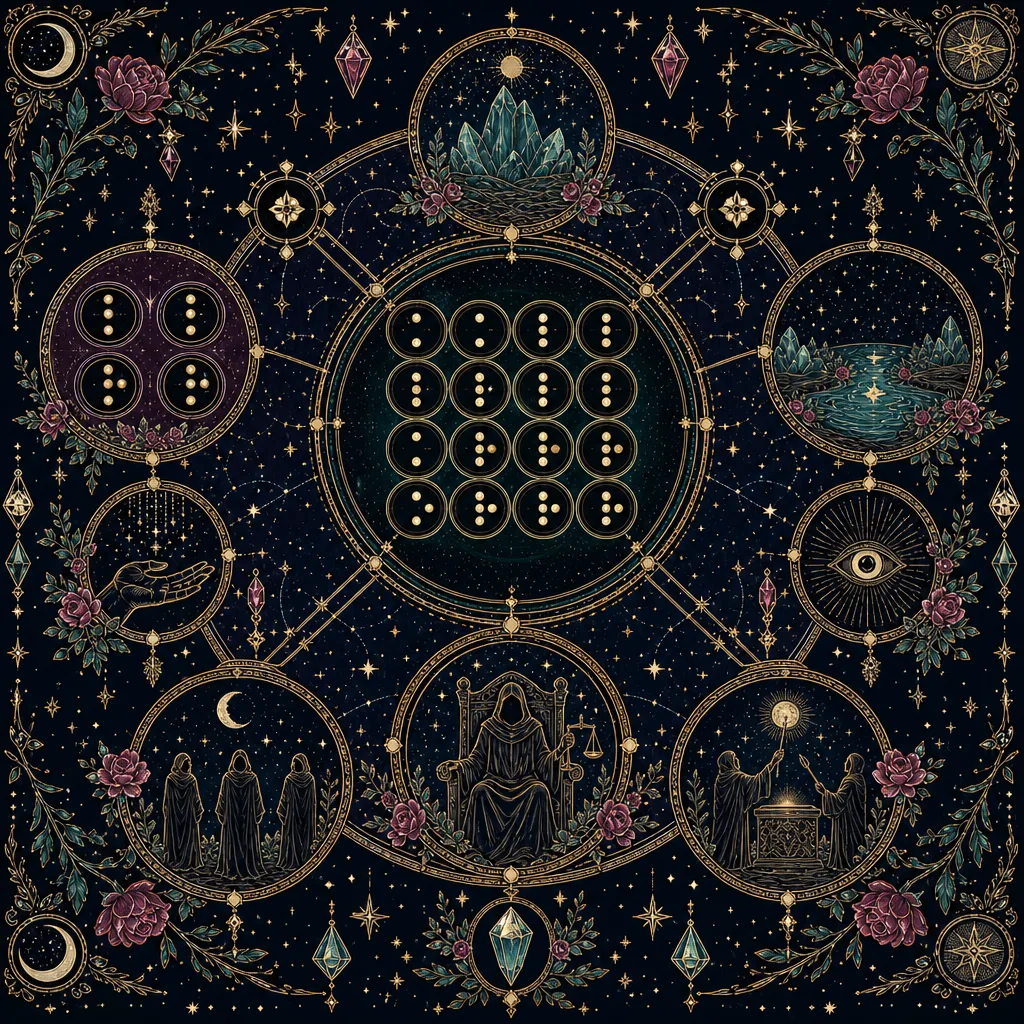
From the Library · Divination & Oracles
Geomancy: A Step-by-Step Tutorial
A complete working introduction to Western geomancy, covering the sixteen geomantic figures, the method of generating a full shield chart from four Mother figures, and the process of reaching a judgment through the Witnesses, Judge, and Reconciler.
Geomancy is a system of divination that generates figures from rows of odd or even marks, then combines and derives those figures through a fixed logical structure to reach a judgment about a question. It is one of the most systematic and learnable of the classical Western divinatory arts: unlike tarot, it requires no cards; unlike astrology, it demands no knowledge of planetary positions at the time of birth. All it requires is something to write with, something to write on, and a question. Its internal logic is rigorous enough that, once you understand the system, the chart practically builds itself.
The word geomancy comes from the Greek geo (earth) and manteia (divination), reflecting the practice’s origins in reading patterns made in sand or soil. The tradition as practiced in the medieval and Renaissance West descended primarily from Arabic sources: the art of khatt al-raml, “writing on sand,” which Arab scholars had systematized by the ninth century. It passed into Latin Europe through translation movements in twelfth-century Spain and Sicily, and within a century it had become one of the most prestigious divinatory systems in the West, studied by scholars of the caliber of Roger Bacon and discussed by Thomas Aquinas. It was practiced continuously through the Renaissance, declined during the Enlightenment, and was revived in the nineteenth century by the Hermetic Order of the Golden Dawn, whose members integrated it with astrological correspondences and Kabbalistic symbolism.
This tutorial teaches you the core mechanical method. You will learn to cast a shield chart and reach a judgment by the end.
The sixteen geomantic figures
Every geomantic figure consists of four rows, each containing either one point or two points. Because each row has two possible states, there are 2 to the power of 4 possible combinations, giving sixteen distinct figures. Each has a traditional name, a set of astrological correspondences, elemental associations, and divinatory meanings. You must learn all sixteen before you can read a chart.
The figures and their primary meanings are as follows:
Puer (two points, one point, two points, two points) means “boy” in Latin and is associated with Mars in Aries. It represents force, rashness, conflict, and youthful energy, favorable in questions about physical courage or decisive action, unfavorable in questions requiring subtlety or patience.
Puella (two points, one point, two points, one point) means “girl” and is associated with Venus in Libra. It indicates beauty, harmony, pleasure, and social grace; generally favorable, especially in relationship questions, though it can indicate superficiality.
Amissio (one point, two points, two points, one point) means “loss” and is associated with Venus in Taurus. It signals things passing away, expenditure, and loss; unfavorable for financial questions, but favorable when asking about releasing something harmful.
Acquisitio (two points, one point, one point, two points) means “gain” and is associated with Jupiter in Sagittarius. It represents increase, acquisition, and fortunate outcomes; one of the most favorable figures overall.
Laetitia (two points, two points, two points, one point) means “joy” and is associated with Jupiter in Pisces. It indicates happiness, health, and upward movement; generally highly favorable.
Tristitia (one point, two points, two points, two points) means “sorrow” and is associated with Saturn in Aquarius. It represents grief, stagnation, and downward movement; generally unfavorable, though it can indicate necessary introspection.
Carcer (one point, two points, one point, two points) means “prison” and is associated with Saturn in Capricorn. It represents restriction, delay, and binding; unfavorable for questions of freedom, though it can indicate stability or necessary limitation.
Fortuna Major (two points, two points, one point, two points) means “greater fortune” and is associated with the Sun in Leo. It represents large-scale success and powerful aid from external sources; highly favorable.
Fortuna Minor (two points, one point, two points, two points by some reckonings; the exact dot pattern varies by source) means “lesser fortune” and is associated with the Sun in Aries. It represents more modest or unstable good fortune; favorable but impermanent.
Via (one point, one point, one point, one point) means “way” or “road” and is associated with the Moon in Cancer. It represents journeys, change, and movement; its significance depends heavily on the question, neither simply good nor bad.
Populus (two points, two points, two points, two points) means “people” and is also associated with the Moon in Cancer. It represents crowds, community, and neutrality; like Via, its meaning depends on context.
Rubeus (two points, two points, one point, two points by standard arrangement) means “red” and is associated with Mars in Scorpio. It represents passion, vice, violence, and danger; generally very unfavorable, especially in the first house or as Judge.
Albus (one point, two points, one point, two points by standard arrangement) means “white” and is associated with Mercury in Gemini. It represents wisdom, peace, and careful thought; favorable, especially for intellectual questions.
Conjunctio (two points, one point, two points, one point by some sources) means “conjunction” and is associated with Mercury in Virgo. It represents meetings, combinations, and recovery of lost things; generally favorable.
Caput Draconis (two points, two points, one point, one point) means “head of the dragon” and is associated with the north lunar node. It represents beginnings, thresholds, and favorable initiation of things.
Cauda Draconis (one point, one point, two points, two points) means “tail of the dragon” and is associated with the south lunar node. It represents endings, exits, and the completion of cycles; generally unfavorable for beginnings, favorable for endings.
You will want to make a reference card with each figure’s dot pattern, name, and core meaning. Learning to recognize the patterns visually is more important than memorizing the dot counts abstractly.
Generating the four Mother figures
To begin a reading, you need a question clearly formulated in your mind. Geomancy works best with specific questions: “Will my application to the graduate program succeed?” or “What is the true nature of my financial situation over the next three months?” rather than vague open-ended inquiries.
Traditional geomancers made their figures by stabbing a wand or stylus into sand or soil rapidly, without counting, then counting the resulting holes in groups of four. The goal is to produce marks in an uncontrolled way so that the rational mind does not determine the outcome. You can replicate this with a pen and paper: close your eyes or look away from the paper, and make a row of random dots or hash marks. Make more than you think you need, then count them from left to right in groups of four, noting whether each group is odd (one point in the figure) or even (two points).
Step-by-step generation of the Mothers:
- With a clear question in mind, make a row of random marks on your paper. Count them into groups of four. Record whether the total number of marks in each group is odd (one point) or even (two points). This gives you the first row of your first Mother figure.
- Repeat this three more times, making a new row of random marks each time. Each row gives you one more row of the figure. After four rows, you have your First Mother (Mater Prima).
- Repeat the entire process of making four rows of random marks. This produces the Second Mother.
- Repeat for the Third Mother.
- Repeat for the Fourth Mother.
You now have four figures, each consisting of four rows of one or two points. These are the Mothers, and they are the only figures in the entire chart that come directly from randomness. Every other figure is derived from these four through strict logical operations.
Deriving the Daughters
The Daughters are generated by rotating the Mothers. Take the first row (top row) of each of the four Mothers in sequence: the first row of Mother One, the first row of Mother Two, the first row of Mother Three, the first row of Mother Four. These four rows, read in order, form the First Daughter. Repeat this with the second row of each Mother to form the Second Daughter. The third rows give you the Third Daughter, and the fourth rows give you the Fourth Daughter.
To be precise: the Daughters are transpositions of the Mothers. Each Daughter takes one horizontal tier from all four Mothers and reads it vertically. If you wrote your Mothers in columns, the Daughters emerge by reading the rows of those columns.
Deriving the Nieces
The Nieces are generated by adding pairs of figures together. In geomantic addition, you add the corresponding rows of two figures: if both rows have one point, the result is two points (one plus one equals two); if one row has one point and the other has two points, the result is one point (one plus two equals three, which is odd); if both rows have two points, the result is two points (two plus two equals four, which is even).
The First Niece is the sum of the First and Second Mothers. The Second Niece is the sum of the Third and Fourth Mothers. The Third Niece is the sum of the First and Second Daughters. The Fourth Niece is the sum of the Third and Fourth Daughters.
Deriving the Witnesses and Judge
The Right Witness is the sum of the First and Second Nieces. The Left Witness is the sum of the Third and Fourth Nieces. The Judge is the sum of the Right Witness and the Left Witness.
The Reconciler (sometimes called the Sentence) is the sum of the Judge and the First Mother. Some geomancers include it; others work without it. It provides a final synthesizing statement when the Judge”s answer seems ambiguous.
Laying out the shield chart
The shield chart arranges all the derived figures in a specific spatial pattern that allows you to read both the final judgment and the relationship between the various houses.
Draw the chart with the Mothers on the right side, stacked in a column: First Mother at top right, then Second, Third, Fourth below it. The Daughters go to the left of the Mothers in the same arrangement. The Nieces are placed to the left of the Daughters, but the First and Second Nieces are placed together above, and the Third and Fourth Nieces below. The Right Witness sits above the Left Witness, both to the left of the Nieces. The Judge is placed at the far left. The Reconciler, if used, goes above or below the Judge.
Reading the shield chart
The Judge is the primary answer to the question. A favorable Judge (Acquisitio, Laetitia, Fortuna Major, Caput Draconis, Conjunctio, Albus, Puella) indicates a positive outcome. An unfavorable Judge (Amissio, Tristitia, Carcer, Rubeus, Cauda Draconis) indicates a negative one. Via and Populus are neutral and indicate that the outcome is indeterminate or depends on choices still to be made.
The Witnesses qualify the Judge. The Right Witness describes the situation from the querent”s perspective or the past leading into it. The Left Witness describes the outcome side or the future trajectory. If both Witnesses are favorable and the Judge is favorable, the answer is strongly positive. If the Witnesses contradict each other, there is tension or ambiguity in the situation that the Judge is mediating.
A caution: certain Judges are considered impossible in a valid chart because geomantic addition always produces figures with an even total number of points, and some figures have an odd total. If you derive Puer, Puella, Caput Draconis, or Cauda Draconis as your Judge, you have made an arithmetic error somewhere and must recalculate.
The Reconciler confirms or redirects the judgment. Where the Judge seems contradictory to the question”s context, the Reconciler (being the Judge combined with the First Mother, which represents the querent) shows how the querent”s own energy interacts with the outcome.
The house chart (optional extension)
The sixteen figures of a full geomantic reading can also be mapped onto the twelve astrological houses for a more detailed analysis. The First Mother goes in the First House, the Second Mother in the Second, the Third Mother in the Third, and the Fourth Mother in the Fourth. The Daughters then fill Houses Five through Eight, and the Nieces fill Houses Nine through Twelve. The remaining derived figures (Witnesses, Judge, Reconciler) function as overall indicators rather than house assignments.
Reading by house follows standard astrological house meanings: the First House represents the querent and their body; the Second represents finances and possessions; the Third represents communication, siblings, and short journeys; the Fourth represents home, family, and the end of matters; the Fifth represents pleasure, children, and creativity; the Sixth represents health and daily work; the Seventh represents partnerships and open opponents; the Eighth represents transformation, inheritance, and hidden things; the Ninth represents travel, philosophy, and higher learning; the Tenth represents career, public reputation, and authority; the Eleventh represents friends, hopes, and alliances; the Twelfth represents hidden enemies, isolation, and undoing.
Locate the house most relevant to your question and examine the figure there first, then look at the house of the answer (the Seventh House for questions about others, the Tenth for career questions) and the house of the Judge for final confirmation.
Common mistakes and troubleshooting
Arithmetic errors are the most common problem and produce nonsensical charts. Work slowly. Check each derivation against the one before it. The rule for addition is simply: count all the points in both figures for each row. If the total is odd, write one point. If even, write two. Verify this row by row.
An invalid Judge figure always signals an arithmetic error earlier in the chart. There is no such thing as a “special” reading that produces a theoretically impossible Judge; it simply means you made a mistake.
Vague questions produce difficult readings. Geomancy is specific: it answers specific questions. If you ask “How is my life going?” the chart will produce a Judge, but you will struggle to apply it because the question is not bounded. Reframe to “What is the most important factor affecting my career right now?” and the chart becomes readable.
Treating the Judge as the only figure that matters flattens the reading and hides how the situation developed. The Witnesses tell you where the situation is coming from and where it is going. The house chart (if used) shows you which areas of life are most activated. The Judge is the verdict, but the rest of the chart is the argument that leads to it.
Rushing through the derivation without recording each step loses your work and makes it impossible to verify. Always write out every figure as you go, labeling each one clearly. A geomantic chart worked out on paper, with every Niece, Witness, and Judge labeled and visible, is a document you can return to and reconsider. A chart done mentally and then forgotten cannot teach you anything.
Building skill over time
The figures reward memorization. Spend a week on five figures at a time: learn their dot patterns, their names, their primary meanings, and their astrological associations. After a month, you will know all sixteen well enough to produce a reading without consulting a reference.
Keep a geomancy journal separate from your general practice journal if possible. Record every question you cast, the full chart, and your interpretation. Note the date so you can return later and assess whether the judgment proved accurate. Nothing teaches geomancy faster than verified experience: knowing that Rubeus in the Seventh House of a relationship reading, with an unfavorable Judge, preceded exactly the conflict it suggested will make the system viscerally real in a way that reading about it never can.
Geomancy is one of the few Western divinatory arts with an entirely self-contained internal logic. Once you have learned the sixteen figures and the derivation procedure, you can produce a complete reading anywhere, with nothing more than paper and a pen. That portability and self-sufficiency is part of what made it so appealing to scholars and travellers across eight centuries of practice, and it is part of what makes it as worth learning now as it has ever been.