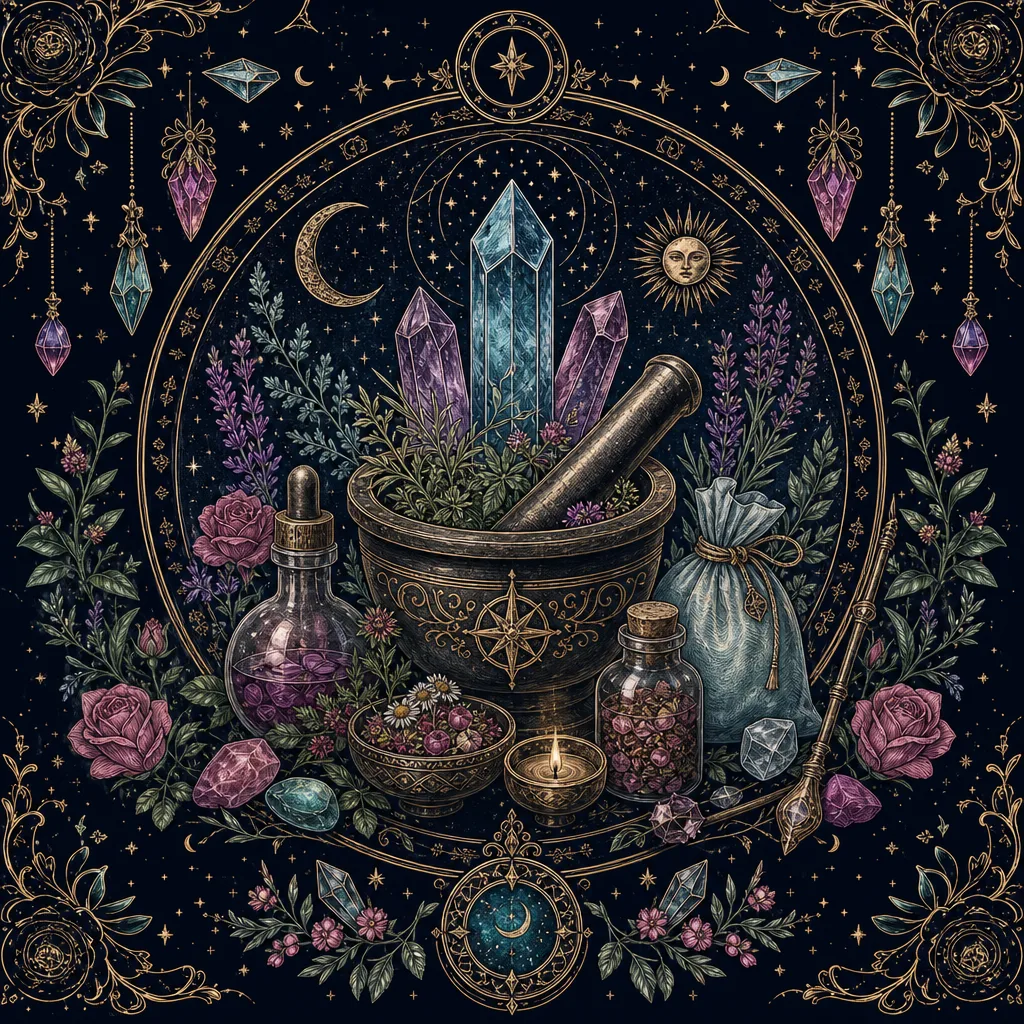
From the Library · Herbcraft, Crystals & Materia Magica
Working with Herbs and Crystals
This guide moves beyond correspondence lists to show how herbs and crystals are actually prepared and used in magickal practice. It covers ethical sourcing, safety, and the main practical methods for both materia, suited to practitioners at any level.
Most practitioners encounter herbs and crystals early in their studies, and most correspondence guides present them in the same way: long lists pairing a plant or stone with a magickal intention, planet, or element. These lists have genuine value as a starting vocabulary, but they tell you little about what to actually do with a piece of labradorite or a handful of dried rosemary. Moving from list-reading to practice requires understanding how each form of materia is prepared, how it is activated, what it can reasonably be used for, and where the firm safety limits are.
The word “materia” is borrowed from the herbalist tradition, where materia medica referred to the working substances of the healer’s craft. Practitioners of magick use it in a similar spirit: the herbs, stones, resins, roots, and minerals that form the physical building blocks of spellwork. These materials are tools, not the source of the power itself. The practitioner’s intention, attention, and skill direct the work; the materia focuses and extends it.
Sourcing Ethically and Affordably
The first practical question is where to obtain your materia. The answer matters both ethically and practically, because the energy and provenance of a material is part of what you bring into your working.
For herbs, the most sustainable source is your own growing, followed by locally foraged plants where you have permission and knowledge to forage safely, followed by small independent herbalists and magical supply shops who source with care. Large commercial suppliers often deal in herbs that have been harvested in ways that damage ecosystems or that rely on poorly compensated labour. White sage, palo santo, and a number of high-demand ritual plants have been significantly overharvested in their native regions. This does not mean you cannot use these plants; it means you should source them from cultivated stock and from sellers with verifiable supply chains.
For crystals and stones, the mining industry is globally significant and not uniformly ethical. Mica, for instance, is frequently mined using child labour. Demand for certain popular crystals has created environmental damage at extraction sites. You do not need to avoid crystals, but buying from dealers who know their sources and who deal in smaller quantities with clear provenance is both more ethical and, in practice, more affordable than buying the cheapest available stock from mass importers.
The good news is that you do not need an extensive or expensive collection of either herbs or stones. A practice built on twenty well-sourced herbs and twelve reliable stones will serve you far better than one built on two hundred items of uncertain quality and origin.
Cleansing and Preparing Materia
Before any herb or crystal enters a working, it benefits from cleansing and, for crystals especially, intentional preparation. Commercial materials have passed through many hands and many environments, and carry the residue of that history.
Cleansing methods vary by material. Most dried herbs can be passed briefly through incense smoke or left in sunlight for several hours. Fresh herbs gathered from a garden or wild space often need no cleansing; they are already charged with living energy.
Crystals respond well to several methods: a brief rinse in cool clean water (noting the exceptions below), placement in sunlight or moonlight for several hours, burying in dry earth overnight, or cleansing with smoke from an herb appropriate to the stone’s correspondences. The important safety caveat: not all crystals are water-safe. Selenite, halite, and many other soft or water-soluble stones will be damaged or destroyed by immersion in water. Stones containing toxic minerals, including malachite, cinnabar, pyrite, and some others, should not be placed in water that will then be used for any purpose. Always check the specific properties of a stone before exposing it to water.
Once cleansed, a crystal benefits from a moment of intentional orientation: hold it in both hands, state clearly what purpose it will serve, and allow your intention to settle into it. This is sometimes called programming, though the term is less important than the action.
Using Herbs in Magick
The most common magickal applications for herbs are sachets, incense and smoke, oils, baths and washes, and dressing candles. Each suits different kinds of working.
A sachet or charm bag holds dried herbs (along with other materia as appropriate) in a small cloth pouch. The bag is sealed and then charged by holding it in both hands, raising energy, and directing it into the bag with a clear statement of intention. Sachets are carried on the person, placed beneath a pillow, positioned near a doorway, or tucked into a relevant space. A sachet for restful sleep goes under the pillow; one for home protection goes near the front door. Refresh or replace the herbs every few weeks as their scent fades, since the aromatic compounds are part of what carries the working.
Incense made from loose herbs and resins burned on charcoal gives you smoke that has been traditionally used to carry prayers and intentions upward, to cleanse a space, and to alter the atmosphere of a working. Mugwort burned before divination or dreamwork, frankincense for protection and purification, lavender for calm and clarity: these are foundational uses that have centuries of practice behind them.
Herbal-infused oils are made by steeping dried herbs in a carrier oil, usually olive oil, for several weeks, then straining. They are used to dress candles, anoint tools or the practitioner’s own skin, and add to baths and washes. You can also use essential oils as a convenient substitute, diluted properly in a carrier oil before skin contact, at a concentration of around two percent.
Herbal baths and floor washes work by immersing you or your space in water that has been steeped with herbs relevant to your intention. A bath made with rosemary and sea salt is a classic cleansing preparation. A floor wash of basil and lemon is used in many folk traditions for drawing prosperity.
The safety limit is absolute: do not ingest herbs in any form, including teas or tinctures, unless you have clear identification of the plant, verified knowledge of its safety profile, and are working with a qualified herbalist. Many plants used in magickal practice are toxic when consumed. Wormwood, pennyroyal, henbane, and datura are examples of plants that appear in historical magical texts but that can cause severe harm or death if taken internally. The magickal use of these plants is entirely separate from their ingestion.
Using Crystals in Magick
Crystals are used primarily for grids, carrying, charging other objects, and elixirs, with the safety caveat on elixirs addressed below.
A crystal grid is an arrangement of stones on a flat surface, often with a geometric pattern, that creates a sustained energetic field for a specific purpose. The stones are placed with intention, starting from the outermost points and working inward, with a central stone that acts as the focus. The grid is then activated by connecting the stones with a clear quartz point or a wand, tracing a line of intention between each stone. Grids are used for healing, protection, manifestation, and clarity over extended periods.
Carrying a stone in a pocket or wearing it as jewellery keeps its correspondence in your personal field throughout the day. Choose the stone for the quality you want to cultivate or the protection you want to maintain. Clear quartz carried during study, black tourmaline during emotionally demanding interactions, rose quartz when working on self-compassion: these are simple and effective applications.
Charging an object with a crystal means placing the crystal atop or beside the object to transfer its energetic quality. A piece of jewellery, a written intention, a candle before lighting: all of these can be charged by placing an appropriate stone alongside them for several hours.
Crystal elixirs, sometimes called gem waters, are made by placing a crystal in or near water that is then used for cleansing, blessing, or (rarely) drinking. The serious and non-negotiable safety warning: many crystals are toxic and must never be placed directly in water intended for any contact with the body. Stones containing lead, arsenic, copper, or other toxic minerals are dangerous in direct water contact. A safer method is the indirect elixir: place the crystal in a sealed glass container and set that container inside a larger bowl of water, so the crystal’s field affects the water without physical contact.
Building a Working Store Over Time
You do not need to build your collection all at once. A practical starting point for herbs is to acquire five or six dried herbs that cover a wide range of purposes: rosemary (protection, clarity, memory), lavender (calm, psychic work, dreams), mugwort (divination, lucid dreaming), bay laurel (success, wishes, protection), calendula (healing, protection, light), and chamomile (peace, sleep, gentle prosperity). These seven will carry you through a great deal of spellwork.
For crystals, a starting kit might include clear quartz (amplification, clarity, all-purpose), black tourmaline (protection, grounding), amethyst (spiritual awareness, calm), rose quartz (love, self-compassion), citrine (confidence, warmth), obsidian (protection, shadow work), and carnelian (courage, motivation). Add to this slowly, choosing stones that address gaps in your practice rather than collecting for its own sake.
As you work with a material repeatedly, you develop a direct felt sense of its character that no written description can give you. The relationship with materia, like the relationship with any working partner, deepens through consistent practice and genuine attention.