From the Library · Deities, Spirits & Entities
Honouring Your Ancestors
This guide covers ancestor veneration as a foundational spirit-work practice, from building an altar to navigating difficult family histories. It is for practitioners of any tradition who want to establish or deepen a meaningful relationship with their dead.
Ancestor veneration is among the oldest continuous spiritual practices in the human record. Archaeological evidence suggests that people were making offerings to the dead tens of thousands of years ago, long before any formal religion or organised priesthood existed. In cultures spanning West Africa, East Asia, Mesoamerica, Celtic Europe, the ancient Mediterranean, and the indigenous Americas, maintaining a relationship with the dead has been understood as a natural extension of the relationships one holds with the living. The ancestors are not gone; they have changed state, and the bond of kinship and love does not dissolve at death.
For practitioners of contemporary witchcraft and earth-centred spirituality, ancestor work is one of the most immediately accessible forms of spirit relationship. You do not need to be initiated, to have studied for years, or to hold a particular theological belief. You need only the willingness to acknowledge those who came before you, to offer something, and to listen.
Who Counts as an Ancestor
One of the most liberating insights of modern ancestor practice is that your ancestors extend far beyond your blood family. Practitioners generally recognise at least four circles of ancestral relationship.
Blood ancestors are the biological lineage: parents, grandparents, and the chain of individuals stretching back through all the generations that led to you. These are often the first people who come to mind, and they are a natural starting point. Even if you know very little about your family history, this lineage exists and can be approached.
Ancestors of tradition and lineage are the practitioners, teachers, and elders who walked your spiritual path before you and whose work you have inherited. If you practice Wicca, you stand in a line that includes Gerald Gardner, Doreen Valiente, and the many teachers who transmitted that tradition forward. If you practice folk magick, your ancestors of tradition include the herbalists and cunning folk who preserved and passed on their knowledge. These figures can be honoured alongside blood ancestors.
Ancestors of place are those who lived and worked on the land where you now live. These ancestors may or may not share your culture, ethnicity, or beliefs, but they have a relationship with the soil and water of your particular location. Acknowledging them can deepen your connection to the land itself.
Chosen-family ancestors are those who loved and shaped you, who may have had no blood relation but who functioned as true family. A beloved mentor, a chosen parent, a friend whose guidance was formative: these relationships do not become less real after death.
Difficult and Harmful Ancestors
One of the questions that arises most honestly in ancestor work is what to do with ancestors who were harmful in life. A parent who was abusive, a grandparent who held views you find repugnant, relatives who caused genuine damage to other family members or to wider society. This question deserves a direct answer.
You are not required to venerate every ancestor equally. Many practitioners draw a distinction between the recent dead, those within two or three generations whose wounds and behaviours are still actively affecting living family members, and the far ancestors, who have had time to heal and who are generally understood to be more accessible as a supportive presence. Beginning your practice by focusing on ancestors who were genuinely loving and supportive, or going back far enough to reach the well dead, is a reasonable and spiritually sound approach.
It is also possible to set a clear boundary with a harmful ancestor: to acknowledge their existence without inviting them into close relationship, and to ask that they not approach your altar space. In many traditions, the ancestor altar is understood as a place where only healed and benevolent ancestors are welcome, and this intention is set explicitly when the altar is consecrated.
Working through grief, anger, or trauma related to family history is sometimes part of ancestor work, and it can be genuinely transformative. If this work stirs up painful material, support from a counsellor or therapist alongside your spiritual practice is not a sign of weakness. Ancestor work and mental health care are complementary, not competing.
Building an Ancestor Altar
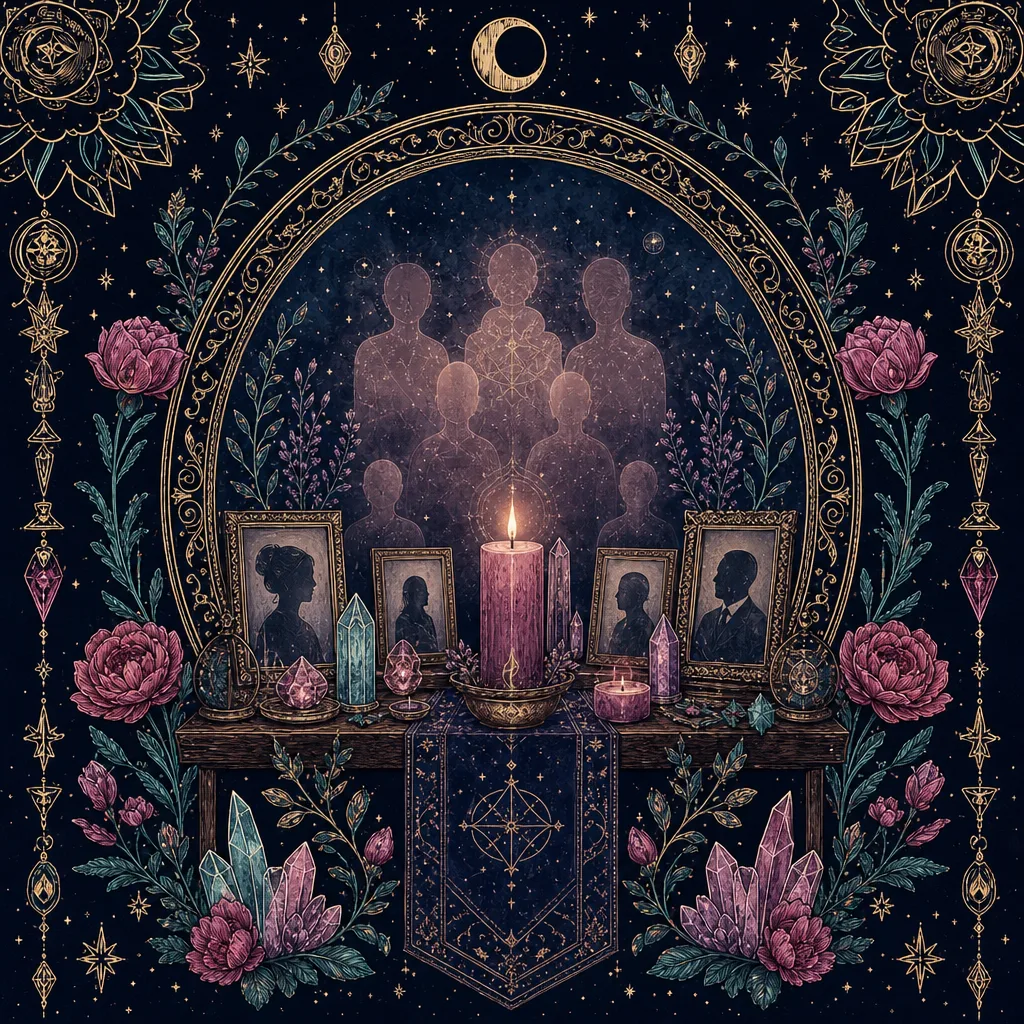
An ancestor altar is a dedicated physical space where you place objects that connect you to those who have died and where you make your offerings. It can be a full shelf, a small tray, or even a single photograph on a windowsill. What matters is the intention you bring to it.
To set up a basic ancestor altar, you will need a surface you can keep relatively undisturbed. Cover it with a cloth in a colour you associate with memory or with death: white is traditional in many African and East Asian traditions; black or purple is common in Western practice; earth tones work well in folk traditions. The cloth marks the space as set apart.
Place photographs of the ancestors you are calling in. If you have no photographs, you can use handwritten names on slips of paper, or small objects that belonged to those people. A candle, ideally white, serves as a beacon and as an offering of light. A glass of fresh water is placed on virtually every ancestor altar in traditions worldwide; water sustains the dead and invites communication. You may also add small offerings of food and drink that the deceased enjoyed in life, flowers, incense, or other items meaningful to your family or tradition.
Light the candle and speak to your ancestors simply and directly. Tell them who you are. Tell them you remember them. Ask for their presence and their support. You do not need elaborate rites for this. The relationship is built through consistent, heartfelt attention over time.
Change the water at least weekly, remove food offerings before they spoil, and tend the altar with the same care you would give to a relationship with someone living.
Offerings and Communication
The logic of offerings in ancestor work is the same as in most spirit relationships: you give something of value to sustain the relationship and to demonstrate genuine regard. The most universally acceptable offerings are fresh water, candle flame, and food. Beyond those, you might offer incense smoke, small cups of alcohol if the ancestor drank, coffee, flowers, tobacco (used carefully and outdoors if smoke is a concern), or handmade items.
Talk to your ancestors. This can feel strange at first, especially if you were raised in a tradition that did not do this. Many practitioners find that speaking aloud at the altar is more effective than silent thought, possibly because the act of forming words into speech requires a kind of commitment and clarity that interior thought does not. You can speak informally, in the same register you might use to talk to a living family member you trust.
Signs of ancestral communication are usually quiet: a sudden clarity of mind after a question you have been wrestling with, a meaningful dream that arrives after altar work, a physical sensation of presence or warmth, or the unexpected surfacing of a memory. These experiences are valid. Keeping notes on them, in your Book of Shadows or working journal, allows patterns to emerge over time.
Seasonal Observances: The Dumb Supper and Samhain
The thinning of the veil between the living and the dead is a widespread belief across many cultures, and in the Wheel of the Year tradition, Samhain (celebrated on or around 31 October in the northern hemisphere) is the primary time for ancestor work. On this night, many practitioners set an extra place at the dinner table for the beloved dead, serve the same meal the family is eating, and eat together in silence: this is the dumb supper, so called because “dumb” once meant silent.
To hold a dumb supper, prepare your meal and set a place at the table with a plate, cup, and utensils for the ancestors. Light a candle at their place. Before eating, serve their plate first and pour their cup. Eat in silence, keeping your thoughts on those you are remembering. After the meal, take the food to a crossroads, a threshold, or a natural body of water and leave it as an offering, or bury it in the earth.
Other seasonal times when ancestor work is particularly potent include the New Moon, which many traditions associate with the underworld and the dead, and the first Monday of each month in some West African diaspora traditions.
Ancestor Work for Adopted Practitioners and Those with Painful Histories
If you are adopted, you may feel uncertain which ancestors are yours to approach. The answer is: all of them. You have biological ancestors who gave you your physical form, whether or not you know who they are. You have the ancestors of the family that raised you, who shaped your life and culture. You have ancestors of place and ancestors of tradition. None of these connections requires a paper trail.
If you do not know your biological family, you can approach the bloodline ancestors in a general way, without names or faces, acknowledging that they existed and that you descend from them. Many practitioners find that the ancestors respond with warmth to this kind of open-hearted acknowledgment, and that family information or connections surface in unexpected ways after the work begins.
If your family history includes profound harm, including genocide, enslavement, or deep intergenerational trauma, ancestor work can be part of the process of healing that legacy. This is not simple or quick work. Going slowly, working with a community or tradition that has experience with this kind of history, and seeking both spiritual and therapeutic support are all reasonable approaches.
Building the Practice Over Time
A sustainable ancestor practice is built through regularity, not through elaborate one-time ceremonies. A weekly tending of the altar, even five minutes of lighting the candle, refreshing the water, and speaking a few words, is more meaningful than a single annual ceremony.
As you develop the practice, you may begin to feel the particular characters of different ancestors: a grandmother whose presence feels warm and practical, a far ancestor who seems connected to land and weather, a lineage ancestor who brings a particular kind of creative energy. These distinctions develop over months and years of quiet, consistent work.
Ancestor veneration is often described as the foundation of spirit work because the ancestors have a vested interest in your flourishing that spirits of other kinds do not necessarily share. They are family. They want the line to continue. Starting here, with those who loved you and who came before you, gives your practice roots that go deeper than any single tradition.