From the Library · Divination & Oracles
How to Read Your First Tarot Spread
A practical, confidence-building walkthrough for anyone sitting down with a tarot deck for the first time, covering card preparation, a simple three-card spread, and how to interpret what comes up.
Reading tarot for the first time is simpler than most beginners expect, and more rewarding than most skeptics allow. You do not need to memorize 78 card meanings before you begin. You need a deck, a question held honestly in mind, and a willingness to sit with what surfaces. This guide walks you through your first complete reading, from shuffling through interpretation, using a three-card spread that experienced readers return to throughout their lives.
Tarot is a tool for reflection, not prediction in the narrow fortune-telling sense. The cards give your intuition a structure to work within, a set of images and archetypes that the mind can use to organize what it already knows, feels, or suspects. A reading does not tell you what will happen. It shows you the energies, patterns, and choices present in a situation at this moment, and what might follow if current trajectories continue.
A brief history of the cards
The tarot deck as most people know it today descends from a set of playing cards developed in fifteenth-century northern Italy. The earliest surviving decks, such as the Visconti-Sforza, were luxury objects painted for noble families and used for a trick-taking card game called tarocchi. The cards did not acquire their associations with divination and occult symbolism until the late eighteenth century, when French occultists, particularly Antoine Court de Gebelin, began claiming (incorrectly) that the images encoded ancient Egyptian wisdom. That origin story was fabrication, but the interpretive framework it inspired proved durable and was refined by later thinkers including Etteilla, Eliphas Levi, and the founders of the Hermetic Order of the Golden Dawn.
The Rider-Waite-Smith deck, published in 1909 and illustrated by Pamela Colman Smith under the direction of Arthur Edward Waite, became the foundation for most modern decks and most modern teaching. Its fully illustrated pip cards, where each numbered card shows a scene rather than a simple pattern of suit symbols, made intuitive reading far more accessible. When people picture a tarot card, they almost always picture one of Smith’s images, even when working with a deck that reimagines them.
Preparing for your reading
Choose a space where you will not be interrupted for at least twenty minutes. Some readers lay out a cloth, light a candle, or take a few slow breaths before beginning. These gestures are not superstition; they are ways of signaling to the mind that ordinary time is pausing and attentive time is beginning. Use whatever transition feels natural to you.
Hold your question in mind as you shuffle. The question does not need to be spoken aloud, but it should be specific enough to point toward something real. Open-ended questions tend to yield richer readings than yes-or-no questions. “What do I need to understand about my situation at work right now?” will give you more to work with than “Will I get promoted?” Shuffle until the deck feels ready, however long that takes. Some readers cut the deck into three piles and reassemble them; others simply pull from the top. There is no wrong method.
The three-card spread
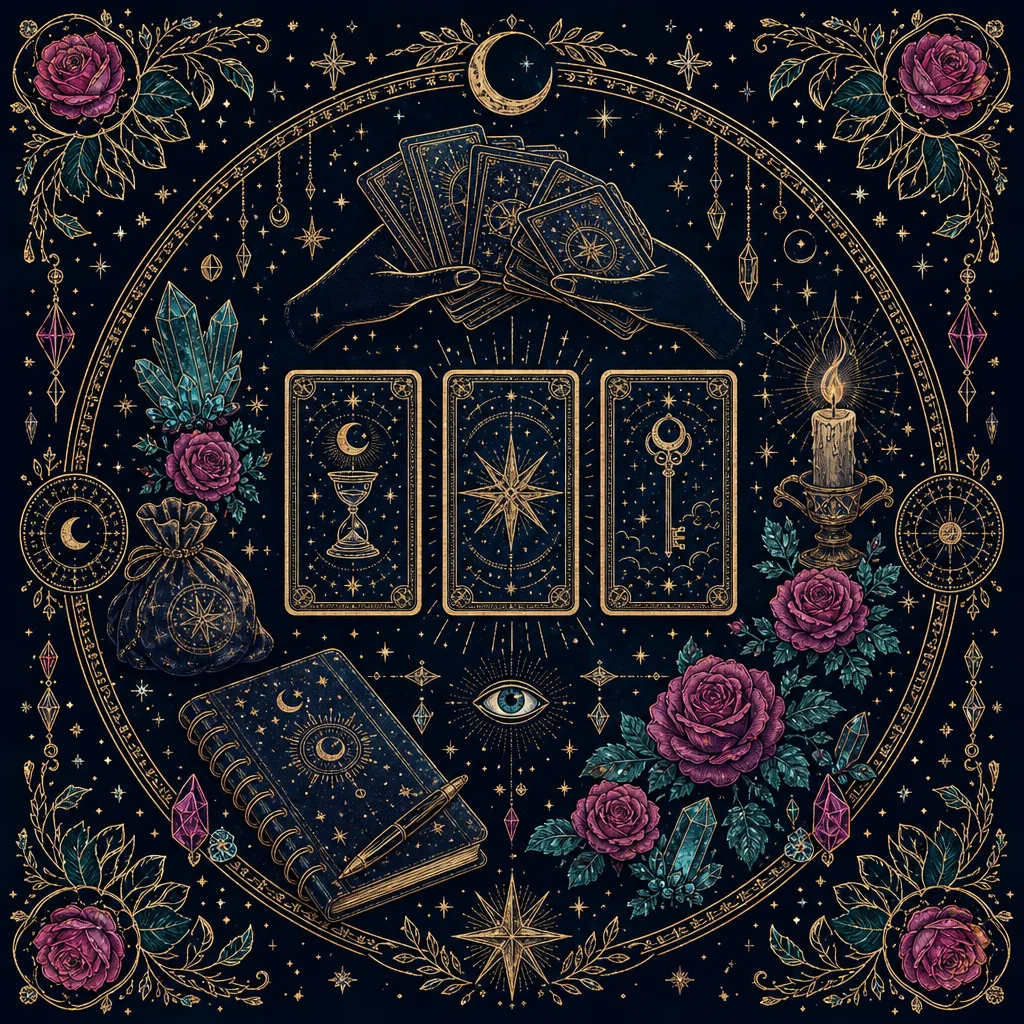
Lay three cards face-down in a row from left to right, then turn them over one at a time.
Card one (left): the past, or the underlying situation. This position holds the context. It shows what has led to the present moment, the energies or events that shaped the ground you are standing on. When interpreting this card, ask what is completing, what is still influencing the present from behind.
Card two (center): the present. This is the heart of the reading. The center card shows the primary energy or challenge active right now, the thing most immediately in play. It often feels like the most directly relevant card of the three.
Card three (right): the path forward, or the potential outcome. This card does not tell you what will happen. It shows you what is possible if you move in alignment with the insights the reading is offering, or what may unfold if current patterns continue unchanged. Hold it as a direction rather than a decree.
Reading what the cards show
Turn over the first card and look at it without immediately reaching for a book. Notice your first impression. Is the image warm or cold, active or still, crowded or spare? Does something in the picture draw your eye immediately? Does anything make you uneasy? Spend thirty seconds with the image before you begin to interpret it, because your instinctive response is part of the reading.
Then bring in whatever you know of the card’s traditional meaning, and allow the two to meet. The traditional meanings are not rules to override your response; they are a deep reservoir of human symbolic thinking that your intuition can draw from. If the Nine of Swords appears in the past position and your first feeling is one of relief, let that relief inform how you read it. If the Sun appears in the present position but something feels off to you, trust that too and look more carefully.
The Major Arcana cards, numbered 0 through 21 and named (The Fool, The High Priestess, The Tower, and so on), tend to speak to larger forces, life themes, and significant turning points. The Minor Arcana, divided into four suits, tend to address the texture of daily life: Wands deal with energy, ambition, and creative force; Cups with emotion, relationship, and intuition; Swords with thought, conflict, and communication; Pentacles (or Coins) with material life, the body, work, and practical resources. Court cards, the Pages, Knights, Queens, and Kings, often represent people in the querent’s life or aspects of the querent’s own personality that are active in the situation.
Weaving the three cards into a reading
A strong tarot reading is a story, not three separate definitions. Once you have sat with each card individually, look at all three together. What conversation is happening between them? If the past card shows conflict and the present card shows rest, is the reading suggesting that a difficult phase has ended? If all three cards are from the same suit, what does that concentration tell you? If the cards feel contradictory, that contradiction is often the most important piece of information in the reading, pointing to an inner tension worth examining.
Write down what you notice. Even a few sentences in a notebook or on your phone creates a record you can return to. Readings that feel opaque in the moment often clarify over the following days, and having your initial notes allows you to track that process.
Working with reversed cards
A reversed card is one that falls upside-down when drawn. Some readers incorporate reversals into their practice; others always read cards upright. Neither approach is more valid than the other. If you are beginning, you may find it easier to learn the upright meanings before adding reversals. When you are ready to work with them, understand that reversals rarely mean a simple opposite. They often suggest that the energy of the card is blocked, internalized, delayed, or expressing in a more subtle way than its upright form.
Building your practice
Reading regularly, even a single card each morning with a journal note, builds the intuitive vocabulary that makes tarot fluent. You do not need to study systematically, though study deepens the practice over time. What develops a reader most reliably is consistency, honest attention to what comes up, and a willingness to be surprised.
Your relationship with a tarot deck is personal. Some readers work with a single deck for years and feel it becomes attuned to them. Others work with many decks, choosing different ones for different questions or moods. The deck is a tool, and the intelligence that interprets it is yours.
The most common mistake beginners make is reaching for a reference before they have spent any time with their own response. The book is there when you need it. Your first impression is always worth noting before you consult it.