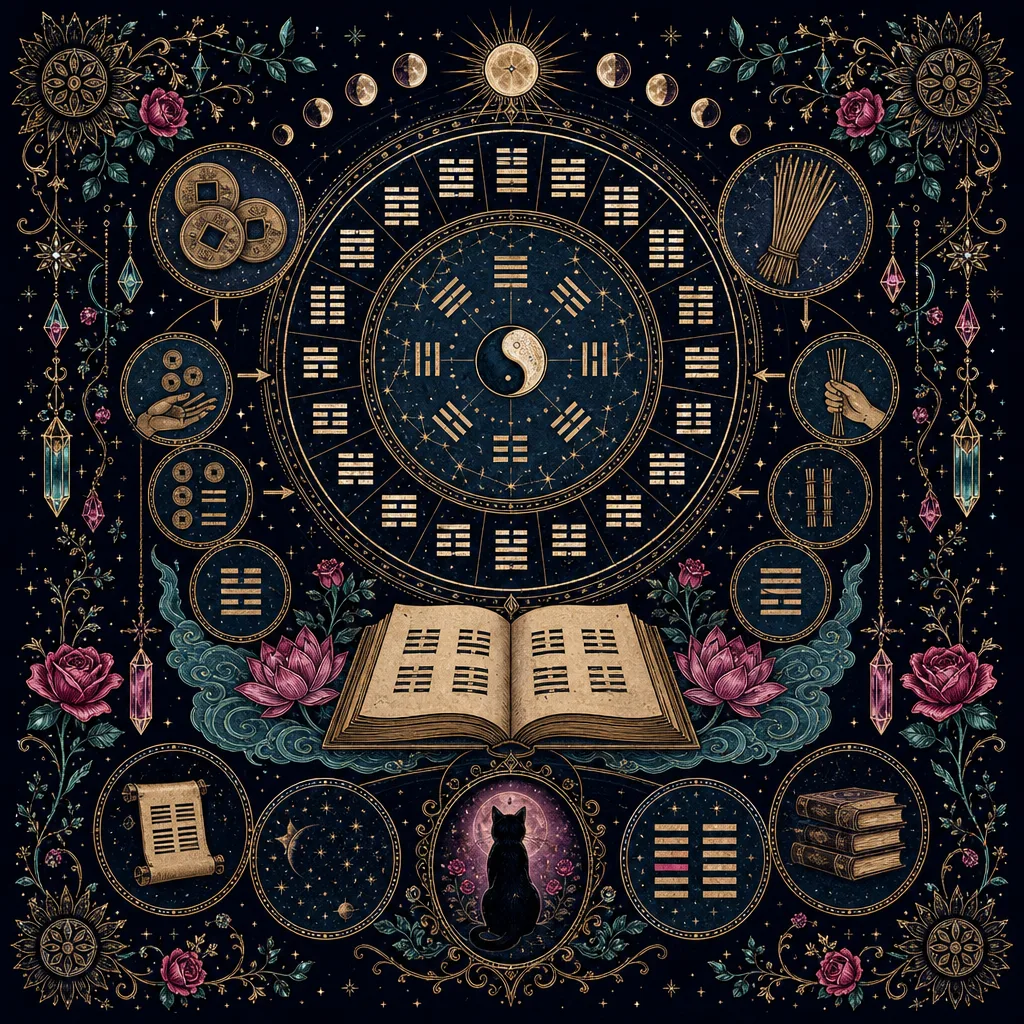
From the Library · Divination & Oracles
Consulting the I Ching: A Step-by-Step Tutorial
A complete practical guide to consulting the I Ching, covering the 8 trigrams, the 64 hexagrams, both the three-coin and yarrow-stalk methods, building a hexagram line by line, identifying and reading changing lines, and choosing a good translation.
The I Ching (Yi Jing), or “Book of Changes,” is one of the oldest continuously consulted oracles in human history. Its roots extend into the early Zhou dynasty of China, approximately the eleventh century BCE, though the text accumulated commentary and interpretive layers over the subsequent millennium. Confucius is said to have studied it intensively in old age; the “Ten Wings,” a collection of philosophical commentaries that form part of the received text, are attributed to him by tradition, though scholars today consider them the work of multiple authors from different periods. The I Ching was transmitted to Europe in the seventeenth century through Jesuit missionaries and entered serious Western occult and psychological discourse through the work of Richard Wilhelm, whose German translation (1924) was itself rendered into English by Cary Baynes in 1950, and through the sustained engagement of C.G. Jung, who wrote the foreword to that edition and explored the concept of synchronicity partly through his work with the I Ching.
The text describes 64 hexagrams: six-line figures, each line either unbroken (yang) or broken (yin), that together form a complete symbolic map of the situations, forces, and transitions a human life can encounter. Consulting the I Ching means casting a hexagram, reading its judgment and image, attending to any changing lines, and arriving at a second hexagram that shows the direction in which the situation is moving.
The 8 trigrams
A hexagram is composed of two trigrams, each a three-line figure, stacked one on top of the other. There are eight trigrams, and understanding them gives you a foundation for reading any hexagram, since the nature of each hexagram is partly understood through the relationship between its lower and upper trigrams.
The eight trigrams are as follows. Qian (three solid lines): heaven, strength, the creative, the father principle, persistence. Kun (three broken lines): earth, receptivity, the yielding that sustains, the mother principle. Zhen (solid line beneath two broken lines): thunder, arousal, movement, the eldest son. Kan (broken-solid-broken): water, the abyss, danger navigated by flowing around obstacles, the middle son. Gen (two broken lines beneath a solid): mountain, stillness, stopping at the right moment, the youngest son. Xun (solid line above two broken lines, in the bottom position this is reversed): wind and wood, gentle penetration, the eldest daughter. Li (broken-solid-broken, mirrored from Kan): fire, brightness, clarity, what clings and illuminates, the middle daughter. Dui (two solid lines beneath a broken): lake, joy, the open mouth, pleasure and gentleness, the youngest daughter.
When you look at a hexagram, identify its lower trigram (lines 1 through 3) and its upper trigram (lines 4 through 6). The lower trigram is often associated with the inner situation or the self; the upper trigram with the outer situation or the world. Their relationship, whether they harmonize, conflict, or transform each other, is part of what the hexagram describes.
The 64 hexagrams
Each of the 64 hexagrams has a name, a judgment (a short oracular statement), an image (a description of the paired trigrams and what they suggest), and line texts that describe the significance of each individual line, particularly when that line is a changing line. A good translation will include all of these elements.
The hexagrams are numbered in a traditional sequence. Hexagram 1 (Qian, heaven over heaven) is pure creative force; hexagram 2 (Kun, earth over earth) is pure receptivity. These two anchor the system. Most of the 64 hexagrams describe the dynamic conditions that arise when yang and yin forces interact in particular configurations. Rather than memorizing hexagram names and meanings in the abstract, let your practice with actual consultations build your familiarity over time; practitioners who have worked with the I Ching for years still find unexpected resonances in hexagrams they have encountered dozens of times.
Preparing for a consultation
The I Ching rewards a clear, honest question. Before you begin casting, formulate your question precisely. The oracle responds poorly to vague inquiries and extremely well to genuine uncertainties. “What is the quality of this situation at work and how should I navigate it?” is a strong question. “Will I get a raise?” is a weaker one, not because the I Ching cannot address practical concerns, but because a binary outcome question limits what the reading can show you.
Choose a clean, quiet space. Many practitioners keep a dedicated cloth, a small bowl or plate for the coins, and their chosen translation nearby. Some light incense or a candle; these gestures serve to mark the consultation as distinct from ordinary time. State your question aloud or write it clearly on paper before you begin casting. This makes it easier to hold the question steady through the casting process.
The three-coin method
The three-coin method is the most accessible way to consult the I Ching and is the standard method for contemporary practice. You need three coins of any denomination, preferably matching. Traditional practice calls for Chinese coins with a square hole (yao qian), where the marked face (the one bearing characters) is yin and the unmarked face is yang, but any three coins work if you assign heads and tails consistently before you begin.
Assign values as follows: heads (yang) = 3; tails (yin) = 2. You will cast the three coins six times, once for each line of the hexagram, building from the bottom line upward.
For each cast:
- Hold all three coins in both hands, focus on your question, and shake them briefly.
- Let them fall onto the surface (or toss them from a cup if you prefer).
- Add up the numerical values of the three coins. The sum will be one of four numbers: 6, 7, 8, or 9.
- Record the result for that line and cast again.
Reading the sums:
- A sum of 7 produces an unbroken (yang) line, written as a solid line. This is a stable yang line.
- A sum of 8 produces a broken (yin) line, written as a broken line. This is a stable yin line.
- A sum of 9 produces an old yang line: a solid line that is changing to yin. Mark it with an X or a circle to indicate it is moving.
- A sum of 6 produces an old yin line: a broken line that is changing to yang. Mark it similarly.
Old lines (sums of 6 and 9) are changing lines, and their line texts in your translation carry the primary divinatory message of the reading.
Building the hexagram: After six casts, you have six lines recorded in order from bottom (first cast) to top (sixth cast). Draw the hexagram with the first cast as the bottom line and the sixth cast as the top line. This is your primary hexagram.
Worked example: You cast six times and record the following from bottom to top: 8 (yin), 9 (old yang), 7 (yang), 8 (yin), 7 (yang), 6 (old yin). Your hexagram from bottom to top is: broken line, solid line with mark (changing), solid line, broken line, solid line, broken line with mark (changing). Drawing this out, the lower trigram (lines 1-3) is broken-solid-solid, which is Gen (mountain) flipped; check carefully. The upper trigram is broken-solid-broken, which is Li (fire). The hexagram is identified by finding these two trigrams in the lookup table in your translation, and you also have changing lines in positions 2 and 6.
The yarrow-stalk method
The yarrow-stalk method is the traditional method described in the I Ching itself and predates the coin method by centuries. It requires 50 yarrow stalks, which can be purchased from botanical suppliers or substituted with thin wooden dowels or bamboo skewers cut to a uniform length. The method is slower and more meditative than the coin method, which many practitioners consider its primary virtue; the extended time spent in each cast deepens focus.
The procedure for each line is as follows:
- Take all 50 stalks in hand. Set one aside; it plays no further role in the casting but is held to represent the Tao, the undivided whole. You now have 49 stalks.
- Divide the 49 stalks into two random piles without counting.
- Take one stalk from the right pile and place it between the ring finger and little finger of your left hand.
- Count through the left pile by fours, setting groups of four aside, until four or fewer remain. Place these remainder stalks between the middle and ring fingers of your left hand.
- Count through the right pile by fours until four or fewer remain. Place these between your index and middle fingers.
- Add up the stalks held in your left hand (the one from step 3 plus the two remainders). The total will be either 5 or 9.
- Set aside the stalks in your left hand. Combine all the remaining stalks (those counted off in groups of four) into a single pile; this is your working pile for the next operation.
- Repeat steps 2 through 7 twice more, using the remaining pile each time. The second and third operations will yield left-hand totals of either 4 or 8.
- Add up the three left-hand totals from operations 1, 2, and 3. The combined total will be one of four values: 13, 17, 21, or 25. These correspond to the four line types: 25 = old yin (6); 21 = old yang (9); 17 = young yang (7); 13 = young yin (8). (Some sources give slightly different mappings; always confirm against your specific procedural reference.)
- Record the line type and reassemble all 49 stalks (plus the one set aside) before beginning the next line.
This process is repeated six times to build the complete hexagram. A single casting session using the yarrow-stalk method takes between 20 and 45 minutes; many practitioners find that the slower pace produces a noticeably more focused state of mind by the time the hexagram is complete.
Identifying and reading changing lines
If your hexagram contains no changing lines (only stable 7s and 8s), you read the hexagram as a whole: its name, judgment, and image. These provide the complete message of the reading.
If your hexagram contains changing lines (one or more 6s or 9s), read the primary hexagram’s name, judgment, and image first to understand the current situation. Then read only the line texts for those specific lines that are changing, in the order they appear from bottom to top. Each changing line’s text speaks directly to the aspect of the situation described by that line’s position.
After reading the changing lines, construct the resulting hexagram by converting each changing line to its opposite: old yang (solid, marked) becomes yin (broken); old yin (broken, marked) becomes yang (solid). All stable lines remain as they are. The resulting hexagram shows the direction in which the situation is moving, the energy that is developing. Read its judgment and image as the direction or outcome.
A practical example: Your primary hexagram is hexagram 29, Kan (water over water), the Abysmal. The judgment speaks of navigating danger by remaining sincere and keeping the heart open. Your changing line is in position 3, and its text warns against advancing before the way is clear. The resulting hexagram, with the third line changed, is hexagram 47, Kun (lake over water), Oppression/Exhaustion. Together, this reading suggests: you are currently in genuine difficulty (the Abysmal), and the temptation to push forward is a trap (line 3). The direction is toward a period of constraint and possible exhaustion (hexagram 47), which the I Ching treats not as defeat but as a test of character. The consultation recommends patience and interior resourcefulness over outward action.
Using a translation
Your translation is a critical tool, and the choice of translation significantly shapes your relationship with the I Ching. Several deserve mention.
The Wilhelm-Baynes translation (“The I Ching, or Book of Changes,” Princeton University Press) remains the most widely used translation in the Western world. Its language is elevated and sometimes archaic, but its commentary is philosophically rich. It is the translation C.G. Jung worked with.
The John Blofeld translation (“I Ching: The Book of Change,” Penguin) is more accessible in style and draws on a somewhat different scholarly tradition. Many practitioners find it easier to read intuitively.
Alfred Huang’s “The Complete I Ching” offers a more literal rendering of the Chinese and is particularly useful for practitioners who want to stay close to the original text’s imagery.
Any of these will serve you well. The key feature to look for in any translation is the inclusion of the judgment, the image, and all six line texts for each hexagram. Some simplified versions omit the line texts, which makes them inadequate for readings with changing lines.
Troubleshooting and common mistakes
Receiving a hexagram and going directly to the line texts without reading the judgment and image first: The judgment and image frame the entire reading and establish the energetic context. Always read them first, even when you have prominent changing lines.
Treating the resulting hexagram as a separate second reading: The resulting hexagram is not a new consultation; it is the continuation of the same one. It shows where the situation is going if current forces play out, not an independent answer to an independent question.
Asking the same question twice because you did not like the first answer: The I Ching is generally understood to give its clearest answer on the first cast of a genuine question. Recasting the same question on the same day typically produces confused results. If you feel the hexagram genuinely did not fit your question, consider whether you framed the question clearly.
Reading with too much reliance on translation keywords rather than the whole text: The I Ching’s meaning is in the complete image its texts evoke, not in single words extracted from the judgment. Read the full text of every section that applies to your cast and let the meaning emerge from the whole.
Rushing the consultation: Both the three-coin and the yarrow-stalk methods benefit from unhurried attention. The time you spend in the casting process itself is part of the practice; it is not merely a mechanism for generating numbers.
Building a practice
Work with the I Ching regularly rather than only in moments of crisis. Many practitioners make a weekly consultation a habit, asking a broad question about the qualities at work in the coming period and keeping notes in a journal. Over months, patterns emerge: particular hexagrams appear repeatedly for particular kinds of situations, certain trigrams dominate certain seasons of life. The I Ching rewards this longitudinal engagement far more than occasional consultation, because the text is not a reference book of fixed answers but a dynamic symbolic system whose depths reveal themselves through sustained relationship.