From the Library · Astrology & The Cosmos
How to Read a Natal Chart: A Beginner's Tutorial
A step-by-step guide to reading an astrological natal chart for the first time, covering the four building blocks of planets, signs, houses, and aspects, a recommended reading order starting with the luminaries and Ascendant, and how to synthesize individual placements into a coherent whole.
A natal chart is a map of the sky at the exact moment and location of your birth. It shows the position of the Sun, Moon, and eight planets in relation to the zodiac signs and the twelve houses, which are divisions of the sky as seen from your birthplace. Astrologers read this map as a portrait of the soul, the constitutional tendencies, strengths, challenges, and life themes that characterize a person. Reading a natal chart is a learnable skill, not an esoteric gift available only to the initiated. It requires patience, some basic vocabulary, and the practice of looking at charts regularly. This tutorial will take you through your first reading with a clear method.
Obtaining an accurate chart
You cannot read a chart without an accurate one, and accuracy depends on three pieces of data: the date of birth, the geographic location of birth, and the time of birth. The date and location determine all the planetary positions except the Moon, which moves approximately 13 degrees per day and therefore changes sign every two and a half days. The time of birth determines the house cusps, particularly the Ascendant (also called the rising sign), which changes sign roughly every two hours.
If you do not know your birth time, check your birth certificate. In most countries, birth certificates record the time of delivery. Hospital records, baby books, and family records are secondary sources. If no time is available, an astrologer can work with a “solar chart,” which places the Sun sign on the first house cusp and proceeds from there. Solar charts are useful but limited; they provide accurate planetary positions but no reliable house placements or Ascendant.
Free natal chart services are available at several reputable sites, including Astro.com, which uses the Swiss Ephemeris, the industry-standard planetary position calculator. Enter your data and select the “Natal Chart, Ascendant” option. The resulting wheel diagram and accompanying data table are all you need to begin.
The four building blocks
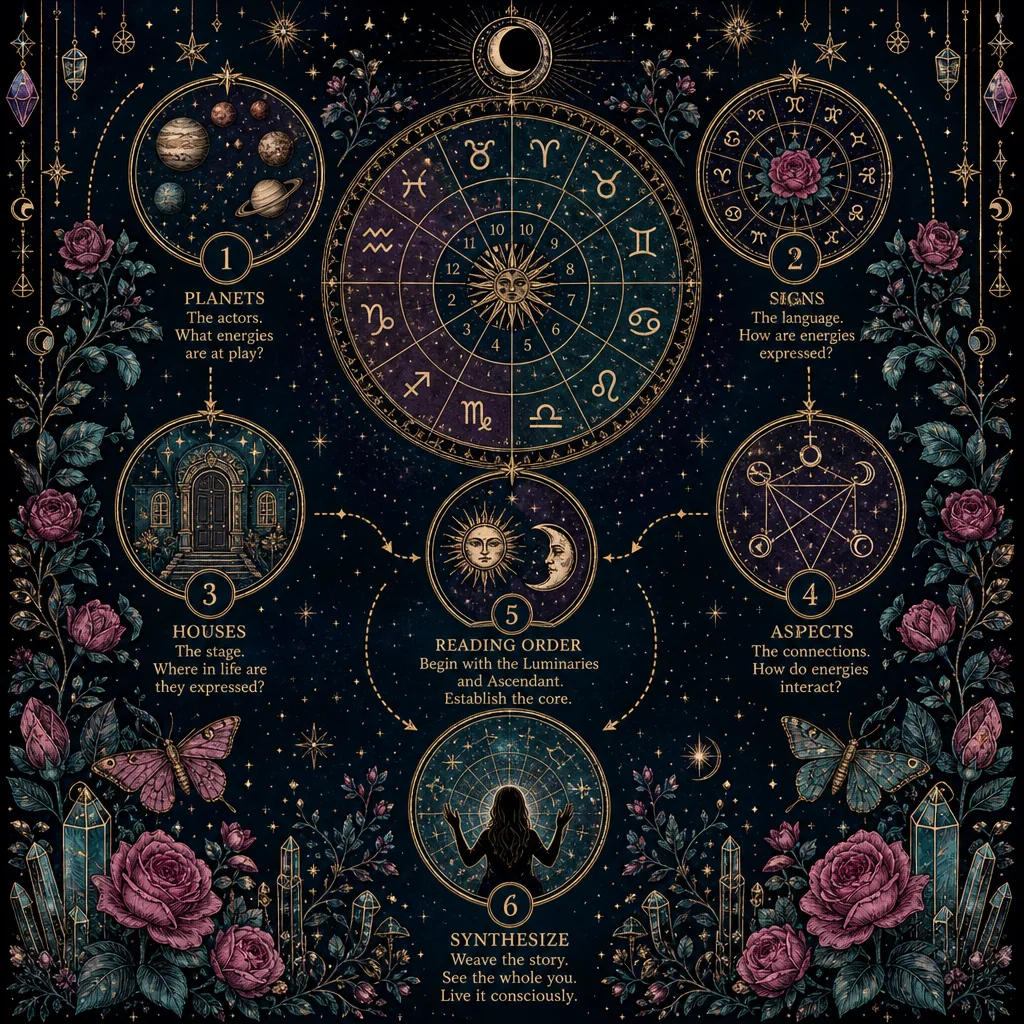
Every meaningful element of a natal chart can be understood through four categories. Learning what each category represents before you look at a single chart placement will prevent the most common beginner errors.
Planets represent drives, functions, and principles. Each planet symbolizes a specific aspect of human experience. The Sun represents identity, will, and the central self. The Moon represents emotional life, instinctive responses, and what the person needs for security. Mercury represents thought, communication, and the way information is processed. Venus represents what a person values, how they love, and what they find beautiful. Mars represents drive, desire, and the capacity for assertion and conflict. Jupiter represents expansion, faith, and where good fortune tends to gather. Saturn represents structure, limitation, discipline, and the areas where life demands the most rigorous work. Uranus represents sudden change, individuality, and the urge to break convention. Neptune represents the dissolving of boundaries, spiritual longing, and the imagination. Pluto represents transformation, power, and what must be destroyed before it can be renewed.
Signs describe the quality or style in which a planetary drive expresses itself. There are twelve signs, one for each thirty-degree segment of the zodiac circle. Aries is direct, initiating, and competitive. Taurus is patient, sensory, and persistent. Gemini is curious, adaptable, and communicative. Cancer is nurturing, protective, and emotionally sensitive. Leo is expressive, generous, and oriented toward recognition. Virgo is analytical, precise, and oriented toward service and improvement. Libra is diplomatic, relationship-oriented, and concerned with fairness. Scorpio is intense, private, and oriented toward depth and transformation. Sagittarius is expansive, philosophical, and oriented toward meaning and adventure. Capricorn is disciplined, ambitious, and oriented toward achievement and social structure. Aquarius is inventive, principled, and oriented toward the collective. Pisces is empathic, imaginative, and oriented toward the transcendent.
Houses describe the area of life in which the planetary energy manifests. The twelve houses correspond to the twelve areas of lived experience. The First House governs the self, the body, and the way one presents to the world. The Second House governs money, possessions, and personal values. The Third House governs communication, siblings, short travel, and early education. The Fourth House governs home, family, roots, and the private inner life. The Fifth House governs creativity, pleasure, children, and romantic encounters. The Sixth House governs health, daily routine, work, and service. The Seventh House governs partnerships, marriage, and open adversaries. The Eighth House governs shared resources, sexuality, death, and transformation. The Ninth House governs higher education, philosophy, religion, and long journeys. The Tenth House governs career, public reputation, and one”s contribution to society. The Eleventh House governs friendships, communities, and long-term hopes. The Twelfth House governs the unconscious, isolation, hidden enemies, and spiritual retreat.
Aspects describe the angular relationships between planets in the chart. When two planets are positioned at certain specific angles to each other, they interact in ways that modify both of their expressions. The major aspects are: the conjunction (0 degrees), in which two planets occupy nearly the same position and blend their energies; the sextile (60 degrees), which represents an opportunity or ease of cooperation; the square (90 degrees), which represents tension, challenge, and the need for effort or adjustment; the trine (120 degrees), which represents natural flow and ease; and the opposition (180 degrees), which represents tension between two opposing principles that must be integrated.
Step-by-step reading order
The following reading order is recommended for beginners because it moves from the most important and accessible elements to the more complex, and because it builds a coherent portrait cumulatively rather than producing a list of disconnected facts.
Step 1: The Sun sign. Locate the Sun in your chart. Note the sign it occupies and the house. The Sun”s sign describes your core identity, the essential quality of your will and self-expression. The Sun”s house describes where in life that core self most naturally and visibly manifests. A Sun in Sagittarius in the Ninth House expresses the Sagittarian love of philosophy, travel, and meaning in the area of life most associated with those themes. A Sun in Sagittarius in the Second House expresses the same philosophical expansiveness but primarily through financial life, material values, and the accumulation and philosophy of resources.
Step 2: The Moon sign and house. The Moon describes your emotional nature, your instinctive responses, and what you need to feel safe and nourished. Its sign tells you the emotional style; its house tells you where you seek that nourishment. A Moon in Capricorn in the Fourth House is emotionally reserved, finds security in structure and accomplishment, and seeks those qualities specifically in the realm of home and family life, perhaps through building a financially stable domestic environment. The Moon”s relationship to the Sun (by aspect) shows how well the conscious will and the emotional instincts are aligned.
Step 3: The Ascendant (Rising Sign). The Ascendant is the sign rising over the eastern horizon at the exact time and place of birth. It describes the mask or persona presented to the world: not a false self, but the instinctive social self that others encounter first. It also rules the physical body and the general appearance. If the Sun is the actor and the Moon is the inner emotional life, the Ascendant is the role or costume the actor wears in their daily performance. Note which sign is on the Ascendant and consider how it modifies or overlays the Sun and Moon picture already established.
Step 4: The chart ruler. The chart ruler is the planet that rules the Ascendant”s sign. If your Ascendant is Aries, your chart ruler is Mars. If your Ascendant is Taurus or Libra, your chart ruler is Venus. If your Ascendant is Gemini or Virgo, your chart ruler is Mercury. Cancer is ruled by the Moon. Leo by the Sun. Scorpio by Mars (traditional) or Pluto (modern). Sagittarius by Jupiter. Capricorn by Saturn. Aquarius by Saturn (traditional) or Uranus (modern). Pisces by Jupiter (traditional) or Neptune (modern). The chart ruler”s sign and house placement carries great weight in the natal chart; it describes a core theme of the life”s expression. Locate the chart ruler and note its sign, house, and any major aspects it makes.
Step 5: Planets in angular houses. The angular houses, the First, Fourth, Seventh, and Tenth, are the most powerful and visible in the chart. Planets placed in these houses, especially close to the house cusp, operate with particular force and tend to be prominent themes in the person”s life. After reading the Sun, Moon, and Ascendant, scan the chart for planets in angular houses and note them as prominent features.
Step 6: Major aspects between personal planets. The personal planets are the Sun, Moon, Mercury, Venus, and Mars. Aspects between these five planets describe the internal dynamics between the core drives and functions. A square between the Moon and Saturn, for instance, describes a tension between emotional needs and the demands of structure, discipline, or authority: the person may feel that their emotional life is constrained or subject to stern internal judgment. A trine between the Sun and Jupiter describes a natural ease of expansion and optimism in the expression of the core self. Work through the major aspects involving the personal planets and note what each interaction suggests about internal dynamics.
Step 7: The outer planets by house. Uranus, Neptune, and Pluto move slowly enough that they are shared by everyone born within a period of years; they describe generational themes rather than purely individual ones. Their house placements, however, are specific to the individual and show where those generational energies manifest in personal life. Neptune in the Seventh House, for example, describes a generational idealism and romanticism specifically expressed through the area of partnership and relationship.
Step 8: Stellia and empty areas. A stellium is a cluster of three or more planets in a single sign or house. Stellia represent concentrated areas of focus and theme. If a person has four planets in the Sixth House, the daily work, health, and routine area of life carries enormous significance in their chart. Empty houses are simply areas of life that do not carry concentrated planetary energy in this chart; they are not blank areas of the life but areas that tend to operate more quietly.
Synthesizing a coherent interpretation
The most common beginner error is to read each placement in isolation, producing a list of sometimes contradictory keywords, rather than building a synthetic portrait. Synthesis requires you to look for the overall patterns and major themes before you get into individual details.
Ask these organizing questions as you look at a chart:
Where is the chart”s weight concentrated, in which signs and which houses? A chart with most planets above the horizon (in Houses Seven through Twelve) tends toward extroversion and public engagement; one with most planets below the horizon (Houses One through Six) tends toward introversion and internal or private focus. A chart weighted in the cardinal signs (Aries, Cancer, Libra, Capricorn) tends toward initiation and leadership; one weighted in fixed signs (Taurus, Leo, Scorpio, Aquarius) tends toward persistence and resistance to change; one weighted in mutable signs (Gemini, Virgo, Sagittarius, Pisces) tends toward adaptability and multiplicity of interest.
What is the most prominent planet in the chart, by angularity, number of aspects, or position as chart ruler? That planet describes a dominant life theme.
What are the major tensions in the chart? Strong squares and oppositions between personal planets describe the psychological tensions that drive the person”s development.
What are the major gifts? Trines and sextiles between personal planets and benefic outer planets describe areas of natural talent or fortunate tendency.
Once you have answered these organizing questions, the individual placements take their meaning from within that larger picture. A Moon in Scorpio means something slightly different in a chart dominated by water signs and deeply private houses than it does in a chart with a fiery, angular Sun and an Aries Ascendant.
Common beginner mistakes
Reading only the Sun sign is the most prevalent error, and the source of most popular astrology”s justified criticism. The Sun sign alone does not an astrological portrait make. A person with the Sun in Gemini and the Moon in Capricorn, Saturn conjunct the Ascendant, and Mars in Scorpio is a substantially different person from someone with the Sun in Gemini alone.
Treating placements as immutable fate misunderstands what natal astrology offers. The chart describes constitutional tendencies, not destinations. A Saturn square Moon does not mean the person will suffer chronically; it means they will likely encounter the need to reconcile emotional needs with discipline or authority, and if they do that work, the tension becomes a source of strength.
Interpreting every placement as equally important produces a flat reading in which everything seems equally emphasized and nothing stands out. Weight your reading: the luminaries, the Ascendant, and the chart ruler deserve more space than the transiting nodes or an asteroid.
Reading by keywords alone, pulling from a list of meanings and concatenating them, without considering how the chart as a whole shapes each placement”s expression, produces generic interpretation. The same planet in the same sign will function quite differently depending on its house, its aspects, and the larger shape of the chart.
Neglecting to account for the house system in use. Different astrologers use different house division systems, the most common being Placidus, Whole Sign, and Koch. These systems produce different house cusps and can move planets from one house to another. Be aware of which system your chart generator used; Astro.com defaults to Placidus. If you are learning from a teacher who uses Whole Sign houses, your placements will differ in some areas. This is not a flaw in the system; it reflects a genuine area of ongoing practice and debate within the astrological community.
Continuing the practice
The most effective way to deepen chart-reading skill is to read charts regularly, beginning with people you know well. When you read a chart for someone whose life you know in some detail, you can immediately test whether what the chart shows corresponds to what you observe: this is how you build genuine interpretive confidence rather than theoretical knowledge.
Keep notes on every chart you study. Over time, you will develop intuitions about combinations, such as what a strong Twelfth House tends to feel like from the inside, or how a person with Mars conjunct Saturn tends to describe their relationship to ambition and effort, that no textbook can give you. Those intuitions are the fruit of practice, and they are what eventually allow you to give a reading that feels genuinely illuminating to the person sitting across from you.
Astrology is, in the end, a symbolic language. Like any language, it rewards the person who studies it seriously and uses it regularly. A natal chart is not a verdict; it is an invitation to understand, with unusual specificity and compassion, the particular shape of a particular life.