From the Library · Divination & Oracles
Reading Ogham: A Tutorial
A thorough introduction to ogham as a Celtic tree alphabet and its use in modern divination, covering the feda and their tree associations, making or sourcing a set of staves or cards, single-stave and spread methods, and an honest account of ogham divination as a modern reconstruction.
Ogham is one of the earliest writing systems associated with the Celtic world, attested in stone inscriptions from Ireland, Scotland, Wales, and southwest England, dated broadly from the fourth to the seventh centuries CE. The inscriptions that survive are almost entirely memorial and territorial in nature: names, dedications, the marking of borders. There is no surviving ancient text that describes ogham as a divinatory system. The use of ogham for divination is a modern development, built primarily in the twentieth century by reconstructionist scholars, Celtic pagans, and practitioners working within the broader revival of pre-Christian European spiritual practice.
Stating this plainly is not a reason to dismiss ogham divination. Many worthwhile practices are modern inventions or reconstructions. What matters is that you understand what you are working with: a beautiful, historically grounded symbolic alphabet whose divinatory meanings have been elaborated by modern practitioners drawing on medieval Irish tree-lore, bardic poetry, and comparative mythology. The system you learn in this tutorial stands on genuine scholarship and has been tested in practice by thousands of readers. Treat it accordingly.
The ogham alphabet and the concept of feda
The ogham alphabet consists of 20 primary characters, each called a fid (plural: feda). The characters are inscribed as groups of lines or notches crossing or meeting a central stemline, which in stone inscriptions was typically the corner edge of the stone itself. In manuscript tradition the stemline runs horizontally or vertically across the page.
The 20 feda are organized into four groups of five, called aicmi (singular: aicme), plus a supplementary group called the forfeda. For divinatory purposes most practitioners work with the 20 primary feda; the forfeda are less consistently included.
Each fid has a name derived from an Old Irish word, and each name corresponds to a tree, shrub, or plant. The correspondence between the feda and specific trees, while present in medieval Irish manuscripts such as the “Book of Ballymote” and the “Scholar’s Primer” (Auraicept na n-Eces), is not always internally consistent across sources, and the divinatory meanings attached to those tree correspondences are largely a twentieth-century synthesis. Modern practitioners, particularly those following the work of scholars such as Erynn Rowan Laurie (“Ogam: Weaving Word Wisdom”) and others who have done serious research, are transparent about this provenance.
The 20 primary feda and their associations
The four aicmi are as follows. Each fid is given with its traditional name, its tree or plant correspondence, and a summary of its most widely accepted divinatory resonance.
First aicme (Aicme Beithe): Beith (birch): new beginnings, cleansing, fresh starts, the first growth after clearing. Luis (rowan, sometimes reed in older sources): protection, clarity of vision, the warding of harm, discernment. Fearn (alder): foundation, support, the protection of established structures, decisions that hold. Sail (willow): the emotions, dreams, intuition, the hidden currents beneath the visible. Nion (ash): connection between worlds, the cosmic tree, destiny, the larger pattern into which small events fit.
Second aicme (Aicme hUatha): Huath (hawthorn, sometimes whitethorn): obstacles, testing, confronting difficulty, the beauty within hardship. Duir (oak): strength, endurance, sovereignty, the long view, what outlasts difficulty. Tinne (holly): challenge met with balance, the sword’s clarity, standing firm in conflict. Coll (hazel): wisdom, the meeting of knowledge and intuition, the nuts of the sacred pool. Quert (apple): beauty, health, the Otherworld’s generosity, abundance and pleasure.
Third aicme (Aicme Muine): Muin (vine or bramble; the etymology is debated): harvest, what your work has produced, abundance after effort, but also intoxication and the need for clarity. Gort (ivy): persistence, the growth that will not be stopped, tenacity, connection. Ngetal (reed): healing, cutting away what harms, direct action on a wound or problem. Straif (blackthorn): difficulty that cannot be avoided, the winter thorn, necessary suffering and what it teaches. Ruis (elder): endings, the transition from one phase to another, the wisdom at the boundary of death and life).
Fourth aicme (Aicme Ailme): Ailm (pine or silver fir): clarity, the long view from high ground, what endures through winter. Onn (gorse): gathered energy before effort, the spark that ignites the process, optimism before action. Ur (heather or earth): grounding, the fertility of the land, what grows from solid foundation. Edad (aspen): the trembling between fear and courage, the threshold of a difficult crossing, facing what frightens. Idad (yew): longevity, the tree that lives through centuries, ancestors, the thread of continuity through time.
Making or sourcing a set of ogham staves
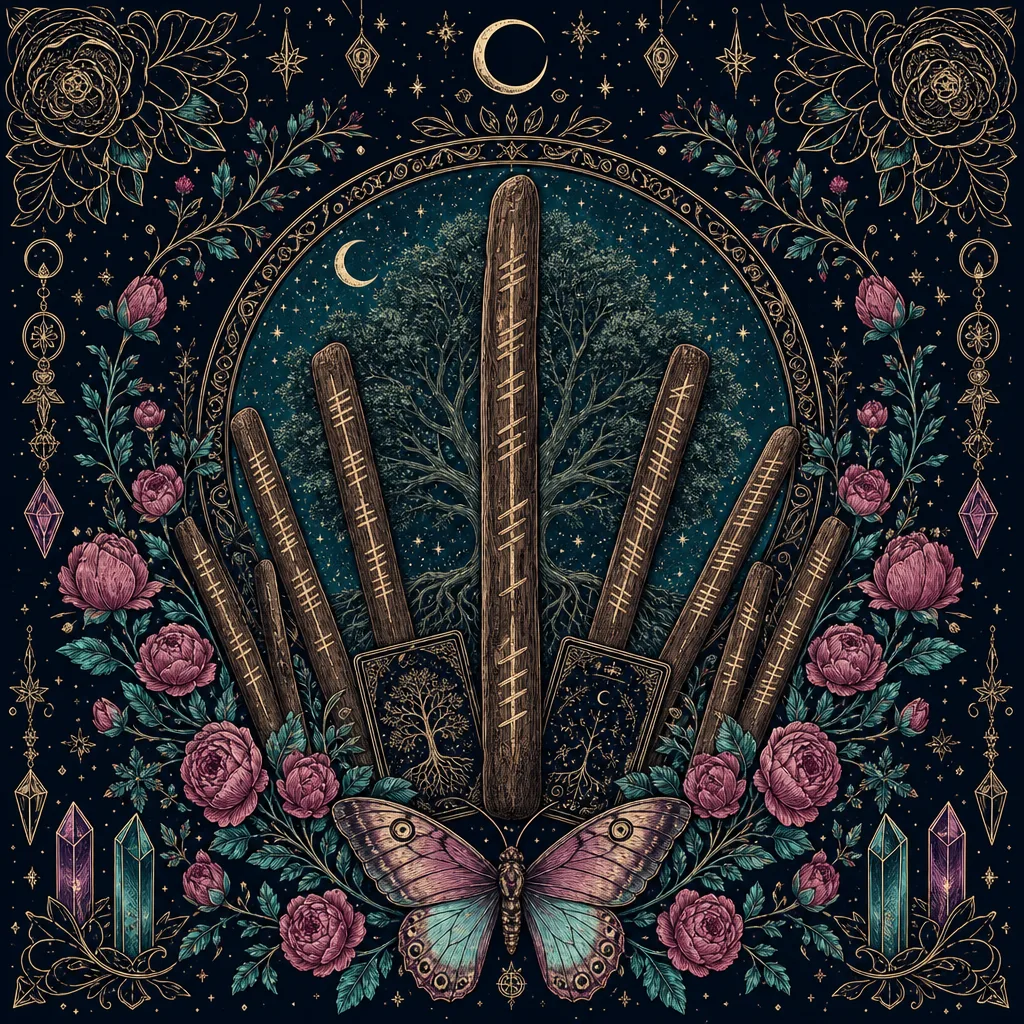
The traditional form for an ogham set is a collection of staves, flat sticks or pieces of wood roughly the size of a large tongue depressor or a short ruler, each inscribed with one fid. Hardwoods are preferred; ash, oak, rowan, yew, birch, and hazel are all appropriate choices given their associations with the tradition. If you can carve or burn the ogham mark into the wood yourself, the time spent doing so builds familiarity with each character before you ever use the set for reading.
If you prefer to purchase staves, look for sets sold by craftspeople who are transparent about the wood species used and the source of their ogham designs. Commercially available ogham card decks are also widely used; they function identically to staves for all the methods described in this tutorial, and a well-illustrated deck can be a valuable study tool.
Whichever format you choose, store your set in a pouch, box, or wrapped cloth when not in use. Some practitioners anoint the staves with a small amount of olive or almond oil when they first acquire the set, then wipe them clean. This practice is not ancient but it is meaningful as a way of marking the beginning of your working relationship with the set.
Preparing for a reading
Find a quiet space and a flat surface covered with a cloth, preferably in a natural color. Ground yourself before beginning: three slow breaths, a brief moment of intention-setting, whatever practice helps you arrive fully in the present. Hold your question clearly in mind. Ogham responds well to questions about growth, timing, and the natural cycles of situations, since the tree alphabet is inherently tied to seasonal and organic processes. “What is the natural progression of this situation?” and “Where am I being asked to apply effort right now?” are well-suited to ogham.
Place your staves or shuffle your cards with the question in mind. If using staves in a bag or bowl, stir them with your non-dominant hand before drawing.
Single-stave draws
The single-stave draw is the appropriate starting method for anyone new to ogham. It produces one character, one tree, one area of meaning, and it is enough for a full, considered reflection.
- Hold your question in mind and reach into the bag or bowl.
- Draw one stave without looking at the characters.
- Lay it on the cloth. Note whether it falls readable to you (upright) or inverted. Some practitioners read ogham reversals; others do not, since the characters on a stemline have a natural reading direction but are not as visually distinct when reversed as tarot card imagery. Decide before you draw.
- Read the name and tree, and sit with the natural image of that tree for a moment before consulting references.
- Bring the fid’s associations to your question and let the connection form.
A single daily draw, noted in a journal, is one of the most effective ways to learn the ogham. Over the course of 20 days you will have drawn each fid at least once and begun to develop a personal relationship with the symbolic language of the set.
Spread methods
The three-stave draw: Draw three staves and lay them in a row from left to right. The most common positional interpretations mirror those used in three-card tarot: past, present, and future; or situation, action, and outcome. A third framing well suited to the ogham’s natural-cycle vocabulary is root (what is established beneath the situation), stem (what is actively growing), and canopy (what is reaching toward). Read each position individually, then read the three staves together as a progression.
The five-stave cross: Draw five staves and arrange them in a cross: one center, one above, one below, one left, one right. The center stave represents the heart of the matter. Above: what aspires or what the situation is reaching toward. Below: what grounds it, its foundation or root. Left: what is moving away or releasing. Right: what is approaching or coming into play. This spread rewards questions about complex situations with multiple active forces.
The seasonal cast: This is a method specific to ogham’s tree-alphabet nature. Draw five staves, one for each of five areas of life or inquiry, and assign them the seasonal correspondences: the first stave is the winter question (what lies dormant, what is being held in seed), the second is the spring question (what is beginning), the third is the summer question (what is in full growth), the fourth is the autumn question (what is being harvested or released), and the fifth is the year-round question (what endures regardless of season). This spread works especially well at seasonal turning points.
Worked example
You ask about a creative project that has stalled. You draw three staves: Idad (yew, the long thread of continuity and ancestral wisdom) on the left, Huath (hawthorn, obstacles and testing) in the center, and Coll (hazel, wisdom and the meeting of knowing and intuition) on the right.
In the root-stem-canopy reading: the root of this project is something that has been carried for a long time, perhaps an inherited interest or a deeply personal thread that predates the current form of the work (Idad). The current blockage is real and the hawthorn is not promising quick resolution; it suggests that the obstacle is a test of the project’s genuineness and your commitment to it (Huath). The canopy shows the direction to grow toward: trusted knowledge, an intuitive sense that the right approach exists and can be found by going inward rather than outward (Coll). Taken together, the reading suggests the stall is meaningful rather than random, and that drawing on older, deeper knowledge will be more productive than seeking external solutions.
Troubleshooting and common mistakes
Trying to read the forfeda before the primary 20 feda are solid: The supplementary characters expand the vocabulary considerably; add them only once you have genuine familiarity with the primary set.
Confusing tree correspondences across different sources: Various authors assign different trees to specific feda, particularly for Muin and Ngetal. Choose one reference source for your primary interpretive vocabulary and stick with it through your first year of practice. You can explore alternate correspondences later.
Treating the modern divinatory meanings as ancient fact: The ogham tree meanings in medieval sources are mostly poetic, grammatical, and mnemonic rather than divinatory. The rich interpretive associations most practitioners use were developed in the twentieth century. Using them is entirely appropriate, but knowing their provenance allows you to engage with them as a living, developing tradition rather than as fixed ancient law.
Drawing too many staves for a simple question: Resist the urge to use a five-stave spread every time. A single well-drawn fid will give you more usable information about a simple question than five staves read in a hurry.
Discarding a reading because the answer seems negative: The hawthorn, the blackthorn, and the yew are not bad omens. They carry difficult but important energies. Sit with what they show rather than recasting.
Continuing practice
The ogham rewards sustained engagement. Keep a journal of your draws, noting the date, your question, the stave or staves drawn, and your initial impressions before consulting references. Return to earlier entries after a week or a month; the patterns that emerge across many readings often reveal something a single session cannot.
Reading the medieval Irish texts, particularly the “Book of Invasions” (Lebor Gabala Erenn) and the tree-kenning poems in the “Scholar’s Primer,” enriches the symbolic vocabulary considerably. These texts are available in translation and repay the time spent with them. The trees of the ogham are not symbols in the abstract; they are particular beings with particular natures, and the more time you spend with actual birch trees, actual hawthorn hedges, and actual yews, the more the feda will come alive in your readings.