From the Library · Divination & Oracles
Rune Casting: An Elder Futhark Tutorial
A thorough, step-by-step guide to working with the 24 Elder Futhark runes, covering how to acquire or make a set, single and multi-rune draws, casting on a cloth, reading by position and proximity, merkstave interpretations, and proper care of your set.
The runes are among the oldest divinatory systems still in active use in the Western world. As an alphabet, the Elder Futhark predates the Viking Age, with inscriptions documented from roughly the second century CE across Germanic-speaking Europe. As a divinatory tool, their use has a more complicated history: references to casting or drawing lots marked with symbols appear in Roman and medieval sources, but the elaborate interpretive systems most practitioners use today draw heavily on nineteenth-century Germanic scholarship, twentieth-century occultism, and the recovery work of researchers such as Ralph Blum, Edred Thorsson (Stephen Flowers), and Freya Aswynn. Understanding that the modern system is a synthesis of ancient symbol and reconstructed practice does not diminish its power; it helps you approach the work honestly and continue building your own relationship with the staves over time.
This tutorial teaches you to work with the 24 runes of the Elder Futhark, from handling your first set to conducting complex multi-rune casts.
Acquiring or making a set
Rune sets are sold commercially in wood, stone, ceramic, bone, and resin. Any material works, but many practitioners find that sets made from natural materials, particularly wood and stone, feel more responsive to handling and more at home in practice. When choosing a commercial set, look for one where each rune is clearly and consistently carved or incised; faded or stamped-on marks have a tendency to blur under handling.
Making your own set is a respected tradition. Cut or collect 24 roughly equal discs or staves of wood, sand them smooth on both faces, and carve or wood-burn the rune symbols into one face of each. Hardwoods such as oak, ash, yew, or birch are associated with runic tradition, though any wood you have a connection to is appropriate. If you paint or stain the marks, red ochre or blood-red pigment carries historical resonance, since runes in early inscriptions were sometimes highlighted in red. After completing the carvings, many practitioners hold each piece and spend time sitting with its rune before putting the set into use.
Whether your set is bought or made, keep a small drawstring pouch or wooden box for storage. This is not mere sentiment; a dedicated container keeps the set clean, together, and psychologically set apart from everyday objects.
The 24 Elder Futhark runes as a working vocabulary
The Elder Futhark is divided into three groups of eight, each called an aett (plural: aettir). Memorizing the runes by aett helps because runes within an aett share thematic resonances.
The first aett (Freya’s aett): Fehu (cattle, abundance, mobile wealth), Uruz (wild ox, primal strength, health), Thurisaz (thorn, conflict, the force of giants), Ansuz (the god Odin, communication, divine breath), Raidho (riding, journeys, right order), Kenaz (torch, knowledge, craft), Gebo (gift, exchange, partnership), Wunjo (joy, harmony, the successful clan).
The second aett (Heimdall’s aett): Hagalaz (hail, disruption, the seed of new growth within destruction), Nauthiz (need, constraint, necessity as teacher), Isa (ice, stillness, stasis), Jera (year, harvest, cycles and their rewards), Eihwaz (yew tree, endurance, the connection between worlds), Perthro (lot cup, chance, the hidden), Algiz (elk-sedge, protection, reaching upward), Sowilo (sun, victory, life-force).
The third aett (Tyr’s aett): Tiwaz (the god Tyr, justice, sacrifice for a higher order), Berkano (birch tree, regeneration, nurturing), Ehwaz (horse, partnership between two beings, travel), Mannaz (humanity, the self in community), Laguz (water, the lake, flow and intuition), Ingwaz (the god Ing, inner work, fertility, completion), Dagaz (day, breakthrough, the liminal moment of dawn and dusk), Othala (ancestral estate, inheritance, what is inalienably yours).
Spend time with these meanings before your first reading. You do not need to have them all memorized; keep a reference sheet nearby until they become familiar.
The blank rune debate
Some commercial sets include a 25th piece: a blank tile sometimes called Wyrd, Odin’s rune, or the unknowable. This rune has no historical basis in the Elder Futhark; it was introduced by Ralph Blum in his 1982 book “The Book of Runes” and has since become a fixture in many manufactured sets. Whether to use it is entirely your choice. Practitioners who include it treat it as representing fate, the unmanifest, or a message that cannot yet be spoken. Practitioners who exclude it (a majority among those with a traditional or reconstructionist bent) point out that the 24-rune system is already complete and that a blank rune in a reading can become an easy exit from meaningful interpretation. Both positions are defensible. Begin without the blank rune if you are uncertain; you can always add it later.
Preparing for a reading
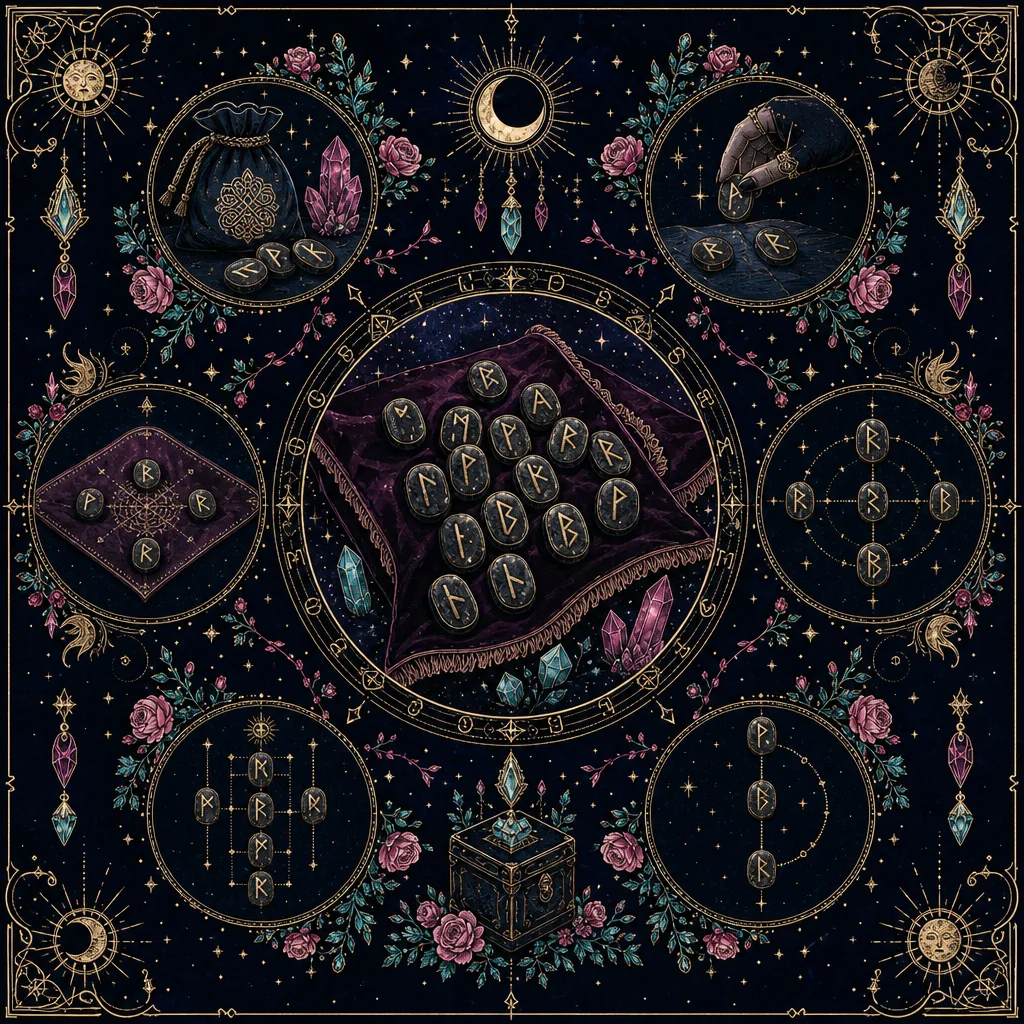
Choose a quiet space where you will not be interrupted. Many practitioners work on a white or natural cloth laid flat on a table or floor; the cloth defines the reading area and makes it easier to see the runes clearly. Place your bag of runes in front of you and hold your question in mind. The question can be spoken aloud or held silently. Rune readings respond well to questions that are open-ended and address genuine areas of uncertainty: “What do I need to understand about this situation?” or “What is the most important energy at work in my life right now?” work better than simple yes-or-no queries.
Take three slow breaths to settle your attention before reaching into the bag.
Single-rune draws
The single-rune draw is the best place to begin. It builds your relationship with each rune individually before you attempt multi-rune casts.
- Hold your question clearly in mind.
- Reach into the bag and stir the runes gently with your non-dominant hand (or the hand you feel most drawn to use).
- Allow one rune to come to your fingers naturally. Do not grasp; let the piece find you.
- Draw it out and lay it flat on your cloth.
- Note whether it falls upright (readable as you set it down) or reversed (inverted). This distinction matters for merkstave interpretations, discussed below.
- Sit with the image and name of the rune before consulting any reference. What do you notice? What associations arise?
- Consult your notes or reference sheet to deepen the interpretation.
The single draw is ideal as a daily practice: one rune each morning as a lens for the day, noted in a journal. Over weeks, patterns emerge that a single sitting cannot reveal.
The three-rune cast
The three-rune cast is the most widely used spread in runic practice and the one most practitioners return to throughout their lives.
- Draw three runes from the bag one at a time, laying them in a row from left to right without looking at them until all three are placed face-down.
- Turn them over left to right, one at a time.
The three positions carry several traditional interpretations; choose the framing that suits your question:
Past, present, future: The left rune represents what has led to the current situation, the center rune shows the present energy or challenge, and the right rune indicates the most likely direction if current patterns continue.
Situation, action, outcome: The left rune describes the situation as it stands, the center rune suggests the most productive course of action available to you, and the right rune shows what that action is likely to bring.
What to embrace, what to release, what to cultivate: This framing is especially useful for introspective questions. The left rune shows an energy worth drawing toward you, the center shows something worth letting go, and the right shows a quality worth developing.
Worked example: You ask about a difficult relationship and draw Nauthiz (center position: present), Gebo (left: past), and Raidho (right: future). In the past-present-future framing, this might read: the relationship was founded on genuine exchange and mutual giving (Gebo), but is now entering a period of friction and necessary constraint, perhaps because a need is not being met or a demand is becoming excessive (Nauthiz). The path forward involves finding the right order and rhythm for the relationship, perhaps a journey, a renegotiation, or simply movement (Raidho). These rune combinations speak in conversation; the meaning of each is inflected by its neighbors.
The five-rune cross
The five-rune cross offers a more expansive view and is well suited to questions involving multiple factors or a situation you need to understand from several angles.
Draw five runes and lay them in a cross pattern:
- Rune 1 (center): the heart of the matter.
- Rune 2 (left of center): what opposes or challenges.
- Rune 3 (right of center): what supports or aids.
- Rune 4 (above center): the ideal outcome or the overarching energy.
- Rune 5 (below center): the hidden factor, the root, or what is not yet conscious.
Read the center rune first, then the opposites (left and right) to understand the field of forces, then the vertical axis (above and below) to understand depth and direction. Notice which aettir are represented; a spread dominated by the second aett suggests disruption and necessary change, while a spread rich with the third aett points toward social and communal dynamics.
Casting on a cloth and reading by position and proximity
The method described above, drawing runes deliberately from the bag and placing them in predetermined positions, is only one approach. The casting method, in which you shake the bag gently and release some or all runes onto the cloth in one motion, produces a spatial reading that many practitioners find more revelatory.
- Hold the closed bag in both hands and focus on your question.
- Open the bag and gently scatter the runes onto the cloth, allowing them to fall freely.
- Some will land face-up and some face-down. Only the face-up runes are read; face-down runes are gathered back into the bag. Their appearance simply means those energies are not active in this reading.
- Note three spatial factors: position on the cloth, orientation (upright or reversed), and proximity to other runes.
Position: Many practitioners divide the cloth into three zones by drawing an imaginary horizontal line. Runes in the upper zone relate to the mind, the spiritual, or the distant future. Runes in the middle zone relate to daily life and near-term events. Runes in the lower zone relate to the past, the body, or unconscious foundations. The center of the cloth is always the most significant area.
Proximity: Runes that land close together are in conversation with each other and should be read as a unit before being considered in relation to the larger cast. Runes at the edges of the cloth are less immediately active.
Orientation in a cast: In a cast reading, runes that land tilted rather than perfectly upright or reversed are read as energies in transition; they carry the upright meaning but with some instability or movement attached.
Reading merkstave (reversed) runes
Merkstave, from the Old Norse for “dark stick,” refers to a rune drawn or cast in a reversed or inverted orientation. Not all practitioners use merkstave readings, and several runes (Hagalaz, Isa, Jera, Ingwaz, Sowilo, and a few others) are symmetrical and do not have a distinct reversed form. The decision to include merkstave is one you make before the reading begins; do not decide mid-reading whether to use them based on what you draw.
When a rune appears merkstave, its energy is generally understood to be: blocked, internalized, distorted, excessive, or expressing as its shadow side. Fehu upright points to earned abundance; Fehu merkstave may indicate financial loss, greed, or abundance blocked by poor stewardship. Ansuz upright is clear communication and divine inspiration; Ansuz merkstave may signal miscommunication, deceit, or a message not being received.
Merkstave is not automatically negative. Some runes carry difficult energies upright (Thurisaz, Hagalaz, Nauthiz) and appear more workable when reversed, since the blocked form of a disruptive force may simply mean the disruption is muted. Read each instance on its own terms, within the context of the full cast.
Troubleshooting and common mistakes
Drawing the same rune repeatedly: When a particular rune appears in multiple consecutive readings, it is asking for sustained attention. Do not recast looking for a different answer. Sit with that rune, research it more deeply, and watch for its themes in daily life.
Receiving a reading that seems to make no sense: Rather than immediately recasting, write down every rune in its position and return to the notes later. Readings often clarify within 24 to 48 hours as you notice relevant events.
Reading for yourself during emotional turmoil: This is when rune casting is most tempting and also when it is most likely to produce readings colored by wishful thinking or fear. Ground yourself first. Take time before beginning, and after the reading, set it aside before drawing firm conclusions.
Trying to memorize all 24 runes at once: Work through one aett at a time, drawing one new rune each day to study. By the end of three weeks you will have a working relationship with all 24.
Ignoring the merkstave: Even if you choose not to use reversed meanings, note which runes land upright and which do not. The pattern itself is information.
Cleansing and storing your set
After each reading, gather your runes, wipe them with a clean dry cloth, and return them to their bag or box. Many practitioners pass the bag briefly through incense smoke, or place a cleansing herb such as rosemary or dried lavender inside the bag between uses. Sunlight and moonlight are both used as charging and cleansing methods; a rune set left in full sunlight for a few hours, or placed on a windowsill during a full moon, is considered by many practitioners to benefit from the exposure.
Store the runes away from spaces where they might be carelessly handled. They need not be locked away or treated as fragile, but keeping them in a dedicated space maintains the psychological distinction between the set and ordinary objects. If another person wishes to handle your runes, use your own judgment; some practitioners welcome the energy exchange, while others prefer to keep the set attuned only to themselves.
Over time, your rune set will become a familiar working tool shaped by accumulated practice. The meanings you hold for each rune will deepen and become more nuanced through repeated encounter. The Elder Futhark is not a static codebook; it is a living symbolic language, and working with it consistently is how it learns to speak clearly to you.