From the Library · Divination & Oracles
Tarot Spreads: Designing and Using Them
A thorough guide to positional tarot spreads, covering the logic behind spread design, the three-card spread, the Celtic Cross, relationship and year-ahead spreads, and a complete method for designing custom spreads for specific questions.
A tarot spread is a predetermined pattern of card positions in which each position carries a defined meaning before any card is drawn. The structure of a spread determines what the reading can address: a well-designed spread for a specific question will yield a focused, actionable reading, while a poorly designed spread, one whose positions overlap in meaning or fail to address the actual question, will produce confusion regardless of how skilled the reader is.
This tutorial covers the logic underlying positional spreads, the most widely used spreads in contemporary practice, and a complete method for designing spreads of your own. Understanding why spreads are structured as they are is as important as knowing how to use them, because that understanding allows you to adapt or create spreads suited to questions for which no ready-made layout exists.
The logic of positional spreads
When you lay a tarot card in a position labeled “the past,” you are not simply drawing a random card and assigning it meaning. You are creating a lens through which that card’s imagery and associations will be filtered. The Three of Swords in a “past” position speaks of a previous grief or conflict that shaped the current situation. The Three of Swords in a “what you fear” position speaks of anxiety about heartbreak or betrayal. The card is the same; the position changes what it addresses. This is the foundational logic of positional spreads.
Because position carries so much interpretive weight, the act of defining positions before drawing any cards is not optional. It is the structure that gives the reading shape. The moment you decide to draw and then find a position that “fits” is the moment the reading loses coherence, because you have introduced selection bias: consciously or not, you will assign the card to whichever position lets it say something comfortable or impressive, rather than allowing the position to determine what the card must address.
A well-designed spread meets several criteria:
The positions address genuinely distinct aspects of the question. If two positions can yield the same answer, one of them is redundant. “What is blocking me” and “what is the obstacle” are essentially the same question; having both in a spread wastes a card.
The positions together cover the question’s full dimensionality. A question about a relationship decision needs cards addressing both people involved, the current dynamic, and the likely direction if something stays the same versus changes. A spread that only asks about one person’s perspective is incomplete.
The positions are held in mind during the entire reading. After laying the spread, resist the temptation to read individual cards independently of their positions. The position is always part of the meaning. Writing the position labels on paper or a sticky note before drawing prevents the drift that happens when you try to hold multiple position meanings in memory.
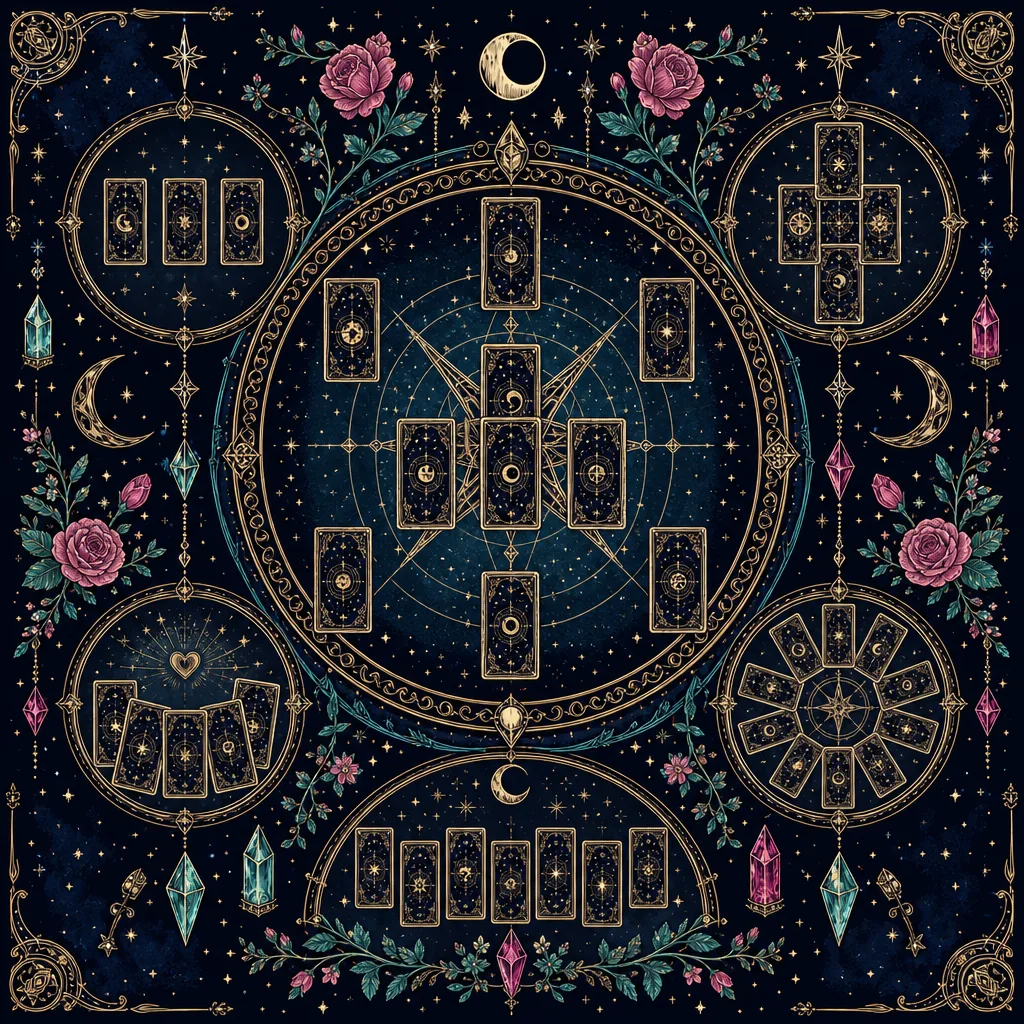
The three-card spread
The three-card spread is the most versatile and most used spread in tarot, for good reason. It is flexible enough to address almost any question, and the small number of cards demands real precision in interpretation rather than allowing diffuse, expansive responses. Many experienced readers use three-card spreads as their default format throughout their careers.
The position labels for a three-card spread can be varied to suit the question. The most common versions:
Past, Present, Future. The left card addresses what has happened or what has shaped the present; the center card addresses what is active now; the right card addresses what is emerging or what may come if the current trajectory continues. This arrangement is not a prophecy; the third card shows the likely future based on present conditions, not an inevitable outcome.
Situation, Action, Outcome. The left card addresses the current situation or the nature of the issue; the center card addresses what action, attitude, or shift is called for; the right card addresses the likely result of that action. This arrangement is particularly useful for decision-focused questions.
The problem, the obstacle, the advice. The left card names what the core difficulty is; the center card identifies what is getting in the way of resolution; the right card offers guidance. This arrangement works well for questions about stuck or frustrating situations.
Body, mind, spirit. The three cards address the physical, mental, and spiritual dimensions of a situation or the querent’s state. This arrangement suits questions about wellbeing, integration, and alignment.
To use a three-card spread:
- Define which version of the three positions you will use before drawing any cards. Write the labels down.
- Shuffle while holding your question clearly in mind.
- Lay three cards face-down from left to right.
- Turn them over one at a time, left to right, and spend a moment with each card individually before moving to the next.
- After all three are face-up, read the spread as a whole. Look at the story the three cards tell in sequence.
- Note where suits or themes repeat across all three positions. Repetition across a three-card spread carries significant weight.
The Celtic Cross
The Celtic Cross is the most recognized multi-card tarot spread and has been taught and used in its current form since at least the early twentieth century. Arthur Edward Waite described a version of it in his 1910 book accompanying the Rider-Waite-Smith deck, and the version most commonly used today derives from that description, with variations in position labels across different traditions.
The Celtic Cross consists of ten cards in a specific positional arrangement.
Positions and their meanings:
-
The central card (the heart of the matter). This card represents the querent’s current situation, the central theme of the question, or the querent themselves in relation to the question.
-
The crossing card (what crosses or opposes). Laid horizontally across card 1. This card represents the primary challenge, complication, or opposing force. It is not inherently negative; it may be an obstacle, but it may also be an unexpected factor or a secondary energy that intersects with the main theme.
-
The foundation (the basis or root). Positioned below cards 1 and 2. This card shows what underlies the situation: the circumstances, experiences, or conditions that the present moment has grown from.
-
The recent past (what is passing). Positioned to the left of cards 1 and 2. This card shows what has been most active recently but is now moving out of direct influence.
-
The possible outcome or what is emerging (the crown). Positioned above cards 1 and 2. This card shows what might be achieved, what the situation is moving toward, or what is becoming possible. It is a potential rather than a certainty.
-
The near future (what is coming). Positioned to the right of cards 1 and 2. This card shows what is entering the situation in the relatively near term, the next energy or event arriving.
-
The querent’s attitude (the self). The first card in a vertical column of four placed to the right of the cross. This card shows how the querent is approaching the situation, their current state of mind, the attitude they are bringing to it.
-
External influences (the environment). The second card in the column. This card shows the social and environmental factors at play: other people’s views, the broader context, what is coming from outside the querent.
-
Hopes and fears. The third card in the column. This position is one of the most psychologically complex in the Celtic Cross. The hope and the fear are often the same thing: what the querent most wants and most dreads may be identical. A card here sometimes needs to be held in both registers simultaneously.
-
The final outcome. The fourth card, at the top of the column. This is the direction the situation is heading if the trajectory shown throughout the reading continues. It is the probable outcome, not the inevitable one.
To read the Celtic Cross effectively:
- After laying all ten cards, note the overall feel of the spread before analyzing any single card. Is the spread predominantly Major Arcana, indicating a significant period of consequence and growth? Is it dominated by one suit, suggesting a particular domain of life is central?
- Read positions 1 and 2 first as a pair, since they define the central tension.
- Read positions 3, 4, 5, and 6 as the environmental context: roots, recent past, emerging possibility, and near future.
- Read positions 7, 8, 9, and 10 as the personal and outcomes column: inner state, external pressures, psychological complexity, and direction.
- Finally, read the spread as a narrative arc: foundation through outcome, tracing the story the ten cards tell together.
The Celtic Cross rewards practice. Its ten positions interact in complex ways, and your facility with it will increase significantly after you have used it ten or fifteen times and begun to develop personal interpretive instincts for how the positions relate.
The relationship spread
Relationship spreads address the dynamic between two people, which requires positions that can speak from both perspectives. A common and practical relationship spread uses seven cards:
- What the querent brings to the relationship. The qualities, patterns, needs, and energies they carry into this dynamic.
- What the other person brings. The same inquiry from the other person’s perspective, based on what the cards show.
- The current dynamic between them. The quality and character of the connection as it stands now.
- What is helping the relationship. What supports, sustains, or is working well.
- What is challenging the relationship. What creates difficulty, friction, or unmet need.
- What the relationship needs to grow. What would allow it to develop or deepen.
- The direction of the relationship. Where things are heading if nothing changes significantly.
A note on reading position 2 for another person: the card that appears here shows the energy present in the relationship from that person’s side, as the cards reflect it. It is not a diagnostic statement about who that person is in all contexts; it addresses who they are in this particular relational dynamic. Maintain this specificity when interpreting, and avoid drawing sweeping characterizations of another person from a single card in a relationship spread.
When reading a relationship spread for yourself, be especially alert to confirmation bias in position 2. The card for the other person should be read with the same honest attention as the card for yourself, not with a softening that protects the relationship narrative you prefer.
The year-ahead spread
A year-ahead spread lays out one card for each of the twelve months of the coming year, often with a thirteenth card as an overall theme for the year. This is a reading most naturally done around a significant transition point: a birthday, the new year, a major life change. It gives a broad calendrical map of the year’s energetic terrain.
Layout:
- Lay 12 cards in a circle or sequential line, beginning with the current month and moving forward.
- Lay a 13th card in the center of the circle (or at the beginning of the line) as the year’s theme.
How to read it:
The 12 monthly cards are not precise monthly forecasts; they are indicators of the prevailing energy or primary theme for each month’s period. A month with the Tower card does not predict a literal disaster; it indicates a month when disruption, revelation, or significant change may be active. A month with the Four of Cups suggests a period of internal reassessment, possible disillusionment, or contemplation.
Read the year-ahead spread in sections as well as card by card:
- Look at the first quarter (months 1 to 3) as an opening phase: what is the year beginning with?
- Look at the middle (months 4 to 9) for the year’s core narrative.
- Look at the final quarter (months 10 to 12) for how the year is likely to close and what foundation it is building for what follows.
- Look at whether particular suits dominate in certain periods. A run of Swords cards in summer months may indicate a mentally demanding period. A cluster of Cups in autumn may suggest an emotionally rich or relationship-focused season.
- The year theme card (position 13) offers the overarching quality of the year as a whole and should be revisited when interpreting each monthly card.
Return to the year-ahead spread monthly to note the card for the current month and track how the reading’s themes are expressing. This practice turns the year-ahead spread from a static prediction into a living document that deepens as the year unfolds.
Designing your own spread
Many questions do not fit neatly into any existing spread. Learning to design your own spread for a specific question is one of the most valuable skills a tarot reader can develop, and it is more systematic than most beginners realize.
Step 1: Identify the question precisely. Before designing any positions, state the question as specifically as you can. “Should I move to a new city?” is too general. “What do I most need to understand about the decision to move to Portland by next spring, given my career situation and my relationship?” is specific enough to work with.
Step 2: Identify the dimensions of the question. What distinct aspects of this question are worth addressing? For the example above, the dimensions might include: what I am moving toward (the opportunities or life that the move offers), what I am moving away from (what I leave behind), what this means for my career, what this means for my relationship, what internal resistance is present, and what the likely territory of the choice looks like in twelve months.
Step 3: Convert each dimension into a position label. Each dimension becomes one card position with a clear label. Be specific: “what I am leaving behind” is clearer than “the past.” If you have six dimensions, you have a six-card spread.
Step 4: Check for redundancy and completeness. Read through the position labels and ask whether any two positions would accept the same answer. If yes, merge them or clarify the distinction between them. Then ask whether the question as stated has any dimension that no position addresses. If yes, add a position or revise one that is not pulling its weight.
Step 5: Arrange the positions spatially in a way that reflects their relationships. Positions that represent two sides of a tension might face each other. A timeline of positions might run left to right. An internal state card might sit at the center with external factors surrounding it. The visual arrangement of the spread is not mere aesthetic; it shapes how the cards speak to each other and how you read the relationships between them.
Step 6: Write the layout down before drawing. Commit the positions and their labels to paper. This prevents the drift that occurs when you try to hold a custom spread in memory.
An example custom spread for the moving question:
Position 1 (center): The heart of this decision at this moment. Position 2 (upper left): What moving toward Portland offers me. Position 3 (upper right): What staying offers me. Position 4 (lower left): What the move would cost or require of me. Position 5 (lower right): What staying would cost or require of me. Position 6 (far left): What this decision means for my career. Position 7 (far right): What this decision means for my relationship. Position 8 (bottom center): What I most need to consider that I am not yet fully weighing.
Reading positions 2 and 3 as a pair, then 4 and 5 as a pair, then 6 and 7 as a pair, before moving to the center and bottom cards, creates a structured interpretive flow that honors the symmetry of the spread.
Common mistakes in working with spreads
Changing position meanings after seeing the cards. If a card you draw for “what is helping” seems to be a difficult card, the temptation is to decide the position must actually mean “what is asking for attention” or “what is complicated.” Resist this. Difficult cards in helping positions often carry their most important messages: perhaps the help being offered requires real effort to receive, or the support available is not the easy comfort you wanted. Stay with the position as defined.
Using a spread that is too large for the question. A ten-card spread for a simple question generates ten cards that must say something, and this leads to either superficial interpretation across all ten or over-interpretation of cards that have little relevance. Match spread size to question complexity. Simple questions deserve simple spreads.
Reading each position as a completely isolated statement. Every card in a spread exists in relationship to every other card. After interpreting each position individually, step back and read the spread as a whole. The story that emerges from the full picture is usually the most important part of the reading.
Using vague position labels. “Energy” is not a useful position label. “Energy” can mean anything, and a card drawn for “energy” can be bent to mean almost anything the reader wants it to mean. Precise position labels produce precise readings.
Avoiding spreads because they feel complicated. The Celtic Cross and the year-ahead spread feel overwhelming to many beginning readers. The solution is to learn them by doing them, tolerating imperfection, and using the reading afterwards to see how the cards spoke. Spreads become comfortable through repetition, not through preparation. Lay the spread, work with what appears, and trust that the structure itself will help you find the meaning.