From the Library · Divination & Oracles
Tea Leaf Reading: A Tasseography Tutorial
A thorough practical guide to reading tea leaves, from choosing the right cup and loose tea through the swirl-and-invert technique, timing regions of the cup, and interpreting common symbols with confidence.
Tasseography is the art of reading symbols in the residue left by loose-leaf tea after the liquid has been drunk. The word comes from the French “tasse” (cup) combined with the Greek suffix “-graphy” (writing or description). It is one of the most intimate forms of divination precisely because the cup is personal: the querent drinks it, holds it, and hands it still warm to the reader. What remains is, in a real sense, a portrait of the moment.
This tutorial takes you through every step of a complete tea leaf reading, from selecting your materials through interpreting what you find, with worked examples and practical guidance for developing a confident reading practice.
A brief history of the practice
The reading of residue in cups appears across several cultures independently. In China, fortune-telling from tea dregs has been practiced alongside tea culture for centuries, though the formal literature on the subject is sparse because the practice was largely oral and domestic rather than scholarly. In the Middle East and the Ottoman world, coffee grounds were read in a parallel tradition that shares many of the same interpretive principles, and from which some Western tasseography conventions appear to have borrowed.
In Europe, tasseography became fashionable during the seventeenth century, arriving alongside the introduction of tea and coffee themselves. Romani fortune-tellers in Britain and Ireland incorporated cup-reading into a broader repertoire of divination, and by the Victorian era it had become a respectable parlor amusement among the middle and upper classes. A wave of printed guides appeared in the late nineteenth and early twentieth centuries, many of them anonymous, which standardized a great deal of the symbolic vocabulary still in use today.
Contemporary tasseography draws on this layered inheritance without being bound by any single tradition. The interpretive framework you will use in this tutorial reflects the broad Western consensus that has developed over roughly two centuries of recorded practice.
Choosing your cup and tea
The choice of cup is not decorative; it materially affects how readable your leaves will be.
Select a wide, shallow cup with a pale interior. Bone china and white porcelain are both excellent because their smooth, light surfaces allow small leaf fragments to stand out clearly against the background. Avoid cups with interior patterns, colored glazes, or ridges, all of which make reading much harder. The cup should have a handle, because the handle has a specific positional meaning in the reading. Wide-mouthed cups give the leaves more surface area to spread across and produce richer, more varied patterns than narrow espresso cups.
For the tea, you need loose-leaf rather than bags. Bagged tea is ground too fine to produce coherent shapes; what it leaves behind is a uniform sediment that offers very little symbolic variety. A medium-leaf black tea works well for beginners because the leaves are large enough to clump into clear shapes but not so large that they block the cup’s base entirely. Assam, Ceylon, and Yunnan blacks are reliable choices. Gunpowder green tea, which rolls into small pellets, produces compact, distinct clumps that some readers prefer. Oolong and white teas with large, open leaves tend to spread dramatically and can be harder to interpret until you develop some experience. Avoid herbal tisanes made from flowers, roots, or cut herbs; they dissolve or disintegrate in ways that do not produce usable symbols.
Do not use a strainer. The leaves must enter the cup freely.
Brewing and drinking
Warm the cup first by rinsing it with hot water and tipping it out. This prevents the cup from cooling your tea too quickly and helps the leaves settle more naturally when the time comes.
Place approximately one heaped teaspoon of loose tea directly into the cup, then pour hot water over it. Steep for three to four minutes. The tea should be fully brewed before drinking. Milk may be added if the querent takes it, though milk can affect how leaves settle in some cup shapes. Sugar does not affect the reading.
The querent should drink the tea themselves, holding the cup throughout. They should hold a question or concern in mind while drinking, but they do not need to concentrate intensely; a relaxed, contemplative mood suits the practice better than anxious focus. The querent drinks down to the last small mouthful, leaving perhaps a teaspoon of liquid in the cup. Drinking too completely will dry the leaves before the swirl; leaving too much will wash the pattern away.
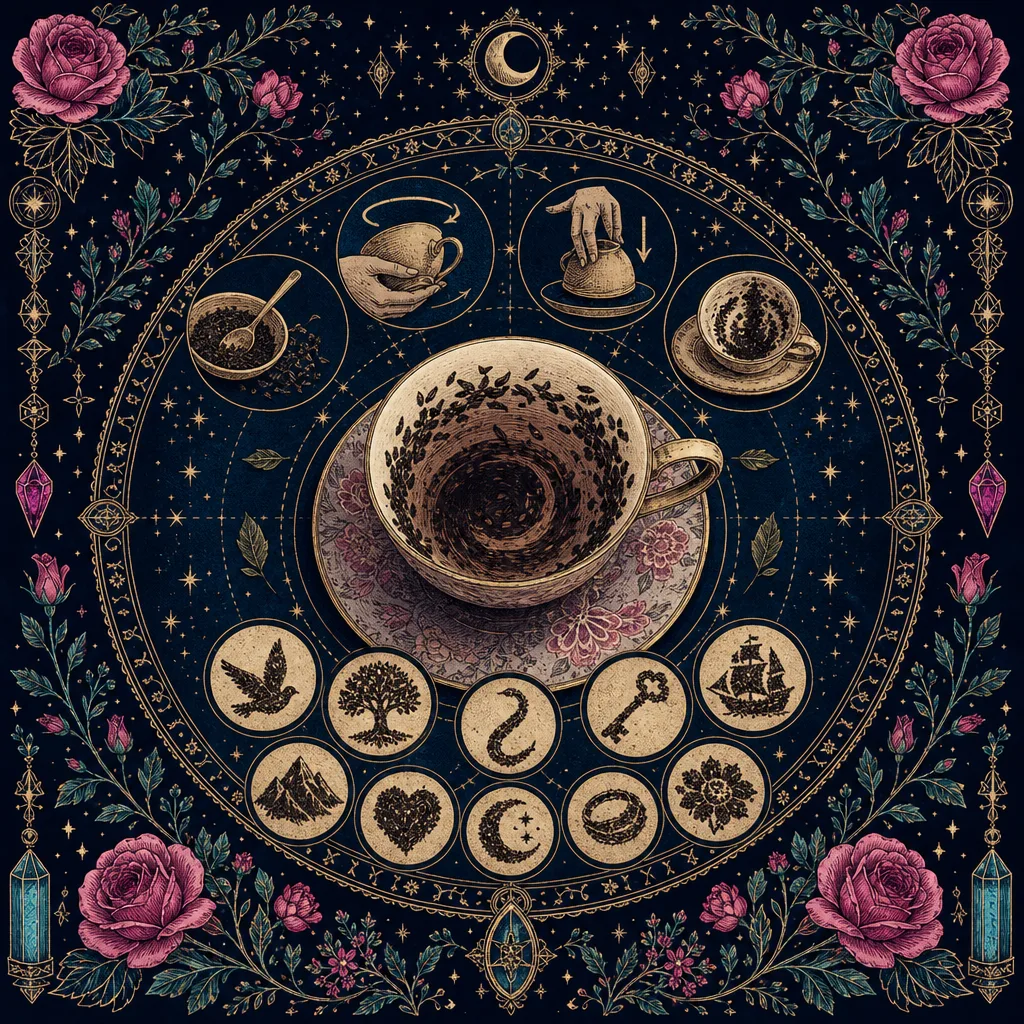
The swirl-and-invert technique
This step distributes the leaves across the inner surfaces of the cup and is the technical heart of the preparation.
- Take the cup in the left hand (regardless of handedness; convention associates the left with the receptive, intuitive self).
- Swirl the remaining liquid three times in a clockwise direction, moving the cup in small circular motions so that the liquid rises up the sides and the leaves travel with it.
- Immediately invert the cup onto its saucer, turning it upside-down in a single smooth motion. Rest it there for approximately thirty seconds to allow the remaining liquid to drain out.
- Lift the cup and set it upright on the saucer. The reader now takes it.
The leaves will have distributed themselves across the bottom of the cup, up the sides, and sometimes near the rim. Each region has a different meaning for timing, as described below.
Some readers ask the querent to make a wish or state their question aloud before inverting the cup. Others work in silence. Either approach is valid; the important thing is that the querent has been holding their question throughout the drinking and the swirl.
Dividing the cup: the timing regions
The interior of the cup is divided into three zones, each associated with a different time horizon. The handle of the cup represents the querent’s home, immediate environment, and personal self. Symbols are read in relationship to their distance from the handle as well as their height in the cup.
The rim: Symbols appearing at or very near the top edge of the cup relate to the near future, events and influences likely to manifest within days or a few weeks. These are the most immediately actionable symbols in the reading.
The sides: The middle zone of the cup’s interior covers the medium-term future, roughly one to six months out. Most of the reading’s content tends to appear here, and this zone receives the most interpretive attention. Symbols higher on the sides are closer in time; symbols lower on the sides are further away.
The base: The bottom of the cup represents the distant future, events that may take six months to a year or more to develop, or alternatively matters that are deeply rooted in the querent’s past and foundational to their situation. A heavy concentration of leaves at the base can suggest that circumstances are more entrenched than the querent realizes.
Distance from the handle: The handle marks the querent’s own position. Symbols directly at the handle relate to the querent personally and immediately. Symbols on the opposite side of the cup relate to people or events outside the querent’s immediate sphere. Symbols to the left of the handle suggest departures, losses, or matters moving away from the querent. Symbols to the right suggest arrivals, gains, and things moving toward them.
Reading the shapes
Begin by scanning the whole cup without immediately naming anything. Let your eye move around the interior and notice what attracts it. The shapes that feel most vivid or that the eye returns to are usually the most significant.
Then work systematically: start at the handle, move clockwise around the rim, then descend to the sides, and finally examine the base. Note which symbols appear in which zones before you begin interpreting, because placement changes meaning considerably.
Hold the cup at a slight angle and rotate it as you look, because different angles of light reveal different shapes. Some readers find it useful to half-close their eyes, as one does when looking for shapes in clouds, which allows the pattern-recognition mind to work more freely than focused scrutiny permits.
A good shape does not need to be a perfect, clean outline. Tasseography is a practice of intuitive perception, and a loose cluster of leaves that reads strongly as an anchor to you is more meaningful than a technically clear shape that suggests nothing. Name what you genuinely see, not what you think you ought to see.
Common symbols and their meanings
The following glossary covers the symbols most frequently encountered in tea leaf readings. These meanings are traditional and widely shared; your own developing intuition should be layered over them, not suppressed in their favor.
Anchor: Stability, groundedness, and security in practical affairs. Near the rim, it suggests a solid foundation being established soon. At the base, it can indicate that the querent is too fixed in their current position.
Bird in flight: Good news arriving, freedom, or a journey. A bird flying toward the handle suggests news coming to the querent directly; one flying away suggests something or someone departing.
Boat or ship: A safe arrival after difficulty; a voyage, literal or metaphorical. Near the rim, a favorable resolution to a period of uncertainty is close.
Book: If open, knowledge, education, or a revelation that will benefit the querent. If closed, a secret or something not yet ready to be disclosed.
Cat: Deception, a hidden enemy, or alternatively a comfortable domestic life depending on context. A curled cat suggests contentment; an arched or upright cat suggests caution.
Circle: Completion, wholeness, and success. A circle near the handle with no breaks in it is one of the most auspicious symbols in the cup.
Cloud: Doubt, confusion, or a period of uncertainty. Heavy, dense cloud shapes suggest the confusion is significant; lighter wisps suggest it will clear quickly.
Cross: Traditionally a symbol of difficulty, sacrifice, or a burden the querent is carrying. It does not predict misfortune so much as acknowledge a challenge that requires patience.
Crown: Success, recognition, and achievement. Often relates to professional or social standing.
Dog: Loyalty, friendship, and trustworthy companions. Near the base, a faithful relationship of long standing; near the rim, a loyal friend about to play an important role.
Eye: Careful attention is needed; something is being watched or observed. It can also indicate psychic sensitivity or an important perception the querent should not ignore.
Fish: Good luck, abundance, and fertility in a broad sense. Fish near the base suggest deep and lasting prosperity.
Flag: A challenge, a call to action, or a claim being made. The direction the flag “waves” in relation to the handle indicates whether the challenge is approaching or receding.
Flower: Joy, pleasure, and affection. A clear, full flower is one of the most straightforwardly positive symbols. Multiple flowers suggest a period of social warmth and happiness.
Gate: An opportunity or threshold. An open gate means the way is clear; a closed or partly closed gate suggests timing or preparation is still needed.
Heart: Love, affection, and matters of emotional life. Combined with a ring, it traditionally suggests a romantic commitment or deepening relationship.
Horse: Speed, power, and forward momentum. A galloping horse suggests rapid change; a standing horse suggests strength held in reserve.
Hourglass: Time is a factor; a decision or action should not be delayed. Near the rim, the urgency is immediate.
Key: An answer, solution, or new access being granted. Near the handle, the querent holds the solution themselves; further away, help will come from outside.
Ladder: Gradual advancement, ambition, and steady progress toward a goal. Each rung represents a step that cannot be skipped.
Letter or envelope: News, communication, or a message of practical importance. Dots near a letter shape suggest money connected to the communication.
Lines: Straight lines indicate a clear path and uncomplicated progress. Wavy lines suggest delays, detours, or an indirect route to the goal.
Moon: Intuition, the subconscious, and matters relating to cycles and emotion. A full moon shape suggests a peak or culmination; a crescent suggests something new beginning.
Mountain: An obstacle, but one that can be surmounted. A single sharp mountain suggests one significant challenge; a range suggests a longer period of sustained effort.
Ring: Commitment, completion, and partnership. A complete ring near the rim suggests a union or agreement close at hand; a broken ring warns of a rupture in a relationship or plan.
Snake: Wisdom, transformation, and sometimes betrayal or a concealed enemy. Context and position determine which reading applies; a snake near the handle warrants more attention to potential deception than one at the far side of the cup.
Star: Hope, inspiration, and favorable outcomes. Multiple stars are particularly positive, suggesting that the querent’s wider situation is moving in a supportive direction.
Sun: Vitality, confidence, success, and warmth. One of the most unambiguously positive symbols in tasseography.
Tree: Growth, health, and stability. A full, leafy tree shape suggests flourishing; a bare or broken tree suggests a period of recuperation or loss.
Triangle: Unexpected good fortune if pointing upward; difficulty or instability if pointing downward.
Umbrella: Protection, shelter, and the need to guard something carefully. Open, it suggests protection is available; closed, it suggests potential vulnerability.
The handle as the querent
The handle functions as a fixed reference point throughout the reading. In traditional practice, it represents the querent: their home, their body, their immediate circumstances, and their perspective on everything else in the cup.
Symbols clustered around the handle concern the querent’s inner life, personal choices, and immediate domestic or physical situation. Symbols directly opposite the handle concern external forces, other people, and circumstances the querent has less direct control over. When two significant symbols appear, one near the handle and one far from it, you are often reading a dynamic between what the querent holds internally and what is happening in the outer world.
If a strong positive symbol appears far from the handle on the rim, something favorable is approaching from outside the querent’s immediate sphere, and it is moving toward them. If a negative symbol appears in that same position, the challenge likewise comes from the outside and is still at a distance.
Reading the saucer
Not all traditions incorporate saucer reading, but many do. After inverting the cup, some leaves will have dripped down onto the saucer. These are generally read as unconscious material, things the querent has not yet brought fully into awareness, or as a secondary commentary on the main cup reading. If the saucer is blank, nothing significant requires adding. If leaves have formed a clear shape, interpret it as you would a base-of-cup symbol: deep, foundational, and possibly requiring some patient attention before its meaning becomes clear.
Troubleshooting and common mistakes
The leaves are all at the bottom and the sides are bare. This happens when too much liquid remains before the invert, or when the swirl was not vigorous enough. Use less water in your next attempt, and swirl more firmly. A reading with few leaves on the sides is not invalid; it simply means most of the session’s information sits in the medium and distant future zones.
You cannot see any clear shapes. Relax your focus rather than concentrating harder. Look at the cup from several angles. Name the shapes loosely: “that could be a bird or a letter.” Give yourself permission to be approximate. The interpretive instinct develops with practice, and early sessions often feel uncertain until the eye learns to do this kind of pattern work reliably.
Two contradictory symbols appear prominently. This is not a failure of the reading; it reflects genuine tension in the querent’s situation. Name both, give each its weight, and let the querent sit with the paradox. Contradiction in a cup often mirrors contradiction in the querent’s life.
The querent is disappointed by the reading. A tasseographer’s obligation is honesty, not reassurance. Deliver what the cup shows, contextualized by timing and the relationship between symbols. If difficulty appears, pair it with what else the cup shows about resources, trajectory, and eventual outcome.
You are not sure whether a shape is significant. A useful rule of thumb: if you see it twice, in two different parts of the cup, it is significant. Repetition in tasseography carries emphasis. Trust the shapes that return your gaze.
Developing your practice
Reading tea leaves improves rapidly with repetition. Begin with your own cup, reading for yourself daily or several times a week. Keep a record: draw the shapes you see, note your interpretations, and return to those notes as time passes. The discipline of reviewing past readings against what actually unfolded is the single most effective way to calibrate your interpretive instincts.
When you begin reading for others, start with people who understand the nature of the practice and will engage with it openly. A skeptical or dismissive sitter does not invalidate the reading, but a receptive one creates the kind of reflective conversation that allows the reading to unfold fully.
Tea leaf reading rewards a slow, unhurried pace. Give yourself time to look, time to consider, and time to let the meaning settle before you speak. The cup, once prepared, will wait for you.