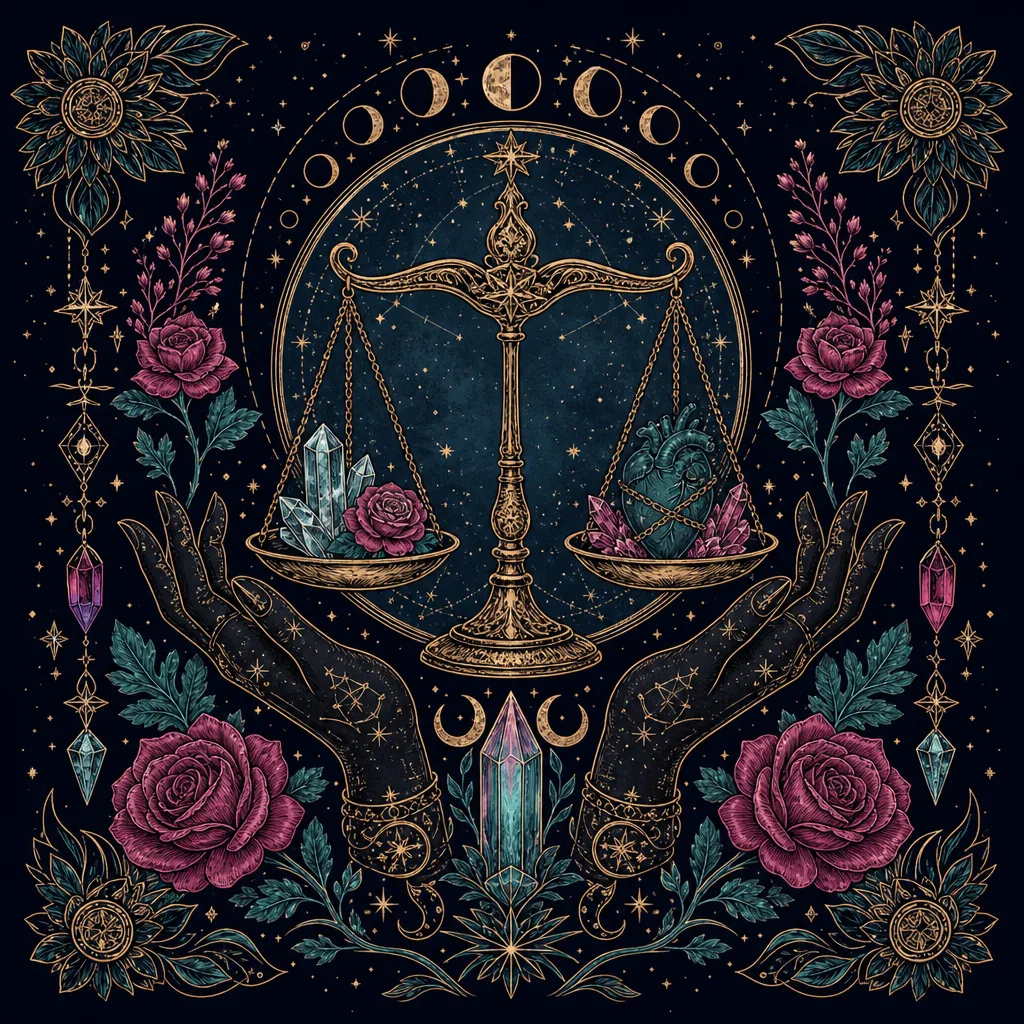
From the Library · Traditions & Paths
The Ethics of Magick
This guide examines the major ethical frameworks in witchcraft and magick, from the Wiccan Rede to traditional witchcraft and chaos magick, and explores the real questions practitioners face around consent, love spells, cursing, and personal responsibility. It is for any practitioner willing to think seriously about how they use their craft.
Anyone who works magick seriously will eventually face questions that no spell book fully answers. Is it acceptable to work a spell on someone without their knowledge? What about a love spell? What about a curse on someone who has genuinely harmed you? The craft does not come equipped with a single universal moral law, and practitioners from different traditions answer these questions differently and with genuine conviction. Understanding the frameworks on offer, and their real implications, is part of what it means to practice thoughtfully.
This is not an area where you can avoid forming your own position. Every working involves a choice, and those choices accumulate into a character. The practitioner who never thinks carefully about the ethics of their craft is not neutral; they are simply unreflective. What follows is an honest account of the major frameworks, the genuine tensions between them, and a method for developing your own considered ethic.
The Wiccan Rede
The Wiccan Rede in its most quoted form is the instruction: “An it harm none, do what ye will.” This is the central ethical touchstone of Wicca and has been widely adopted by eclectic practitioners who may not otherwise identify with Wiccan practice. It appears to be simple, but its application is considerably more complicated than it looks.
The word “harm” is the difficulty. Almost any action harms someone in some indirect or extended sense. A prosperity spell might draw resources in your direction rather than another person’s. A healing spell changes someone’s trajectory whether or not you have their consent. A spell to attract a lover limits the free choices of the person who finds themselves drawn toward you. The Rede taken literally to its furthest conclusion would paralyse all practice entirely.
Most Wiccan practitioners read the Rede as a general orientation rather than an absolute legal code: work toward good, avoid obvious harm, and when harm is unavoidable, choose the path that minimizes it. That is a reasonable and workable ethic, though it requires the practitioner to exercise genuine judgment rather than follow a rule mechanically.
The Rede emerged in recognizable form in the mid-twentieth century, associated with the Wiccan revival of Gerald Gardner and later formalised in various published forms. It is a modern guideline, not an ancient universal law, and it was written for a specific religious context. Practitioners outside Wicca are not bound by it, though they may find value in it.
The Threefold Law
The Threefold Law, or Rule of Three, holds that whatever energy you send out returns to you three times over, whether beneficial or harmful. This functions as both a cosmological description of how magickal cause and effect works and as an incentive toward ethical practice: harm others magickally and you will receive triple that harm in return.
The Threefold Law is a specifically Wiccan teaching with no particular parallel in older folk traditions, ceremonial magick, or most other paths. It provides a clear deterrent against malefic work, and many practitioners find it a useful inner check. Whether it operates as described is a matter of faith and personal experience rather than demonstrable fact.
Critics within the broader community note that the Threefold Law can function as a way of pressuring practitioners into passivity rather than as a genuinely coherent ethical framework. It does not, for example, distinguish between a defensive ward and an offensive curse. It also says nothing about what to do when someone is actively causing harm and protection alone is insufficient.
Traditional Witchcraft and the Absence of Universal Moral Law
Traditional witchcraft, a term that covers a range of historical and revivalist practices that predate or exist outside the Wiccan framework, generally operates without either the Rede or the Threefold Law. In most folk magick traditions worldwide, including the European cunning craft, Appalachian folk magick, and most African diaspora traditions, the witch or practitioner is understood to be capable of both healing and harming, and the question of whether to do either is settled by circumstance, community, and personal judgment rather than by a universal rule.
In these contexts, cursing a thief, warding off an enemy with binding or banishment, or laying a hex in response to genuine wrong is not viewed as inherently unethical. The practitioner is expected to act with discernment and to bear responsibility for the outcomes of their choices, but no overarching law prohibits malefic work categorically.
Chaos magick, which emerged in the late twentieth century, takes a broadly pragmatic position: ethics are personal and situational, the practitioner is the author of their own moral framework, and the practitioner bears full responsibility for the results. This is a more demanding ethical stance than it appears, because it removes the comfort of rules and places all responsibility on the individual.
Consent and Magick Worked on Others
The consent question is one of the most practically pressing in everyday magick. If you work a healing spell for a sick friend without asking them first, are you violating their autonomy? Most practitioners draw a reasonable line here: general well-wishing, prayer, and sending positive energy toward someone without their request is not considered ethically problematic in most traditions, because it is analogous to caring for someone in your thoughts. A fully constructed spell designed to alter the course of a specific person’s life without their knowledge or consent is a more serious matter, particularly if you know they would object.
The principle that matters here is not the mechanism of the spell but the intent to override another person’s choices. A spell to make your neighbor friendlier toward you is not the same as a spell to make your neighbor move away, but both impose your will on a person who has not agreed to it. Most thoughtful practitioners apply extra scrutiny to any working directed at a specific named person who is not the caster.
Love Spells
Love spells raise the consent problem in its sharpest form and deserve direct treatment. A spell designed to make a specific named individual fall in love with, feel attracted to, or remain with the caster is working to override that person’s free will in one of the most intimate areas of their life. Most practitioners who have thought carefully about this conclude that targeting a specific person in this way is ethically indefensible, regardless of how strong the desire is or how certain the caster is that they and the target belong together.
This is not squeamishness. It is recognition that attraction without genuine free consent produces results that tend to be hollow at best and harmful at worst, and that the caster’s desire to have a particular person is not a sufficient justification for overriding that person’s autonomy.
The alternative, and it is fully workable magickally, is to cast for the qualities you seek in a partner and for the conditions that will allow love to enter your life, without naming or targeting a specific individual. This leaves the outcome open and preserves everyone’s freedom to choose.
Baneful Magick and Self-Defence
Cursing, hexing, and binding are real practices with long histories across virtually every magical tradition in the world. The question of whether to use them is not answered by pretending they do not exist or by treating anyone who considers them as automatically corrupt.
Binding, which prevents a person from taking harmful actions, is widely regarded as acceptable even among practitioners who reject offensive cursing, because it is understood as a defensive rather than offensive working. Banishment, which removes a harmful presence from your life or space, falls in similar ethical territory.
Offensive cursing, in which the practitioner actively sends harm toward a specific person, is where more serious ethical weight accumulates. Most experienced practitioners advise against cursing from a place of anger or wounded pride, not because cursing is forbidden but because workings done from those states tend to be poorly aimed and to have unintended consequences. When cursing is considered at all, it is most defensible as a last resort in situations of genuine ongoing harm where other avenues have been exhausted.
You should also be aware that what feels like a justified curse from inside an emotional situation may look different from outside it. Divination before any major malefic working is strongly recommended.
Influence and Manipulation
The line between acceptable magickal influence and manipulation is real and worth drawing clearly. A spell to attract opportunities, to smooth social situations in your favour, or to improve how you are perceived in a job interview is working within a generally accepted range, because these workings create favorable conditions rather than forcing specific people to act against their interests or nature. A spell to compel a specific employer to hire you regardless of whether you are suited to the role, or to compel a specific person to do something they would clearly refuse, crosses into manipulation. The difference is whether the working leaves meaningful space for other people to act freely.
Developing a Personal Ethic
The frameworks above are tools for thinking, not a final answer. Your own ethic will emerge from the intersection of the tradition you practice, the values you hold before you ever consider magick, and the experience you accumulate from the results of your workings over time.
A practical method is to pause before any working that involves another named person and ask three questions. First, would this person consent to this working if you asked them? Second, what would the full consequences of success look like, including for everyone affected? Third, are you comfortable fully owning the results of this spell, good and bad? If any of those questions produces significant discomfort, that discomfort deserves attention before the spell is cast.
Record your workings and their results. Over time you will develop a clear picture of which of your ethical choices produced outcomes you are genuinely at peace with, and which did not. Responsibility for the results of your workings is not an abstract principle; it is something you discover in practice, gradually, and the discovery shapes the practitioner you become.
The craft is most powerful and most honest when practiced with full awareness of the choices it involves. That awareness is itself a form of skill, and developing it is part of the work.