From the Library · The Wheel & Sacred Time
The Wheel of the Year
This guide covers the eight sabbats of the Wheel of the Year, their honest twentieth-century history, their agricultural and solar logic, and how to begin observing them in practice. It is for anyone curious about the seasonal calendar at the heart of modern Wicca and earth-centred spirituality.
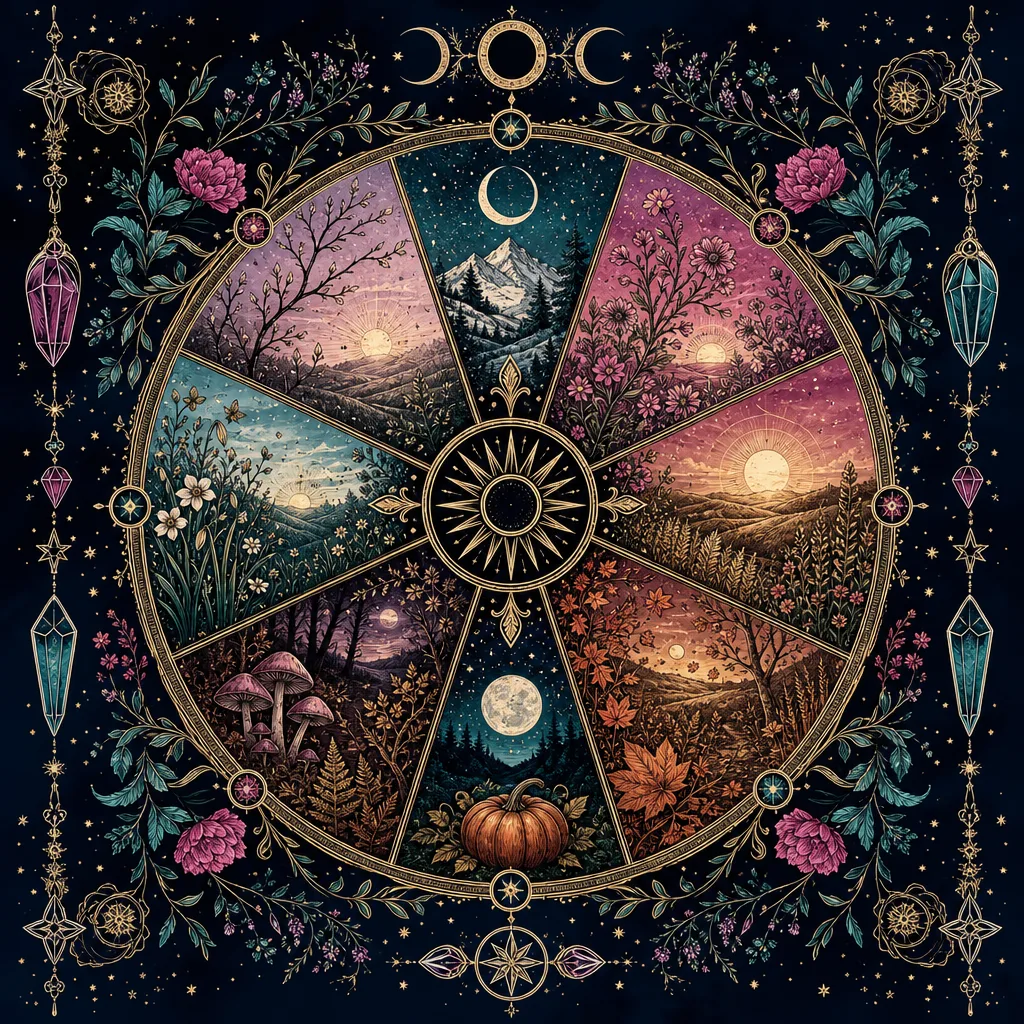
The Wheel of the Year is a calendar of eight seasonal festivals, or sabbats, spaced roughly evenly across the solar year. Four of them, the solstices and equinoxes, track the sun’s astronomical position; the other four fall at the midpoints between them, anchoring the cycle to the agricultural rhythms of sowing, growing, harvest, and fallow. Together they form a complete mythological and practical framework for living in relationship with the turning seasons.
The Wheel is the ceremonial backbone of Wicca and has been adopted widely across contemporary Paganism, earth spirituality, and solitary witchcraft. Understanding it deeply means understanding both its mythological richness and its actual history, which is considerably shorter and more inventive than popular imagination tends to assume.
Honest History: A Modern Synthesis
The Wheel of the Year as a unified eight-festival system is a twentieth-century creation. Gerald Gardner, the figure most responsible for the public emergence of Wicca in the 1950s, assembled a festival calendar that drew on older and separate seasonal observances: the four Celtic fire festivals (Samhain, Imbolc, Beltane, and Lughnasadh), which had been observed in Ireland and Scotland as distinct occasions, and the four solar stations (the solstices and equinoxes), which appear in Northern and Continental European traditions separately. The scholar and Druid order founder Ross Nichols worked closely with Gardner and helped to consolidate and popularise the eight-fold framework. Many of the sabbat names still in use today were coined or formalised in the 1970s by the Wiccan writer Aidan Kelly.
This history does not diminish the Wheel’s power or value. Living traditions are always assembled, developed, and transmitted; the important question is whether they serve and whether they are engaged with honestly. The individual festivals draw on genuine folk and liturgical traditions from across Britain, Ireland, and continental Europe, even where the specific eight-fold structure is a twentieth-century synthesis rather than an ancient inheritance. The scholar Ronald Hutton’s “Stations of the Sun” (1996) is the definitive historical account and worth reading by anyone who wants to understand what is historically attested and what is more recent.
Knowing this history also helps explain why different festivals feel uneven in their historical depth. Samhain, Beltane, and Imbolc have deep documented roots in Irish culture. Mabon, named for a Welsh deity, is largely a contemporary invention. Both kinds of festival have a place in a living tradition.
The Greater and Lesser Sabbats
Practitioners commonly distinguish between the four greater sabbats, Samhain, Imbolc, Beltane, and Lughnasadh (also called Lammas), and the four lesser sabbats, the two solstices and two equinoxes. The greater sabbats are rooted in the Celtic fire-festival tradition and were historically celebrated at night, often with bonfires, in connection with agricultural transitions. The lesser sabbats are solar in character and are often observed closer to the exact astronomical moment, since they can be calculated precisely.
The agricultural logic linking all eight is visible when you see them in sequence. The cycle begins at Samhain with the death of the year and a honouring of the dead, moves through Yule’s returning light, through Imbolc’s first green stirring, through Ostara’s acceleration into spring, through Beltane’s fullness of life and fertility, through Litha’s peak of solar power, through Lughnasadh’s first harvest, through Mabon’s completion of the harvest, and returns to Samhain again. Each sabbat marks a turning point in this story, and the mythological themes of the season are legible in the world around you when you learn to read them.
The Eight Sabbats in Turn
Samhain falls on or around 31 October in the northern hemisphere. It is the Celtic new year, the festival of the dead, and the time when the boundary between the living and the dead is understood to be thinnest. Themes include ancestor veneration, release, divination, and completion of the year’s unfinished business. Simple ways to observe it include setting an ancestor altar, lighting candles for the dead, performing divination for the coming year, and leaving offerings at a threshold or crossroads.
Yule, the winter solstice, falls around 21 December in the north. It marks the longest night of the year and the moment from which the days begin to lengthen again: the return of the light. Themes include hope, endurance through darkness, the rebirth of the sun, and the warmth of community in the cold season. Observances include lighting candles or a Yule log, staying awake through the night to greet the dawn, decorating with evergreens, and feasting with those you love.
Imbolc falls on 1 or 2 February. It is the first stirring of spring, sacred to the Irish goddess Brigid, whose Christian counterpart Saint Brigid continued the tradition with remarkable continuity. Themes include healing, inspiration, creative fires kindled after winter, and purification in preparation for the growing season. Observances include making a Brigid’s cross from rushes, lighting a candle in every room of the house, and cleaning the home as a deliberate act of preparation.
Ostara, the spring equinox, falls around 21 March. Day and night stand equal, and from this point light overtakes darkness. Themes include new beginnings, fertility, balance, and the full arrival of spring. The imagery of eggs and hares, now familiar from secular Easter celebrations, belongs to spring festival customs across many Northern European cultures. Observances include planting seeds (literally or as written intentions), spring-cleaning, and blessing eggs.
Beltane falls on 1 May. It is the great fertility festival, a celebration of the full arrival of summer and of life at its most exuberant. In Irish tradition it was one of the three great fire festivals, with cattle driven between two bonfires for protection and blessing. Themes include passion, creativity, unions, and the abundance of the green world at its height. Observances include dancing around a maypole, lighting bonfires, adorning yourself with flowers, and making offerings to land and to growing things.
Litha, the summer solstice, falls around 21 June. The sun is at its greatest strength and the day is longest. This is the feast of the sun in its fullness, and it carries a productive paradox: even at the height of its power, the light now begins its slow retreat. Themes include abundance, courage, clarity, and the acknowledgment that even peak moments contain their turning. Observances include watching the sunrise, gathering herbs (traditionally understood to be at the height of their potency at midsummer), fire and water rituals, and outdoor feasting.
Lughnasadh, also called Lammas, falls on 1 August. It is the first harvest, the festival of the grain, and in Irish mythology it commemorates the funeral games held by the god Lugh in honour of his foster mother Tailtiu, who died clearing the plains of Ireland for agriculture. Themes include gratitude, sacrifice, skill, and the first fruits of a year’s labour. Observances include baking bread from new grain, games and competitions that honour craft and skill, and making an offering of the first harvest back to the earth.
Mabon, the autumn equinox, falls around 21 September. Day and night are equal again, but now darkness is overtaking light. This is the completion of the harvest and a time of genuine thanksgiving for what the year has yielded, alongside preparation for the dark months ahead. Observances include harvest meals, giving away surplus, preserving and storing, and building the autumn altar.
The Agricultural and Solar Logic
The deeper logic of the Wheel becomes clear when you see both the solar and the agricultural layer together. The solstices and equinoxes are astronomical facts: the sun reaches its extreme positions at Yule and Litha, and the days are perfectly balanced at Ostara and Mabon. These four points give the year its structural skeleton.
The fire festivals fall between them and mark the agricultural transitions that matter most in a farming culture: the lambing season and seed-planting at Imbolc; the beginning of summer grazing at Beltane; the first cutting of the grain at Lughnasadh; the slaughter and preservation of livestock before winter at Samhain. Taken together, the eight festivals trace a year of genuine agricultural labour and its sacred dimension.
Understanding this helps you find your own relationship to each festival, even in a non-agricultural life. The themes of Lughnasadh, for instance, what have I worked hard at this year, and what is it bearing? apply to any creative or professional project, not only to literal farming.
Adapting the Wheel
The Wheel was designed around the agricultural rhythms of northwestern Europe. If you live in the southern hemisphere, the seasons are reversed. Many southern-hemisphere practitioners observe the sabbats at the locally appropriate time: Samhain in late April, Yule in June, Beltane in late October. This makes ecological sense and keeps the festivals genuinely connected to the living world rather than to a calendar inherited from the other side of the planet.
If you live in a climate that does not experience four distinct seasons, or in a city where seasonal changes are less immediately visible, adaptation is equally valid. The Wheel can be observed through whatever natural signals your location offers: the first rains of a desert autumn, the bloom cycle of local flora, the migration of birds visible from your rooftop, the shift in light quality in the afternoon. Urban practitioners often find that the astronomical sabbats feel most grounded, since they are measurable in daylight length regardless of where you live.
Beginning the Practice This Year
The simplest way to begin is to mark the next sabbat on your calendar and prepare one deliberate, modest observation of it. Attempting to observe all eight in your first year is possible but can feel pressured; beginning with two or three and building outward from there is more sustainable than forcing an immediate full year of rites.
Pick up a secular almanac or astronomy application to track sunrise, sunset, and solstice times in your location. Notice the actual world around you: what is blooming, what has gone dormant, what the angle of the light looks like in the late afternoon. The Wheel is most alive when rooted in observed reality, not only in mythology and calendars.
Over time, the cycle becomes something you feel in your body as well as understand with your mind. You will find yourself noticing the shortening days in late summer before you consciously remember that Lughnasadh is approaching. You will feel the quality of the Imbolc air differently once you have observed the festival for several years. That embodied, felt sense of the seasons turning is one of the most lasting gifts this practice offers.