From the Library · Ritual, Ceremony & High Magick
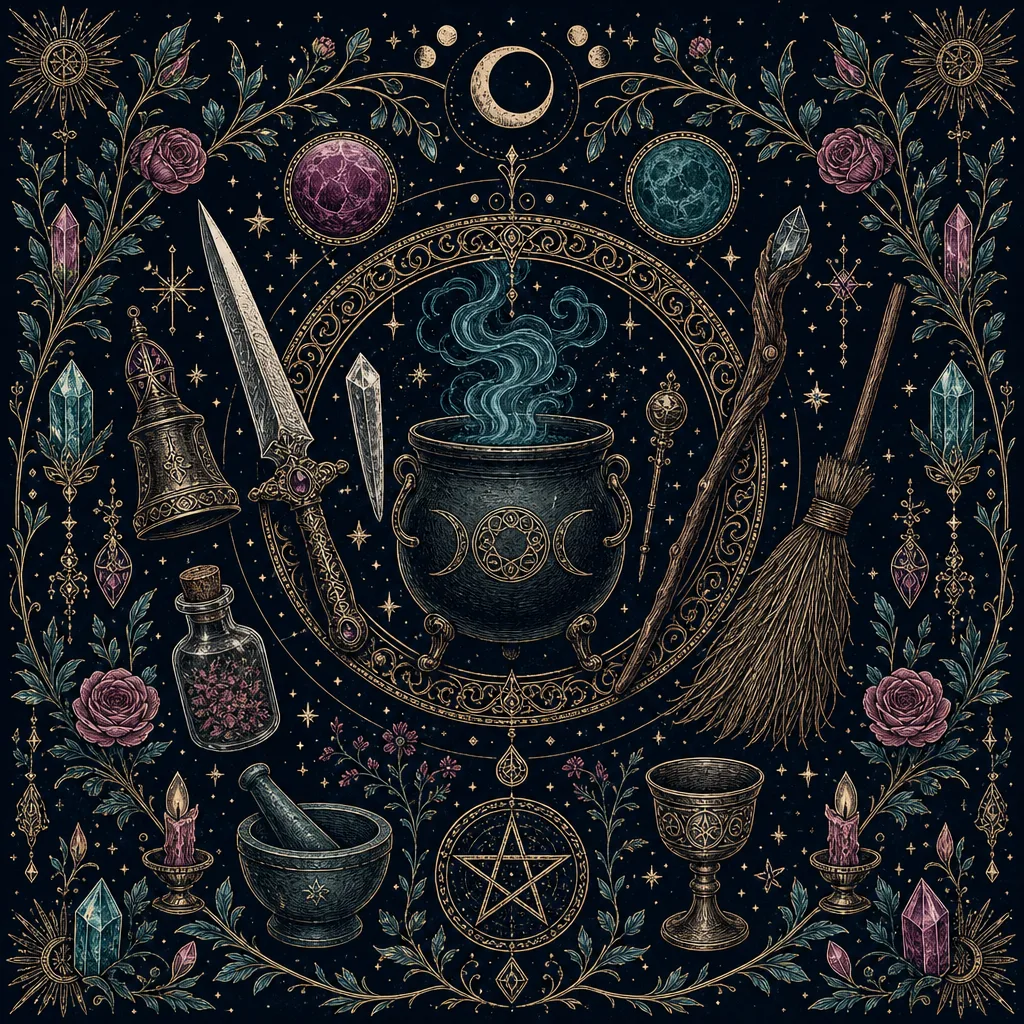
The Witch's Tools
A thorough guide to the traditional tools of the witch, from the athame and wand to the cauldron and besom, covering their history, elemental attributions, and practical use. Written for practitioners at any stage who want to understand what their tools actually do and how to acquire or make them thoughtfully.
The tools of the witch are among the most misunderstood aspects of the craft from the outside, and one of the most practically important from within. They are not decorations, and they are not required. They are, when used well, physical anchors for intention: objects that have been chosen, worked with, and attuned until they carry the practitioner’s will as naturally as a well-worn pen carries a writer’s hand. Understanding what each tool is actually for, and why, gives you a far more useful relationship with them than simply acquiring a matching set and setting them on an altar.
The idea of ritual tools is ancient and cross-cultural. Priests, shamans, and folk practitioners across every inhabited continent have used physical objects to focus attention, mark sacred action, and embody abstract principles. In the Western witchcraft tradition as practiced today, the set of core tools was largely codified through Gerald Gardner’s mid-twentieth century work. Gardner drew on earlier ceremonial magical practice, particularly the Hermetic and Solomonic traditions, as well as on older folk practice. The result is a toolkit that is modern in its specific form while drawing on much older streams. That is not a problem; it is useful context for understanding why the tools look the way they do.
The Four Primary Tools and Their Elemental Attributions
The foundational system places four tools in correspondence with the four classical elements: earth, air, fire, and water. There is, however, a significant split between traditions on which tool corresponds to which element, and neither assignment is more correct than the other.
In the Wiccan tradition following Gardner and the Golden Dawn, the athame (a double-edged ritual knife, usually black-handled) corresponds to fire, and the wand to air. In many traditional witchcraft streams and in older ceremonial practice, these are reversed: the wand to fire and the blade to air. The logic of both is internally consistent. The blade is sharp, quick, and cuts through, which suggests the mental clarity of air; but it also enacts will forcefully, as fire does. The wand, shaped from wood and often insulating, can seem like the conductor for fire’s force; but the wand’s link to growing things and the tree also connects it to the elemental breath of air. When you begin working, pick the attribution that resonates with your tradition or your own sense of the elements, apply it consistently, and trust that coherent use is what matters.
The chalice or cup corresponds to water, and this attribution is near-universal. The cup holds, receives, and contains. It is the vessel of emotion, relationship, and the cycles of the moon. The pentacle, a flat disk or tile bearing a five-pointed star within a circle, corresponds to earth: it is solid, stable, and used to ground workings and to consecrate objects placed upon it.
The Athame
The athame’s primary function is to direct and cut, not to physically cut anything material. It is used to cast the circle, to invoke and banish, to direct raised energy, and to carve symbols into candles and other soft materials. In most traditions, the athame does not draw blood and is never used as a cooking or general-purpose knife. It holds a specific charge of magickal intent that is built over time through use, and mingling that with mundane tasks dissipates the charge.
When you first acquire an athame, it matters more that the handle sits well in your hand and that you feel a natural affinity with the object than that it matches any particular description. Many practitioners use a single-edged blade or even a letter opener, particularly in the early years of practice. The tool should feel like an extension of your arm when you hold it. Secondhand athames are entirely usable and are addressed in the guide on consecrating your tools.
The Wand
The wand’s primary purpose is to invite and to direct energy in a gentler and more receptive manner than the blade. Where the athame commands, the wand requests. Wands are used to invite deity, to channel healing energy, to draw symbols in the air, and to direct the cone of power in a more open-handed way. This distinction is subtle but real, and most experienced practitioners develop a clear sense of which tool they want for which working.
Wands are made from a wide variety of materials: wood is most traditional, but copper, crystal, glass, and composite materials are common. Wooden wands are often cut from living trees, in which case the tradition is to ask the tree’s permission and to leave a small offering, then to thank the tree for the gift. The species of wood matters to many practitioners, who work with traditional wood correspondences from Celtic, Norse, or folk sources. Others choose wood by intuition. Both approaches work.
The Chalice
The chalice is used in ritual to hold water, wine, mead, or juice for consecration, sharing, and offering. In Wiccan practice it appears centrally in the symbolic Great Rite, in which the athame is briefly lowered into the chalice to represent the union of the divine masculine and feminine principles. It is also used to hold water for scrying, to offer liquid to deity, and to hold blessed water for sprinkling during cleansing. Practically speaking, a sturdy chalice that will not tip easily is worth more than an expensive one that you are afraid to use.
The Pentacle
The pentacle is the working surface of the altar. Objects placed upon it are consecrated and grounded. It receives offerings, supports candles or stones being charged, and serves as the earth-anchor in a set of four elemental tools. In some traditions it is engraved with additional symbols specific to the tradition. It can be made from wood, ceramic, metal, or clay, and many practitioners make their own. A simple circle drawn on card or a flat stone with a pentagram marked on it functions just as well as an elaborately engraved brass pentacle.
The Cauldron
The cauldron sits slightly outside the four-element structure and belongs equally to all elements. It holds fire (for burning spells and herbs), water (for scrying or making moon water), earth (for burying small workings within), and air (as the smoke of its contents rises). It is the vessel of transformation, associated strongly with the Celtic goddess Cerridwen and her cauldron of inspiration, and appearing throughout world mythology as the place where things are rendered into something new.
Practically, the cauldron is used for burning paper spells, for cauldron fires at sabbat, for scrying, and for making herbal waters. Cast iron is the traditional material, and a three-legged cast iron cauldron is the most stable for actual fire use. If you burn things inside a cauldron, ensure it stands on a heat-proof surface, never on a wooden altar without protection, and keep water nearby.
The Besom
The besom, the traditional witch’s broom, is used for energetic sweeping rather than physical cleaning. Before ritual, the besom is used to sweep the circle space, pushing stale or unwanted energy out of the area before the sacred space is formally cast. It is swept just above the floor, often moving around the circle in a counterclockwise direction for banishing. The besom is also used in handfasting ceremonies, where the couple jumps the broom as a mark of commitment.
Traditional besoms are made from a bundle of twigs, historically birch, bound to a handle of hazel or ash, with a withy of willow or other flexible wood used to secure the binding. Modern craft and garden stores often sell them, or you can make one. The important point is that the besom used for ritual sweeping does not sweep the physical floor; keep a separate one for physical dirt.
The Censer, Bell, and Cords
The censer or thurible holds incense, connecting the tool to the element of air and to the action of carrying prayers, petitions, and energy upward. Incense in loose or stick form can be burned in a censer, a fireproof dish, or a dedicated incense holder. It is used to cleanse and consecrate, to set the atmosphere of ritual, and to make offerings of scent to deity and spirit.
The bell is rung to mark transitions in ritual: the opening and closing of the circle, the calling and dismissal of the quarters, the beginning of a working. Its sound cuts through mundane distraction and signals clearly to the practitioner’s own attention that something different is happening. The quality of the sound matters more than the material; a bell that rings clear and true serves better than an expensive one with a dull tone.
Cords in traditional Wicca are used in binding and binding-release spells, in the cord magic of knot work, and in certain initiatory rites. A practitioner’s cords often come in the colors of the elemental directions or in colors associated with a degree of initiation within a particular tradition.
Acquiring and Making Your Tools
Tools do not need to be expensive, matched, or acquired all at once. A charity shop chalice, a stick from a tree you love, a stone from your garden, and a kitchen knife set aside for magickal use are all perfectly serviceable. The relationship you build with an object through repeated intentional use is what makes it a magickal tool, not the price tag or the provenance.
Making your own tools is a meaningful practice that many find develops a stronger attunement than purchasing. Carving a wand, sewing a pouch for a stone pentacle, or painting symbols on a thrifted plate gives you a direct physical relationship with the object from its creation. There is no functional advantage to a tool you could not afford over one you made with care.
Before you acquire anything, consider what you actually need for the practice you are building. A practitioner who focuses on candle work and sigil magick has little need for a cauldron immediately. One who works heavily with the elements in circle may want all four primary tools on hand. Start with what you will use, and let the collection grow as your practice does.
Using Tools Well
The most important understanding about magickal tools is the one the brief named: they focus and direct power rather than create it. You are the source. The tools are the focus. A practitioner who fully understands this and works with a single stone and a candle will outperform one who owns an elaborately outfitted altar but has not developed the skill to work with focused intention.
The skill is built through consistent, attentive use. When you pick up your wand, bring your attention to it. When you cast with your athame, mean the gesture fully. When you ring the bell, let the sound land in your body as well as the air. Tools develop their charge and their attunement through exactly this kind of repeated, present engagement. An altar full of beautiful objects that you do not use with attention is simply decoration. An old kitchen knife that you have worked with for years, directing every spell with precise intention, is a powerful magickal tool. The practice of presence and attention is the practice of the craft itself.
As you work with your tools over time, you will notice that some feel more natural in your hands than others, that certain tools suit certain kinds of work more readily, and that some objects you thought you wanted turn out to serve you less well than simpler alternatives. That feedback is useful information. Let your practice teach you what you actually need, rather than acquiring a complete set from the outset and hoping it all fits. The toolkit of a mature practitioner is almost always a particular and personal selection, assembled over years through experience.