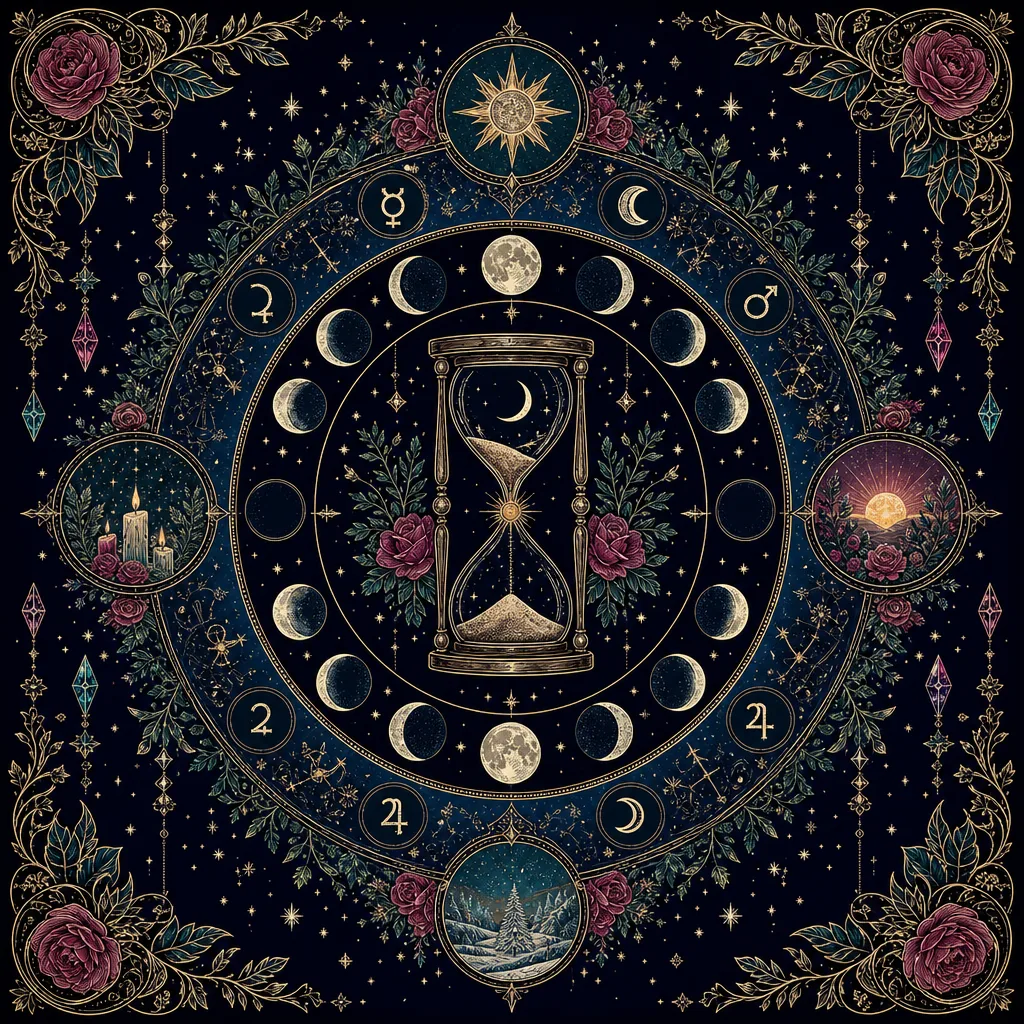
From the Library · The Wheel & Sacred Time
Timing Your Magick: Moons, Days, and Hours
A thorough guide to timing magickal workings by the lunar cycle, the days of the week, planetary hours, and the sabbats, explaining the principles behind each system and how to combine them without becoming paralysed by complexity. Written for practitioners who want to work with natural tides rather than against them.
The principle behind timing in magick is not superstition and is not astrology in its predictive sense. It is the recognition that time moves in cycles, that those cycles carry distinct qualities, and that a practitioner who works in alignment with the current quality of a moment has more natural force behind the working than one who works against it. The moon pulls the tides. The length of daylight shapes biological rhythms across the planet. The turning of the year governs the growth and dormancy of plants. A magickal practitioner who ignores these rhythms is not wrong in any absolute sense; any sincere working done with clarity of intention can produce results regardless of the moment. But working with the tides rather than against them is simply more efficient, the way sailing with the wind is more efficient than sailing across it.
The systems available for timing your magick range from the very simple to the genuinely complex. The lunar cycle alone gives you a functional calendar that most practitioners find sufficient for most purposes. Adding the days of the week and their planetary associations deepens your options. Planetary hours add a further layer of specificity for those who want it. The sabbats provide an annual structure that connects your practice to the turning of the seasons. You are under no obligation to use all of these systems simultaneously, and the practitioner who chooses two or three and applies them with intelligence will do better than one who attempts all of them and becomes mired in calculation.
The Lunar Cycle
The moon is the most accessible and frequently consulted timer in magickal practice, because it moves through a complete cycle in approximately twenty-nine and a half days, which means its phases are observable without equipment and its calendar fits neatly within ordinary life.
The new moon, the dark of the moon when the lunar face is invisible, is the moment of seed and intention. Work done at the new moon is directed toward beginnings: new projects, new directions, invitations to something that does not yet exist in your life. It is an excellent time for setting intentions for the coming cycle, for sigil work oriented toward growth, and for quiet inner work such as scrying or dream divination.
The waxing moon, the period from new to full when the moon is growing in the sky, supports works of increase, attraction, and growth. Anything you want to bring toward you, whether abundance, health, a relationship, a skill, or an opportunity, draws on waxing energy. The waxing half-moon and the gibbous phases are particularly active; the working has momentum.
The full moon is the peak of the cycle, when the lunar current is at its strongest. Full moons are used for major workings of all kinds, for charging tools and water, for divination that benefits from heightened sensitivity, and for celebration and gratitude. Many practitioners observe a monthly esbat, a moon ritual, at the full moon. The three days surrounding the exact full moon are considered within the full moon’s influence rather than only the precise night.
The waning moon, the period from full back toward dark, supports works of decrease, release, and banishing. Anything you want to remove from your life, bad habits, stale energy, harmful relationships, and unnecessary obligations, is addressed in the waning phase. This is also a good time for cleansing workings, for binding, and for protective magick oriented toward keeping things out rather than drawing things in.
The dark moon, the final two or three days before the new moon, is a time for deep rest, shadow work, ancestor contact, and the kind of inner work that requires stillness. Some practitioners consider this an inauspicious time to begin new workings and use it instead for reflection, journal work, and preparation for the cycle that is about to begin.
Full Moon Names
Each full moon of the year carries a traditional name drawn largely from Native American and Northern European sources, adopted into folk almanac tradition and now widely used in contemporary witchcraft. The Wolf Moon falls in January. February brings the Snow Moon. March carries the Worm Moon. April brings the Pink Moon. The Flower Moon rises in May. The Strawberry Moon comes in June. July’s moon is the Buck Moon. The Sturgeon Moon falls in August. September brings the Harvest Moon. The Hunter’s Moon comes in October. November’s moon is the Beaver Moon, and December closes the year with the Cold Moon. These names are evocative and connect the lunar cycle to the natural world in a way that many practitioners find meaningful, though they are named for the Northern Hemisphere and sit reversed in seasonal reference if you practice in the south.
Days of the Week and Their Planetary Rulers
Each day of the week is associated with a classical planet, and each planet carries a set of qualities that inform the nature of workings performed on that day. These attributions are ancient and consistent across Western magickal tradition.
Monday is the moon’s day, suited to divination, psychic work, dream magick, travel, and anything involving the emotions, home, and family. Tuesday is ruled by Mars and supports courage, conflict, competition, physical vitality, and workings requiring decisive action. Wednesday belongs to Mercury and is the day for communication, contracts, learning, writing, and any working that involves the movement of information. Thursday is Jupiter’s day, well suited for abundance, legal matters, career advancement, and expansion of any kind. Friday is ruled by Venus and governs love, friendship, beauty, the arts, and pleasurable matters generally. Saturday belongs to Saturn and is appropriate for discipline, binding, banishing, and workings involving boundaries, endings, and long-term structures. Sunday is the sun’s day, suited to success, confidence, health, leadership, and workings that benefit from solar vitality and clarity.
Aligning a working to the appropriate day requires nothing beyond knowing which planet governs your intention and checking the day of the week. A working for a new job begun on a Thursday and supported by a green or gold candle has both the day of Jupiter and the colour of abundance behind it. This kind of simple alignment is easy to maintain as a habit.
Planetary Hours
Planetary hours offer a finer level of timing within each day. The day from sunrise to sunset and the night from sunset to sunrise are each divided into twelve unequal hours, and each of these hours is ruled by one of the seven classical planets in a specific sequence. The first hour of the day, beginning at sunrise, is ruled by the planet that rules that day. Sunday”s first hour belongs to the sun. Monday”s first hour belongs to the moon. The subsequent hours follow a fixed sequence: Saturn, Jupiter, Mars, Sun, Venus, Mercury, Moon, Saturn, and so on, cycling through repeatedly.
The practical result is that you can perform a working at any hour of any day and have it resonate with a specific planetary quality, not just the quality of the day as a whole. If you need to work for Mercurial communication on a Sunday, you can find the hour of Mercury on Sunday and work then. Many free apps and websites calculate the planetary hours for your location automatically, so the arithmetic need not be done by hand. Planetary hours are particularly valued in ceremonial and high magick traditions, where precision of timing is considered important. For most everyday practical workings, the day of the week is sufficient.
Sabbats and Seasonal Timing
The eight sabbats of the Wheel of the Year provide an annual rhythm of major power points that many practitioners use for their most significant workings. The sabbats are detailed fully in their own guide; here the relevant point is how they function as timing markers for magick.
The solstices and equinoxes are times of solar threshold. The winter solstice, Yule, carries themes of return, hope, and the rebirth of light. The spring equinox, Ostara, is associated with new beginnings and fertility. The summer solstice, Litha, is the peak of solar power, well suited for bold and ambitious workings. The autumn equinox, Mabon, is a time of harvest and balance. The cross-quarter days between them, Imbolc, Beltane, Lughnasadh, and Samhain, each carry their own qualities. Samhain in particular is widely considered the thinning of the veil between worlds, making it especially powerful for ancestor work, divination, and workings involving endings and transition.
The Void-of-Course Moon and Planetary Retrogrades
When the moon makes its final major aspect to a planet and then moves through the remaining degrees of a zodiac sign without making another, it is said to be void of course. This period, which can last from minutes to hours, is traditionally considered unpropitious for beginning new workings or signing agreements. The general advice is to wait until the moon enters the next sign. In practice, many practitioners note the void-of-course periods in their planning and simply schedule major workings around them.
Planetary retrogrades, periods when a planet appears to move backward against the stars from Earth”s perspective, are treated with unnecessary alarm in popular astrology. Mercury retrograde in particular is blamed for every communication failure and lost key in contemporary culture. The traditional view is more measured: when a planet is retrograde, its qualities turn inward rather than flowing outward effectively, which makes retrograde periods less suitable for initiating new projects in that planet”s domain and more suited for review, revision, and inner work. Mercury retrograde is a reasonable time to review contracts, not necessarily to avoid all communication. Work with retrogrades intelligently rather than being held hostage by them.
Combining Timing Factors Without Paralysis
The most common difficulty beginners encounter with magickal timing is the proliferation of factors. If you attempt to align the moon phase, the day of the week, the planetary hour, the moon”s sign, and the proximity to a sabbat all at once, you will quickly find that the perfect moment almost never exists, because some factor is always suboptimal. This paralysis is the enemy of practice.
The solution is to prioritise. For most workings, the lunar phase is the most important factor. If your working is about attraction and growth, do it during the waxing moon. If it is about release, do it during the waning moon. Add the appropriate day of the week if you can do so without unreasonable delay. Add planetary hours if precision matters to you and the calculation is easy. A working performed at a good phase on an acceptable day with a clear intention will almost always outperform one that waits for the perfect alignment.
Equally, if a working is urgent, the right time is now. A clear intention and a focused will can override imperfect timing. The tides are aids, not gatekeepers.
Building a Timing Practice
The most effective way to develop a feel for magickal timing is to begin tracking it. Keep a lunar calendar and note the moon phase each day. Record which workings you perform and when. Over the course of several months, you will begin to sense the quality of different phases directly, and the intellectual knowledge of what each phase supports will become experiential knowledge grounded in your own practice. Many practitioners keep a simple moon journal for exactly this reason.
Observe the sabbats as they come, even in small ways, and notice how the season”s energy matches the traditional attributions. Work with the days of the week deliberately for a month and notice whether workings performed on their aligned days feel different from those performed without regard to timing. Your own experience is ultimately the authority that matters, and timing is a skill that deepens through attentive, recorded practice rather than through memorising a correspondence table.