From the Library · Astrology & The Cosmos
Understanding Your Natal Chart
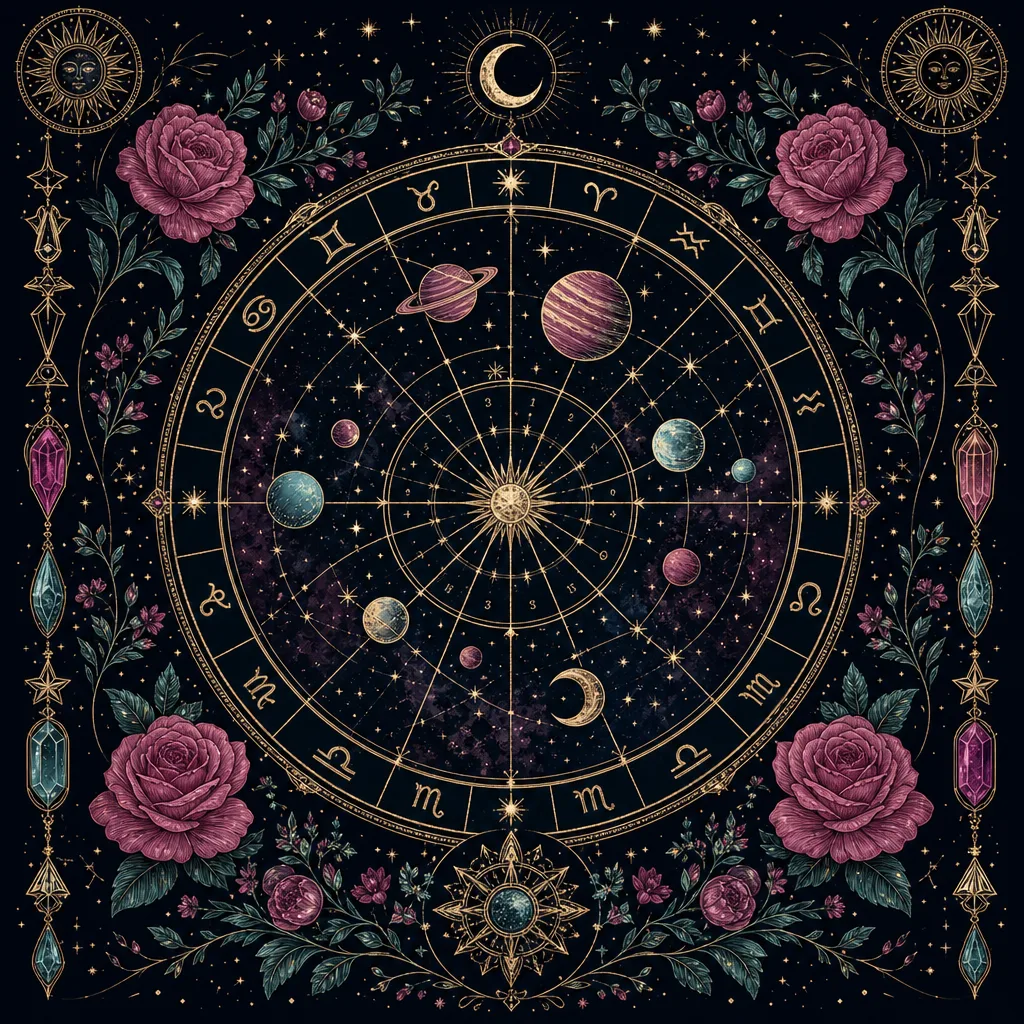
Your natal chart is a map of the sky at the exact moment of your birth, showing the positions of the Sun, Moon, and planets across the zodiac and the twelve astrological houses.
Your natal chart is a circular diagram showing where each planet in our solar system was positioned in the sky at the precise moment you were born, viewed from your birthplace. It divides the sky into twelve sections called houses and maps the twelve signs of the zodiac around the wheel. The chart is understood in astrology as a blueprint of the soul’s intent for this lifetime: the raw materials, the challenges chosen, the gifts available, and the areas of life where the most growth is likely to occur. You do not live inside your chart as a fixed fate; you live with it as a map of terrain that is genuinely yours.
Reading your own chart does not require years of study before anything becomes meaningful. The three components that matter most at the beginning are the Sun sign, the Moon sign, and the rising sign (also called the Ascendant). Together they form what astrologers sometimes call the core triad, and understanding them already tells you something real about how you move through the world.
History and origins
The astrology that underlies natal chart reading developed over thousands of years in a continuous conversation between Babylonian, Egyptian, Hellenistic, Persian, Arabic, and eventually European traditions. Babylonian sky-watchers were tracking celestial cycles and associating them with earthly events as early as the second millennium BCE. The development of the zodiac as a twelve-sign belt, the twelve-house system, and the interpretation of planetary positions at the moment of birth all emerged from the sophisticated astronomical observations of Hellenistic Egypt, consolidated in texts like Claudius Ptolemy’s “Tetrabiblos” in the second century CE.
The tradition was preserved and considerably enriched through the Islamic Golden Age, during which scholars such as Al-Kindi and Abu Ma’shar translated and extended the Greek texts. Medieval European astrology inherited the tradition through Arabic transmission and placed it at the center of medical, political, and philosophical thought until the scientific revolution of the seventeenth century began to separate astronomy from astrology. The revival of astrology in the twentieth century, particularly the psychological astrology developed by Dane Rudhyar and later by Liz Greene, reimagined the natal chart not as a deterministic fate but as a map of psychological and spiritual potential. This is the framework most contemporary practitioners work within.
The Sun, Moon, and rising sign
The Sun sign is the sign the Sun occupied at your birth and is what most people mean when they say their “star sign.” The Sun in astrology represents the conscious self, the core identity, the will, and the primary life force. It shows what you are growing toward, the central narrative of self-development in this lifetime. If your Sun is in Scorpio, the Scorpio qualities of depth, intensity, transformation, and desire for truth are central to your identity’s expression and development.
The Moon sign is the sign the Moon occupied at your birth. The Moon moves through a complete zodiacal cycle in about twenty-eight days, so the Moon signs change roughly every two and a half days. The Moon governs emotional nature, instinctive responses, the inner world, memory, and the domain of comfort and security. A Moon in Gemini will need mental stimulation to feel emotionally grounded; a Moon in Taurus will require physical comfort and stability. The Moon sign often describes the self that close relationships and private moments reveal more clearly than the public persona does.
The rising sign, or Ascendant, is the zodiac sign that was rising on the eastern horizon at the moment of birth. Because the Earth rotates, the rising sign changes approximately every two hours, which is why an accurate birth time matters for chart calculation. The Ascendant governs the outermost layer of personality, the first impression one makes, the body and its presentation, and the lens through which the chart as a whole is filtered. Someone with Capricorn rising often appears more reserved, structured, or authoritative than their Sun sign alone might suggest.
The twelve houses
The chart is divided into twelve houses, each governing a domain of life experience. The First House begins at the Ascendant. Moving counterclockwise around the wheel, each house corresponds to a different area.
The First House covers identity, appearance, and the physical body. The Second covers personal resources, money earned, and material values. The Third governs communication, early education, siblings, and local travel. The Fourth holds home, family of origin, and the private inner life. The Fifth covers creativity, pleasure, romance, and children. The Sixth addresses daily work, health routines, and service. The Seventh governs partnerships, marriage, and significant one-to-one relationships. The Eighth holds shared resources, transformation, sexuality, and what is inherited or lost. The Ninth covers higher education, philosophy, long-distance travel, and the search for meaning. The Tenth, at the top of the chart, governs career, public reputation, and life’s primary vocation. The Eleventh addresses community, friendships, and long-term goals. The Twelfth governs solitude, the unconscious, hidden matters, and spiritual retreat.
A planet in a house concentrates its energy in that area of life. Venus in the Seventh House, for example, brings Venusian qualities of harmony, beauty, and partnership orientation to the domain of significant relationships. The house a planet occupies is as important as the sign it is in.
The planets and what they represent
Each planet rules a different sphere of experience and expression. The Sun and Moon, called the luminaries, govern identity and emotion as described above. Mercury governs the mind: thinking, speaking, writing, and the movement of information. Venus governs pleasure, beauty, love, and what one values and attracts. Mars governs drive, desire, conflict, and the energy one applies to pursue goals.
Jupiter and Saturn are called the social planets. Jupiter governs expansion, abundance, philosophy, and the quality of luck or grace in a life. Saturn governs structure, discipline, limitation, responsibility, and the long-term lessons that become the chart’s most durable achievements. Their cycles of about twelve and twenty-nine years respectively mark significant periods of development.
Uranus, Neptune, and Pluto move so slowly that they define generational themes as much as individual characteristics. Their positions in the houses and their relationships to personal planets in the chart are where their individual significance becomes clear.
Aspects: how the planets speak to each other
An aspect is a specific angular relationship between two planets in the chart. Conjunctions occur when two planets are within a few degrees of each other and blend their energies, sometimes harmoniously and sometimes in tension depending on the planets involved. Trines (120 degrees apart) and sextiles (60 degrees) indicate ease and natural talent in the area governed by the planets and houses involved. Squares (90 degrees) and oppositions (180 degrees) indicate tension, challenge, and the places where a person is pushed to grow.
A square between Mars and Saturn, for example, might appear as a recurring struggle between the desire to act boldly and the fear of consequences, a tension that, when worked through consciously, often produces exceptional discipline and the ability to accomplish difficult things. The challenging aspects in a chart are rarely liabilities; they are more often the locations of the most significant development.
Beginning to read your own chart
Generate your natal chart through a free service such as Astro.com, which requires your birth date, birth time, and birthplace. If you do not know your exact birth time, a birth certificate or hospital record is the most reliable source. Without an accurate birth time, the houses and the Ascendant cannot be calculated reliably, though the planetary signs remain valid.
Read your chart beginning with the Sun, Moon, and Ascendant. Then look at where each of those falls in the houses. Then look for any planets in your First or Tenth House, which tend to be particularly prominent in personality and life direction. From there, a chart begins to reveal itself in layers; each pass through it adds something new.
Living with your chart over time, noticing which transits and cycles produce which kinds of experiences, is how astrology becomes genuinely personal rather than generic. The natal chart is not a fixed sentence. It is a living description of the soul’s material for this life, always available to be understood more deeply.