From the Library · Symbols, Theory & History
Witchcraft and Belief: How Magick Works
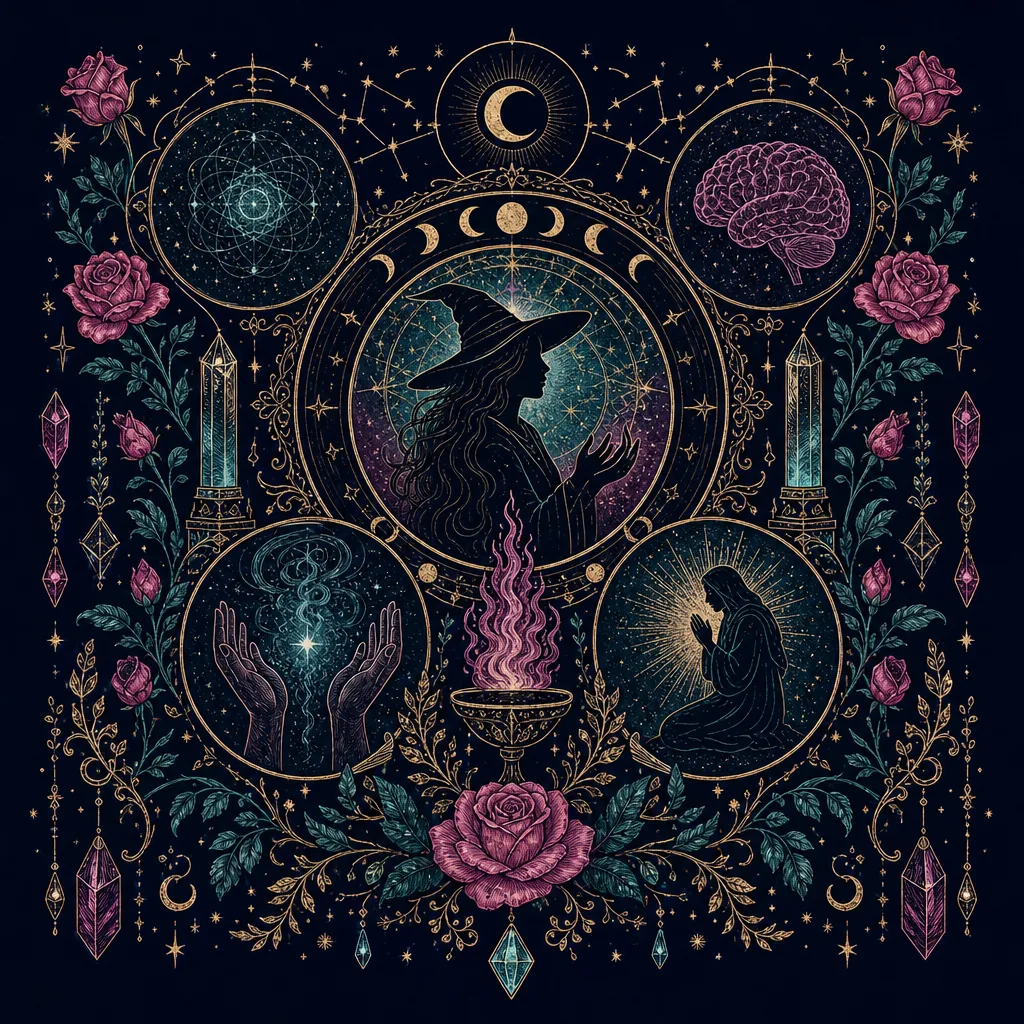
A serious essay on the major models for how magick produces results, from the energetic to the psychological to the devotional, with an honest treatment of the relationship between belief, practice, and real-world outcomes. Written for practitioners who want to understand what they are doing and why it works.
The question of how magick works is one that serious practitioners return to throughout their practice, and no single answer has achieved consensus across traditions. This is not a weakness. The fact that multiple models coexist within the craft reflects an honest engagement with a phenomenon that is genuinely complex, that operates at the intersection of consciousness and the world in ways that current scientific frameworks do not fully account for, and that has been producing real results for practitioners across cultures and centuries without requiring a unified theoretical explanation.
What matters most for a working practitioner is not which model is metaphysically correct but which model or combination of models is most useful for your specific practice. Understanding the options gives you better tools for designing workings, evaluating results, and developing your understanding of what you are doing when you work magick.
The Energetic Model
The most widely held model among contemporary practitioners holds that everything that exists carries or is composed of some form of subtle energy, variously called prana, chi, ki, mana, or simply “energy” in modern witchcraft contexts. In this model, human consciousness can perceive, direct, and work with this energy, and magickal practice is essentially the art of moving energy with will and intention in ways that produce changes in the world.
A spell, in the energetic model, raises a charge of this subtle energy through ritual actions such as chanting, movement, breath, or concentrated visualization, shapes it with a clear intention, and releases it toward a target or outcome. The charge then moves through the subtle field connecting all things and produces effects through a mechanism that is not mechanically explicable but that practitioners report experiencing directly.
The energetic model is coherent and useful. It explains many features of practice: why raised emotional intensity tends to improve results, why grounding is important both before and after working, why correspondence systems based on the sympathetic resonance of colors, herbs, and planetary forces produce consistent effects when used correctly. It maps onto a range of traditional cosmologies from Polynesia to South Asia to Northern Europe that have independently developed similar concepts.
The model’s limitation is that subtle energy has not been measured by scientific instruments, and the mechanism by which it would produce physical effects remains unexplained at the level of physics. Practitioners who work primarily within the energetic model generally hold this uncertainty without finding it disqualifying; the results of practice are, for them, sufficient evidence that something real is happening.
The Symbolic and Correspondence Model
A second model, closely related to the energetic but distinct in its emphasis, holds that magick works through the logic of symbol and correspondence. In this view, when you light a green candle for prosperity, you are not simply releasing energy toward a financial goal; you are enacting a symbolic statement about the nature of reality that the world responds to. The color green corresponds to Venus and to the natural world’s generative force; the candle corresponds to the alchemical fire of transformation; your intention corresponds to the seed that will grow. The working creates a resonance between your intention and the forces in the world that share its nature.
This model draws on the two classical principles of sympathetic magick, identified by anthropologist James Frazer and recognized as operating principles by practitioners across traditions. The first is the law of similarity: like affects like, and an image or symbol of something participates in its nature. The second is the law of contagion: things that have been in contact remain connected. These principles appear in magickal practice from ancient Mesopotamia through modern witchcraft without significant variation, suggesting that they reflect something real about how intention and symbol interact with the world.
Correspondence systems, the tables matching colors, herbs, stones, planets, and days of the week to specific qualities and intentions, are the practical expression of this model. They are not arbitrary. They developed through centuries of observation and refinement within working traditions, and practitioners who use them carefully consistently find that they produce more reliable results than substituting correspondences at random.
The Psychological Model
The psychological model, associated in the modern craft primarily with chaos magick and with the influence of depth psychology on contemporary spirituality, holds that magick works primarily through the practitioner’s own psyche rather than through any external subtle force. In this view, a well-designed ritual communicates with the unconscious mind in a language it understands, symbol and image and emotional intensity, and causes the unconscious to redirect its enormous influence over perception, behavior, and circumstance toward the stated intention.
The psychological model is grounded in real and well-documented phenomena. The placebo effect, the nocebo effect, and the substantial body of research on how expectation shapes perception and outcome all demonstrate that the unconscious mind has a powerful and largely unacknowledged influence over what happens in a person’s life. A spell that gives the unconscious a clear, emotionally charged image of the desired outcome may genuinely redirect behavior, perception, and social signal in ways that produce the intended result through what appear to be entirely mundane channels.
The psychological model does not require the practitioner to believe in anything beyond what mainstream psychology already accepts. For practitioners who work within a broadly scientific worldview and struggle to commit to the energetic or cosmological models, it provides a coherent and genuinely useful framework. Its limitation is that it seems inadequate to explain workings performed at distance without any possible psychological mechanism, or results that arrive through channels the practitioner could not plausibly have influenced through behavior change. Practitioners who work within this model usually acknowledge that it is most satisfying as a partial account.
The Devotional Model
The devotional model holds that magick works because the practitioner is operating within a relationship with a deity, spirit, or other non-human intelligence who acts on the practitioner’s behalf in response to petition, offering, and sustained relationship. This model is not a theoretical framework in the same sense as the others; it is a description of how magick is understood to work within devotionally oriented traditions that include Hoodoo, Vodou, Santeria, and much traditional folk magick, as well as the God-and-Goddess centered practice of many Wiccan and pagan witches.
Within the devotional model, the effectiveness of a working depends substantially on the quality of the practitioner’s relationship with the powers they are working with. A practitioner who maintains a consistent altar, makes appropriate offerings, keeps their promises to their deities and spirits, and approaches the relationship with genuine respect and reciprocity will find their workings better supported than a practitioner who approaches the divine only when they want something. This is not arbitrary; it reflects the same relational logic that governs meaningful human relationships.
The devotional model produces some of the most dramatic results reported in the tradition, and experienced practitioners in devotionally structured paths often describe the experience of working with a strongly present deity as qualitatively different from other forms of magickal work. For practitioners who have a genuine and active relationship with named powers, this model is often experienced as not a model at all but simply an accurate description of what is happening.
Whether Belief Is Required
A frequent question from newcomers is whether magick requires belief to work. The honest answer is that practice produces results in people who approach it with skepticism as well as in those who believe fully, and most experienced practitioners would say that practice rather than belief is the prerequisite. You do not need to resolve the question of how magick works before you begin working; you need to be willing to act as if it might.
There is a distinction between belief and commitment. A practitioner who believes with absolute certainty that the world is flat but refuses to board ships will not circumnavigate the globe. A practitioner who is genuinely uncertain about the mechanism of magick but performs workings carefully, consistently, and with full attention will accumulate results. The results, over time, will inform the practitioner’s beliefs in ways that no amount of prior reflection can. Practice is epistemologically prior to belief in magick: you learn what is true about it by doing it honestly, not by deciding in advance.
Results, Coincidence, and Honest Discernment
One of the genuine skills developed through sustained practice is the capacity for honest discernment about results. Magick does not produce results in every case, and the practitioner who attributes every positive development to their most recent working is not being epistemically honest. The practitioner who refuses to attribute anything to magick is also not being honest, because the pattern of results across a long and carefully recorded practice is usually not plausibly explained by coincidence alone.
Honest discernment requires several things: careful records so that the connection between workings and results can be traced over time; a genuine willingness to note both the workings that appeared to produce results and those that did not; and a settled equanimity about uncertainty that allows the practitioner to observe without forcing the data into a predetermined conclusion.
Keeping a working journal with honest notes on results is the most important practice for developing discernment. After a year of careful record-keeping, most practitioners find that the pattern of results provides more useful evidence about what works, and how, than any theoretical framework could offer from the outside.
Holding Magick and Science Together
Many practitioners hold a scientific understanding of the world alongside a genuine commitment to magickal practice, and this combination is less contradictory than it might appear. The scientific worldview describes what is currently measurable and theorized within the frameworks that science has developed. Magick, as a practical discipline, operates in a domain where those frameworks are incomplete.
Consciousness itself remains deeply mysterious to neuroscience. The mechanism by which the firing of neurons produces subjective experience is not understood. The relationship between observation and the behavior of quantum systems remains philosophically contentious. The nature of time at the fundamental level is far from settled. A practitioner who works within the energetic or devotional model is not asserting something that science has disproved; they are operating in a domain where science’s current tools produce only partial accounts.
What the scientific habit of mind does offer the practitioner is a commitment to honest evaluation of results, a resistance to motivated reasoning, and a recognition that claims should be proportional to evidence. These are excellent qualities in a magickal practitioner. The craft is served by practitioners who think clearly about what their workings produce, who distinguish genuine results from wishful attribution, and who remain open to revising their understanding as their experience accumulates. Genuine magick and rigorous thinking are not opponents. They are complementary disciplines that strengthen each other in a long and serious practice.