From the Library · Deities, Spirits & Entities
Working with Deities
This guide covers what it means to enter a relationship with a deity, from first contact and discernment through devotion, offerings, and the ethics of working with gods from cultures not your own. It is written for practitioners at any stage who are ready to move their practice into the devotional dimension.
Deity work sits at the centre of many magickal and spiritual paths, and yet it is one of the topics that beginners find hardest to get honest, grounded instruction about. Part of the difficulty is that it sits at the intersection of the devotional and the practical in a way that other skills do not. When you learn to cast a circle or charge a sigil, the method can be described in steps. When you begin working with a deity, you are entering into a relationship, and relationships resist being reduced to steps.
That said, there is a great deal of useful, concrete guidance available, and experienced practitioners have learned through their own work what tends to open a relationship well, what tends to disrespect or damage it, and when to step back. This guide offers that knowledge plainly: what deity work is, how a deity is said to make contact, how to approach one respectfully, what to bring to the relationship over time, and what the ethical limits are when you are drawn to a god from a tradition not your own.
What Deity Work Is
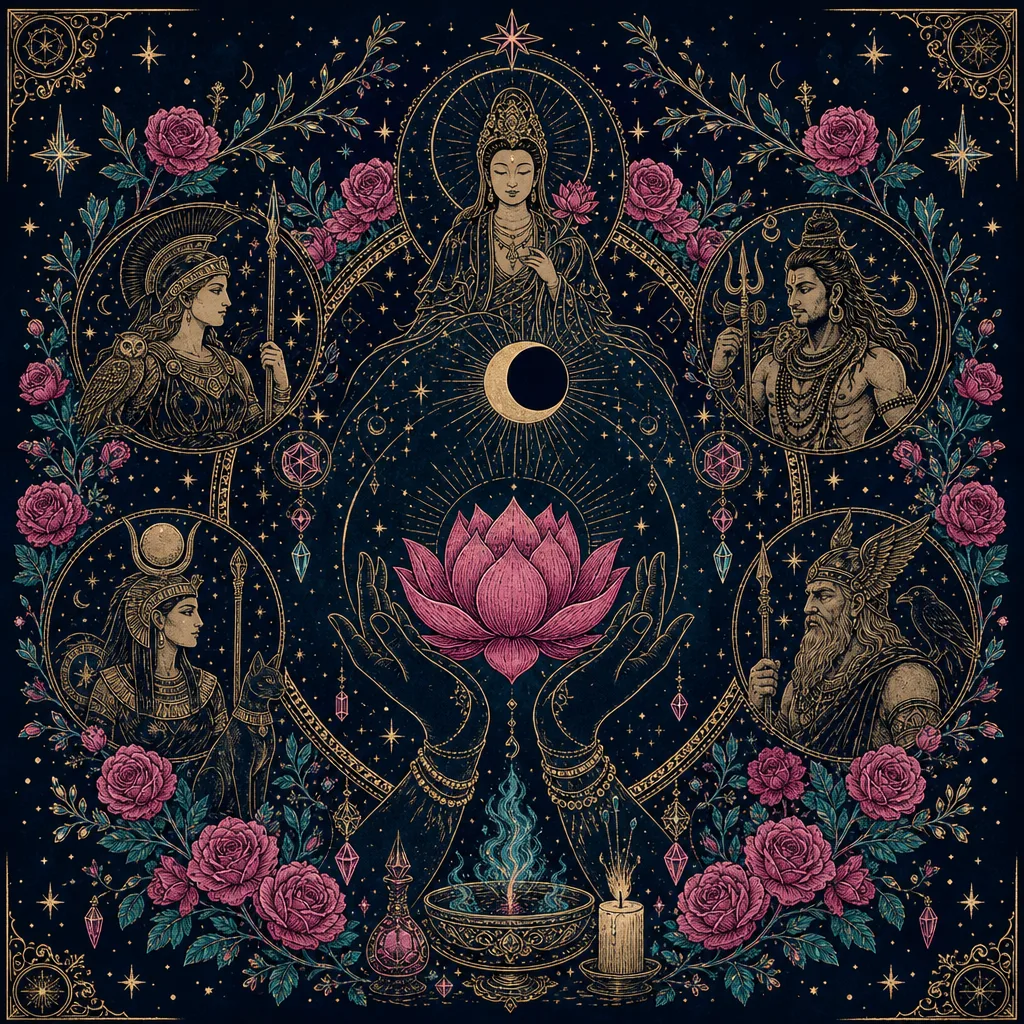
The word “deity” covers an enormous range of beings across human religious history: the great cosmic gods of ancient Egypt, the warrior and wisdom figures of the Norse tradition, the multi-armed gods of the Hindu pantheon, the animistic divine forces of Shinto, the orisha of Yoruba religion, and countless others. These are not interchangeable. Each deity belongs to a specific cosmology, a specific set of relationships with other divine beings, a specific body of myth and cultural practice, and in many cases, a specific living community of worshippers for whom that deity is not a historical curiosity but a present and real relationship.
Within modern witchcraft and Paganism, the approach to deity ranges widely. Some practitioners work within a reconstructed or living tradition and worship specific named deities from that tradition’s pantheon. Others work with a generic divine polarity, a Lord and a Lady in the Wiccan sense, where the specific names are less important than the principle they represent. Others are polytheists who maintain active devotional relationships with several named deities from the same or different pantheons. Still others petition specific deities for specific kinds of help without maintaining an ongoing devotional practice. All of these are recognized forms of deity work, and none is inherently superior to the others.
How Deities Are Said to Make Contact
Many practitioners report that their first deity relationship began with an unexpected encounter: a recurring symbol or image, a dream in which a figure appeared with unusual clarity and presence, a strong pull toward a particular mythological tradition, or an uncanny series of omens pointing toward a specific deity. This is not universal, and it is worth being careful about the eagerness to interpret every vivid dream or meaningful coincidence as a divine calling. Discernment is part of the work.
When something does seem like contact, the useful questions are: Is this consistent? Does it recur across different parts of your life and practice? Does it feel expansive and clarifying rather than anxious or compulsive? Does engagement with this deity’s myths and stories feel like recognition rather than mere interest? These are not foolproof criteria, but they help distinguish genuine resonance from ordinary enthusiasm.
You do not have to wait for contact to initiate deity work. You can choose to approach a deity whose qualities, mythology, and cultural context you have studied carefully, out of genuine affinity or for the specific help they are known to offer. In many traditional polytheistic contexts, this is exactly how relationships with gods begin: through respectful approach, offerings, and gradually deepening attention over time.
Approaching a Deity for the First Time
The first approach to a deity deserves preparation and intentionality. Before you speak or make any offering, study. Learn the deity’s mythology across multiple primary and secondary sources if you can access them. Understand their domain, their character, their relationships with other gods, and what they are traditionally offered. Understand what they dislike or prohibit. Many deities have known aversions: specific animals, foods, or colours that carry negative associations in their tradition. Bringing an inappropriate offering to a first approach is not catastrophic, but it signals a lack of care that sets a poor tone.
A first contact ritual does not need to be elaborate, but it should be deliberate. Set aside time and space, cleanse the area, and build a simple altar that includes an image or symbol of the deity, a candle in an appropriate colour, and a first offering. Then, in your own words, introduce yourself. State your name, your practice, and what draws you to this deity. State clearly what you are asking for: a relationship, guidance, a specific kind of help, or simply the opportunity to be heard. Then be still and receptive for a few minutes before closing. Take note afterward of anything you sense, feel, or dream in the days that follow.
Offerings, Altars, and Prayer
Offerings are one of the foundational languages of deity work across virtually all human cultures. The principle is straightforward: you bring something of value to the deity as an expression of respect, gratitude, or petition. What constitutes value varies by tradition and by deity. Common categories include food and drink, flowers and botanicals, incense and smoke, candles, artwork, time and creative work offered in the deity’s honour, and acts of service aligned with the deity’s values.
Research the traditional offerings associated with your deity before you begin. A deity of the sea might be offered salt water, shells, or fish; a deity of the hearth might be offered bread, milk, or a flame kept burning. Many deities have specific offerings that appear across their traditional worship, and honoring those traditions is a mark of respect. You can also follow what is sometimes called the law of the heart: give what you genuinely value and what you have genuinely prepared, and state clearly that it is given freely.
An altar dedicated to a deity serves as a focal point for the relationship, a place where the deity’s presence is invited and maintained. A basic devotional altar includes an image of the deity (a statue, a printed image, or a found object that you associate with them), a candle, a vessel for offerings, and any symbols, plants, or stones associated with their tradition. Keep the altar clean and tended. An altar that is set up and then ignored is not a devotional practice; it is decoration.
Prayer is the spoken dimension of the relationship. It does not need to be formal or flowery. Speak to your deity as you would speak to a powerful being you respect deeply: honestly, clearly, and with appropriate reverence. Express gratitude when something you asked for arrives, even in unexpected form. Describe your situation plainly when you are petitioning for help. Check in during your daily practice even when you have no specific request.
The Ethics of Working Across Cultures
This is the part of deity work that deserves the most careful and honest treatment.
The world’s religious traditions are not all equally open to outside practitioners. Some are living traditions with active, indigenous communities for whom those religious practices are a matter of cultural survival, ancestral continuity, and sometimes physical and political safety. The deities, rituals, and spiritual offices of these traditions belong, in a meaningful sense, to those communities. Taking up their practices casually, without invitation or proper initiation, is a form of extraction that causes real harm.
Specific traditions that are closed to outside practitioners include the initiatory lineages of the Afro-Caribbean diaspora religions: Candomble, Lucumi (Santeria), Vodou, and others. Working with the orisha, lwa, or other divine beings within these systems requires initiation by a lineage holder. Reading about them is fine and valuable. Taking up their ritual practices, adopting their specific forms of worship, or claiming access to their divine beings without initiation is not appropriate, regardless of how sincere your interest is or how drawn you feel. Practitioners within those communities are unambiguous on this point.
By contrast, many historical religions whose original cultures no longer exist as living communities, the Norse, the ancient Egyptian, the Greco-Roman among them, are reconstructed by modern practitioners from historical sources. Working with the gods of these traditions is ethically different in character, though still not a casual matter. It requires learning the tradition’s internal logic, respecting its mythological record, and not treating its divine beings as generic supernatural assistants available for any purpose you choose.
When you feel drawn to a deity from a tradition not your own by ancestry or community, the responsible path is to study the tradition thoroughly, to seek out practitioners within it where they are accessible and willing to share knowledge, to be transparent about being an outsider, and to defer to those practitioners on what is and is not appropriate. Some traditions welcome sincere outsiders. Some do not. That boundary belongs to the tradition, not to your desire to engage with it.
Building a Relationship Over Time
A deity relationship is not a transaction that closes when your petition is answered. The practitioners who report the most meaningful and sustained relationships with deities describe a process of consistent attention and reciprocity across years, not weeks. The deity comes to know you, and you come to know the deity, through repeated encounter.
Practical ways to sustain a relationship over time include maintaining your altar and renewing offerings on a regular schedule, observing any festivals or calendar days traditionally associated with the deity, engaging with the deity’s mythology as a form of study and meditation, returning to the deity in divination or meditation to ask questions and receive guidance, and following through on any commitments you have made. If you asked for help with a specific situation and promised something in return upon its resolution, that promise must be kept.
Relationships with deities can also go through fallow periods. A deity who has been strongly present in your practice may recede. This can mean that the work you came together for has been completed, that you need to reassess the relationship, or simply that the rhythm of closeness varies over time as it does in any relationship. Do not immediately assume that a quiet period means the relationship is broken or that you have done something wrong.
Recognizing When to Step Back
Not every deity relationship is meant to be permanent. Some are intensely productive for a specific season of your life and then naturally complete themselves. Others may begin to feel draining, destabilizing, or demand more than you are able to give without harm to yourself or others. Recognizing when to step back is as important as knowing how to approach.
Signs that a reassessment is needed include: obsessive preoccupation with the deity that crowds out the rest of your life and practice; directives from the deity that, when examined honestly, conflict with your ethics or wellbeing; a sense that the relationship operates through fear or compulsion rather than respect and resonance; or a feeling that you are giving without any sense of reciprocity or presence.
Closing or pausing a deity relationship is done with the same care and honesty as any other aspect of the relationship. Approach the deity’s altar, state clearly that you are stepping back and why, give a final offering, and express gratitude for what the relationship gave you. This is not a rupture but a transition, and treating it as one honours both the deity and the work you did together.
Deity work at its best is one of the most rewarding dimensions of a serious magickal practice. It grounds the practitioner in something larger than technique, asks for consistent reciprocity rather than occasional intensity, and over time cultivates a quality of attention and devotion that extends into every other part of the work. Approach it with genuine study, honest discernment, and respect for the living traditions that hold these powers, and it will reward that care.