From the Library · Ritual, Ceremony & High Magick
Working with the Four Elements
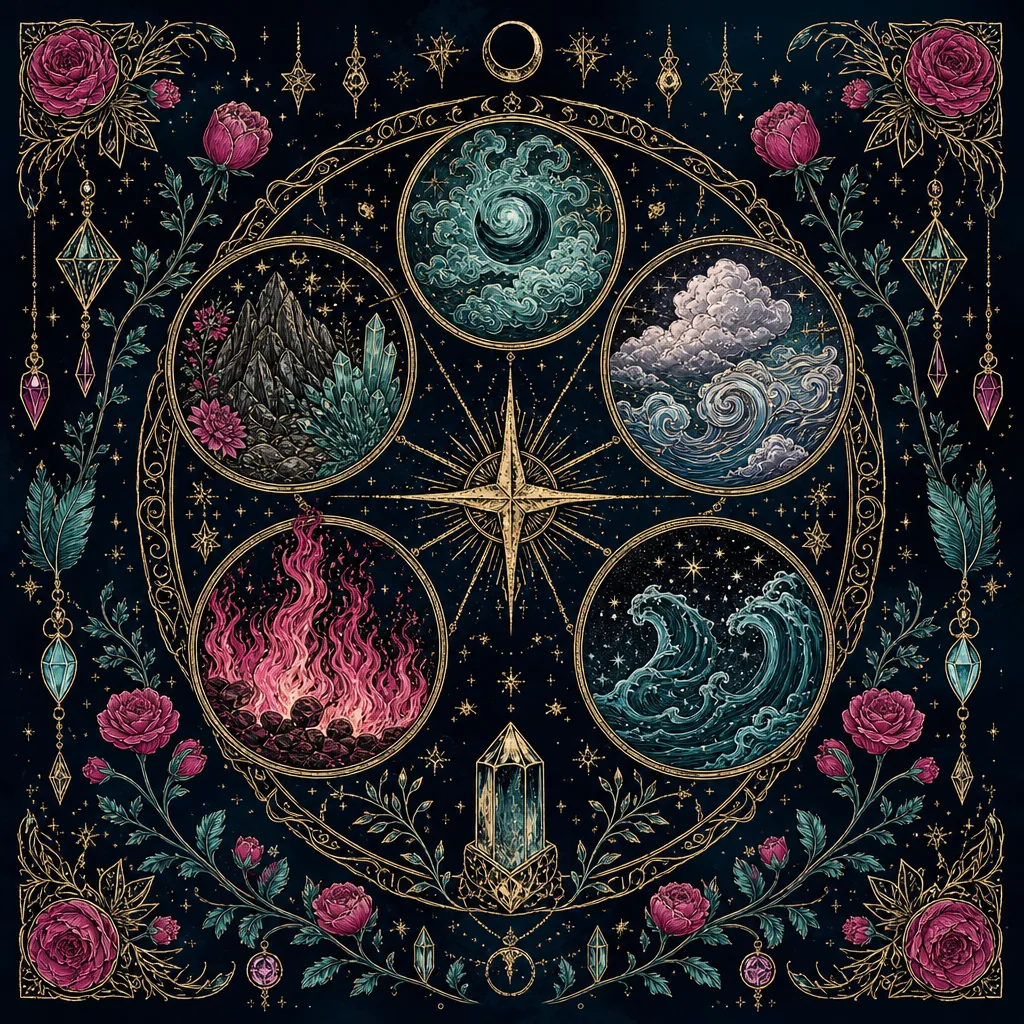
This guide explores the four classical elements, earth, air, fire, and water, along with spirit as the fifth, examining their qualities, correspondences, and practical applications in ritual and spellwork. It is for practitioners who want to move beyond rote correspondence lists into genuine elemental relationship.
The four classical elements, earth, air, fire, and water, form one of the oldest organizing frameworks in Western magick, and they remain among the most practically useful. They appear in ancient Greek philosophy, in Renaissance natural magic, in the ceremonial traditions, and in modern Wicca and witchcraft, not as a literal description of the physical world but as a symbolic language for organizing qualities, energies, and correspondences in ways that practitioners have found reliable for centuries. Spirit, sometimes called ether or akasha, is recognized in many traditions as a fifth element that pervades and animates the others.
Understanding the elements is not a matter of memorizing a table. It is a matter of developing a felt sense of what each element actually is, how it behaves, and how it can be engaged. A practitioner who genuinely understands fire as an element understands something about transformation, will, courage, and the quality of things that consume and purify; they can work with that understanding in spellwork, in ritual, and in their own inner development. The correspondences in any reference list are secondary to that living understanding.
The Qualities and Correspondences of Each Element
Earth is the element of the physical body, of material things, of stability, endurance, fertility, and the cycles of growth and decay. It is associated with the direction north in most Western and Northern European traditions, with the season of winter, with the colour green or brown or black, and with the magical tool of the pentacle or dish. Its qualities are cold and dry. Earth corresponds to practical matters in spellwork: money, home, career, physical health, and anything that requires patience and steady accumulation over time. In the body, earth governs bones, flesh, and the basic physical structures that ground a person in the world.
Air is the element of mind, communication, knowledge, travel, and change. It is associated with the east, with dawn and spring, with yellow or white, and with the athame or the wand, depending on the tradition. Its qualities are warm and wet. Air corresponds to spells involving communication, learning, clarity of thought, contracts, and relationships where the exchange of ideas and understanding is central. In the body, air governs breath, the lungs, and the nervous system.
Fire is the element of will, passion, transformation, courage, and energy. It is associated with the south, with noon and summer, with red or orange, and with the wand or the athame. Its qualities are hot and dry. Fire is used in workings of protection, purification, strength, ambition, and banishing. It is the element most associated with the active, projective force in magick. In the body, fire governs the blood, the heart, and the metabolic processes that generate heat and energy.
Water is the element of emotion, intuition, the unconscious, dreams, healing, and psychic perception. It is associated with the west, with dusk and autumn, with blue or silver, and with the chalice or cauldron. Its qualities are cold and wet. Water governs spells of love, healing, emotional recovery, purification of a different kind than fire’s burning, and the development of psychic and divinatory ability. In the body, water governs the blood in its liquid quality, the lymphatic system, and the emotional body.
Spirit, where recognized, is understood as the animating principle that underlies and connects the other four. It corresponds to the centre of the circle, to the vertical axis running between earth below and sky above, and to the deepest self or higher self of the practitioner. Spirit is not usually called as a quarter in the way the four elements are, but is acknowledged in various ways: as the sacred centre, as deity, or as the animating presence that makes the circle a living space.
The Elements Within the Self
Every practitioner contains all four elements in some proportion, and most practitioners are naturally stronger in some elements than others. A person who is quick-minded, verbal, and comfortable with abstraction is high in air. A person who is passionate, driven, and easily inflamed or inspired is high in fire. A person who is emotionally perceptive, intuitive, and attuned to relational currents is high in water. A person who is practical, patient, and grounded in physical reality is high in earth.
Identifying your natural elemental balance is useful because it shows you where your practice will tend to come easily and where you will need to develop deliberately. A person strong in fire and air but weak in earth may find they are excellent at generating ideas and intentions but poor at the patient follow-through that makes those workings actually land in material reality. A person strong in water but weak in fire may find emotional richness in their practice but struggle to summon the directed will that spellwork requires.
Working to develop a weaker element in yourself is a genuine form of inner work with practical consequences for your craft.
Meeting Each Element Directly
The most effective way to develop a real relationship with the elements is through direct physical experience, not study. For each element, there is a simple exercise.
For earth: go outside and find a patch of bare ground. Sit or kneel on it and press your palms flat against the earth. Let your weight settle downward. Stay there for ten minutes, breathing slowly, and direct your attention to what you feel: temperature, texture, the particular quality of stillness in the earth beneath you. Come home and write down what you noticed.
For air: stand outside on a day when the wind is moving. Face into it and breathe deeply. Let your attention follow the movement of air around and through you. Notice the way it carries sound, scent, and change. If you can find a high open place where the sky is broad and the air moves freely, so much the better.
For fire: sit with a candle flame in a darkened room. Spend ten to fifteen minutes simply watching it. Notice the quality of its movement, the way it consumes without being consumed by what it burns, the heat that radiates outward without the flame diminishing. Let your attention rest on what fire actually does, not on the symbol of fire.
For water: immerse your hands or your feet in natural water if you can find it, a stream, the ocean, a lake, or rain water collected in a bowl will serve. Let your attention rest on the way water moves around you, the way it yields but exerts pressure, the way it takes the shape of whatever contains it.
These exercises are not theatrical. They are the beginning of genuine relationship with the elements as living forces rather than as intellectual categories.
The Elementals
Many traditions recognize elemental beings, spirits whose nature is aligned entirely with one element. In the system inherited from Renaissance philosophy via the work of Paracelsus and later absorbed into the ceremonial tradition, these are gnomes for earth, sylphs for air, salamanders for fire, and undines for water. In folk traditions, similar beings appear under different names.
Working directly with elemental beings is a more advanced practice that is beyond the scope of an introductory guide, but it is worth knowing they are recognized in the tradition. The elementals are not symbolic; in the framework of magical understanding they are considered genuine presences that can be respectfully invoked in elemental work.
Calling the Quarters in Ritual
In Wiccan and many eclectic ritual formats, the four elements are called at the beginning of a rite through the practice of calling the quarters, sometimes called calling the watchtowers. The practitioner faces each of the four cardinal directions in turn, beginning traditionally with east, and invites the presence and energy of the corresponding element into the circle.
A simple quarter call for east might be: “Powers of the east, powers of air, bring your clarity and your swift intelligence to this rite. Be welcome here.” Each quarter is called in turn, and at the close of the rite each is thanked and released in reverse order. The structure creates a circle that is held in balance by all four elements simultaneously, which is understood to create a stable and complete sacred space.
You do not need elaborate scripts. A sincere, specific acknowledgment of what each element brings is more effective than a florid recitation delivered without genuine attention.
Using Elemental Correspondences in Spellwork
Once you understand the elements, their correspondences become practical tools rather than lists to memorize. When designing a spell, consider which element or elements are most aligned with your intention. A working for emotional healing calls naturally on water: working near water, using water in the rite, choosing blue candles, incorporating herbs associated with water such as chamomile or rose. A working for courage calls on fire: working with a strong flame, using red or orange, incorporating herbs like ginger or cinnamon.
You can layer elements when the intention is complex. A working for a job that requires both practical stability and clear communication might incorporate both earth and air elements, grounding the working in practical reality while sharpening the communicative quality of the intention.
The point is not rigid adherence to a system but genuine engagement with the qualities that the elements represent. The element you choose should feel right for the nature of what you are working, because you understand what that element actually is.
Carrying Elemental Practice Forward
The four elements are not a topic to study once and set aside. They are a living framework that grows richer with every year of practice. Practitioners who maintain a regular relationship with the elements, through the exercises above, through calling the quarters in ritual, and through attention to the elemental qualities of the world around them, find that their understanding deepens in ways that reading alone cannot produce.
Pay attention to the elements in daily life. Notice the particular quality of the air on a cool autumn morning versus a hot summer afternoon. Notice the difference between standing water and moving water. Notice what fire does to different materials. Notice the varieties of earth, from clay to sand to rich loam. This kind of sustained, attentive observation builds the felt knowledge of the elements that makes all elemental work more effective and more alive.
The elements are the world as well as the ritual circle, and approaching them with genuine curiosity and respect will serve your practice for as long as you work.