From the Library · The Wheel & Sacred Time
Working with the Moon Phases
This guide covers the lunar cycle as the most accessible magickal calendar a practitioner has, explaining what each phase supports, how to work with full moons and esbats, moon water, the void-of-course moon, and how to build a sustainable monthly lunar practice.
The moon completes its cycle from new to full and back again in approximately 29.5 days, and this rhythm has been one of the most reliable timekeeping systems available to human beings across recorded history. Farmers, sailors, herbalists, midwives, and ritual specialists on every continent have tracked the moon’s phases for practical and spiritual purposes. In contemporary magickal practice, the lunar cycle functions as the most accessible and immediate calendar a practitioner has: it requires no special equipment beyond the willingness to look up and pay attention, and it provides a continuous, granular structure for timing intentions, rituals, and practical workings throughout the month.
The core principle is simple. As the moon grows from new to full, energy flows toward expansion, attraction, and growth. As it wanes from full to dark, energy supports release, banishment, and completion. Within those two broad arcs, each phase has its own character, and learning to feel those distinctions in your practice takes time but deepens the work considerably.
The Phases and What They Support
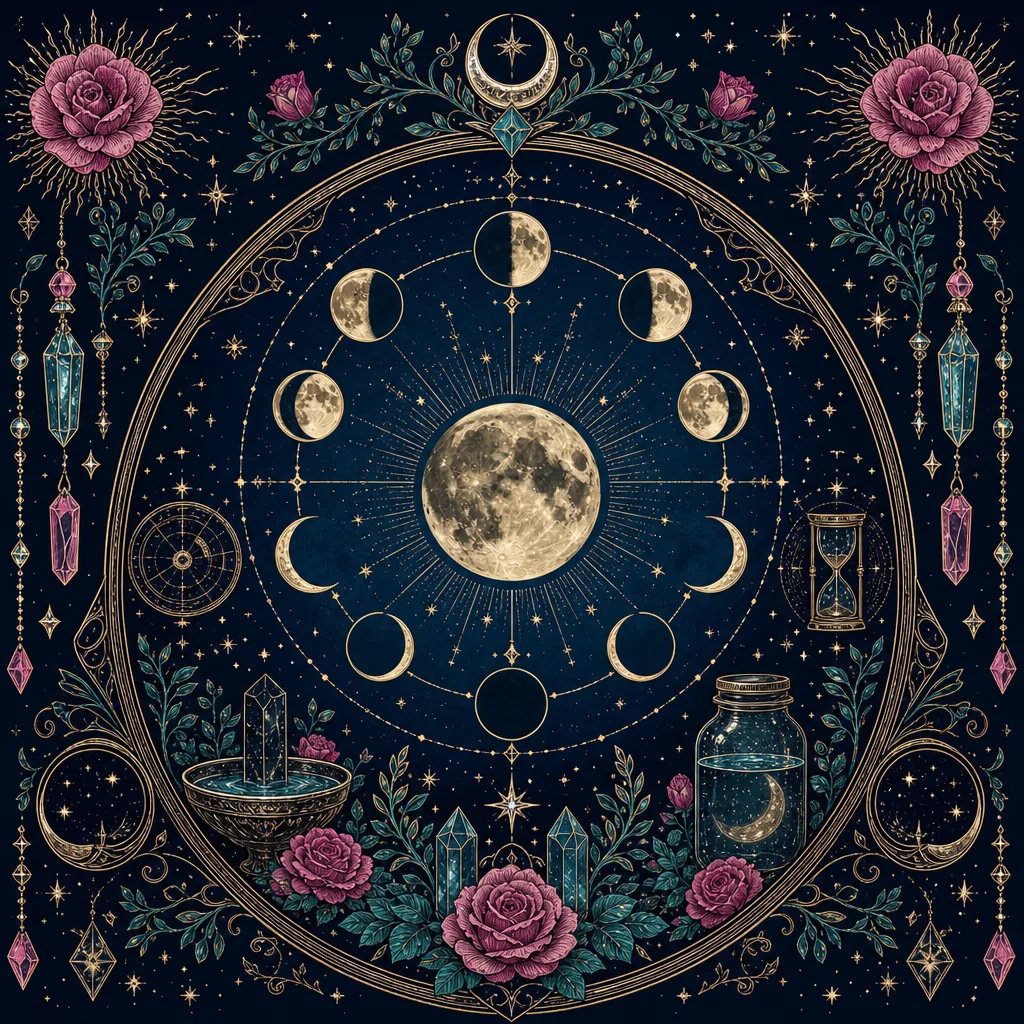
The lunar cycle is divided into eight phases, though the moon moves continuously rather than switching from one state to another. Think of these as zones of energetic quality rather than rigid periods with hard edges.
The new moon is the point at which the moon is between the earth and the sun, invisible in the night sky. This is the moment of initiation: the phase for setting intentions, beginning new projects, and planting the seeds of what you want to call into being over the coming cycle. Magick done at the new moon is traditionally oriented toward potential and beginning. Many practitioners use the new moon as a time for journaling, scrying, or sitting quietly with the question of what they genuinely want to invite into their life in the month ahead.
The waxing crescent is the first thin sliver of light appearing after the new moon. The energy here is one of forward momentum: early movement, first steps, and building confidence in the direction chosen at the new moon. Spellwork for growth, attraction, and opportunity gains traction during this phase.
The first quarter presents a half-lit moon, growing toward fullness. This is a phase of decision and concrete action. Intentions set at the new moon now require your engagement and practical effort to support them. Magick for strength, courage, and clear commitment suits this phase.
The waxing gibbous is the moon more than half-lit and still growing. This is a refinement phase, associated with adjustment, patience, and improvement of what is in progress. Spellwork for skill-building, discernment, and fine-tuning works well here.
The full moon is the peak of the cycle, the moment of complete illumination. It is the most ceremonially significant phase in Wiccan and Pagan practice: the esbat, the monthly full moon ritual, is a regular practice in many traditions. Full moon energy is associated with fullness, clarity, manifestation, gratitude, and heightened psychic awareness. Workings for healing, divination, and the completion of longer spells reach their potency now. Many practitioners find that emotions, dreams, and intuitive perception intensify around the full moon, which can be used as a resource in the practice or simply noticed and accommodated.
The waning gibbous sees the light beginning to recede. This is a phase of sharing, reflection, and the beginning of release. Giving gratitude for what the cycle has produced and beginning to identify what no longer needs to be carried forward suits this period.
The last quarter presents a half-lit moon, diminishing. This is the phase of active release: ending patterns, clearing space, and breaking unwanted cycles. Magick for banishment, boundary-setting, cord-cutting, and reversals is traditionally placed here.
The waning crescent, sometimes called the balsamic moon, is the final sliver before darkness. This is the rest and surrender phase: deep introspection, shadow work, and preparation for the new cycle. Attempting to force new beginnings during the balsamic moon tends to produce frustrated energy. The cycle is completing, and the appropriate posture is stillness and integration.
The Full Moons and Their Traditional Names
Each full moon of the year carries a traditional name drawn from the natural world of the season in which it occurs. These names vary across cultural traditions, and most of the versions in wide use today derive from the English colonial almanac tradition, which itself drew on a mixture of Algonquian, Anglo-Saxon, and Medieval European sources. They are offered as useful pointers to the season’s character, not as a single authoritative ancient system.
Common names include the Wolf Moon (January), Snow Moon (February), Worm Moon (March), Pink Moon (April), Flower Moon (May), Strawberry Moon (June), Buck Moon (July), Sturgeon Moon (August), Harvest Moon (September, or the full moon closest to the autumn equinox), Hunter’s Moon (October), Beaver Moon (November), and Cold Moon (December). A year occasionally holds thirteen full moons, the thirteenth being called the Blue Moon, though this astronomical usage of the term is itself a twentieth-century convention.
Esbats: The Full Moon Ritual
In Wiccan tradition, the esbat is the regular full moon gathering, distinct from the seasonal sabbats. An esbat is a working occasion, not just a celebration: the high energy of the full moon is used to charge intentions, empower tools, practise divination, and honour the Goddess in her full expression.
A simple esbat framework that works without belonging to any particular tradition proceeds as follows. Cleanse your space and yourself. Cast a circle if your practice includes this step. Light a white or silver candle as a representation of the moon’s light. State your purpose for the working: what you are charging, releasing, or asking for clarity on. Raise energy by whatever method works best for you, whether breath and visualisation, chanting, movement, or simply sitting in focused stillness. Direct that energy toward your intention, then release it. Allow a period of quiet reception before closing the circle.
The esbat does not need to be elaborate. Even a fifteen-minute focused practice held consistently on each full moon will build a relationship with the lunar cycle that is more useful than a single grand working done irregularly.
Drawing Down the Moon
Drawing down the moon is a ritual practice in which the practitioner invites the Goddess, understood as embodied in the full moon, to enter and speak through them. In Gardnerian and Alexandrian Wicca, this is performed by the High Priestess with the assistance of the High Priest, using a specific liturgy including the Charge of the Goddess, attributed in its current form to Doreen Valiente.
Solitary practitioners can adapt this practice as an act of devotion and receptive attunement: standing or sitting in moonlight (or in the light of a candle lit in the moon’s honour), opening the body to the moon’s energy with arms raised, and inviting the Goddess’s presence in whatever form feels right. What follows is often a period of deep calm, heightened perception, or inspired speech. This is a practice to approach with genuine reverence rather than as a formulaic exercise.
Moon Water
Moon water is water that has been charged under the full moon’s light. It is used for cleansing, blessing, watering sacred plants, anointing the body, and adding to baths, washes, and spellwork.
To make moon water: place clean water in a clear glass or bowl and set it outdoors or on a windowsill where the moon’s light will fall on it. Leave it overnight. In the morning, retrieve it before direct sunlight falls on it, cover it, and store it in a cool dark place. Moon water does not remain potent indefinitely; use it within the lunar cycle that follows.
Do not leave moon water uncovered outdoors if you are in an area with insects, wildlife, or air quality concerns. The water’s potency comes from the intention and the lunar exposure, not from any particular physical transformation, so adjusting the method to your circumstances does not diminish the result.
The Moon Through the Zodiac Signs
The moon spends approximately two and a half days in each zodiac sign as it moves through its cycle, and many practitioners track this placement as an additional layer of timing. The sign the moon occupies at any given time colours the energy available.
Moon in Aries supports bold initiatives and quick decisive workings. Moon in Taurus favours abundance, stability, and works involving the physical body. Moon in Gemini suits communication, learning, and social magick. Moon in Cancer is ideal for home, family, emotional healing, and working with intuition. Moon in Leo supports creativity, visibility, and confidence. Moon in Virgo favours precision, health, and practical organisation. Moon in Libra suits relationships, justice, and balance. Moon in Scorpio is potent for transformation, divination, and deep workings. Moon in Sagittarius supports expansion, travel, and philosophical clarity. Moon in Capricorn favours long-term goals, career, and sustained effort. Moon in Aquarius suits innovation, community, and liberation from constraint. Moon in Pisces is excellent for dreamwork, spiritual receptivity, and artistic inspiration.
A lunar calendar or astrology application will show you the moon’s sign alongside its phase.
The Void-of-Course Moon
The void-of-course period occurs when the moon has made its last major aspect to another planet in its current sign but has not yet moved into the next sign. This period can last from a few minutes to several hours. In astrological tradition, workings initiated during a void moon are said to come to nothing or to develop in unexpected ways.
Many practitioners treat the void-of-course moon as a pause: a time for rest, routine tasks, and reflection rather than new beginnings or important workings. This is a reasonable caution, though not a reason for alarm. If a working cannot wait, proceed with full intention; clear purpose overrides imperfect timing in most circumstances.
Building a Sustainable Lunar Practice
A sustainable lunar practice rests on a small number of consistent anchors rather than on elaborate ritual at every phase. Begin with two: a brief new moon intention-setting and a full moon acknowledgment. Once those feel natural, add the waning practice of release. Over time, the entire eight-phase cycle becomes something you move through naturally rather than consciously manage.
Track the moon. A simple notebook, a printed lunar calendar, or a phone application will serve. Note what phase the moon is in each day, what sign it occupies, and how your own energy and mood feel in relation to it. After three to four cycles, patterns will begin to emerge that are specific to you, and those personal patterns are some of the most useful information your practice can give you.