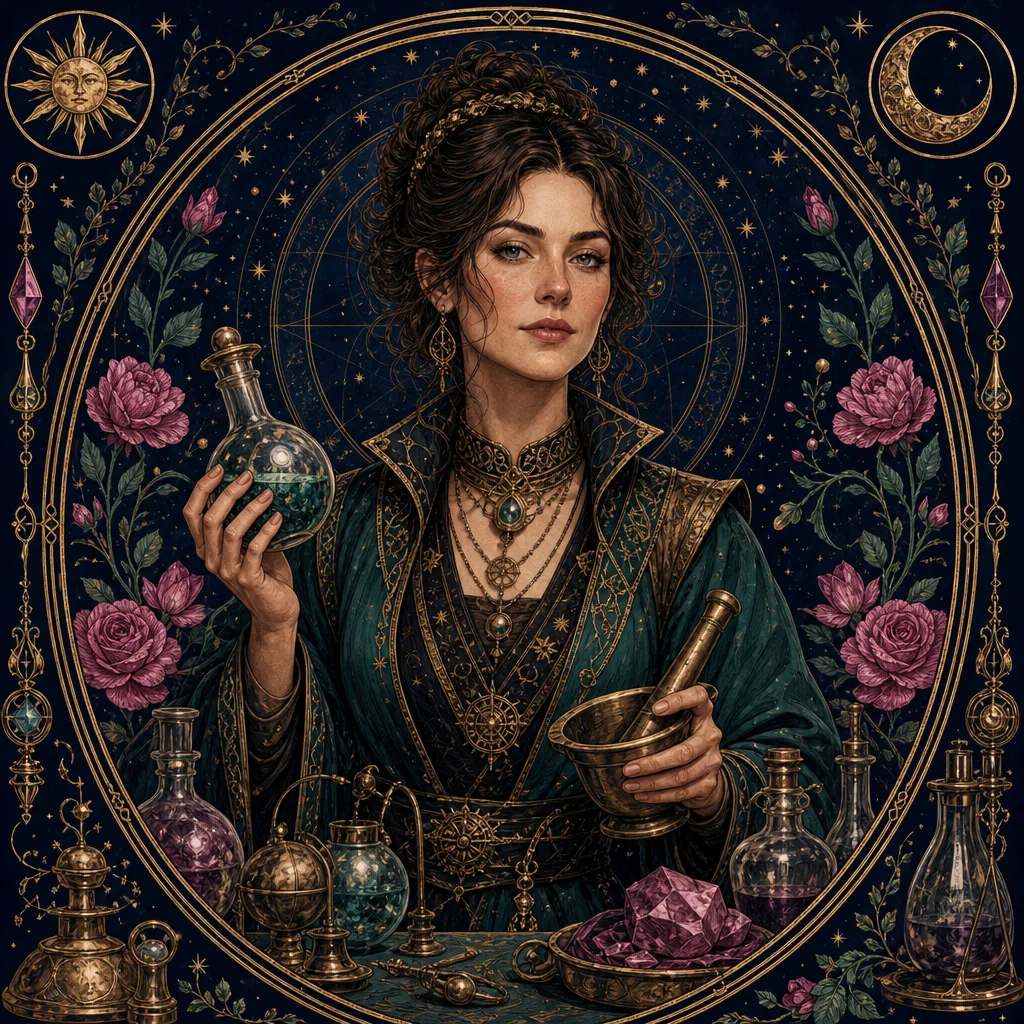
Scholars & Mystics
Alchemist
Also called spagyrist, philosopher-chemist
An alchemist is a practitioner who works with the transformation of matter and consciousness in pursuit of perfection, most famously seeking the Philosopher's Stone that would transmute base metals into gold and provide a universal medicine. The deeper tradition understands these material operations as simultaneously spiritual: the alchemist's true work is the refinement of their own soul.
- Tradition
- Hellenistic Egyptian, Arabic, European medieval and Renaissance; parallel traditions in Chinese and Indian alchemy
- Standing
- Open
A profile of the Alchemist
The alchemist is the patient philosopher in the smoke-stained laboratory, who understands that the lead in the crucible and the lead in the soul are the same substance and require the same art to perfect.
- Loves
- the Emerald Tablet and its commentaries, the smell of alcohol distilling, old alchemical manuscripts with illustrations, the philosophical writings of Paracelsus, the patience that the furnace teaches.
- Hobbies and pastimes
- tending the athanor through the night, collecting historical alchemical glassware, growing medicinal plants for spagyric preparation, studying the symbolic iconography of the Rosarium Philosophorum.
- Dream familiar
- The pelican, who in heraldic legend feeds her young with her own blood, the very image of sacrificial transformation and the vessel that feeds itself to make gold.
- Found in their element
- The alchemist is found in a stone-floored laboratory where the air smells of herbs and mineral vapours, surrounded by glassware in various stages of a months-long operation.
- Signature objects
- the alembic for distillation, a retort and athanor furnace, palm-sized sulphur, mercury, and salt preparations, a laboratory notebook dense with symbols, a worn copy of the works of Jabir ibn Hayyan.
An alchemist is a practitioner who works with the transformation of matter, consciousness, and soul through a tradition of philosophy, laboratory practice, and spiritual discipline that spans more than two thousand years and three continents. The most famous goal of alchemy is the production of the Philosopher’s Stone, a substance said to transmute base metals into gold and to serve as a universal medicine; but the tradition’s deeper purpose, articulated more or less explicitly by different practitioners in different periods, is the perfection of the practitioner alongside the perfection of the material they work with. The alchemist who truly transforms a substance is simultaneously transformed.
The alchemical worldview holds that matter is alive with qualities, that metals and plants carry spiritual principles that can be separated, purified, and recombined in more perfect forms, and that the laboratory operations of dissolution, distillation, calcination, and conjunction are not merely physical but operate simultaneously on the subtle dimensions of the substances involved. This inseparability of material and spiritual is what makes alchemy a mystical and philosophical tradition and not merely an early form of chemistry.
The work
The working alchemist’s practice typically involves both study and laboratory operation. Study means immersion in the alchemical corpus: the Emerald Tablet, which condenses the entire tradition into a few dense sentences; the works of Jabir ibn Hayyan (Geber), whose 9th-century Arabic texts established systematic laboratory method; Paracelsus, who reformed alchemy in the 16th century and developed spagyric medicine; and the rich symbolic literature of European alchemy from the 16th and 17th centuries, including the Rosarium Philosophorum and the work of Michael Maier.
Laboratory alchemy begins with the spagyric work on plants: separating the three principles of sulphur (the essential oil or volatile spirit), mercury (the alcohol), and salt (the purified mineral ash), purifying each, and recombining them in a preparation understood to carry the plant’s healing virtue in concentrated and spiritually active form. This practical work with plants is considered an appropriate and rewarding beginning for students before they attempt mineral or metal work, which requires more specialised equipment and considerably more experience.
The inner or spiritual dimension of the work runs parallel to the laboratory operations. The nigredo, the phase of dissolution, putrefaction, and death, corresponds both to the blackening of a substance in the laboratory and to the experience of confronting one’s own shadow, limitations, and mortality. The subsequent phases, whitening, yellowing, and reddening, correspond to progressive stages of inner purification and illumination. Many practitioners who work without laboratory access practice alchemy purely as an inner path, using its symbolic map as a framework for understanding and working with their own transformative experiences.
History and tradition
Alchemy emerged in Hellenistic Egypt, where Greek philosophical ideas about the four elements, the Stoic pneuma (spirit that pervades and animates matter), and Egyptian metallurgical practice met and fused. The earliest alchemical texts, attributed to authors such as Zosimos of Panopolis (c. 300 CE), are already philosophically sophisticated, treating laboratory operations as spiritual allegory and speaking of the transformation of the practitioner alongside the transformation of matter.
Arab scholars of the 9th and 10th centuries systematised and enormously extended the tradition, producing the vast corpus associated with Jabir ibn Hayyan and developing laboratory equipment and method that shaped chemistry for centuries. European alchemy received this Arabic transmission through the great translation movement of the 12th century and flourished through the medieval and Renaissance periods, attracting practitioners including Roger Bacon, Albertus Magnus, and John Dee. Paracelsus in the 16th century reformed the tradition away from gold-making toward medicine, establishing the spagyric tradition that continues today.
Chinese alchemy, known as waidan (outer alchemy, working with minerals and metals) and neidan (inner alchemy, working with breath, visualisation, and energy within the body), developed independently and produced its own sophisticated tradition deeply integrated with Taoism. Indian rasayana shares important structural similarities with Western alchemy and developed in equally sophisticated ways within an Ayurvedic and tantric framework.
Walking this path
The alchemical path rewards commitment to primary sources. Dennis William Hauck’s “The Complete Idiot’s Guide to Alchemy” provides an accessible entry point; his subsequent works go deeper. Adam McLean’s Alchemy Website provides extensive access to historical texts and imagery. The works of Manly P. Hall offer context for the symbolic tradition, and Frater Albertus’s “Alchemist’s Handbook” offers practical instruction in spagyric work.
Finding community is particularly valuable in alchemy because the tradition has historically been transmitted through apprenticeship and the judgment of experienced eyes in the laboratory is genuinely important. The International Alchemy Guild holds annual conferences and connects practitioners. Paracelsus College offers both online and in-person instruction in spagyric medicine.
The alchemist’s path is one that rewards patience above all. The tradition counsels that the work cannot be hurried, that nature proceeds at her own pace, and that the practitioner who tries to force results will fail where the one who attends and cooperates will succeed. This patience is itself a spiritual teaching, and the laboratory becomes a place where it is practiced in the most concrete and immediate way.
In myth and popular culture
The alchemist is one of the most persistently compelling figures in Western imagination, and the reasons are not hard to find: the idea that matter can be perfected, that the practitioner is transformed alongside the substance they work, and that there is a single philosophical key that unlocks the secret structure of the world makes for endlessly generative fiction. The historical alchemists themselves fed this imagination richly. Paracelsus (1493-1541) left behind an enormous body of writings on medicine, philosophy, and magical natural science that later writers mined for centuries. John Dee, court astrologer to Elizabeth I and the founder of Enochian magic, had a working alchemical laboratory and corresponded with European courts on alchemical matters. Nicolas Flamel, a 14th-century French scribe, became the subject of elaborate legends claiming he had achieved the Great Work and gained immortality, legends that were almost entirely post-mortem inventions but that proved irresistible.
Ben Jonson’s play The Alchemist (1610) is the sharpest satirical treatment of the tradition in English literature, presenting two con men who fleece London citizens with false promises of alchemical gold during a plague year. Jonson knew the alchemical literature well enough to make the fraud convincing, and the play captures with precision the gap between the tradition’s genuine philosophical content and the spectacular promises of its charlatans. Goethe’s Faust (1808-1832) presents a character who has exhausted academic learning — including alchemy — and is driven to a pact with Mephistopheles out of despair at the limits of what the rational and esoteric arts can offer. Wagner, Faust’s assistant in Part One, is a comic version of the narrow laboratory alchemist who mistakes the shell of the work for its substance.
In contemporary fiction, Paulo Coelho’s The Alchemist (1988) uses alchemical symbolism as a framework for a parable about following one’s destiny, though the book’s engagement with the historical tradition is more symbolic than technical. Patrick Süskind’s Perfume (1985) is a more unsettling treatment: the protagonist Jean-Baptiste Grenouille pursues the Great Work in olfactory terms, seeking a perfect essence, and the novel uses alchemical structure (nigredo, albedo, rubedo) with real precision while building toward a deeply disturbing conclusion. In film, the figure of the alchemist appears most literally in the Harry Potter series through Nicolas Flamel, who is introduced as the maker of the Philosopher’s Stone in the first book and film (1997 and 2001 respectively), and who is depicted as genuinely ancient, having drunk the Elixir of Life. The portrayal sticks close to the legend rather than the history.
People also ask
Questions
Is alchemy the precursor to chemistry?
Alchemy contributed significantly to the development of laboratory chemistry, producing many important discoveries in metallurgy, pharmacology, and material science. But alchemy was never merely proto-chemistry: its practitioners held that matter, consciousness, and spirit were inseparable, and that working with physical substances was simultaneously working with inner realities. Modern chemistry retained the material operations and discarded the spiritual framework.
What is the Philosopher's Stone?
The Philosopher's Stone (or Philosopher's Stone) is the supreme goal of many alchemical traditions: a substance that, once made, could transmute base metals into gold, cure all illness, and confer spiritual perfection on its maker. Some alchemists pursued it as a literal material substance; others understood it as a symbol for the perfected self or the divine presence within matter.
What is spagyrics?
Spagyrics is the branch of practical alchemy that works with plant medicine, extracting the three alchemical principles (sulphur, mercury, and salt) from medicinal plants and recombining them in a purified preparation understood to be more medicinally potent and spiritually active than simple herbal preparations. Spagyrics is practiced by contemporary herbalists and alchemists who work within this tradition.
What is the Great Work?
The Great Work (Magnum Opus) is the alchemical process of perfecting a substance or soul through a sequence of operations often described in terms of colours: the nigredo (blackening, dissolution, death), albedo (whitening, purification, resurrection), citrinitas (yellowing, dawn, the awakening of solar consciousness), and rubedo (reddening, completion, the fully perfected state). The same sequence is understood to describe both laboratory work and inner transformation.
Is alchemy practiced today?
Yes. Contemporary alchemists work in several modes: laboratory alchemy working with minerals and plants; spiritual alchemy as an inner practice of transformation; and philosophical alchemy as a framework for understanding consciousness and reality. Organisations including the International Alchemy Guild and Paracelsus College support practicing alchemists and offer instruction.