Spirit Workers
Ancestor Worker
Also called ancestor veneration practitioner, ancestral healer
An ancestor worker is a spiritual practitioner who cultivates ongoing relationship with the spirits of their dead -- blood ancestors, chosen ancestors, and lineage spirits -- as the foundation and primary resource of their spiritual practice. Ancestor work appears across virtually all world cultures and traditions, and its contemporary form draws on many of these streams.
- Tradition
- Cross-cultural; African, Asian, European, and indigenous ancestor veneration traditions
- Standing
- Open
A profile of the Ancestor Worker
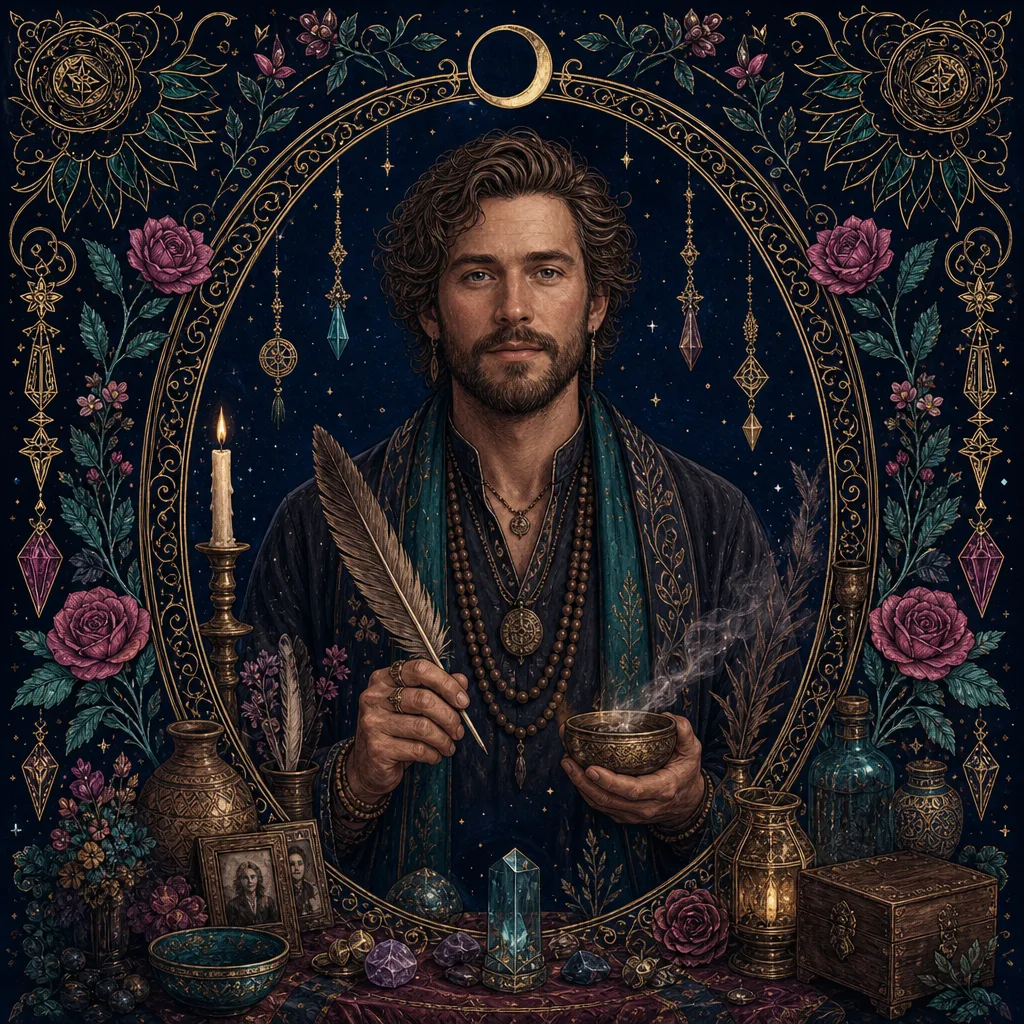
The ancestor worker is the living link in an unbroken chain, tending the dead with the same care a gardener gives to the soil that will feed the next season's growth.
- Loves
- old family photographs, fresh flowers on the altar, genealogical research and family stories, the practice of naming the dead aloud, the smell of incense in a quiet room.
- Hobbies and pastimes
- maintaining the ancestor altar daily, collecting and transcribing family oral histories, recording dreams and the communications that arrive in them, researching the folk traditions of their lineage's homeland.
- Dream familiar
- A raven with one eye silver as the moon, who carries messages between the living world and the place where the dead are gathered.
- Found in their element
- You find the ancestor worker at their altar before sunrise, speaking softly to the photographs of their dead while the candle burns and the water is changed.
- Signature objects
- a glass of fresh water on the altar, framed photographs of the known dead, a white candle kept burning during practice, a notebook of ancestral communications and dreams, offerings of food and drink specific to ancestors' known tastes.
An ancestor worker is a spiritual practitioner who places relationship with the dead — specifically the spirits of their own blood lineage, chosen ancestors, and broader ancestral categories — at the centre of their practice. The ancestor worker tends the relationship with those who have gone before, offering nourishment, remembrance, and communication, and in return receives from the well dead their accumulated wisdom, protection, and power.
Ancestor work is among the oldest and most universal of spiritual practices. Every culture that has left a record has some form of ancestor veneration, and the recognition that the dead remain present and relevant to the living appears to be one of humanity”s most consistent spiritual intuitions. The contemporary ancestor worker draws on this deep inheritance while developing a personal, ongoing, and living relationship with their own dead.
The work
The practical foundation of ancestor work is the altar. This is a dedicated physical space where the ancestors are honoured and where the relationship is maintained through regular offering and communication. The altar typically includes photographs or images of known ancestors, a glass of fresh water (offered for spiritual refreshment and clarity), a candle for light and connection, and regular offerings of food, drink, flowers, and incense. The specific materials and arrangement reflect the practitioner”s lineage, tradition, and the preferences expressed by their own dead through communication.
Regular practice is the discipline that distinguishes serious ancestor work from occasional acknowledgment. Most practitioners offer at their altars daily or several times a week, maintaining a consistent rhythm of light, water, and greeting. This regularity is what builds relationship: the ancestors come to know the practitioner”s presence as reliable, and the practitioner develops the perceptual sensitivity to notice their ancestors” responses, presences, and communications.
Communication takes different forms for different practitioners. Some receive impressions, images, or emotional tones during their altar practice. Some work with divination systems — particularly shells, cards, or pendulums — as structured tools for receiving ancestral guidance. Some work in dream, where ancestral contact is particularly common across traditions. Others simply speak aloud to their dead and trust that the communication is received, building the relationship through consistent address rather than waiting for perceptual confirmation.
Ancestral healing work addresses the reality that not all dead are in a state to offer clear, helpful guidance. Troubled, confused, or unhealed ancestors exist, and their unresolved patterns can affect living descendants in identifiable ways. Working with the well dead to identify and address these troubled ancestors — facilitating their healing rather than simply channelling their patterns — is a significant dimension of more advanced ancestor practice. Daniel Foor”s “Ancestral Medicine” framework has become an important resource for this dimension of the work.
The ancestor worker may also engage with broader categories of ancestral connection: the teachers and mentors who have died, the lineage of one”s spiritual tradition, the collective ancestors of one”s cultural heritage, and the ancient dead who are no longer personally identifiable but whose accumulated wisdom is available to those who call on it.
History and tradition
Ancestor veneration in its various forms is documented from the Palaeolithic onward. Evidence of offerings to the dead in burial contexts, care of bones, and practices suggesting ongoing communication with the departed appears in the earliest archaeological record of human spiritual behaviour. In every major civilisation — China, Egypt, Mesopotamia, Greece, Rome, India, pre-Columbian America — formal ancestor rites formed a cornerstone of religious and family life.
The specific traditions that inform contemporary ancestor work are diverse. West African ancestral traditions, maintained through the African diaspora in Candomble, Umbanda, Vodou, Santeria, and Hoodoo, offer some of the most robustly preserved and living ancestor-practice frameworks. East Asian ancestor rites, particularly Chinese, Korean, and Japanese forms, have maintained extraordinary continuity over millennia. Celtic and Northern European ancestral practices are being reconstructed from historical and archaeological evidence by practitioners in Heathenry and Celtic-tradition communities. Indigenous traditions worldwide have maintained their own ancestor practices, many of which remain living and are not available for outside adoption.
Contemporary ancestor work as a named practice draws on all of these streams, and practitioners including Daniel Foor, Malidoma Some, and many others have developed articulations of the practice that bridge traditional frameworks and contemporary Western context.
Walking this path
Ancestor work is among the most accessible entry points into spirit work precisely because the relationship it builds is inherently personal and specific to the practitioner”s own lineage. You are not approaching unknown spirits but your own dead, and the relationship comes with a natural foundation of connection.
The path begins with establishing the altar and beginning regular practice. Consistency matters more than elaborateness in the early stages: a simple altar tended daily builds more genuine relationship than an elaborate setup visited occasionally. Learning to offer water, light, and greeting every day, and developing the patience to wait for the relationship to deepen rather than demanding immediate dramatic results, is the foundation.
Reading in the tradition is valuable. Foor”s “Ancestral Medicine” is perhaps the most comprehensive contemporary guide to the deeper levels of this practice. Malidoma Some”s work provides a West African perspective. The specific scholarly literature on the ancestor traditions of your own lineage — whatever cultural heritage you carry — will enrich your practice in ways that generic ancestor-work guidance cannot.
Ancestor work is compatible with virtually any other magickal or spiritual practice, and many traditions treat it as foundational: you work with your dead first and from there develop all other spirit relationships. The necromancer, psychopomp, rootworker, and spirit worker all find ancestor work to be a natural starting point and ongoing foundation.
In myth and popular culture
The relationship between the living and the ancestral dead is one of the oldest and most universal themes in human storytelling, and it takes forms ranging from tender to terrifying across cultures and media. In Greek myth, the dead are present as shades who retain personality and feeling: Odysseus in Book XI of the Odyssey descends to the underworld to consult the prophet Tiresias and encounters his own dead mother, who cannot speak to him until she has drunk the blood offered to the dead. The scene captures the ancestor worker’s logic with striking precision — the living must nourish the dead in order to receive their counsel. The Roman practice of caring for the household dead, the Lares and Manes, gave the ancestor relationship a domestic, daily quality that is closer still to contemporary ancestor work: offerings, shrines, and regular acknowledgment as a normal part of household life.
In Japanese literature and film, the persistence and needs of the ancestral dead are a recurring preoccupation. The Bon festival, which celebrates the annual return of ancestor spirits to the family home, underlies countless works of Japanese literature and art. Hayao Miyazaki’s films return repeatedly to the theme of the spirit world intersecting with the human, and while his primary concern is with nature spirits, the structural logic of relationship, obligation, and reciprocal care between humans and non-human beings is continuous with ancestor work’s premises. The ghost films of Japanese cinema, from Masaki Kobayashi’s anthology Kwaidan (1964) to more recent horror films, often turn on the consequences of failed or neglected relationship with the dead.
Contemporary fiction has produced several works that engage seriously with ancestor work’s actual content. Toni Morrison’s Beloved (1987), set in the aftermath of American slavery, centres on a woman haunted by the spirit of her dead daughter and on the way unhealed ancestral trauma shapes and distorts the lives of the living. While Morrison’s framework is literary rather than spiritual-practical, the novel’s deepest concern — the obligation of the living to receive and heal what the dead carry — is exactly what contemporary ancestor workers describe as the most demanding dimension of the practice. In nonfiction, Malidoma Patrice Some’s memoir Of Water and the Spirit (1994) documents his experience of initiation and ancestor relationship within the Dagara tradition of Burkina Faso, and has become an important resource for contemporary practitioners precisely because it describes the relationship with the ancestral dead from inside a living cultural tradition.
People also ask
Questions
What is ancestor work?
Ancestor work is the deliberate cultivation of ongoing relationship with the spirits of the dead -- primarily one's own blood and chosen lineage, but potentially including other ancestral categories. It involves regular communication, offering, and service in exchange for the ancestors' guidance, protection, blessing, and support in daily life and spiritual practice. The relationship is reciprocal: the living give remembrance, nourishment, and care; the dead give their accumulated wisdom and power to those who honour them.
Do I need to know my ancestors' names or history to work with them?
No. Many people, particularly those whose family histories include adoption, loss of records, or the deliberate erasure of genealogical information through slavery and colonial displacement, cannot access the specific names and stories of their ancestors beyond a few generations. Ancestor work does not require this information: you can address and honour "all my well ancestors, those I know and those I do not know" and build relationship with the collective body of your lineage. What matters is intention, consistency, and genuine relationship rather than genealogical documentation.
What if some of my ancestors were harmful people?
This is a real and important question that ancestor-work traditions address directly. The practitioner does not work with troubled, unhealed, or harmful ancestors in the same way as with well and supportive ones. Many traditions -- particularly as developed by Daniel Foor in his "Ancestral Medicine" framework -- distinguish carefully between the "well dead" (ancestors who have completed their own healing and who offer genuine support) and those who are not yet in a position to be helpful. Working with the well dead first, and addressing troubled ancestors as a healing project rather than a resource, is the standard guidance.
What does an ancestor altar look like?
Ancestor altars vary by tradition, family culture, and personal development, but typically include photographs or representations of specific ancestors, a glass of fresh water (offered for refreshment and spiritual clarity), a candle (providing light for the dead and connection between worlds), food and drink offerings, flowers, incense, and objects that belonged to or are associated with specific ancestors. The altar is maintained regularly -- offerings refreshed, candles lit, communication offered -- as the physical expression of the ongoing relationship.
Is ancestor work specific to any culture?
Ancestor veneration appears in virtually every human culture that has been documented: Chinese ancestor rites, West African and African diaspora ancestor practice, Shinto ancestor veneration, Celtic and Northern European ancestral cult, indigenous American ancestor traditions, Hindu pitru puja, and many others. The specific methods, cosmological frameworks, and ritual forms vary enormously, but the fundamental recognition that the dead continue to exist and remain connected to the living is nearly universal. Contemporary practitioners often draw on multiple cultural streams while being careful to distinguish what belongs to specific living traditions.