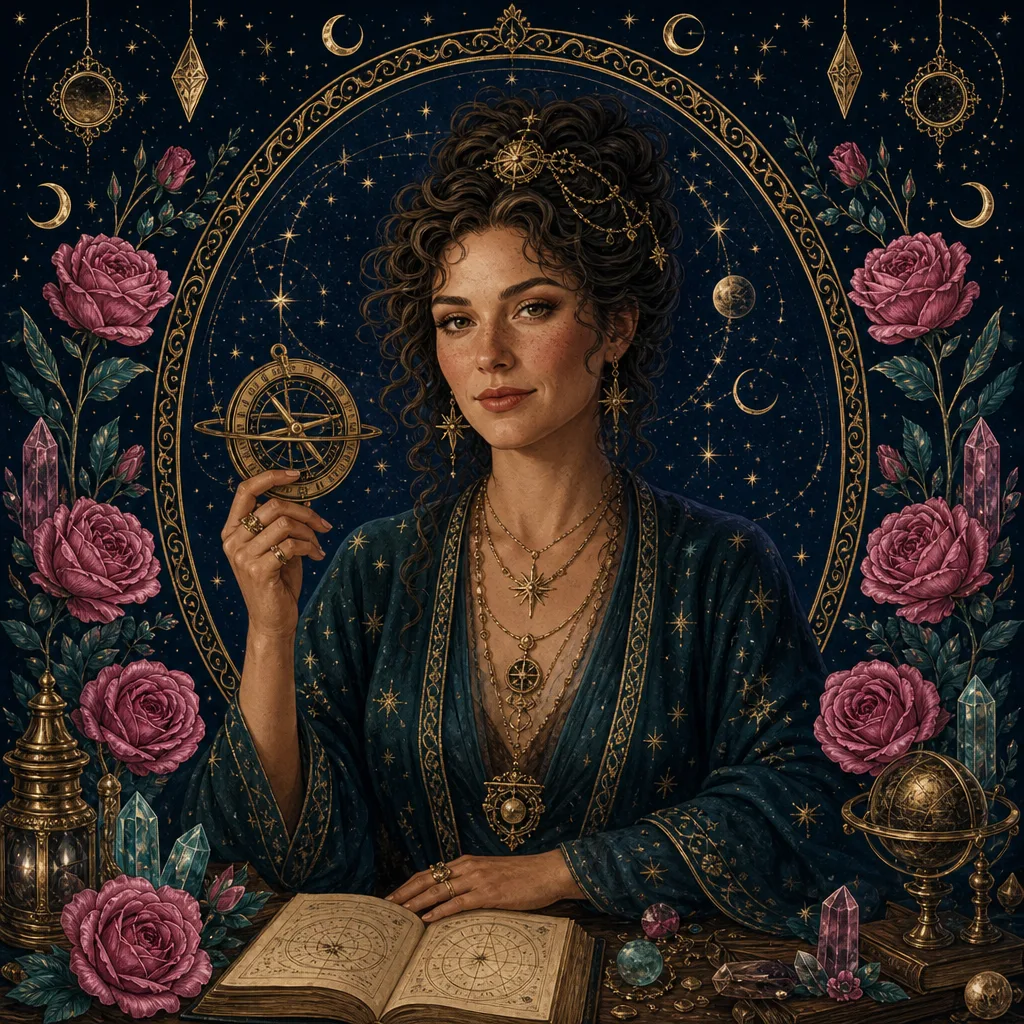
Diviners & Seers
Astrologer
Also called stargazer, horoscopist
An astrologer reads the positions of planets, luminaries, and other celestial points relative to Earth to interpret cycles, character, and timing. They translate the sky's symbolic language into practical guidance for individuals, groups, and events.
- Tradition
- Mesopotamian, Greek, Arabic, and Western modern synthesis; parallel traditions in Vedic (Jyotish) and Chinese astrology
- Standing
- Open
A profile of the Astrologer
The astrologer is a translator standing between the vast clock of the sky and the very particular, irreplaceable life of a single human being, finding the correspondence that makes both legible.
- Loves
- the quality of light during a significant transit, a precisely timed birth chart, the classical texts of Vettius Valens and Dorotheus, the moment a client recognises themselves in the chart, returning to the same chart over years and watching it unfold.
- Hobbies and pastimes
- tracking personal transits against a life journal, studying traditional and Hellenistic techniques, participating in astrological study groups, collecting historical ephemerides and star catalogues.
- Dream familiar
- An owl who has memorised every star by name and perches on the astrolabe at midnight, unimpressed by darkness.
- Found in their element
- The astrologer is found late at night at a desk covered in printed charts, a planning calendar beside them, working out the year ahead in planetary terms.
- Signature objects
- an ephemeris for the current and adjacent years, a set of chart wheels printed and annotated by hand, a dedicated notebook for client transit observations, a reference library of classical and modern texts, a quality astrology software subscription.
An astrologer is a diviner who reads the positions of celestial bodies as a symbolic map of earthly conditions, personal character, and unfolding time. The discipline holds that the sky at any given moment reflects and resonates with the qualities of that moment: the birth of a person, the founding of a nation, or the launch of an endeavour. An astrologer’s task is to read that correspondence with precision and to translate it into language that serves real human needs.
Astrology is one of the oldest continuous intellectual traditions in human history, and its modern practitioners inherit centuries of accumulated technique. The field encompasses natal astrology (the reading of birth charts), mundane astrology (the study of planetary cycles as they affect communities and nations), horary astrology (answering specific questions by reading the chart cast for the moment the question is asked), and electional astrology (choosing auspicious times for undertakings). A working astrologer may specialise in one or several of these branches.
The work
The astrologer’s foundational tool is the horoscope, a circular chart divided into twelve houses, with the positions of the Sun, Moon, Mercury, Venus, Mars, Jupiter, Saturn, Uranus, Neptune, and Pluto noted by zodiac sign and degree. Software has made chart calculation instantaneous, freeing the astrologer’s energy for interpretation. Beyond the natal chart, practitioners routinely work with transits (the current positions of planets relative to a natal chart), progressions (a symbolic time-scale in which one day of actual planetary movement represents one year of life), and solar returns (charts cast for the moment the Sun returns to its natal position each year).
Interpretation works through a layered logic. Each planet has a set of core meanings: Venus governs values, beauty, and relationship; Saturn governs structure, limits, and time. Each zodiac sign colours how a planet expresses: Venus in Aries expresses desire directly and urgently; Venus in Taurus is patient and sensual. Each house places that expression in a domain of life: the seventh house governs partnership, the tenth governs public role and career. Aspects add a further layer: a trine between Venus and Jupiter suggests ease and abundance in Venusian matters; a square between Venus and Pluto suggests intensity and potential for upheaval.
Many astrologers keep detailed records of their readings, tracking how transits and progressions manifested in clients’ lives over time. This empirical practice, returning to the same chart across years, is one of the sharpest tools for deepening skill.
History and tradition
Astrology originated in Mesopotamia, where Babylonian priests recorded celestial omens as early as the second millennium BCE. They observed that certain planetary configurations correlated with events of state: wars, famines, the deaths of kings. Greek thinkers synthesised Babylonian observation with their own philosophical framework, producing the twelve-sign zodiac and the system of planetary rulers and aspects that Western astrology still uses. The Hellenistic period (roughly 200 BCE to 200 CE) was enormously productive, generating foundational texts by Ptolemy, Dorotheus, and Vettius Valens.
Arabic scholars preserved and extended the tradition through the medieval period, adding considerable sophistication in timing techniques. Medieval Europe received astrology through Arabic transmission and considered it a legitimate branch of natural philosophy. The Renaissance saw astrology practised at the highest levels of court and church. Its gradual separation from mainstream natural science began in the 17th century, though it never disappeared and has experienced sustained revival since the early 20th century.
Vedic or Jyotish astrology developed in parallel in South Asia and has its own continuous lineage stretching back to the Vedic period, with a distinct body of classical texts and a rich living tradition of practitioners. Chinese and Mesoamerican cultures also developed sophisticated celestial interpretation systems that are properly understood on their own terms rather than as variants of Western astrology.
Walking this path
Most astrologers begin by studying their own chart intensively. Learning the symbols, understanding your own planetary placements, and watching transits move through your life builds both knowledge and the deep personal relationship with the sky that distinguishes a serious practitioner from a casual reader. The literature is vast: foundational modern texts by Liz Greene, Robert Hand, and Steven Forrest offer excellent starting points, and translations of Hellenistic texts are now widely available for those drawn to traditional methods.
Certification programmes exist through organisations such as the National Council for Geocosmic Research and the Association for Astrological Networking in North America, and through equivalent bodies in the UK, Europe, and Australia. These programmes offer structure, accountability, and community. Many astrologers work independently after a period of study without formal certification, building a client base through reputation and referral.
Astrology sits well alongside tarot, numerology, and other symbolic systems, and many readers combine them. It also resonates with psychological depth work, Jungian analysis, and contemplative practice. The path rewards patience, rigour, and genuine curiosity about human life.
In myth and popular culture
Astrologers appear throughout the literature and visual art of cultures that have taken the discipline seriously, which means most of pre-modern Eurasia. In the Hebrew Bible, the Magi who follow the star to Bethlehem in the Gospel of Matthew are most plausibly understood as Persian or Babylonian astrologer-priests, the word magi being cognate with the Zoroastrian priestly caste. Dante’s Paradiso (1320) describes the planetary heavens as spiritual realities through which the soul ascends after death, and the characteristics Dante assigns to each planetary sphere reflect the astrological symbolism of his time with remarkable precision. Shakespeare’s plays are saturated with astrological reference: the description of Edmund in King Lear dismissing the “excellent foppery of the world” in attributing human behaviour to the stars is Shakespeare staging the early modern debate between astrological determinism and human responsibility, not declaring his own position.
In the 19th and 20th centuries, astrology’s separation from mainstream science did not diminish its cultural presence but changed its character, as the rise of popular horoscope columns in newspapers (beginning in earnest with R. H. Naylor’s column in the British Sunday Express in 1930) brought sun-sign astrology to mass readership for the first time. This popularisation has coexisted with more serious technical astrological practice throughout the 20th and 21st centuries, and the two are often confused in popular discussion. The astrologer as a professional character appears in contemporary fiction as a figure ranging from charming fraud to genuinely insightful counsellor.
Margaret Atwood’s novel The Handmaid’s Tale (1985) includes an astrologer among the women in the underground resistance, a detail that functions as a marker of the pre-Gilead world’s tolerance for heterodox knowledge. Umberto Eco’s novel Foucault’s Pendulum (1988) features extended and accurate engagement with the history of occult traditions, including astrology, as part of its examination of how human minds build pattern from noise. In film, the figure of the court astrologer appears frequently in historical drama, often as an ambiguous counsellor whose interpretations are as much political as celestial. The television series Black Sails (2014-2017) features no astrologer, but mentions of celestial navigation remind viewers that astronomy and astrology were not yet fully separated in the early modern period. The most straightforward fictional treatment of a practising astrologer remains Liz Greene’s novelistic work, which is too didactic to be purely fiction but which dramatises the discipline’s methods through characters and their charts with unusual accuracy.
People also ask
Questions
What does an astrologer actually read?
An astrologer calculates the positions of the Sun, Moon, and planets at a specific time and place, then maps those positions onto a circular chart called a horoscope or natal chart. They interpret the planets, the zodiac signs they occupy, the houses of the chart, and the geometric angles between planets, called aspects.
What is the difference between Western and Vedic astrology?
Western astrology uses the tropical zodiac, which is anchored to the seasons, while Vedic (Jyotish) astrology uses the sidereal zodiac, which tracks actual star positions. They also differ in house systems, the planets emphasised, and interpretive techniques, though both traditions share ancient roots.
Is astrology a form of fortune-telling?
Most practicing astrologers describe their work as interpretation of cycles and tendencies rather than fixed predictions. Planetary patterns reveal climates and pressures, but human choice operates within those patterns. Timing astrology can indicate when certain themes are likely to be prominent without determining exact outcomes.
What is a natal chart reading?
A natal chart reading interprets the horoscope calculated for the moment of a person's birth at their birth location. The astrologer reads it as a symbolic map of the person's character, gifts, challenges, and the major cycles they are likely to move through during their life.
How long does it take to learn astrology?
Basic chart interpretation can be learned in months of dedicated study. Fluency in reading complex charts, timing techniques, and predictive work takes years of practice. Most serious astrologers describe themselves as students throughout their careers.