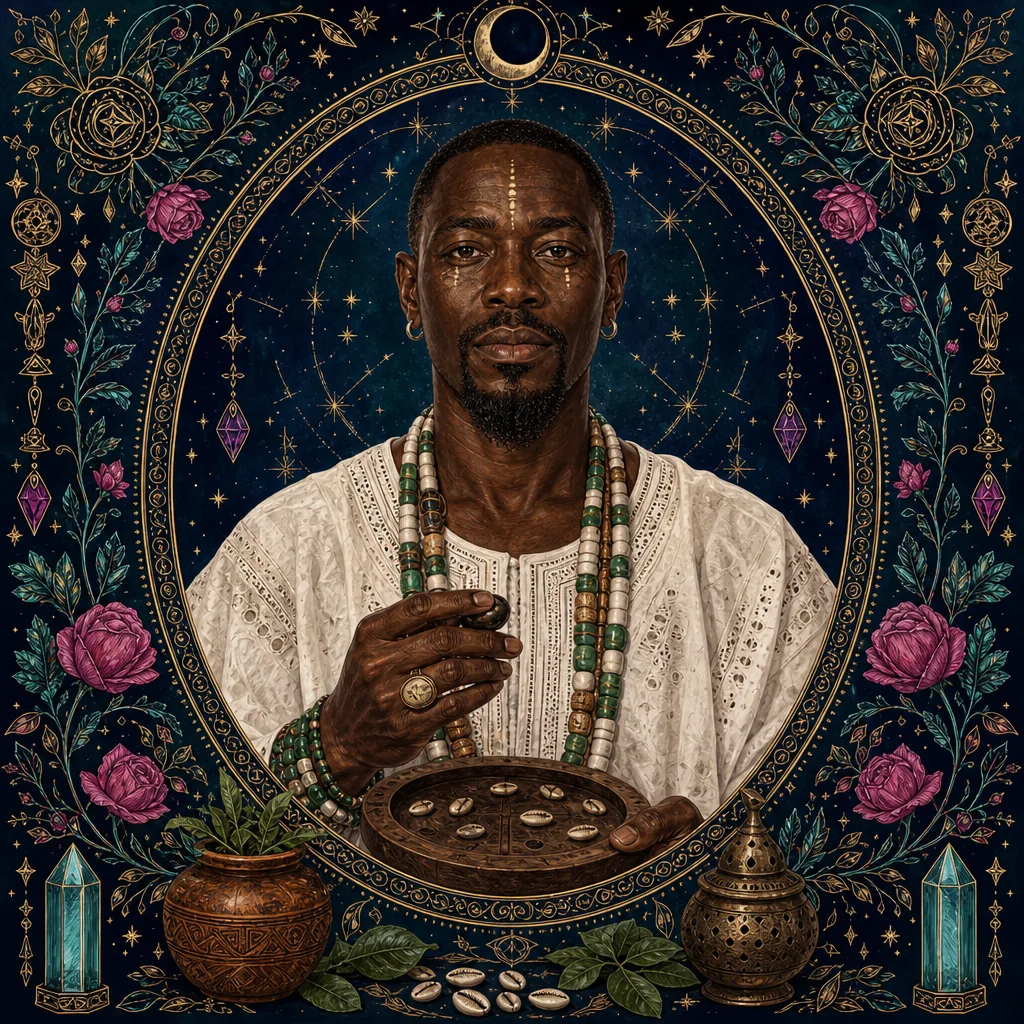
Spirit Workers
Babalawo
Also called Ifa priest, father of secrets
A babalawo is an initiated priest of Ifa within the Yoruba religious tradition, trained in the vast corpus of Ifa divination and serving as a spiritual advisor, healer, and keeper of the sacred knowledge of Orunmila, the orisha of wisdom and divination. This is a closed, initiatory role entered through the living Ifa lineage and available only through legitimate initiation within that tradition.
- Tradition
- Yoruba Ifa tradition; a living West African religion of the Yoruba people
- Standing
- Closed
A profile of the Babalawo
The babalawo is the father of secrets who has given his life to memorising the accumulated wisdom of Orunmila, so that Ifa's counsel reaches the person in front of him with precision and care.
- Loves
- the daily study of Ifa verses, the weight of palm nuts in the hand, the community that gathers around the tradition, the precision and beauty of Yoruba oral literature, the smell of fresh palm oil and herbs.
- Hobbies and pastimes
- daily review and memorisation of the Odu Ifa corpus, carving and caring for ritual objects, teaching students who are beginning their initiation studies, consulting with elders in the tradition.
- Dream familiar
- The parrot, Orunmila's own messenger bird, who carries words between worlds and speaks only the truth of what it has witnessed.
- Found in their element
- The babalawo is found in the consultation room with the opon Ifa before him, the palm nuts in hand, and a client seated across from him whose life's question fills the space between them.
- Signature objects
- the ikin, the sixteen sacred palm nuts, the opele divining chain, the opon Ifa, the wooden divination tray, irosun powder for marking the Odu patterns, the ile Ifa, the vessel housing the sacred palm nuts.
A babalawo is an initiated priest of Ifa — the divination system, sacred literary corpus, and religious tradition of the Yoruba people of West Africa and their global diaspora. The word means “father of secrets” in Yoruba, and it names one of the most demanding and respected priestly roles in any living religious tradition: the keeper and practitioner of the Ifa corpus, a body of sacred literature containing hundreds of thousands of verses that the babalawo has committed to memory, which they interpret and apply in the service of those who seek Ifa”s counsel.
This is a closed role. The babalawo”s authority, knowledge, and spiritual relationships are transmitted through initiation within the living Ifa tradition — not through self-study, not through online courses, and not through any form of credential that bypasses genuine initiation within a legitimate lineage. The Ifa tradition belongs to the Yoruba people, is maintained by the Yoruba people and their diaspora communities, and its priestly roles are theirs to confer.
The work
The babalawo”s primary work is consultation: receiving those who come with questions about their destiny, their health, their relationships, their decisions, and the forces affecting their lives, and consulting Ifa on their behalf. The consultation uses a set of 16 palm nuts (ikin) or a divining chain (opele) to generate one of 256 Odu patterns. Each Odu is associated with an enormous body of memorised oral literature — specific verses, stories, proverbs, and prescriptions — from which the babalawo draws what is relevant to the specific person in front of them.
Selecting the right verses from the vast corpus, interpreting their application to the client”s situation, and identifying the ebo (offering or ritual action) that Ifa prescribes all require the developed judgment that comes from years of intensive study and established relationship with Orunmila. The mechanical generation of an Odu pattern is the beginning of the work, not the end of it.
Ebo prescription and facilitation is a central responsibility. The prescriptions that emerge from Ifa consultation typically include specific ritual actions — offerings to specific orisha, specific substances used in specific ways, specific behaviours adopted or abandoned — that address the client”s situation. The babalawo may perform these ebos themselves or guide the client through performing them.
Priestly ceremonies for specific orisha, lifecycle ceremonies, and community leadership within the tradition also fall to the babalawo. The babalawo carries the weight of a priestly role in a full religious community, not merely that of a divination specialist, and this breadth of responsibility is inseparable from what the role is.
The training required for this work is substantial. The babalawo is expected to memorise the Ifa corpus — a body of material that takes many years of intensive daily study — and to continue deepening their knowledge of it throughout their life. Study begins before initiation and continues long after, and the elder babalawo with decades of study behind them possesses a depth of knowledge and interpretive capacity that the newly initiated cannot match.
History and tradition
The Ifa tradition is among the most extensively documented and academically studied religious traditions in sub-Saharan Africa. It belongs to the Yoruba people, whose civilisation — centred in present-day southwestern Nigeria, Benin, and Togo — has produced one of Africa”s richest artistic, philosophical, and religious legacies.
The Ifa corpus was transmitted orally for centuries before being committed to writing, and its scope is staggering: 256 Odu, each associated with a vast body of verses, stories, and prescriptions. The literary character of this corpus has been recognised internationally — UNESCO proclaimed the Ifa corpus an Intangible Cultural Heritage of Humanity in 2005, acknowledging both its depth as a literary tradition and the danger it faces from modernisation and displacement.
The Yoruba diaspora, produced primarily through the transatlantic slave trade, brought the orisha tradition and Ifa to the Americas, where it took root and developed in the specific conditions of Cuba, Brazil, Trinidad, and other places. Cuban Lucumi/Santeria and Brazilian Candomble Nago both carry the Yoruba orisha and Ifa tradition in diaspora form, with their own lineages, adaptations, and internal debates about what authenticity requires. Today”s babalawo practice includes both Yoruba-based lineages in West Africa and diaspora lineages in the Americas and internationally.
The International Council for Ifa Religion (ICIR), established in the 1990s, represents Ifa communities across multiple countries and has issued guidance on initiation standards and protection of the tradition. The diversity of Ifa communities worldwide means that debates about practice, initiation standards, and tradition management are active and ongoing within the tradition itself.
Walking this path
The babalawo role is not walked from outside the tradition. It is entered through itefa initiation — a specific, multi-stage ritual process conducted within a legitimate Ifa lineage by established babalawo, which establishes the initiate”s personal relationship with Orunmila and begins the transmission of the Ifa corpus. This initiation requires genuine engagement with the tradition, real financial investment, and the establishment of an ongoing relationship with an Ifa community that will support and evaluate the initiate”s development.
For those not from Yoruba or Yoruba-diaspora backgrounds who feel genuinely drawn to Ifa: the tradition has historically accepted people of any background whom Ifa itself has called, and there are non-Yoruba babalawo who have been legitimately initiated within the tradition. But the path requires honest engagement with what initiation actually involves — not a symbolic gesture or a purchased certificate but a real, demanding, lifelong religious commitment made within a real community.
What is not available is the title, authority, or knowledge of the babalawo role outside of genuine initiation. The claim to be a babalawo without legitimate lineage initiation is not a spiritual style choice but a misrepresentation that the Ifa community has the standing and the capacity to evaluate. Respect for this tradition begins with taking seriously its own account of what its priesthood requires.
For those who wish to learn about Ifa, excellent scholarly resources exist. Wande Abimbola”s work — including “Ifa: An Exposition of Ifa Literary Corpus” — provides a depth of engagement by one of the tradition”s own leading scholars. J. Lorand Matory”s work addresses Yoruba religion and its diaspora. These resources can ground genuine curiosity without claiming what is not yours to claim.
In myth and popular culture
Orunmila, the orisha whose knowledge the babalawo channels, appears in the Yoruba mythological corpus as a figure who was present at creation and who witnessed the destiny (ori) assigned to each human being before they descended into the world. The Ifa oral literature itself — the 256 Odu with their thousands of verses — constitutes one of the largest bodies of living oral mythology in the world, and its stories of the orishas, of humans navigating their destinies, and of the relationships between the divine and earthly realms are as rich and complex as any literary mythological canon. These narratives have been recorded and translated by scholars including Wande Abimbola, whose published collections give non-Yoruba readers genuine access to the literary character of what the babalawo memorises and applies.
The figure of the Ifa diviner has been depicted with unusual care in some recent literary and film work. The Nigerian novelist Amos Tutuola drew on Yoruba oral tradition in works including The Palm-Wine Drinkard (1952) and My Life in the Bush of Ghosts (1954), which introduced Yoruba spiritual and mythological concepts to international literary audiences; his narrators encounter spirit beings, perform prescribed actions, and navigate a universe in which Ifa’s logic of destiny, sacrifice, and prescribed remedy is structurally present even where the babalawo does not appear explicitly. Wole Soyinka, the Nobel laureate, draws on the Yoruba orisha tradition throughout his dramatic and poetic work, and his engagement with Orunmila and Ifa is substantive and rooted in the tradition.
In film, Fernando Meirelles and Katia Lund’s City of God (2002) includes practitioners of Candomble and orisha religion in its portrait of Rio de Janeiro, reflecting the living presence of Yoruba-descended tradition in Brazilian culture. More directly, various documentary films have been made about Ifa divination in Nigeria and in the diaspora, including work by ethnomusicologists and religious scholars that captures babalawo practice in real consultation contexts. These documentaries, while not entertainment fiction, are the closest thing to an accurate portrayal of the babalawo at work that outside audiences can access, and they confirm the extraordinary complexity and depth of the knowledge the babalawo carries.
People also ask
Questions
What is Ifa?
Ifa is a divination system, a body of sacred literature, and a religious tradition of the Yoruba people of West Africa (primarily present-day Nigeria, Benin, and Togo) and their diaspora. The Ifa corpus -- called the Odu Ifa -- consists of 256 literary volumes containing thousands of poems, stories, proverbs, ritual prescriptions, and philosophical teachings that the babalawo memorises and interprets in the course of divination. UNESCO recognised the Ifa literary corpus as an Intangible Cultural Heritage of Humanity in 2005.
Who is Orunmila?
Orunmila is the orisha (divine being) of wisdom, divination, and destiny in the Yoruba tradition. He was present at the creation of human beings and witnessed the destiny (ori) that each person was assigned. Ifa divination gives the babalawo access to Orunmila's knowledge of destiny, allowing specific guidance for specific people in specific situations. The babalawo serves Orunmila and is understood as speaking with his knowledge when consulting the oracle.
How does Ifa divination work?
Ifa divination involves the babalawo using a set of 16 palm nuts (ikin) or a divining chain (opele) to generate one of 256 Odu patterns. Each Odu is associated with a vast body of memorised oral literature -- the Ifa corpus -- from which the babalawo draws specific verses relevant to the client's situation. Interpreting which verses apply and what they prescribe for the client requires years of study and the babalawo's developed capacity to select appropriately from the corpus. The prescription typically includes specific ebos (offerings or ritual actions) to be performed.
Why is the babalawo role closed?
The babalawo role is closed because it is a priestly role within a living religion belonging to the Yoruba people, entered through initiation that confers specific spiritual relationships, knowledge, and authority that cannot be self-granted or acquired through study alone. Ifa initiation (itefa) establishes the initiate's personal relationship with Orunmila through specific ritual procedures, and the transmission of the Ifa corpus occurs within that initiatory relationship. The Ifa tradition itself -- through the International Council for Ifa Religion and other bodies representing Yoruba and diaspora Ifa communities -- is explicit that the babalawo role requires legitimate initiation and cannot be conferred by internet study or self-declaration.
How does Ifa relate to traditions like Santeria or Candomble?
Ifa and the orisha tradition of the Yoruba people spread through the African diaspora via the transatlantic slave trade, producing related but distinct traditions in Cuba (Lucumi/Santeria/Regla de Ocha), Brazil (Candomble Nago), Trinidad, and other places. The babalawo tradition of Ifa spread with this diaspora and developed in diaspora contexts. Contemporary Ifa practice includes both the original Yoruba tradition in West Africa and diaspora lineages, and both are legitimate, though they have developed differently. The babalawo in diaspora contexts is part of these living traditions.
Can women become babalawo?
This is a debated question within the Ifa tradition itself, and the answer depends on which lineage is asked. Traditional Yoruba practice has restricted the babalawo role to men, while some diaspora lineages and contemporary voices within the tradition have argued for the inclusion of women. The debate is active and ongoing within the tradition, and it is not for outsiders to resolve. Women in the Yoruba tradition may be initiated as iyanifa (a female practitioner who works with Ifa) in some lineages.