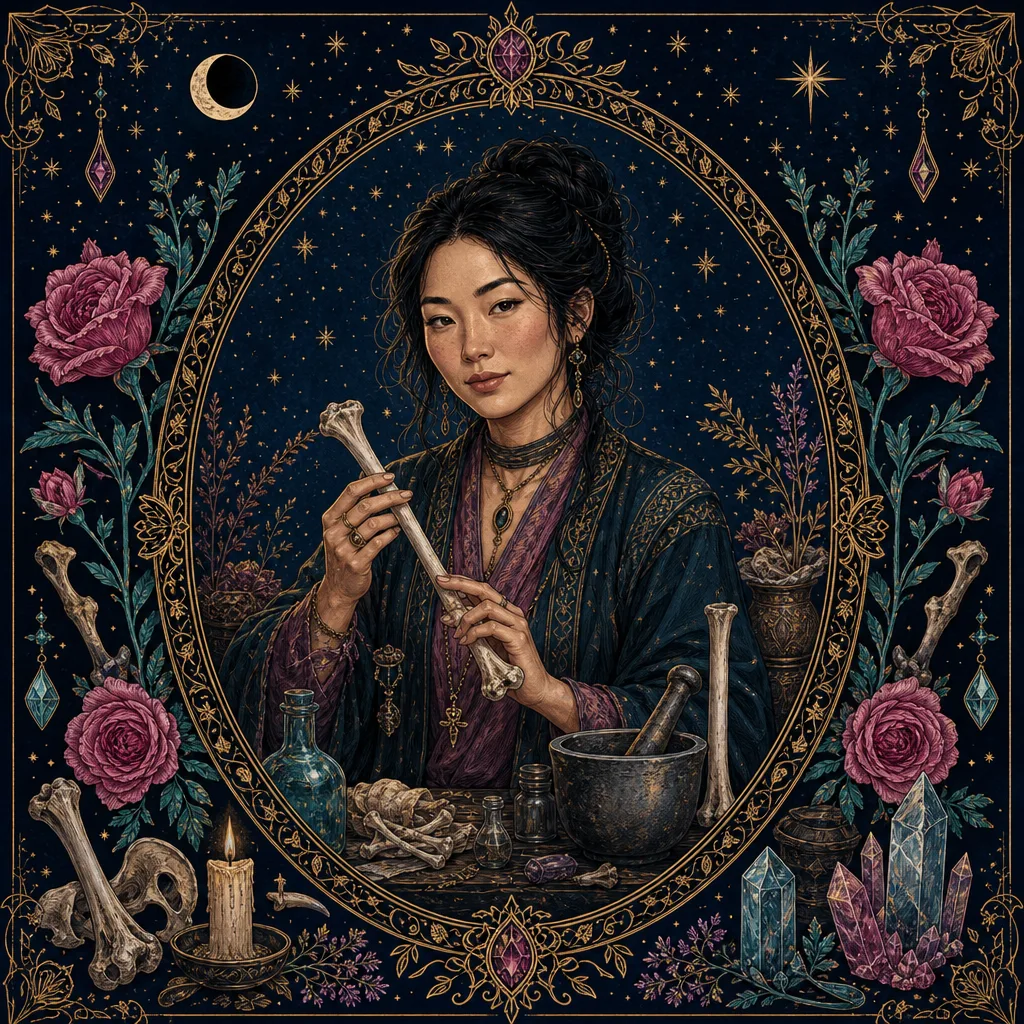
Healers & Wise Folk
Bone Setter
Also called Bonesetter, Joint Setter, Folk Osteopath
A bone setter is a folk practitioner who manipulates bones and joints to treat dislocations, fractures, sprains, and musculoskeletal pain, typically combining physical manipulation with spoken charms, prayers, and ritual elements understood to make the physical treatment effective. Bone setting represents one of the oldest documented forms of practical folk medicine in the world.
- Tradition
- Present in virtually all human cultures with documented medical history; particularly well-attested in British, Irish, Welsh, and Middle Eastern traditions
- Standing
- Open
A profile of the Bone Setter
The bone setter is the neighbour who knows your skeleton better than the doctor who studied textbooks, whose hands have a memory all their own, and who speaks the old words quietly while they work.
- Loves
- the logic of the skeleton under the hand, family knowledge passed down without a book, the satisfaction of a joint returning to place, the gratitude of someone who walked in limping and left upright, the old Welsh and Irish charm formulae.
- Hobbies and pastimes
- studying anatomy through touch rather than illustration, collecting and transcribing folk charm texts, herbal poultice preparation for post-manipulation care, keeping case records across years of practice.
- Dream familiar
- A heron, patient and anatomically precise, who stands in the shallows on one leg without any apparent effort and understands the exact angle of every joint in its body.
- Found in their element
- The bone setter is found in a quiet back room of a farmhouse or a small workshop, someone's dislocated shoulder already beginning to ease under their steady hands.
- Signature objects
- hands trained over decades of practice, a linen bandage for aftercare strapping, a poultice of comfrey leaf and beeswax, a family charm book written in a grandparent's hand, a low stool for the patient to sit on during treatment.
A bone setter is a folk practitioner who treats musculoskeletal injuries, dislocations, joint disorders, and related physical conditions through manual manipulation of bones and soft tissue, typically combining this physical treatment with verbal charms, prayers, or ritual elements understood as integral to the treatment”s effectiveness. Bone setting is one of the oldest forms of practical folk medicine attested in the historical record, with documented lineages in the British Isles, Ireland, Wales, the Middle East, South and East Asia, and many other regions, and it represents a tradition of applied anatomical knowledge transmitted outside formal institutional frameworks for thousands of years.
The bone setter occupies a distinctive position in the landscape of folk healing because their practice is simultaneously highly practical and physical, requiring real skill in anatomical knowledge and manual technique, and embedded in a magical and spiritual framework that understands the healer”s words and the healer”s gift as components of treatment no less important than their hands. This integration is characteristic of folk medicine more broadly but is particularly striking in bone setting because the physical nature of the problem treated makes the effectiveness of the intervention relatively easy to evaluate.
The work
The bone setter”s work begins with assessment: handling the affected area carefully to understand the nature of the injury, distinguishing fractures from dislocations from sprains and identifying which structures are involved. This assessment may be conducted entirely through touch, without the imaging tools that modern orthopaedic medicine relies on, and the most experienced bone setters develop an exceptionally refined sense of skeletal and soft tissue structure through years of hands-on work.
Manipulation itself requires confidence and precision. A dislocation that has been sitting for some time may require considerable force applied in exactly the right direction to bring the joint back into position; applied wrongly the same force makes things worse. Most bone setters develop their technique through direct transmission from an experienced practitioner, because the feel of correct manipulation cannot be fully communicated in words or images. Family lineage transmission and direct apprenticeship are the primary channels through which this knowledge has been preserved.
The verbal element accompanies or follows the physical manipulation in most traditions that include it. In Welsh lineages, specific words known only within the family were spoken over the injury; in Irish traditions, prayers to saints whose domains included bones and healing were combined with the manipulation; in Middle Eastern traditions, Quranic verses or specific du”as accompanied the treatment. The relationship between the words and the physical technique is not incidental: most practitioners in these traditions hold that manipulation performed without the appropriate words is less effective, and that the gift for bone setting, where it is understood as a hereditary gift, includes both the physical knowledge and the access to the verbal formulae that activate it.
Aftercare instructions are a normal part of the bone setter”s treatment, typically involving rest, specific positions, and sometimes poultices or other herbal applications to the treated area. Follow-up assessment and additional manipulation as healing progresses have also been common parts of the practice in documented lineages.
History and tradition
Bone setting appears in some of the oldest medical records in the world. Egyptian papyri from the second millennium BCE describe manipulative treatment of dislocations and fractures. Hippocratic medicine in ancient Greece included extensive discussion of reduction techniques for dislocations. Arabic medical literature of the medieval period, drawing on Galenic sources and its own empirical tradition, documented bone setting methods in considerable detail.
In the British Isles the bone setter”s role is particularly well-documented in the early modern period. The Whitworth family of Wales produced famous bone setters across several generations from the seventeenth century onward, their fame eventually reaching London where they attracted wealthy clientele. Sarah Mapp of Epsom, a celebrated eighteenth-century bone setter known as “Crazy Sally,” successfully treated cases that leading London physicians had failed with, demonstrating to uncomfortable effect that the folk practitioner could outperform the credentialed professional.
James Watt, the engineer, and Percival Pott, a distinguished surgeon, both recognized the effectiveness of folk bone setting and the embarrassment it represented for the medical profession. When James Renfrew White established the connection between the folk bone setter and the emerging profession of osteopathy in the late nineteenth century, he acknowledged that osteopathy had developed from and refined the bone setting tradition rather than having invented manipulative therapy independently.
In Ireland the bone setting tradition has been particularly persistent. The Sheela Creighton family in County Monaghan, among others, maintained active bone setting lineages into the twentieth century and have been the subject of folklore scholarship documenting their methods, their transmission protocols, and the community relationships that sustained their practice.
Walking this path
Contemporary practitioners who wish to work in the bone setting tradition face the challenge that the primary channel of transmission, family lineage, is not available to everyone, and that the practical skills involved carry genuine risk if poorly learned. The safest and most effective path into serious work with manual therapy is structured training in osteopathy, chiropractic, or physical therapy, which provides the anatomical knowledge and supervised clinical practice that make hands-on work with the musculoskeletal system genuinely safe.
Those with family or community connections to an active bone setting lineage have the opportunity to learn through the traditional channel of direct transmission, and where this is available it is invaluable precisely because it carries the accumulated practical wisdom of generations in a form that textbooks cannot fully convey.
The verbal and magical element of the tradition is documented in folklore scholarship and in the accounts of practitioners themselves, and can be engaged with thoughtfully and respectfully by anyone who understands the tradition. The integration of physical skill with verbal or ritual elements that is the bone setter”s distinctive mark also characterizes the folk healer, the wise woman, and the wise man, and the bone setter role sits naturally within this family of integrated physical-and-spiritual healing practices.
In myth and popular culture
The folk healer who works with bones and joints appears in the medical and magical literature of many cultures, and the most historically documented individual bone setters have attracted considerable popular interest. Sarah Mapp of Epsom (c. 1706-1737), known widely as “Crazy Sally,” is perhaps the most vivid figure: a self-trained bone setter of extraordinary skill who treated London”s wealthy clientele at a time when orthodox medicine could not match her results, she was caricatured in William Hogarth”s print The Company of Undertakers (1736), appearing alongside two prominent physicians in a satirical image of the medical establishment. The combination of mockery and genuine fame captures the bone setter”s ambiguous cultural position precisely. Mapp”s story has attracted attention from historians of medicine, and she appears in various accounts of British folk medicine and women”s medical history.
The Whitworth family of Wales, whose bone setting practice spanned multiple generations from the 17th century into the 19th, became the subject of Welsh folklore and were consulted by clients from considerable distances. Their practice was studied by early folklore scholars and is one of the best-documented examples of family-transmitted bone setting in the British Isles. The Irish bone setting tradition produced comparable family lineages, and folklorists including Sean O”Sullivan documented these practitioners as part of the broader tradition of Irish folk healing in the 20th century.
In fiction the bone setter as a character is rarer than other folk healers, partly because the role”s primary claim is physical skill rather than spiritual authority, and fiction tends to prefer the more overtly dramatic. The healer whose hands know what is wrong and whose words complete the cure appears more often as a secondary figure in historical fiction than as a protagonist: the village woman called in when the doctor cannot reduce a dislocation, the old man whose family has been doing this for generations, the quiet practitioner operating at the edge of official medicine”s notice. George Eliot”s Middlemarch (1871-1872), set in a provincial English town with a strong interest in the tensions between folk medical practice and the emerging medical profession, creates the atmosphere in which the bone setter would have worked without explicitly featuring one. The relationship between folk bone setting and the emergent professions of osteopathy and chiropractic is a genuine historical story that has not yet found its novelist, though it has found its historians.
People also ask
Questions
How is a bone setter different from an osteopath or chiropractor?
Osteopathy and chiropractic are modern professions that developed in the nineteenth century in explicit relationship to, and partly in reaction against, the folk bone setting tradition that preceded them. The bone setter typically works without formal credentials or institutional training, having learned through family transmission or apprenticeship, and typically combines physical manipulation with spoken charms or prayers as part of a single integrated treatment. Osteopaths and chiropractors have standardized training, professional regulation, and work within biomedical or at least systematic frameworks. The physical techniques, however, show considerable overlap, and both professional traditions borrowed from and refined the folk bone setter's empirical knowledge.
What does the magical element of bone setting look like?
The magical element varies by tradition and practitioner but typically involves spoken charms or prayers said while the manipulation is performed or immediately after it. In Welsh and Irish traditions these might be specific formulas passed down within the practitioner's family, understood to have power only when spoken by someone of the right lineage or with the right gift. In other traditions they take the form of Christian prayers to specific saints associated with bone and joint healing. The words are not understood as separate from the physical treatment but as part of a unified therapeutic act, and most practitioners in these traditions hold that the manipulation alone is less effective than manipulation accompanied by the appropriate verbal element.
Were bone setters recognized or persecuted by official medicine?
The relationship has been complex and varied by period and place. Some bone setters achieved considerable fame and were consulted by wealthy and aristocratic clients, even in the presence of licensed physicians who could not help them. The Royal Bone Setter Sarah Mapp in eighteenth-century England drew wealthy London clients despite (or alongside) mockery in the press. Other bone setters operated quietly at the margins of official medicine, trusted by their communities but ignored or disdained by institutions. The general pattern has been that bone setters were tolerated or even respected when they could produce results that orthodox practitioners could not, which was often.
Is bone setting still practised today?
Yes, in many parts of the world. In rural areas of Ireland, Wales, and Scotland, family lineages of bone setters have continued into the present. Middle Eastern and South Asian traditions of bone setting remain active. Many practitioners now describe themselves with terms that connect their folk lineage to recognized manual therapy professions, calling themselves bonesetter-osteopaths or similar. The specific folk element, the verbal charm accompanying the manipulation, is less often publicized but in some lineages continues as a private, family-transmitted element of the practice.
Can the bone setter's gift be learned or must it be inherited?
In many traditions the bone setter's gift is held to run in families and to pass through lineage in ways that cannot be fully transmitted to someone outside the family. In other traditions the practical skill can be learned through apprenticeship regardless of lineage, though some practitioners hold that the specific verbal charms are family-held secrets that retain power only in that family. In practice, both lineage and learning play roles, and many capable practitioners combine inherited knowledge with extended observation of skilled practitioners and considerable self-taught empirical refinement.