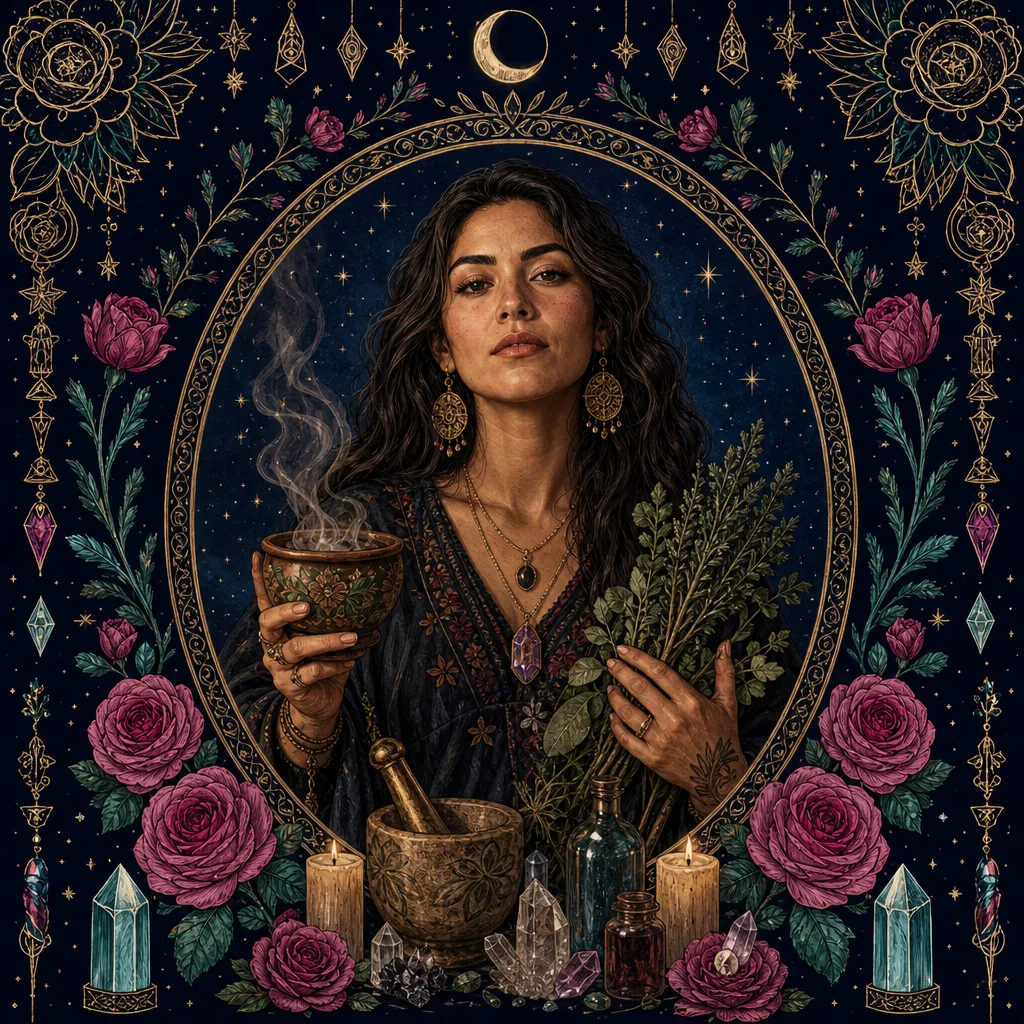
Folk Magick Practitioners
Brujo / Bruja
Also called bruja, brujo, hechicero, hechicera
A brujo or bruja is a Latin American folk practitioner of magic who works across a wide spectrum from healing and protection to malefic and defensive sorcery. The tradition varies considerably by country and community, drawing on indigenous, African, and Spanish Catholic sources, and remains a living part of folk religious and magical culture throughout Latin America and Latino communities worldwide.
- Tradition
- Latin American folk magic and brujería; varies by country and community
- Standing
- Culturally rooted
A profile of the Brujo / Bruja
The brujo or bruja is the person in the neighbourhood who understands how harm works because they understand how power works, and who will look you in the eye and tell you the truth about your situation before they lift a finger to help you.
- Loves
- copal smoke and the smell of fresh herbs, the Spanish baraja and what it shows, a well-stocked botanica, the folk saints who answer without asking too many questions, the resilience of communities that kept this knowledge alive.
- Hobbies and pastimes
- maintaining relationships with plant spirits in the garden, reading eggs after a limpia and learning from them, studying the specific regional traditions of their family's origin, collecting old cuadernos of spells and prayers from the community.
- Dream familiar
- A black cat who knows every threshold in the neighbourhood, slips through walls that stop everyone else, and comes home at dawn with useful information.
- Found in their element
- The brujo or bruja is found in their consulta, a candle burning beside the image of their patron saint, the cards already laid out before the client sits down.
- Signature objects
- a raw egg for cleansing and diagnosis, a baraja espanola or tarot deck, bundles of rue, romero, and albahaca for the limpia, candles in colours specific to the work at hand, a glass of water set for the spirits.
A brujo or bruja is a Latin American practitioner of folk magic whose work spans protection, healing, divination, and the active use of magical force to address enemies and alter conditions. The tradition known as brujeria is not a single unified system but a broad family of related practices shaped by the specific history, geography, and cultural synthesis of each Latin American region and community.
The role is morally complex in most of the cultures where it appears. Unlike the curandero, whose identity centres on healing, the brujo is understood as someone capable of working in both directions — of helping and of harming, of protecting and of attacking. This dual capacity is precisely what gives the brujo authority and what makes them feared as well as sought. In many communities, you consult a brujo because you need someone who understands how harm works from the inside.
The work
The brujo”s practice covers a wide territory. Protection work is central: identifying threats to a client, both human and spiritual; diagnosing conditions including mal de ojo (evil eye), susto (spiritual fright), envidia (harm sent through envy), and the effects of enemy work; and providing appropriate remedies and shields. The limpia — a ritual cleansing using eggs, herbs, prayer, smoke, or water — is one of the most widely used procedures, adapted to the specific tradition of each region.
Divination is a regular component. The brujo or bruja reads conditions through a range of methods: card reading (often a Spanish baraja or tarot deck), candle reading, egg divination (the contents of the cleansing egg read to diagnose the condition that was removed), cowrie shells in traditions with African influence, and direct spiritual perception. The diagnostic reading determines what kind of work is needed.
Offensive and defensive magical work — sending, binding, crossing, cursing — is within the brujo”s range, though how openly this is acknowledged varies by tradition and by the specific practitioner. The capacity to harm is often what gives the brujo their authority: a practitioner who can only heal and protect is less powerful than one who understands the full spectrum. But the brujo”s reputation is built on effective and targeted work, not indiscriminate harm.
Relationship magic, luck work, money magic, and justice work are also common offerings. The santeria-influenced brujos of Cuba and Puerto Rico work with the orishas; the bruja of Mexico may work with folk saints, with pre-Columbian spiritual beings, or with the spirits of the dead. The spiritual ecology is diverse and locally specific.
History and tradition
Brujeria as it is practiced today represents a long and complex history of cultural synthesis under colonial conditions. Spanish colonisation brought Catholicism, Inquisition prosecutions of folk magic, and European magical traditions. Indigenous peoples of the Americas had their own rich traditions of healing, divination, and what European observers called sorcery. The forced transportation of enslaved Africans brought additional spiritual and magical traditions. These streams did not blend smoothly — they met under conditions of violence and power imbalance — but they met, and what emerged from that encounter was distinct from any of its sources.
In Mexico, the brujo tradition draws heavily on Nahuatl and other indigenous conceptual frameworks: the tonalpohualli (the sacred calendar), the specific classes of spiritual beings in the indigenous worldview, and the complex understanding of the human person that includes multiple spiritual components. Spanish folk Catholicism layered over and syncretised with this, producing a tradition where folk saints, indigenous beings, and Catholic prayers coexist.
In Cuba, Puerto Rico, and the Dominican Republic, African-derived religious systems — Lucumi/Santeria, Palo Mayombe, Sanse, 21 Divisions — inform brujeria practice extensively, and the brujo may simultaneously be a practitioner within one of these traditions.
Walking this path
Brujeria is a cultural tradition rooted in specific Latin American and Latino communities, shaped by the history of colonialism, syncretism, and survival that defines those communities” experience. The tradition belongs to those communities first, and it is living, diverse, and actively evolving.
If you are from a Latin American or Latina/o/x background, your engagement with this tradition is an engagement with your own cultural inheritance. The specific traditions of your family”s place of origin — Mexican, Puerto Rican, Cuban, Guatemalan, and so on — have their own character, their own spiritual entities, and their own practices, and learning those specifics is more meaningful than a generic “brujeria” without regional grounding.
If you are outside these communities, approach the tradition with genuine respect for the cultures it belongs to. This means learning from Latin American and Latina/o/x practitioners and scholars, supporting practitioners from within the tradition, and being honest about what you are engaging with. Brujeria is not a generic Latin aesthetic or a collection of free-floating symbols — it is a living practice with specific cultural roots and specific communities who continue to hold it.
The brujo or bruja role can be held alongside other roles. Many practitioners combine brujeria with Spiritist practice, with African-derived religion, or with other folk traditions that have converged in their family or community. The tradition is syncretic by nature, and that adaptability is one of its enduring strengths.
In myth and popular culture
The figure of the brujo and bruja in Latin American folk tradition has generated a rich body of legend, cautionary tale, and narrative that reflects the role’s genuine cultural complexity. In Mexican folklore, the brujo is often associated with the nagual, the human practitioner who can transform into an animal, typically a black dog, coyote, or other night creature, to travel and work harm. The tlahuelpuchi of Tlaxcalan tradition is a related figure: a person born with the ability to transform and who must feed on blood, particularly the blood of infants, a figure that combines the social fear of the sorcerer with older pre-Columbian concepts of human-animal transformation. Ruth Behar’s ethnographic study Translated Woman (1993) documents the life of a Mexican woman who identified as a bruja and presents her self-understanding, her practice, and her social position with genuine ethnographic care.
In Puerto Rican and Caribbean tradition, the bruja’s relationship with Spiritism, the movement founded on the teachings of Allan Kardec and introduced to the Spanish-speaking Caribbean in the mid-19th century, has produced a distinct synthesis in which the bruja works with spirit guides, performs cleansings and protections informed by Spiritist practice, and operates within a cosmological framework that combines Kardecian spiritualism with African-derived and indigenous elements. This synthesis is documented in anthropological literature including works by Raul Canizares and others who have written from within the tradition.
In contemporary Latina/o/x literature and fiction, the bruja figure has undergone significant reclamation. Zoraida Cordova’s Brooklyn Brujas series (beginning with Labyrinth Lost in 2016) presents Latina bruja protagonists in a fantasy context that draws on real elements of brujeria practice, including the brujo family’s inherited knowledge, the botanica, and the complexity of magical work that can harm as well as heal. Carmen Maria Machado’s short fiction and Isabel Quintero’s poetry engage with the bruja figure as an emblem of inherited power and cultural survival. The reclamation of the bruja title in feminist and social justice contexts within Latina communities is a live cultural development, documented in academic work by scholars including Theresa Avila, and represents the tradition’s continuing capacity to generate meaning within its own communities rather than simply serving as material for outside imagination.
People also ask
Questions
Is being called a brujo or bruja positive or negative?
It depends entirely on the context and community. In many Latin American folk traditions, "brujo" and "bruja" carry an ambivalent charge: they name someone who works with powerful forces that can be used for both help and harm. A brujo is often feared as much as respected, and in some communities the term is primarily negative, associated with sorcery and malefic work. In other communities and among practitioners themselves, the title is claimed with pride as a marker of power and knowledge. The meaning is not fixed across the diversity of Latin American cultures.
How does brujería differ from curanderismo?
Curanderismo is specifically a healing tradition, and the curandero or curandera's primary identity is as a healer who addresses spiritual illness, physical ailment, and conditions like susto and mal de ojo. Brujería has a broader and more morally ambiguous scope, encompassing both protective and offensive magical work. In many communities, the curandero is trusted and sought out while the brujo is viewed with suspicion. In practice the roles can overlap: a single practitioner may be called both depending on what they are doing.
What spiritual frameworks does brujería draw on?
The sources vary dramatically by region. Mexican brujería draws on indigenous Nahuatl and other pre-Columbian magical and healing traditions, Spanish Catholic folk practice, and in some regions African-derived influences. Caribbean brujería (particularly in Puerto Rico, Cuba, and the Dominican Republic) draws heavily on Spiritism, Santería, Palo, and African-derived religious currents alongside indigenous Taino influences and Spanish Catholicism. Each regional tradition has its own character, its own spiritual entities, and its own methods.
What is mal de ojo and how does it relate to brujería?
Mal de ojo (the evil eye) is one of the most widely recognised conditions in Latin American folk belief. It is believed to be caused by an intense or envious gaze -- not necessarily intentional -- that causes illness, particularly in children. The brujo or bruja may both diagnose and treat mal de ojo, using eggs, herbs, prayer, and specific ritual procedures for the cleansing (limpia). The evil eye belief crosses cultural lines broadly, but its specific forms and treatments in Latin American tradition are culturally distinct.
Is brujería practised today?
Yes. Brujería is practised actively throughout Latin America and in Latino and Latina/x communities in the United States, Canada, and Europe. It adapts continuously to new urban and diaspora contexts while maintaining living roots in specific regional traditions. Many contemporary practitioners identify openly as brujos or brujas, and the term has been reclaimed in some feminist and social justice contexts as a marker of indigenous and folk knowledge in resistance to colonial erasure.