Diviners & Seers
Cartomancer
Also called card reader, playing card reader
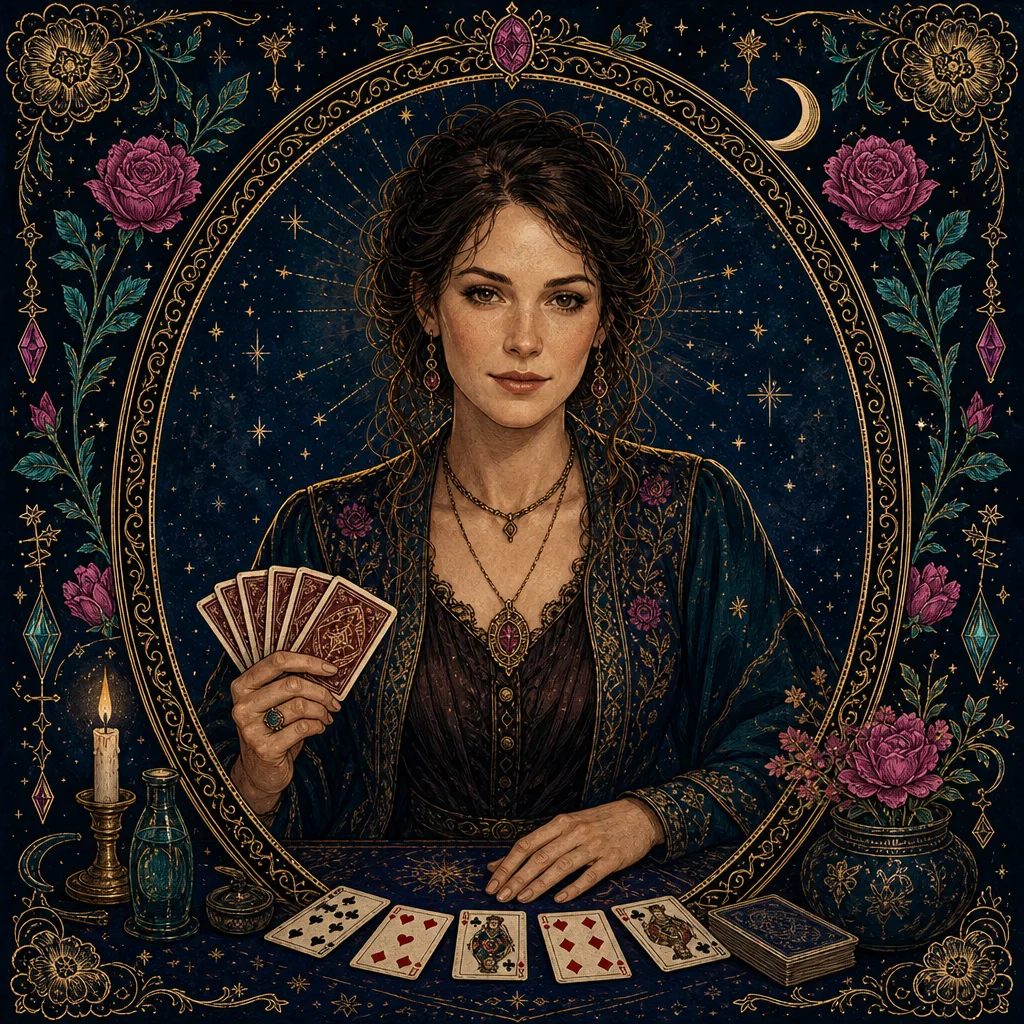
A cartomancer is a diviner who reads playing cards for guidance and insight, using a standard deck of 52 cards as a divinatory system with its own interpretive tradition. The practice predates tarot reading in Western culture and continues as a vital, independent divinatory art.
- Tradition
- European, particularly French and German; developed from at least the 18th century and likely earlier
- Standing
- Open
A profile of the Cartomancer
The cartomancer is the sharp-eyed reader at the kitchen table, who sees the whole shape of your life in the fall of 52 cards and speaks it plainly, without ceremony.
- Loves
- antique playing card decks, the quiet of a morning reading, a well-worn shuffle, the nine of spades and what it knows, cartomancy history and its hidden lineages.
- Hobbies and pastimes
- collecting historic fortune-telling manuals, studying Lenormand combinations, recording daily one-card draws, researching 18th-century French cartomancers.
- Dream familiar
- A raven who watches the spread from the back of the chair and taps one talon on the table when a card is being underread.
- Found in their element
- You find the cartomancer at a small round table by a window, cards already in hand, ready to begin before you have finished sitting down.
- Signature objects
- a well-shuffled 52-card deck, a handwritten card-meaning notebook, a significator card set aside before each reading, a small cloth spread surface, a cup of strong tea at the elbow.
A cartomancer is a diviner who reads the standard playing card deck as a symbolic language, using the 52 cards and their suit, value, and court character associations to address questions about love, money, career, timing, and the general currents of a querent’s life. Cartomancy is a genuine and independent divinatory tradition with centuries of development, distinct from tarot reading, which uses a different deck and carries a different symbolic heritage, though the two practices have influenced each other.
The playing card deck arrived in Europe from the Arab world around 1370 to 1380 and became one of the most widely distributed objects in European culture. Its ubiquity, present in virtually every home and tavern, made it a natural vehicle for popular divination, and cartomantic traditions developed in parallel with the card games the deck was designed for. By the time formal esoteric tarot reading emerged in the late 18th century, cartomancy from ordinary playing cards was already a well-established practice.
The work
The cartomancer’s primary tool is any standard 52-card deck, though many readers develop a preference for a particular deck whose face design suits them. Some traditions include the two jokers as wild cards or as significators of the querent and a significant other; most systems of 52-card cartomancy do not.
Each card carries meaning in three dimensions: its suit (clubs, diamonds, hearts, spades), its value (ace through ten, each number carrying specific significance), and for the court cards (jack, queen, king), its character as a specific type of person or energy. A reading typically begins with selecting a significator card to represent the querent, then shuffling the deck with the question in mind, and laying cards in a spread whose positions give each card a contextual meaning.
Different cartomantic traditions assign different specific meanings to each card, and the serious cartomancer studies several traditions before settling into their own synthesis. Some traditions are highly specific, naming individual cards as precise indicators: the nine of spades as illness, the ace of diamonds as a letter, the king of hearts as a fair-haired benefactor. Others work more organically with suit and number. Many experienced readers combine both approaches, using traditional specific meanings as a reference against which intuitive impressions are measured.
The Lenormand tradition, using its 36-card illustrated deck derived from a German game, is a distinct cartomantic system that deserves study on its own terms. It reads cards primarily through pairs and combinations and is considered by many practitioners to be exceptionally precise for practical questions.
History and tradition
The earliest documented European cartomancy appears in 16th-century Italian and French sources, but the most systematic development of playing card divination in the written record occurs in the 18th century. Etteilla, the French occultist who first published systematic instructions for tarot divination, began his career as a playing card reader and published a system of cartomancy in 1770 before he turned to tarot. Marie Anne Lenormand, the most famous cartomancer in French history, served clients including Napoleon’s wife Josephine and many figures of the revolutionary period, though the deck named for her was actually published after her death.
In England, popular cartomancy traditions were transmitted through almanacs, chapbooks, and the oral tradition, and by the Victorian period they were widely known across all social classes. The tradition was maintained in folk practice throughout the 20th century alongside the rise of tarot, and has seen renewed scholarly and popular attention in recent decades as researchers have worked to document and revive the older cartomantic lineages.
Walking this path
Learning cartomancy begins with choosing a tradition and learning its card meanings thoroughly. Andy Boroveshengra and Caitlin Matthews have produced scholarly and practical work on historical cartomancy in English; Rana George’s work on Lenormand provides an excellent introduction to that system. The older folk traditions can be accessed through 19th-century publications, many now in the public domain, including Mlle. Lenormand’s own books and various Victorian fortune-telling manuals.
Daily practice with the deck, drawing one or three cards for a morning reading and recording results, builds familiarity rapidly. Reading for others is the fastest teacher because it demands specificity: the generalisations that can feel meaningful for your own situation become obviously insufficient when you are trying to be genuinely useful to someone else.
Cartomancy works well alongside other divinatory practices and is especially complementary to Lenormand reading, oracle work, and traditional astrology. Many practitioners find the playing card deck particularly immediate and direct, as if the lack of elaborate esoteric symbolism leaves the signal unusually clean.
In myth and popular culture
The fortune teller with a deck of cards is one of the most recognisable figures in European and American popular culture, appearing in literature, opera, and film from the nineteenth century onward. Perhaps the most celebrated fictional cartomancer is Madame Irma, though the role has many variants; what persists across them is the image of a woman at a table, laying cards, and speaking truths the querent would rather not hear. In George Bizet’s opera Carmen (1875), the titular character reads playing cards with her companions and turns up death for herself, a scene that crystallised the association between the card reader, fate, and the tragic foreknowledge of what cannot be changed.
Marie Anne Lenormand, the historical figure who claimed to have read for Napoleon’s wife Josephine and for many figures of the revolutionary and imperial periods, became a legend in her own lifetime and a near-mythological figure after her death. She published prolifically and cultivated her reputation with considerable skill. The deck that now bears her name was not designed by her, but her legend attached to it and has sustained interest in cartomancy for nearly two centuries. Her story has been told in numerous popular books and periodicals, and she remains the most famous named cartomancer in Western cultural memory.
In literature, playing card divination appears in the Gothic and sensation fiction of the Victorian period as a reliable signal of mystery and impending danger. Sheridan Le Fanu, Wilkie Collins, and their contemporaries used the fortune teller with cards as a narrative device, and the association was strong enough that it survived into twentieth-century fiction and film as a near-universal shorthand. The James Bond film Live and Let Die (1973) centres its plot on a Tarot reader who also reads ordinary cards, and while the film conflates several divinatory traditions for effect, it captures something of cartomancy’s reputation for directness and fatalism that distinguishes it from more mystical-seeming systems.
People also ask
Questions
How does cartomancy differ from tarot reading?
Cartomancy uses a standard 52-card deck (sometimes with jokers) rather than a 78-card tarot deck. The four suits of clubs, diamonds, hearts, and spades carry their own interpretive meanings, as do the pip values and the court cards. Cartomancy is an independent divinatory tradition, not a simplified version of tarot.
What do the four suits mean in cartomancy?
While interpretations vary by tradition, hearts generally govern emotions, love, and inner life; diamonds govern material matters, money, and practical affairs; clubs govern career, ambition, and growth; and spades govern challenges, endings, and mental struggle. These associations have parallels with tarot suit meanings but are not identical.
What is the Lenormand system?
Lenormand is a distinct cartomantic tradition using a 36-card deck, each card bearing a simple illustrated image such as a heart, a ship, or a coffin. Named for the legendary French fortune teller Marie Anne Lenormand, the system reads cards primarily through their combinations and positions relative to a central significator rather than through individual card meanings alone.
Can a standard deck be used for serious divination?
Yes. Cartomancy has produced sophisticated and detailed interpretive systems that rival tarot in depth and specificity. Many experienced cartomancers describe the playing card deck as highly sensitive and direct, with a tradition of precision that comes from its long use in practical divination contexts.
Is there a historical link between playing cards and occultism?
Playing cards arrived in Europe from the Arab world in the late 14th century. By the 18th century, French cartomancers had developed published systems for reading them divinatorily. The claim that tarot trump cards encode ancient esoteric wisdom, made by Court de Gebelin in 1781, blurred the history of playing cards and tarot, but playing card divination has its own independent history that predates the tarot's esoteric reputation.