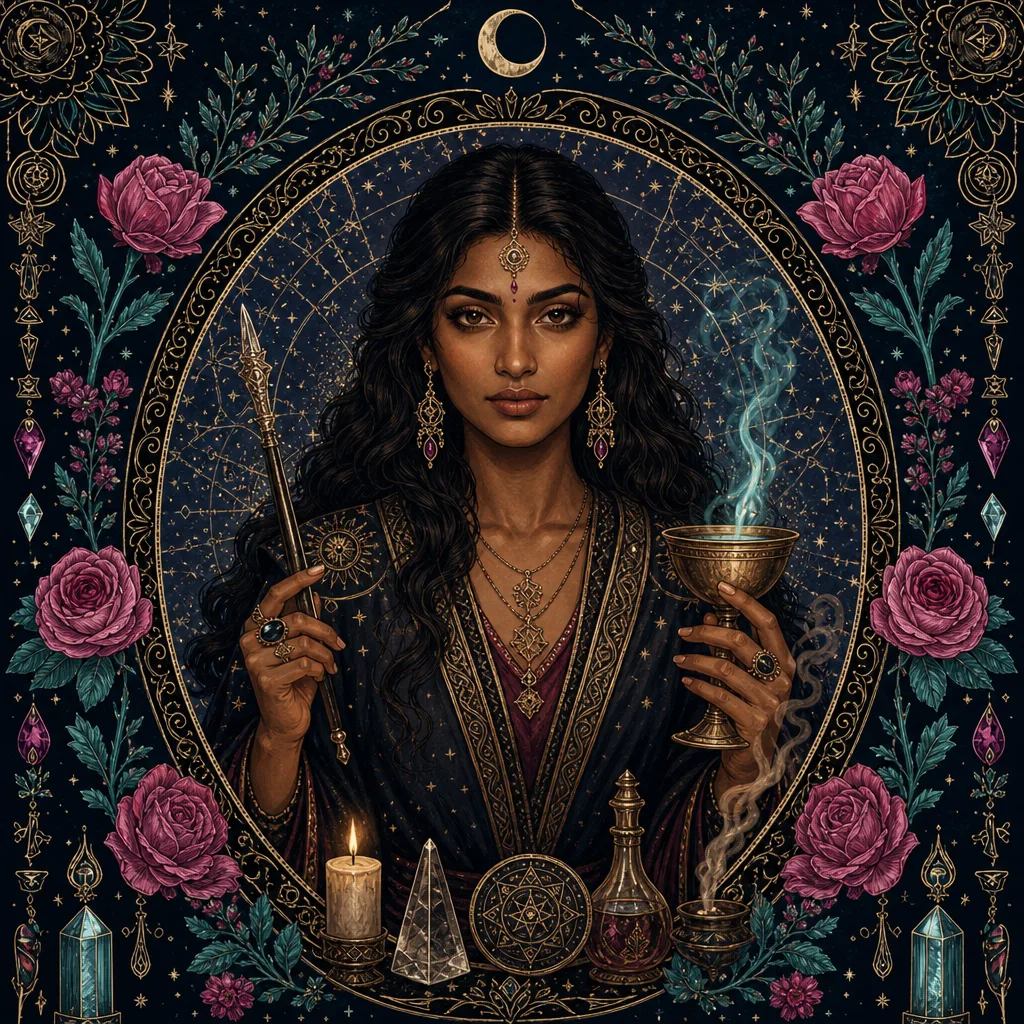
Ceremonial & High Magicians
Ceremonial Magician
Also called High Magician, Ceremonial Occultist
A ceremonial magician is a practitioner who works within structured, often complex ritual systems drawn from Hermetic, Kabbalistic, and Western esoteric traditions. Their practice centres on the deliberate alignment of will, symbol, and cosmos to achieve spiritual and practical ends.
- Tradition
- Western esoteric tradition, rooted in Renaissance Neoplatonism, Hermeticism, and Kabbalah
- Standing
- Open
A profile of the Ceremonial Magician
The ceremonial magician is the scholar in the robe, who treats the universe as a text that can be read, a system that can be known, and a cosmos that responds to the disciplined will of one who has done the work to earn that response.
- Loves
- the Kabbalistic Tree of Life and its intricacies, a freshly copied magical diary, the vibration of divine names in an empty room, planetary timing and electional astrology, the smell of incense in a consecrated space.
- Hobbies and pastimes
- studying Enochian tables and their correspondences, translating Renaissance grimoires, mapping the Tarot to the Tree of Life, maintaining a precise magical record.
- Dream familiar
- An ibis, steady and observant, who walks the perimeter of the circle once before each working and settles to watch from the east.
- Found in their element
- You find the ceremonial magician in a dedicated working room at a precise hour, everything in its place, the banishing already done, the record open and the pen uncapped.
- Signature objects
- the wand, cup, sword, and pantacle, a robe and lamen for formal working, the magical circle drawn on the floor, a large and much-annotated magical diary, Regardie's Golden Dawn on a well-worn shelf.
A ceremonial magician is a practitioner of Western esoteric magick who works within formal, structured ritual systems derived from Hermetic philosophy, Jewish and Christian Kabbalah, Neoplatonism, and the accumulated grimoire tradition of Europe. The defining characteristic of this path is rigor: the careful construction of ritual space, the precise use of symbol and correspondences, and the cultivation of a disciplined will regarded as the primary instrument of all magickal work.
Ceremonial magick holds that the universe is structured according to principles that can be known, mapped, and engaged through ritual means. Where folk traditions often work with place and relationship, the ceremonial magician works with system and correspondence, using the Tree of Life, planetary attributions, or Enochian tables to understand exactly where in the cosmic architecture a given force resides, and how to address it correctly. This does not make the practice cold or academic. At its best it is intensely devotional, and many practitioners describe the work as fundamentally transformative in ways that parallel mystical religion.
The work
The daily practice of a ceremonial magician typically begins with banishing, the ritual clearing of the working space of unwanted influences, followed by some form of invocation or alignment with a higher spiritual current. The Lesser Banishing Ritual of the Pentagram, originating with the Hermetic Order of the Golden Dawn, remains the most widely used opening rite in the Western tradition. It involves the tracing of pentagrams in the four quarters, the vibration of divine names, and the invocation of archangels, and it takes only a few minutes once learned but repays years of study.
Beyond this daily work, the ceremonial magician may undertake operations of evocation, in which intelligences or spirits are formally called to visible or perceptible appearance; invocation, in which a divine force is drawn into the self; or theurgy, the elevation of the soul toward its source. Tools include the wand, the cup, the sword, and the pantacle as classical instruments corresponding to the four elements and Tarot suits; the robe and lamen as markers of identity within the working; and the magical circle and triangle as containing and directing structures. The magician maintains a magical record, commonly called a magical diary, in which every operation is documented so that results can be compared and the Work refined over time.
Study is inseparable from practice. The ceremonial magician reads widely in Hermetic philosophy, learns at least the structure of the Kabbalistic Tree of Life, and develops working knowledge of astrological timing, geomancy, or other divinatory arts to select appropriate moments and conditions for important operations.
History and tradition
The roots of ceremonial magick reach into the Neoplatonic philosophy of the ancient Mediterranean, the Hermetic corpus attributed to Hermes Trismegistus, and the Kabbalistic mysticism transmitted through Jewish and then Christian learned communities in the medieval and Renaissance periods. The great grimoires, the Key of Solomon, the Lemegeton, the Picatrix, and others, codified practical systems for working with angelic and demonic hierarchies and were copied across centuries among clergy, scholars, and curious aristocrats.
The nineteenth century saw a decisive reorganization of this material when the Hermetic Order of the Golden Dawn, founded in London in 1888, synthesized Kabbalah, Tarot, astrology, Enochian magick, and Egyptian symbolism into a coherent graded curriculum. Members including W. B. Yeats, Dion Fortune, Aleister Crowley, and Israel Regardie produced a body of practical writing that remains central to the tradition. Crowley’s subsequent development of Thelema and the A.:A.: system extended and adapted the Golden Dawn framework, and his published works form a substantial part of what most contemporary ceremonial magicians study. The publication of Regardie’s complete account of the Golden Dawn system in 1937 made this material available to solitaries outside any lodge.
Today ceremonial magick is practised by solitaries working from published texts, by members of formal initiatory orders, and by eclectic practitioners who combine ceremonial techniques with witchcraft, chaos magick, or other paths. The tradition continues to develop, with new commentaries, new orders, and new syntheses appearing regularly.
Walking this path
Most ceremonial magicians come to the path through books, whether a chance encounter with Crowley or Fortune, a deeper reading of Tarot that leads to its Kabbalistic underpinnings, or a sustained interest in the history of Western esotericism. The path asks for patience, because the early stages are heavily oriented toward study and memorization, and for consistency, because the benefits of practice tend to accumulate slowly and irregularly rather than arriving in sudden dramatic moments.
Joining an order provides community, mentorship, and an initiatory structure that can provide both accountability and access to teachings not published in full, but it is not required. Many capable ceremonial magicians are self-taught, assembling their practice from published sources and sharpening it through years of recorded experiment. The magical diary is the solitary practitioner”s most reliable teacher, because it makes visible patterns that the memory alone would miss.
Ceremonial magick sits comfortably beside many other roles. A practitioner may also identify as a Hermeticist, a Thelemite, a Kabbalist, or even a witch, and may practise divination, spirit work, or folk methods alongside formal ceremonial operations. The system is comprehensive enough to accommodate and connect these approaches rather than excluding them.
In myth and popular culture
The ceremonial magician has a long literary ancestry stretching back through the Renaissance figure of the learned magus. Christopher Marlowe’s Doctor Faustus (c. 1592) presents the most dramatically influential version of this archetype: a scholar of tremendous learning who turns from conventional knowledge to magical operations, summons Mephistopheles with a ritual circle and Latin invocations, and bargains his soul for power and knowledge. Faustus remains the template against which fictional ceremonial magic is measured, and the story’s structure, preparation, invocation, binding, consequence, has shaped how the tradition is imagined in literature ever since. Goethe’s later Faust (1808, 1832) extended and complicated the same figure into a more sympathetic philosophical hero.
In the twentieth century, the ceremonial magician appears in fiction with varying degrees of accuracy. W. Somerset Maugham’s novel The Magician (1908) drew closely on his acquaintance with Aleister Crowley, fictionalising him as the villainous Oliver Haddo, a portrayal Crowley found flattering enough to review positively under a pseudonym. Dennis Wheatley’s popular Satanic thrillers, particularly The Devil Rides Out (1934), gave the ceremonial magician enormous popular reach, depicting elaborate ritual workings drawn from a recognisable Western esoteric tradition, though mixed freely with sensationalist invention. The novel was filmed in 1968 with Christopher Lee as the ceremonial magician Duc de Richleau, a portrayal that fixed the archetype in British popular imagination for a generation.
In games and speculative fiction, the ceremonial magician is represented by characters who work within formal, structured, scholarly magical systems: the magic-user or wizard who prepares spells from a grimoire in Dungeons and Dragons draws explicitly on the Western ceremonial tradition’s image of magic as a learned art requiring careful preparation and precise execution. More recently, Susanna Clarke’s novel Jonathan Strange and Mr Norrell (2004) presents a version of the ceremonial magician as English antiquarian, reconstructing a lost tradition from old books with the same mixture of rigour, obsession, and occasional catastrophic misjudgement that the historical tradition amply illustrates.
People also ask
Questions
What does a ceremonial magician actually do in practice?
A ceremonial magician performs structured rituals that may involve banishing, invocation, evocation, and the consecration of tools and talismans. They study foundational texts such as the Key of Solomon, the Lesser Banishing Ritual of the Pentagram, and the works of the Hermetic Order of the Golden Dawn. Daily practice often includes meditation, ritual diary keeping, and study of astrology, Kabbalah, or Enochian systems alongside the formal rites.
Do I need to join an order to practise ceremonial magick?
Membership in an initiatory order such as the Golden Dawn, the A.:A.:, or an Ordo Templi Orientis lodge offers structured transmission and community, but the written sources for most ceremonial systems are publicly available and can be studied independently. Many serious practitioners work as solitaries for years before seeking initiation, and many never seek it at all.
Is ceremonial magick connected to Satanism or devil worship?
No. Ceremonial magick draws on Neoplatonism, Jewish Kabbalah, Christian mysticism, and Hermeticism, and its cosmology does not centre on a Satanic figure. Some currents within ceremonial magick engage with adversarial or chthonic forces as part of their system, but this is distinct from Satanism as a religion or the popular misconception of devil worship.
How does ceremonial magick differ from witchcraft?
Ceremonial magick tends to be more text-based, more focused on elaborate formal ritual structures, and more explicitly tied to Hermetic and Kabbalistic cosmology, whereas witchcraft paths are often more nature-centred, less formally structured, and rooted in folk or pagan tradition. In practice the two overlap considerably, and many practitioners draw on both.
What is the best first text for a beginner in ceremonial magick?
Israel Regardie's The Golden Dawn is the most comprehensive single entry point into the classical Western ceremonial system. Dion Fortune's The Mystical Qabalah provides the cosmological backbone. Many practitioners also recommend beginning with a simple daily banishing ritual such as the Lesser Banishing Ritual of the Pentagram before moving into more complex workings.