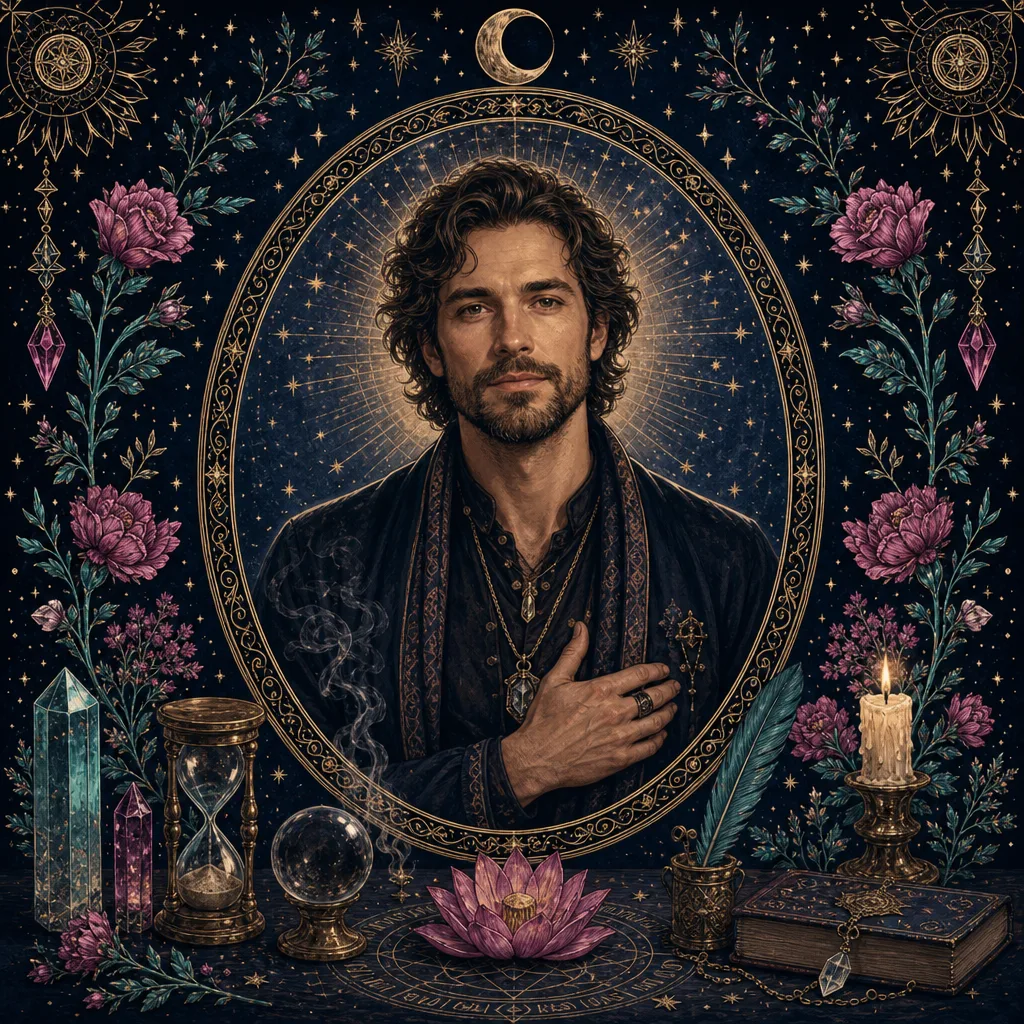
Diviners & Seers
Channeler
Also called channel, trance channel, conscious channel
A channeler is a practitioner who serves as a conduit for communication from non-physical intelligences, which may include spirit guides, higher-dimensional beings, ascended masters, or the collective consciousness, receiving and transmitting their guidance in spoken or written form. The practice may involve deep trance states or maintain full conscious awareness depending on the channeler's method.
- Tradition
- Modern Spiritualism and New Age movement (19th to 20th century); overlaps with older mediumistic traditions
- Standing
- Open
A profile of the Channeler
The channeler is the open window, who has learned to step aside with great care and great clarity so that something larger than themselves can speak, and who bears the weight of that responsibility with full seriousness.
- Loves
- the particular stillness before a session opens, a well-kept journal of received transmissions, the philosophy of non-physical intelligence, careful discernment and honest self-examination, the writings of Jane Roberts and Edgar Cayce.
- Hobbies and pastimes
- automatic writing practice, studying the great channelled works in depth, developing reliable meditation protocols, comparing transmission styles across practitioners.
- Dream familiar
- A white owl who arrives at the window at the start of every session and departs silently when the transmission is complete.
- Found in their element
- You find the channeler in a dim and quiet room, eyes closed, voice steady, speaking words that carry a quality the ordinary conversation never quite achieves.
- Signature objects
- a dedicated channelling journal, a comfortable chair for trance work, a recording device for session capture, a clear quartz point for focus and amplification, a specific opening prayer or invocation.
A channeler is a practitioner who opens their consciousness as a conduit through which non-physical intelligences communicate with the world of the living. The communicating source may be described as spirit guides, ascended masters, angelic presences, star beings, collective consciousness, or other categories of non-physical intelligence depending on the channeler’s tradition and the nature of the contact. The information received is transmitted in spoken or written form, sometimes in trance states where the channeler’s ordinary waking consciousness is substantially displaced, and sometimes in conscious states where the channeler remains present and active in the translation process.
Channelling as a named practice emerged from 19th-century Spiritualism and became especially prominent in the New Age movement of the late 20th century, though the underlying phenomenon of speaking as or on behalf of non-human intelligences is among the oldest in human spiritual experience. What modern channelling offers that distinguishes it from older traditions is a particular framework for understanding the source and nature of the communication and a set of practices for developing and refining the capacity to receive and transmit it clearly.
The work
The channeler’s practice varies significantly by method and source. Those who work in deep trance typically begin by inducing an altered state through meditation, hypnotic suggestion, or specific breathing practices, then allow their ordinary consciousness to recede as the communicating entity takes over more fully. In this state, the channeler’s voice, posture, and even facial expressions may change to reflect the character of the communicating being. They may or may not retain memory of what was said when they return to ordinary awareness.
Conscious channelers maintain full awareness while receiving. They describe the experience as a kind of clear, felt knowing that arrives before or alongside words, which they then articulate as faithfully as possible. The skill of conscious channelling involves learning to distinguish the received communication from one’s own thoughts, opinions, and desires, a discernment that requires both practice and genuine humility.
Writing is also a major channelling modality. Automatic writing, in which the hand writes without deliberate direction of the content, was practiced extensively in Spiritualism and continues today. Many channelers receive material more clearly in written form, finding that the act of writing creates the necessary slowing and receptivity.
Most channelers maintain a regular practice of connection with their source outside of formal sessions, developing the relationship through meditation, prayer, or contemplative practice. The quality and clarity of the transmission in sessions tends to reflect the depth of the ongoing relationship.
History and tradition
The roots of channelling in the modern Western sense lie in 19th-century Spiritualism, where trance mediums communicated not only with deceased individuals but with entities claiming to be spirits of great wisdom, ancient teachers, or beings from other realms. Andrew Jackson Davis, known as the Poughkeepsie Seer, channelled philosophical material in trance states in the 1840s and was an early major figure in this tradition. Helena Petrovna Blavatsky, founder of the Theosophical Society, claimed to receive her major works as transmissions from Mahatmas or Masters, highly evolved beings who communicated with her across vast distances.
The 20th century saw a major elaboration of channelling practice. Edgar Cayce conducted thousands of trance readings in which he claimed to access the Akashic Records. Jane Roberts began her work with Seth in 1963, producing a body of channelled philosophy that addressed consciousness, the nature of reality, and the structure of time in considerable depth. The Law of One material, received by Carla Rueckert in sessions beginning in 1981 and attributed to a social memory complex called Ra, represents one of the most internally consistent and philosophically demanding channelled bodies of work in the tradition.
The New Age movement of the 1980s and 1990s brought channelling to broad popular awareness through figures such as J. Z. Knight, who channelled Ramtha, and the Abraham material channelled by Esther Hicks, which continues to be widely consulted.
Walking this path
Development as a channeler typically begins with a grounding in meditation sufficient to reliably achieve altered or receptive states, and with enough inner work to have a stable relationship with your own mind, its voices, patterns, and preferences. This self-knowledge is the baseline against which you will distinguish genuine received communication from wishful thinking, projection, or mental noise.
Many practitioners recommend beginning with written channelling, using a journal and a specific invocational practice to open a session, then writing whatever arrives without editing or judging. Over time, the character and quality of what arrives through this practice helps you understand the nature of the communication you are capable of receiving.
Working with a teacher or a group is particularly valuable on this path because outside perspective helps calibrate what can be very difficult to assess alone: whether what is coming through has the quality and character of genuine communication beyond the ordinary self. Ethics are fundamental; the channeler’s responsibility to those who receive the transmissions, and their own wellbeing, requires a stable and grounded practice rather than one that chases dramatic experience.
In myth and popular culture
The channeler’s closest mythological ancestor is the oracle, the human mouthpiece through whom a divine or non-human intelligence speaks. The Pythia at Delphi, who delivered Apollo’s pronouncements in an altered state of consciousness, is the most famous example in the classical world; similar figures appear in the Norse tradition with the volva, a seeress who enters a trance state called seidr to obtain knowledge from non-ordinary sources. The tradition of prophetic trance speech runs through the Hebrew prophets and the ecstatic pneumatics of early Christianity, and the question of how to distinguish genuine divine speech from ordinary human fabrication has occupied religious communities in virtually every culture that has known the practice.
In literature, the channeler appears most memorably where the transmission threatens to overwhelm the vessel. Henry James’s novella The Turn of the Screw (1898) turns on the question of whether its narrator is receiving genuine spirit communication or generating it from within, a dramatic ambiguity the text refuses to resolve. William Butler Yeats and his wife George Hyde-Lees produced the automatic writing collected in A Vision (1925) through a sustained process that Yeats understood as spirit-dictated, whatever one makes of the source. The material organised his poetic cosmology for the remainder of his career.
In popular culture, the trance channeler achieved broad recognition through the work of figures such as J. Z. Knight, whose channelling of the entity Ramtha beginning in the 1970s was documented in films and television programmes and attracted both large audiences and sustained sceptical scrutiny. The character of Oda Mae Brown in the film Ghost (1990), played by Whoopi Goldberg, is a comic and eventually serious treatment of a reluctant channeler, a person who has the capacity but has been trying to avoid its consequences. More recently, the characters of River Tam in the television series Firefly (2002) and Eleven in Stranger Things (2016) carry traces of the channeler archetype, though translated into science fiction frameworks where the non-ordinary perception has a technological rather than spiritual explanation.
People also ask
Questions
How is channelling different from mediumship?
Mediumship classically focuses on communication with the spirits of deceased individuals, usually for the purpose of providing evidence of survival and messages to loved ones. Channelling typically refers to communication with non-human intelligences, guides, higher-dimensional beings, or collective consciousness, though many practitioners use the terms flexibly and some work with both.
What is trance channelling?
In trance channelling, the practitioner enters a deep altered state in which their ordinary waking consciousness recedes and the communicating entity speaks or writes through their physical body. The channeler may have partial or no memory of what was communicated. Edgar Cayce and later Jane Roberts, channelling the entity Seth, are among the most studied examples.
What is conscious channelling?
In conscious channelling, the practitioner remains fully aware and present while receiving and transmitting the communication. They experience the information as arriving rather than as their own thought, but they consciously choose and articulate the words. Many contemporary channelers work in this mode, describing themselves as translating rather than disappearing.
Who are spirit guides?
Spirit guides, in the usage of many channelers, are non-physical beings understood to work with individual humans or humanity as a whole from a position of greater wisdom and perspective. They may be described as ancestors, ascended masters (humans who have completed their earthly development), angelic beings, or other categories of consciousness depending on the tradition and the channeler's framework.
What famous channelled works exist?
The Seth Material, channelled by Jane Roberts beginning in 1963, comprises many volumes and is among the most coherent and philosophically sophisticated channelled bodies of work. A Course in Miracles, received by Helen Schucman beginning in 1965 and attributed to the voice of Jesus, has had enormous influence. The Law of One material, channelled by Carla Rueckert in the early 1980s, represents another major body of channelled teaching.