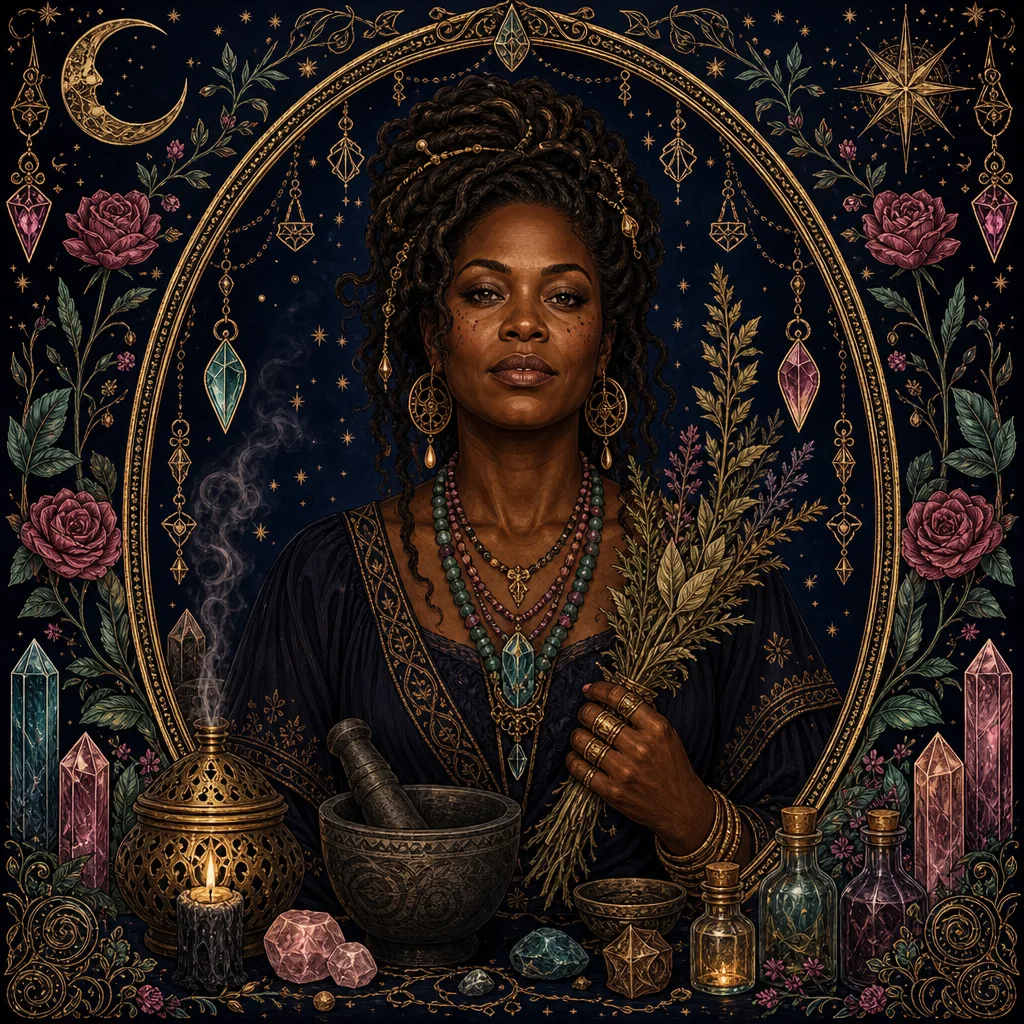
Folk Magick Practitioners
Conjure Doctor
Also called conjurer, two-headed doctor, conjure man, conjure woman
A conjure doctor is a practitioner of Hoodoo and Southern African American conjure tradition who works as a specialist healer, spiritual counsellor, and magical practitioner, often with particular emphasis on the diagnosis and reversal of crossed conditions, spiritual illness, and the work of enemies. The conjure doctor occupies a position of deep community authority in the African American South.
- Tradition
- Hoodoo and Southern African American conjure tradition
- Standing
- Culturally rooted
A profile of the Conjure Doctor
The conjure doctor is the community's spiritual physician, who can see the difference between bad luck and enemy work at a glance, and who has the knowledge and the standing to do something about both.
- Loves
- the Psalms as precise spiritual prescriptions, root and herb knowledge accumulated over decades, the mojo bag and its careful assembly, community trust built through demonstrated results, Hyatt's field collection and what it preserves.
- Hobbies and pastimes
- formulating condition oils from traditional recipes, studying the African American conjure tradition's history, reading Hurston's Mules and Men and her field notes, maintaining relationships with suppliers of quality roots.
- Dream familiar
- A large black cat who sits in the corner during consultations and whose attention, when it shifts to the client, tells the doctor something the client has not yet said.
- Found in their element
- You find the conjure doctor in a room that smells of herbs and candle wax, where there is always something simmering and the floor has been washed with something that is not just water.
- Signature objects
- a worn Bible opened to the relevant Psalm, a collection of roots, herbs, and condition materials, red flannel and the mojo bag that goes inside it, a bottle of Van Van or Uncrossing condition oil, a candle dressed and ready for the diagnosis.
A conjure doctor is a practitioner of Hoodoo and Southern African American conjure tradition who occupies the role of spiritual physician within their community — diagnosing the invisible causes of visible suffering, prescribing and applying spiritual remedies, and serving as the community”s expert on the complex interface between the seen and unseen worlds. The conjure doctor”s authority rests on demonstrated knowledge, practical effectiveness, and community recognition built over years of service.
The “doctor” in the title is not metaphorical. In communities where formal medical care was denied, inaccessible, or mistrusted with good reason, the conjure doctor was often the actual first resort for illness — and always the primary resource when illness was understood to have a spiritual dimension, when bad luck persisted despite normal remedies, or when an enemy”s work was suspected. This role of community specialist is central to what the conjure doctor is and does.
The work
Diagnosis is the conjure doctor”s primary skill and the dimension that most clearly sets the role apart from the ordinary rootworker. When a client comes with a problem, the conjure doctor assesses not just what the client wants but what is actually happening: Is this illness natural or has something been laid against the client? Are crossed conditions blocking multiple areas of life simultaneously? Is the client dealing with the effects of their own actions, the work of a specific enemy, or a pattern established long before the current crisis? Has a spirit been disturbed?
This diagnostic work draws on the practitioner”s developed capacity to read both physical and spiritual signs. The conjure doctor pays attention to the pattern of the client”s trouble, to physical symptoms and their distribution, to the specific timing and onset of problems, and to the impressions received during the consultation itself. Some practitioners work with specific divinatory tools; others rely on prayer and direct spiritual perception.
Once the condition is diagnosed, the conjure doctor prescribes and usually performs the appropriate work. For crossed conditions, this typically involves first uncrossing and cleansing the client — removing what has been laid — and then rebuilding protection against future interference. Spiritual baths, floor washes, smoke cleansings with specific herbs, the removal and destruction of any physical tricks that have been found, and prayer form the basic uncrossing toolkit.
Active enemy work, where the conjure doctor turns back or restrains a specific harmful actor, draws on a different range of materials and procedures. The tradition contains specific formulas for binding enemies, compelling them to stop their work, and returning harm to its source. These are not casual applications; the conjure doctor”s reputation depends on accurate diagnosis and appropriately targeted action.
The conjure doctor also blesses and builds conditions for clients: assembling mojo bags for love, protection, money, and other aims; performing candle work and condition oil work; providing prepared materials and instructions for the client to use at home; and making spiritual tools like protective washes and anointed objects.
History and tradition
The conjure tradition is the same tradition as Hoodoo, understood through the lens of the “doctor” — the specialist with elevated expertise and social standing. The tradition has its deepest roots in West and Central African magical and healing traditions brought to the Americas by enslaved people, synthesised with European folk magic and Native American plant knowledge under the specific conditions of Southern slavery and its aftermath.
Zora Neale Hurston, the African American author and anthropologist, documented the conjure doctor tradition from inside it. She trained under several practitioners, including the New Orleans root doctor Luke Turner (a claimed descendant of Marie Laveau), and published her observations in “Mules and Men” (1935) and in later unpublished material. Her accounts provide an invaluable primary-source view of the tradition in the early twentieth century.
Harry Middleton Hyatt”s massive five-volume collection, assembled from interviews with practitioners and clients across the American South between 1935 and 1939, preserves an enormous range of conjure procedures and the voices of the people who practiced and sought them. This is the largest single archive of Hoodoo practice in existence.
Walking this path
The conjure doctor tradition is rooted in African American culture, history, and community, and that rootedness is not incidental — it is constitutive. Hoodoo emerged from the specific experience of African people enslaved in America: their spiritual inheritance from diverse African cultures, the specific pressures of slavery and its aftermath, and the creativity and resilience that produced a coherent and effective tradition under conditions designed to destroy everything like it.
Anyone approaching this tradition who is not part of the African American community must do so with a clear and honest understanding of this history, and must ask whether their engagement is respectful and reciprocal or extractive and disrespectful. The conjure tradition is not a closed initiatory system in the way that Vodou is, but it is a cultural tradition with a living community, and that living community has the right to define the terms of engagement with its inheritance.
The appropriate response is to learn from African American sources, support African American practitioners and businesses, and approach the tradition with gratitude for what has been shared rather than entitlement to what has not. For African American practitioners, the conjure doctor is an ancestral role of enormous dignity and practical importance, available as inheritance and as living practice.
In myth and popular culture
The conjure doctor as a character type appears throughout African American literature and folklore, often as a figure of ambiguous power who can heal, harm, or perceive what others cannot. Charles W. Chesnutt’s short story collection The Conjure Woman (1899) is the earliest major literary treatment of the conjure tradition by an African American writer. Chesnutt’s stories, narrated through the frame of an elderly formerly enslaved man named Uncle Julius, present the conjure doctor as a figure of genuine and sometimes frightening capacity operating in the world of the antebellum South. The collection is widely taught as a foundational text of African American literature and remains one of the richest fictional engagements with the tradition.
Zora Neale Hurston’s novel Moses, Man of the Mountain (1939) reframes the biblical Moses as a supreme conjure man and root doctor, a reading grounded in actual folk tradition in which Moses has long been understood as the greatest of conjurers. Hurston’s ethnographic and fictional work across the 1930s treated the conjure tradition with serious scholarly and artistic respect at a time when it was more commonly dismissed or sensationalised, and her accounts of training under New Orleans practitioners remain some of the most vivid primary-source writing the tradition has produced.
In twentieth-century popular culture, the conjure doctor’s power was often filtered through Hollywood’s reductive image of the Voodoo practitioner, a distortion that merged distinct traditions and stripped them of their specificity. More careful representations have appeared in later decades. The character of Mama Odie in the Disney animated film The Princess and the Frog (2009) draws loosely on the New Orleans root doctor tradition, and while the film is far from a documentary treatment, it represents a mainstream acknowledgement of the tradition’s existence that would have been unusual in earlier American popular culture. Tony Kushner’s play Caroline, or Change (2003), set in Louisiana in 1963, engages seriously with the spiritual dimensions of African American domestic life in a period when the conjure tradition was actively practiced in that world.
People also ask
Questions
How does a conjure doctor differ from a rootworker?
The terms overlap significantly, and many practitioners use them interchangeably. "Conjure doctor" often implies a higher level of specialisation or community standing: the title "doctor" signals recognised expertise and the authority to diagnose and treat both physical and spiritual conditions. The conjure doctor is particularly associated with the ability to identify the work of enemies, diagnose crossed conditions and spiritual illness, and prescribe specific remedies -- functioning analogously to a physician for spiritual and magically-induced problems.
What is a "two-headed doctor"?
The term "two-headed doctor" appears frequently in the Hoodoo tradition and in Hyatt's field collection. It refers to a practitioner who works in both directions -- who can both lay down conditions and remove them, who sees into both the visible and invisible worlds, and whose knowledge gives them authority in both registers. The two-headedness implies doubled sight and doubled capacity, not ethical neutrality about how that capacity is used.
What does a conjure doctor diagnose?
The conjure doctor assesses conditions that do not yield to ordinary medical treatment or that carry signatures of spiritual interference: persistent bad luck across multiple areas of life, unexplained physical symptoms, relationship breakdown that happens too suddenly or thoroughly to feel natural, financial reversal, and other patterns that suggest someone has "crossed" the client or that the client has crossed conditions on themselves through their own actions. The diagnosis is both practical and spiritual.
Is the conjure doctor tradition still active?
Yes. Conjure doctors continue to practice in the American South and in Northern cities with large Southern African American communities. The tradition has shown remarkable continuity and adaptability. Contemporary practitioners include both those who work within strictly traditional frameworks and those who have adapted the tradition to new contexts and clienteles while maintaining its African American roots.
How does prayer fit into conjure doctor work?
Prayer, particularly from the Psalms, is central to the conjure doctor's practice. The Psalms are used as specific spiritual prescriptions: Psalm 23 for protection and comfort, Psalm 91 for shielding from enemies, Psalm 37 for restraining malicious people, and many others. This integration of Biblical text into magical procedure reflects the deep synthesis of African American Christianity and African spiritual practice that characterises Hoodoo as a whole.