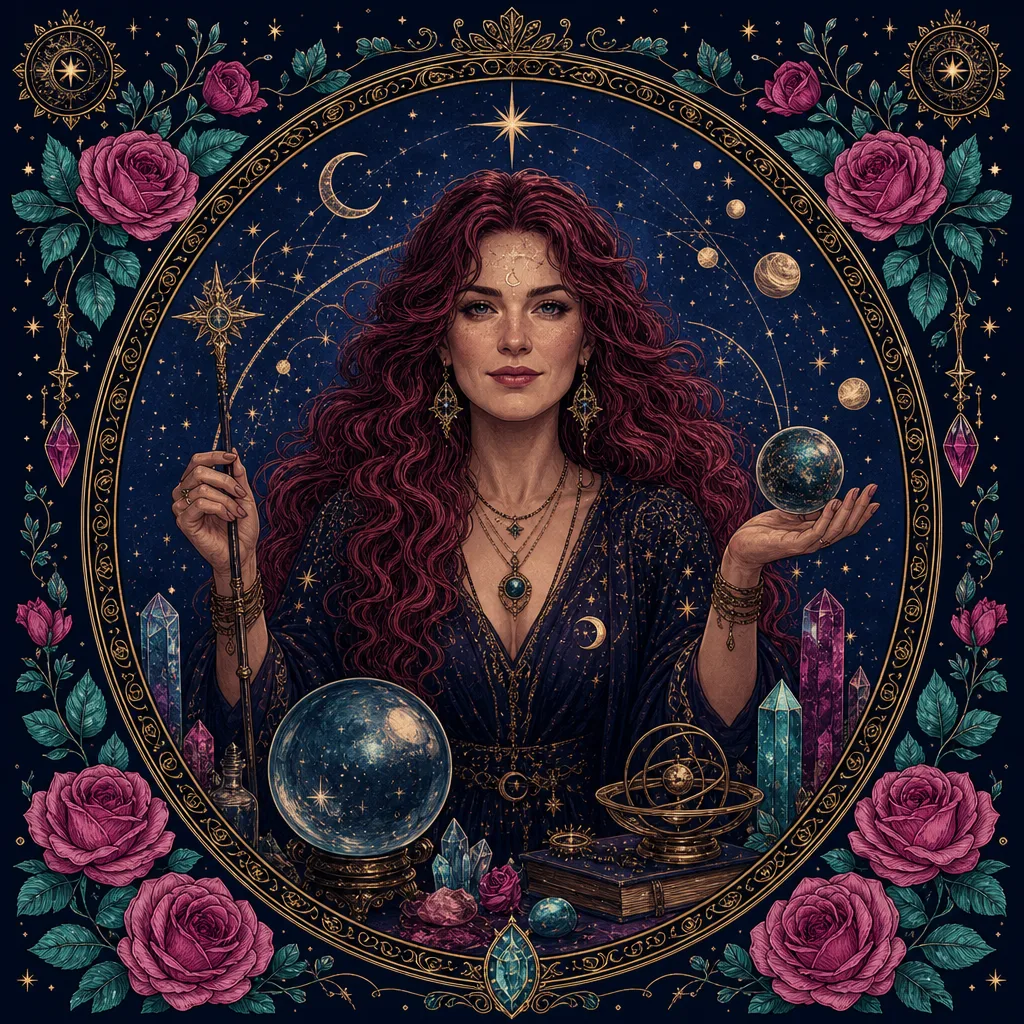
Witches & Their Paths
Cosmic Witch
Also called Astro Witch, Celestial Witch
A cosmic witch is a practitioner who centres their magic on astrology, planetary energies, and the broader cosmos, using celestial timing, planetary correspondences, and stellar lore to shape every aspect of their practice.
- Tradition
- Contemporary eclectic witchcraft, drawing on traditional astrology and planetary magic
- Standing
- Open
A profile of the Cosmic Witch
The cosmic witch is the practitioner who looks up first and always, who schedules workings around planetary hours as naturally as other people schedule meetings, and who knows exactly what Jupiter is doing and what to do about it.
- Loves
- the ephemeris and the story it tells, planetary hour timing for everyday magic, fixed star lore and its ancient lineages, the natal chart as a map of the self, Agrippa's tables of planetary correspondences.
- Hobbies and pastimes
- tracking long-cycle planetary transits, learning electional astrology for major workings, setting altars to reflect the current celestial season, studying Babylonian and Hellenistic astrological systems.
- Dream familiar
- A peregrine falcon who wheels high above and reports back on what the sky looks like from up there, with an opinion about the current Jupiter placement.
- Found in their element
- You find the cosmic witch at their altar at the exact start of a planetary hour, everything arranged to match the energy of the moment, ready to begin.
- Signature objects
- a printed ephemeris and a pencil, candles in the seven planetary colours, a natal chart printed and well-studied, a planetary hour clock or app always within reach, crystals and herbs keyed to the current focus planet.
A cosmic witch is a practitioner who centres their magical work on astrology and the energies of the cosmos, using planetary timing, celestial correspondences, and knowledge of the stars to shape and direct every aspect of their practice. Where a general witch might note the lunar phase, a cosmic witch tracks the full astrological picture: what sign the moon is in, what planets are making significant aspects, which planetary hour is current, and what larger cycles of transits and progressions are active in their personal chart.
It is worth being warmly honest about the origins of this specific label: “cosmic witch” as a self-identified role is a recent development, gaining widespread use on social media platforms from around 2018 onward. The practice it describes, however, draws on some of the oldest surviving magical systems in the Western tradition. Planetary magic predates the label by millennia, and a cosmic witch working with Agrippa”s tables of correspondences or timing a working to a Jupiter trine is connected to a tradition with genuine historical depth.
The work
Astrological timing is the backbone of cosmic witch practice. Before undertaking major workings, the cosmic witch consults the ephemeris or an astrology app to find an auspicious moment: a day when the relevant planet is well-aspected, the moon is in a compatible sign, and no obstructive configurations are active. This is called electional astrology, the art of choosing the best moment for an action, and it has been a core component of magical practice since Babylonian times.
Planetary hours provide a finer-grained timing system accessible even for everyday small magic. Each hour of each day is ruled by one of the seven classical planets in a rotating sequence, and the cosmic witch who learns this system can align even a quick candle working or a short meditation with the relevant planetary energy. Monday is the moon”s day; Tuesday belongs to Mars; Wednesday to Mercury; Thursday to Jupiter; Friday to Venus; Saturday to Saturn; Sunday to the sun.
The natal chart, the astrological snapshot of the sky at the moment and place of birth, is treated as a map of the self. Cosmic witches often work closely with their own chart, identifying their strong planetary placements, their challenging aspects, and the timing of major transits that mark turning points. This self-knowledge shapes how they approach magical work: someone with a strong Saturn influence might work with the discipline and structure Saturn offers rather than against it.
Altars and ritual spaces in cosmic witch practice typically reflect the current celestial season: representations of the active planetary energies, candles in the colours associated with each planet, crystals and herbs governed by the planet of focus. Many cosmic witches also work with fixed stars, using a select few particularly powerful stars whose qualities are well-documented in traditional astrological magic.
History and tradition
Planetary magic is one of the oldest surviving systems of Western esotericism. The Babylonians organised their week around the seven visible planets, assigned each a deity and a sphere of influence, and developed elaborate omen systems based on planetary movements. This tradition passed through Hellenistic Egypt, was systematised by Claudius Ptolemy in the second century CE, and was transmitted into medieval Arabic astrology and then into European Renaissance magic.
The Renaissance magicians who codified planetary magic, Ficino, Pico della Mirandola, Cornelius Agrippa, were working with a sophisticated and internally coherent system of correspondences: each planet linked to a metal, a colour, a set of herbs and animals, a musical tone, a geometric figure, and a category of human experience. This system, transmitted through grimoires and later through Golden Dawn teaching materials and Aleister Crowley”s synthesis, remains largely intact in contemporary use.
The “cosmic witch” label emerged from the social-media-driven witchcraft communities of the late 2010s, where aesthetic and identity became important organising principles. The label is new; the underlying system of planetary magic is not.
Walking this path
Learning astrology is the main prerequisite for depth in cosmic witchcraft. Even a basic working knowledge, understanding the signs, planets, and major aspects, opens a great deal of the practice. Many cosmic witches begin by learning their own natal chart with one good book or a few reliable online courses, then expanding outward to tracking current transits and learning to use an ephemeris.
Starting with planetary hours is a gentle on-ramp for those new to the path. Choosing the planetary hour for even small daily actions, writing an important email during the Mercury hour, beginning a new financial discipline during the Jupiter hour, builds the habit of astrological attention in a low-stakes way.
The cosmic witch path sits naturally alongside lunar witchcraft, ceremonial magic in its Hermetic form, folk magic that uses planetary timing, and devotional practice directed toward planetary deities. It is a path that rewards study, patience, and the willingness to track patterns across long cycles of time.
In myth and popular culture
Planetary magic has one of the richest bodies of mythological representation of any magical system, because the planetary deities of the ancient world were among the most widely worshipped figures in Mediterranean religion. The seven classical planets were identified with specific gods: Saturn with Kronos, Jupiter with Zeus, Mars with Ares, the Sun with Apollo or Helios, Venus with Aphrodite, Mercury with Hermes, and the Moon with Artemis or Selene. Each deity carried the qualities the corresponding planet was understood to govern, and the theological and magical systems were effectively the same system described from different angles. The myths of these deities are, in part, extended meditations on the qualities of planetary energy.
In literature, the most sustained philosophical treatment of planetary influence in the Western tradition is Dante’s Divine Comedy (1308-1320), in which the planetary spheres structure the architecture of Paradise. Dante ascends through the spheres of the Moon, Mercury, Venus, the Sun, Mars, Jupiter, and Saturn, meeting souls whose characters were shaped by each planet’s influence. This is not metaphor in Dante’s framework; it is cosmology, and it represents the high medieval synthesis of classical planetary theology and Christian mysticism that Renaissance magicians like Ficino would later draw on directly.
In twentieth-century popular culture, astrology as a system of self-knowledge became a dominant mass-market phenomenon, reaching millions of readers through newspaper horoscope columns and, later, social media. The contemporary cosmic witch’s aesthetic and practice are continuous with this broader astrological culture, though more sophisticated in their engagement with the tradition’s technical depth. Joanna Martine Woolfork’s The Only Astrology Book You’ll Ever Need (1982) and later Chani Nicholas’s You Were Born for This (2020) represent successive moments in the mainstream popularisation of astrological self-knowledge that the cosmic witch’s path presupposes and builds upon.
People also ask
Questions
What is the difference between a cosmic witch and a lunar witch?
A lunar witch focuses specifically on the moon and its cycle. A cosmic witch works with the full breadth of astrology: the sun, moon, and all planets, as well as fixed stars, eclipses, planetary returns, and transits. The lunar witch's work is contained within a monthly cycle; the cosmic witch tracks longer planetary cycles and times workings to match them.
Do cosmic witches need to know astrology?
Some study of astrology is central to the path, but the depth required varies. Some cosmic witches develop deep astrological literacy, reading natal charts and tracking transits with precision. Others work at a simpler level with planetary day and hour correspondences and the basic qualities of each planet. The path rewards investment in astrological study because the more you know, the more precisely you can time and direct your work.
How do planetary correspondences work in magic?
In traditional Western magic, each planet governs specific areas of life: Venus rules love and beauty, Mars governs will and conflict, Jupiter expands and brings abundance, Saturn restricts and teaches, Mercury governs communication and travel, the Moon rules cycles and the subconscious, the Sun governs vitality and identity. A cosmic witch times and shapes workings to match the planet most relevant to the intention.
Is cosmic witchcraft historically old?
Planetary magic has very old roots in Babylonian, Greek, and Renaissance magical traditions. The *Picatrix*, a twelfth-century Arabic grimoire translated into Latin, provides elaborate planetary magic. Agrippa's *Three Books of Occult Philosophy* (1531) codified planetary correspondences that many cosmic witches still use today. The specific identity label "cosmic witch" is recent, but its source material is ancient.
What does a cosmic witch do during a retrograde?
During a planetary retrograde, which is an apparent backward motion of a planet as seen from Earth, most cosmic witches adjust their work to reflect the inward, reviewing, or complicating qualities the retrograde is held to bring. Mercury retrograde prompts caution with communication and contracts; Venus retrograde invites reassessment of relationships and values; Mars retrograde calls for patience with forward progress. The retrograde period is used for review, release, and reflection rather than new launches.