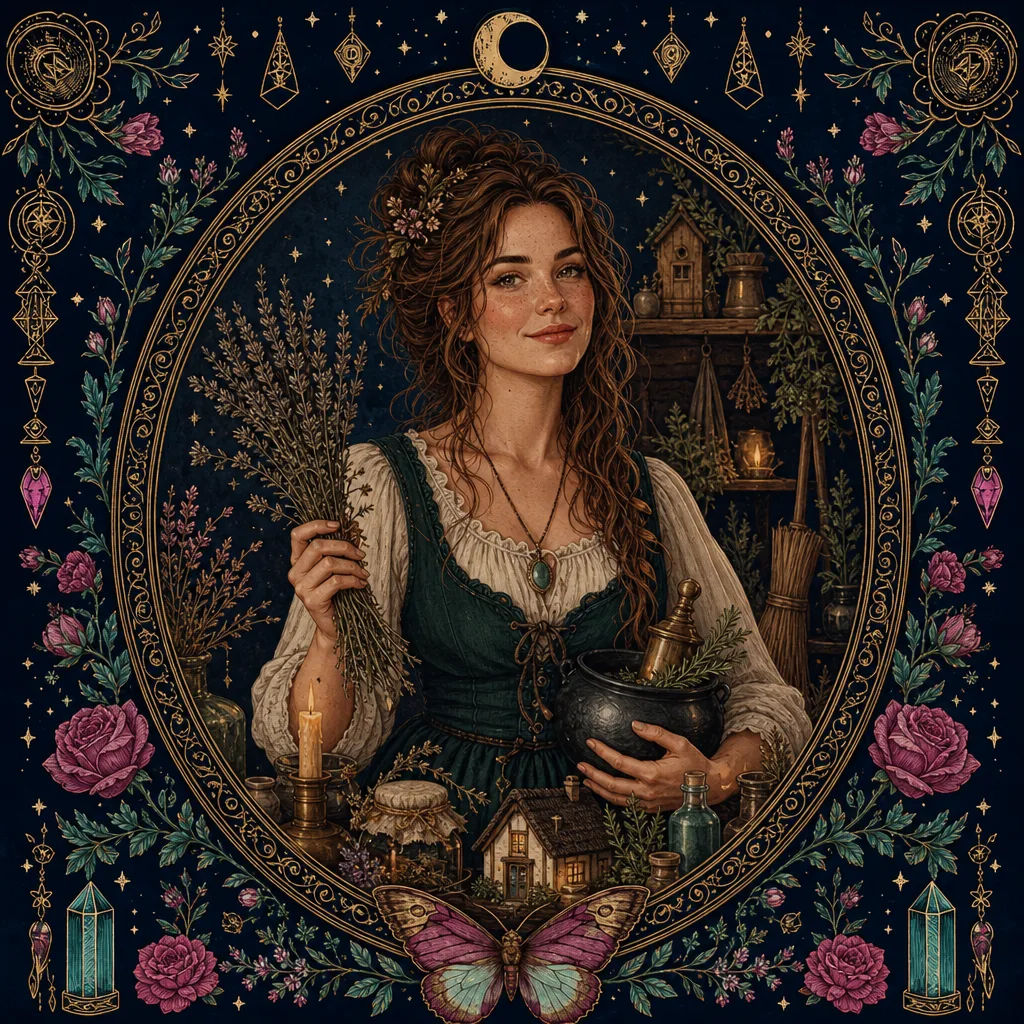
Witches & Their Paths
Cottage Witch
Also called Hearth Witch, Domestic Witch
A cottage witch is a practitioner who treats the home as a sacred and magical space, weaving spellcraft into daily domestic life through tending, making, and blessing the household.
- Tradition
- European domestic folk magic and hearth spirituality
- Standing
- Open
A profile of the Cottage Witch
The cottage witch is the keeper of the hearth's deeper life, who knows that a swept threshold is a magical act, that a pot of soup made with care is a blessing laid in, and that the home tends back if you tend it first.
- Loves
- the smell of a freshly scrubbed floor washed with rosemary water, a fat candle burning on the hearth shelf, the specific ritual of a seasonal threshold decoration, her collection of protective stones arranged at every window, the tradition of witch bottles and what archaeology keeps finding.
- Hobbies and pastimes
- drying and pressing herbs from the garden, sewing protective sachets and dream pillows, fermenting and preserving for the cold season, reading the history of British domestic folk magic.
- Dream familiar
- A large tortoiseshell cat who has already inspected every room and judged most of them acceptable, and who sleeps nearest the hearth because the hearth belongs to both of them.
- Found in their element
- You find the cottage witch in a kitchen that smells of something simmering, or kneeling at a threshold with a small brush and a bowl of protective wash, doing the work that keeps the house safe and alive.
- Signature objects
- a besom hung by the door, a witch bottle buried under the threshold, a hearthside altar that changes with each season, bundles of dried herbs hanging from the rafters, a threshold charm of rowan or iron.
A cottage witch is a practitioner who treats the home as both sanctuary and temple, weaving magical intention into every aspect of domestic life. The house itself, from its threshold to its hearth to its garden gate, is understood as a living entity that can be cleansed, blessed, protected, and invited to participate in the work of the practitioner. Daily acts of homemaking become acts of magic when performed with awareness and intent.
This is a path of integration rather than separation. The cottage witch does not step away from ordinary life to do magic; the cooking, cleaning, tending, and making of the home are the magic. This orientation makes the practice sustainable across the full rhythm of ordinary weeks and years rather than dependent on special occasions.
The work
Protection of the home is foundational. A cottage witch establishes and maintains magical defences as carefully as physical ones: cleaning thresholds with herb-infused water, hanging protective charms over doorways and windows, placing significant stones at corners, and burying witch bottles beneath entryways. These protections are not set and forgotten; they are renewed with the seasons and after any disruption to the household”s peace.
The threshold receives particular attention because it is the boundary between the household”s interior world and everything outside. Many folk traditions treat the threshold as one of the most magically significant points in any building, and the cottage witch works with it accordingly: blessing all who cross inward, redirecting or deflecting what should not enter, and marking seasonal transitions with decorations that carry magical intent.
The hearth, whether an open fireplace or a modern stove, is treated as the home”s spiritual centre. Many cottage witches maintain a small altar nearby, change its decorations with the seasons, and offer the first taste of food or the first cup of tea to whatever spirit or deity presides over the home. Fire-tending practices range from candle vigils to the careful maintenance of a wood stove through cold months.
Making is a significant part of the practice: sewing sachets and pillows for sleep and dreaming, weaving protective knot work into braided garlands, drying herbs for winter, pressing flowers for spell use, fermenting and preserving food for the cold season. The cottage witch”s hands are always doing something, and the making is always in service of the household”s wellbeing.
Seasonal celebration brings the wider magical calendar into the domestic sphere. The cottage witch decorates for each turn of the wheel not merely for beauty but to bring the qualities of each season into the home: winter holly for endurance and protection, spring flowers for renewal, summer dried herbs for abundance, autumn gourds and grains for gratitude and preparation.
History and tradition
Every culture that has built permanent homes has developed some form of domestic magic. In the British and European tradition, the home was protected by a rich body of folk practice: horseshoes above doorways, shoes hidden in walls, rowan tied above the lintel, and elaborate customs around threshold crossings at new year and after births and deaths. The cunning woman or wise woman of a village was as likely to be called on to bless or cleanse a house as to heal a person.
Material archaeology has confirmed many of these practices. Witch bottles, shoes, and dried cats have been found hidden in the walls and floors of English houses dating from the sixteenth to the nineteenth century, evidence that domestic protection magic was widespread, persistent, and taken seriously across social classes.
The term “cottage witch” as a self-applied label is contemporary, gaining currency in online witchcraft communities from the 2010s onward, often alongside the aesthetic wave of cottagecore. But the practice it describes draws on a genuine and well-documented tradition of domestic folk magic that predates the label by centuries.
Walking this path
The cottage witch begins where they already live. There is no required toolkit beyond attention and a willingness to treat the home as something more than a container for objects. Sweeping with intention, opening windows to clear stagnant air, and saying a greeting when coming home are small starting points from which a full practice grows.
Learning the folk traditions of protective domestic magic is rewarding for the cottage witch: the history of witch bottles, the lore of threshold customs, the regional variations in British and European household folk magic. These traditions provide both practical techniques and the satisfaction of working in continuity with people who have tended homes in the same spirit across many generations.
The cottage witch path blends naturally with kitchen witchcraft, green witchcraft, hedge witchcraft, and hearth-based spiritual practices of many kinds. The home is large enough to contain multitudes, and the practitioner who tends it with magic will find that it offers back, in equal measure, the care that is given.
In myth and popular culture
The domestic magic practitioner has deep roots in European household mythology. In Roman tradition, the Lares were divine protectors of the household, honoured at the lararium, a small shrine kept near the hearth or at the home’s entrance, with daily offerings of incense and food. The Penates guarded the household’s food stores. These rites were practised by the paterfamilias on behalf of the household, but the daily management of offerings fell largely to women, and the domestic shrine was a feminine religious space in practice if not in official theology. The Vestal Virgins at Rome maintained the city’s sacred hearth fire as a civic extension of the same domestic religious logic.
In Norse tradition, the tomte or nisse, a small protective household spirit, was understood to inhabit the farm and ensure its prosperity in exchange for respectful treatment and regular offerings, traditionally a bowl of porridge left at the threshold on Christmas night. The tradition persists in Scandinavian folklore and has been documented across centuries of rural practice. Similar figures appear in Slavic tradition as the domovoi, in Scottish tradition as the brownie, and in English folklore as various household spirits who help with night work if treated well and cause mischief if offended. These beings represent a very old understanding of the home as a place with its own spiritual presences that must be cultivated.
In fiction, the cottage witch’s direct literary ancestor is the wise woman of the village who appears in fairy tales across the European tradition, keeping a house full of herbs and knowledge, trading remedies and counsel for goods and goodwill. L. M. Montgomery’s character Matthew and Marilla Cuthbert in Anne of Green Gables (1908), while not practitioners of magic, represent the same ethic of domestic tending as sacred work that underlies the cottage witch path. A more explicitly magical version appears in Terry Pratchett’s Discworld novels, where Nanny Ogg represents the cottage-witch archetype with considerable affection: she is a woman whose power is grounded in her household, her relationships, and her long knowledge of what actually works, rather than in dramatic ceremonial gesture.
People also ask
Questions
How is a cottage witch different from a kitchen witch?
The kitchen witch focuses specifically on food, cooking, and the kitchen as magical space. The cottage witch's scope extends to the whole home: the threshold and its protection, the garden, the bedroom, the workshop, the cellar, and every act of domestic keeping. Kitchen witchcraft is a significant part of cottage witchcraft, but the cottage witch tends the whole household as a living magical entity.
What does blessing a home involve in cottage witchcraft?
Home blessing typically involves a physical and energetic cleansing: sweeping with a besom, washing thresholds with herb-infused water, and smudging or using herbal smoke. This is followed by protective measures such as hanging protective charms over doorways, burying witch bottles beneath the threshold, and placing stones or dried herbs at windows. The practitioner speaks blessings for each room.
Do cottage witches follow a specific tradition or religion?
Cottage witchcraft is a practical path rather than a religion, and it accommodates many spiritual frameworks. Some cottage witches are polytheists who honour household deities; others work in a secular animist framework. The path is defined by its orientation toward the domestic sphere, not by a required theology.
What is a witch bottle and how does it work?
A witch bottle is a protective charm with documented roots in British folk magic stretching back to the sixteenth century. It is typically a sealed bottle or jar containing sharp objects such as pins or broken glass, along with protective herbs and sometimes the maker's own urine or hair. It is buried beneath the threshold to intercept and neutralise ill intent directed at the household.
Is cottage witchcraft the same as cottagecore aesthetics?
They share visual vocabulary but are not the same thing. Cottagecore is a contemporary aesthetic trend celebrating rural simplicity and handcraft. Cottage witchcraft is a genuine magical practice with roots in folk tradition, one that may look like cottagecore from the outside but is oriented toward actual spellcraft, spirit relationships, and intentional domestic ritual rather than aesthetic preference.