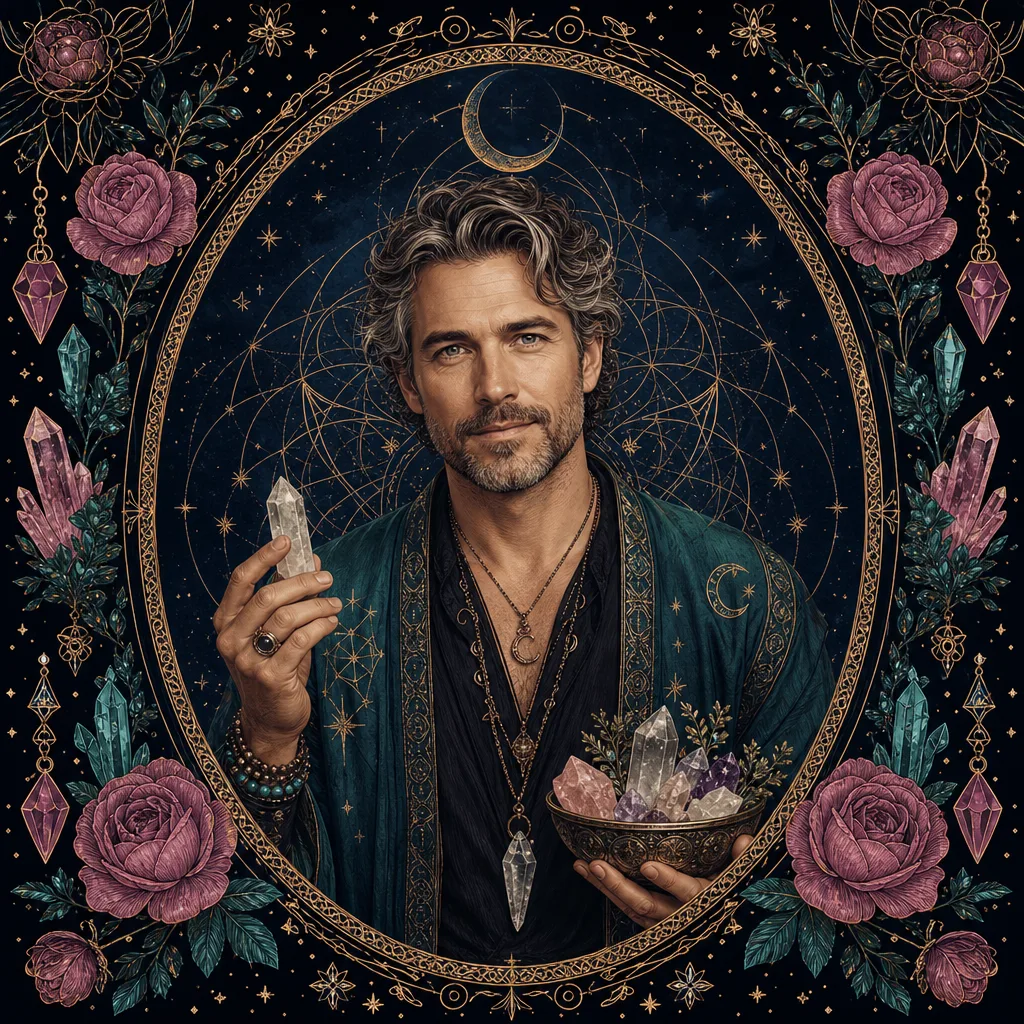
Healers & Wise Folk
Crystal Healer
Also called Crystal Worker, Lapidary Healer, Stone Worker
A crystal healer is a practitioner who works with stones and crystals as tools for healing, energy balancing, protection, and spiritual development, understanding each stone as carrying specific vibrational qualities that can interact with the human energy field to support wellbeing and magical intention.
- Tradition
- Draws on ancient lapidary traditions worldwide; the contemporary form emerged primarily in the late twentieth century as part of the New Age and crystal healing movements
- Standing
- Open
A profile of the Crystal Healer
The crystal healer is the practitioner who has built a working relationship with the mineral kingdom, who knows that a black tourmaline in the pocket is a different kind of company than an amethyst on the desk, and who treats each stone as a specific ally with its own character.
- Loves
- the weight and coolness of a good piece of selenite, the lapidary tradition and its medieval texts, a crystal grid assembled for a specific intention, the moment in a session when something clearly shifts, sourcing ethically mined specimens directly from suppliers.
- Hobbies and pastimes
- sleeping with a new stone to learn its character, studying historical lapidaries in translation, building and activating geometric crystal grids, learning the geology behind each stone's formation.
- Dream familiar
- A slow, ancient tortoise whose shell catches the light like faceted stone, and who carries a quiet wisdom that makes the crystals on the table seem to lean toward it.
- Found in their element
- You find the crystal healer in a room where every surface holds stones arranged with purpose, where the light is soft and something has recently been cleared, and where you are offered a glass of water before anything else happens.
- Signature objects
- a large clear quartz point for amplification and focus, a selenite wand for clearing the energy field, black tourmaline for protection work, a velvet-lined case of working stones, Judy Hall's Crystal Bible, heavily consulted.
A crystal healer is a practitioner who works with the mineral kingdom, using stones and crystals as tools for healing, energetic balancing, protection, and spiritual development. Each stone is understood to carry a specific vibrational character arising from its molecular structure, colour, form, and geological history, and the crystal healer works with these qualities to support the recipient”s own healing and to address specific conditions of the energy field. The practice combines an extensive lapidary knowledge with sensitivity to the subtle dimensions of health and energy, and it typically takes place in the context of a genuine care relationship between practitioner and recipient.
This is one of the most immediately accessible entry points into energy healing and magical practice, because crystals are physical objects that can be held, observed, and worked with directly without any prior background in ritual or spiritual systems. The tangibility of the stone provides a concrete anchor for attention and intention, and the beauty of many minerals makes the practice genuinely pleasurable. For many people crystal work is both the first magical practice they encounter and the one they sustain most consistently across a lifetime.
The work
The crystal healer”s practice involves several interrelated activities. The acquisition and care of stones, which includes cleansing them of accumulated energies, programming them with specific intentions, and maintaining their vitality through appropriate methods, is a prerequisite for effective work. Different traditions recommend different cleansing methods: moonlight, sunlight (with attention to which stones fade in sunlight), running water, earth burial, salt, sound, and smoke are all in common use, and the choice depends on both the stone”s physical nature and the practitioner”s tradition.
A healing session begins with the practitioner”s own centring and preparation, followed by an assessment of the recipient”s current energetic state. Stones are selected based on the qualities needed: grounding stones such as hematite or obsidian for someone who is scattered or overwhelmed, clearing stones such as selenite for congested or stagnant energy, heart-opening stones such as rose quartz or green aventurine for grief or isolation, and protective stones for someone under psychic or energetic pressure. These are placed on or around the body in an intentional arrangement, often following the chakra map from crown to root.
Grid work involves placing stones in geometric arrangements on a flat surface to create a field of combined energy directed toward a specific intention. A crystal grid for healing may surround a photograph, candle, or other representation of the recipient; a grid for protection may be set in the corners of a room; a grid for abundance might use citrine and pyrite in a specific geometric pattern charged and activated with an intention. The geometry of the grid is understood to amplify and organize the combined energy of the stones.
Personal crystal practice, wearing or carrying specific stones, placing them in living and sleeping spaces, and using them in meditation, is as important as formal healing sessions. Many practitioners develop a highly personalized relationship with specific stones that goes beyond their general correspondences, understanding particular stones as personal allies or teachers.
History and tradition
The use of stones for magical, healing, and protective purposes is ancient and geographically universal. Amulets of specific stones appear in the archaeological record of ancient Egypt, Mesopotamia, the Mediterranean, and the Americas. Medieval European lapidaries, texts cataloguing the properties of gems and stones, drew on sources reaching back through Arabic scholarship to Greek and Roman natural history, and they were regarded as genuinely practical handbooks rather than mere folklore.
The idea that specific stones carry specific virtues and that these virtues can be engaged through appropriate use is found in virtually every tradition with access to interesting stones. Turquoise as a protective stone in Native American and Middle Eastern traditions, jade as a stone of virtue and vitality in Chinese culture, amber as a protective amulet across Northern European tradition: these reflect independent recognition of the same kinds of qualities in the same or analogous materials across very different cultural contexts.
The contemporary crystal healing movement as a named practice emerged primarily in the 1970s and 1980s, drawing on the lapidary tradition, the New Age synthesis of chakra work and energy healing, and the intuitive and channelled material that became a major source of crystal correspondence information during this period. Katrina Raphaell”s Crystal Enlightenment trilogy (1985-1987) and Judy Hall”s Crystal Bible (2003) are the most widely cited foundational texts of the contemporary movement. The practice has grown enormously since the 1990s and now constitutes one of the most popular entry points into complementary healing and spiritual practice.
Walking this path
Most crystal healers come to their practice through a personal encounter with a stone that affects them in a way they cannot easily explain, or through receiving a crystal healing that produces a notable shift in their state. The accessibility of crystals, available in every metaphysical shop and increasingly in mainstream retail, means that the initial exploration of the practice has very low barriers.
Building genuine working knowledge takes longer than building a collection, and most experienced practitioners recommend slowing down rather than acquiring rapidly. Working with one stone at a time, sitting with it in meditation, sleeping with it nearby, noting what arises in dreams and daily life over a period of weeks, develops a direct experiential knowledge of that stone”s qualities that is far more useful in practice than knowing the correspondence listings for hundreds of stones by rote.
Training in crystal healing is widely available through workshops, courses, and certification programs, and a structured course from an established teacher provides both organized knowledge and a community of fellow practitioners. The self-taught path is also perfectly viable, particularly with good foundational texts and a commitment to the kind of sustained personal practice that develops real sensitivity over time.
The crystal healer role sits naturally alongside the energy healer, the folk healer, and in the context of stone magic, the ceremonial magician working with talismans. Many practitioners combine crystal work with other healing modalities and other magical practices, finding the stones” specificity and tangibility a valuable complement to more abstract or purely intentional work.
In myth and popular culture
Stones and gems with specific powers appear in the mythological record of virtually every culture that has produced written texts. In the classical tradition, the carbuncle or ruby was believed to shine in darkness, and the sapphire was associated with the heavens and with truth; Pliny the Elder’s Natural History (77 CE) catalogues the supposed properties of dozens of gems with the same matter-of-fact authority he brings to animal behaviour. Medieval bestiaries were typically accompanied by lapidaries, and texts such as Marbode of Rennes’s Liber Lapidum (c. 1090) described the virtues of sixty stones in verse, treating each as both a natural object and a spiritual tool. These texts were taken seriously as practical references, not as fantasy, and their influence can be traced through the Western magical tradition into contemporary crystal healing correspondences.
In the Arthurian tradition, magical stones appear repeatedly as gifts of power or markers of significance: the stone in which Excalibur was set is the most famous, but the broader tradition contains many references to gems that protect their bearers, reveal truth, or confer special capacities. The image of the gemstone as concentrated magical virtue was widespread enough to inform both the literary tradition and the ecclesiastical one; reliquaries were typically encrusted with precious stones whose spiritual properties were understood to complement the sanctity of the relic within.
In popular culture, crystal healing achieved particular visibility during the New Age movement of the 1980s, when it became associated with a broader aesthetic of spiritual wellness that included meditation, channelling, and alternative medicine. The film Practical Magic (1998) and the television series Charmed (1998-2006) both include crystal use as part of a general witchcraft toolkit, though without precision about specific correspondences. More recently, crystals have become an enormous consumer phenomenon, with amethyst, rose quartz, and obsidian available in mainstream retailers worldwide, a development that has drawn renewed attention to the question of how stones are sourced and whether the industrial-scale extraction required to meet that demand is consistent with the ethical relationship with the earth that the practice claims to embody.
People also ask
Questions
Do crystals actually have healing properties?
The scientific evidence for specific physiological healing effects of crystals is not established in clinical research. Crystals do have measurable physical properties, including piezoelectric effects in quartz, that are genuinely interesting, but these do not straightforwardly explain the healing experiences practitioners and recipients report. Many crystal healers hold their practice within an energetic or vibrational model that is not identical to biomedical causation, and practitioners in this framework understand the crystals' effects as operating at the level of the subtle energy field rather than through direct biochemical mechanisms. Others approach crystal work within a psychological or symbolic framework where the stones' value lies in their capacity to anchor and focus intention.
How are crystals used in healing sessions?
In a typical crystal healing session the practitioner assesses the recipient's energetic state and places stones on or around the body, often corresponding to the chakra system or other maps of the body's energy centres. Different stones are selected for their traditional associations with specific qualities: clear quartz for clarity and amplification, amethyst for calm and spiritual opening, black tourmaline for protection and grounding, rose quartz for the heart and compassion, and so through an extensive lapidary. The stones may be left in place for a period while the recipient rests, adjusted as the session proceeds, or moved across the body in specific patterns.
Where do crystal correspondences come from?
The oldest layer of crystal lore comes from the lapidary tradition, texts cataloguing the properties and uses of gems and stones, which exists in Egyptian, Roman, Arabic, medieval European, and Asian forms. The magical and healing uses of specific stones were recorded and transmitted through these texts across many centuries. The contemporary crystal healing system synthesizes this historical material with the chakra system from Indian tradition, the colour correspondences of the Western esoteric tradition, and the intuitive or channelled attributions that became widespread in the New Age movement of the 1980s and 1990s. Judy Hall's Crystal Bible (2003) synthesized much of this material into the most widely consulted modern reference.
How do I choose crystals for my own practice?
Most experienced crystal workers recommend beginning with a small selection of foundational stones, commonly clear quartz, amethyst, black tourmaline, rose quartz, and citrine, and working with each one over an extended period rather than accumulating large collections quickly. Handling stones directly before purchase is recommended where possible, because many practitioners find that a direct energetic sense of whether a particular stone is right for them is more reliable than colour or reputation alone. Beginning with the traditional correspondences and then testing them through personal experience is the approach most likely to develop genuine working knowledge.
Is crystal healing the same as crystal magic?
Crystal healing focuses specifically on the health, energy, and wellbeing applications of stones, typically working with a recipient in a quasi-therapeutic context. Crystal magic uses stones as components of spells, talismans, protective grids, and ritual work oriented toward practical magical ends. Many practitioners use the same stones in both contexts, and the boundary between healing and magical work is not sharp, because both draw on the same understanding of each stone's properties and both work with the same energy field. A black tourmaline placed for protection functions simultaneously as a healing and a magical tool.