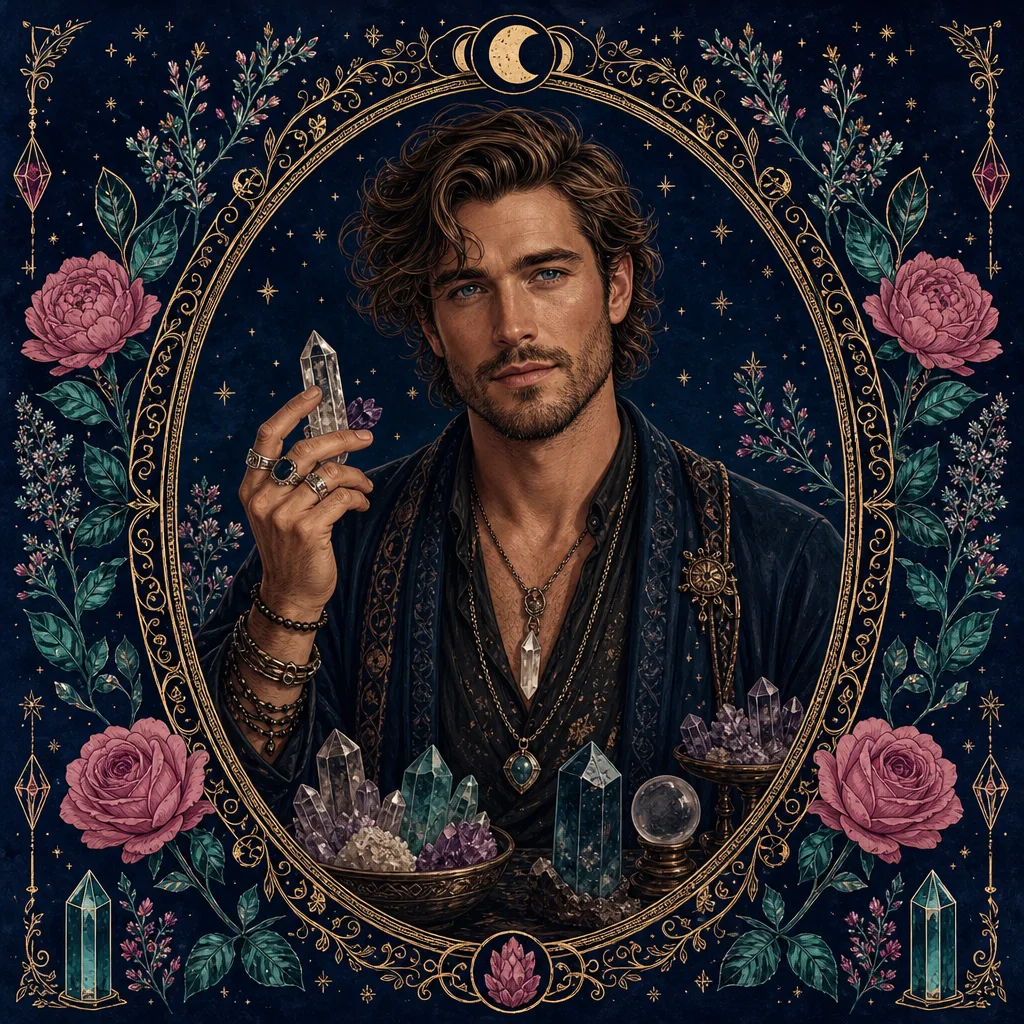
Witches & Their Paths
Crystal Witch
Also called Stone Witch, Crystal Worker
A crystal witch is a practitioner who works primarily with crystals, stones, and minerals as tools of healing, energy work, and magical focus, building a practice organised around the properties and relationships of these earth materials.
- Tradition
- Contemporary eclectic witchcraft, drawing on gemstone lore and folk stone magic
- Standing
- Open
A profile of the Crystal Witch
The crystal witch is a collector of earth-born light, reading the language of stone the way a scholar reads old manuscripts.
- Loves
- raw mineral specimens from the earth, the way light moves through quartz, a well-ordered altar, old lapidary texts, slow mornings with a pendulum.
- Hobbies and pastimes
- attending gem and mineral shows, learning crystal formation geology, building crystal grids, journaling stone correspondences.
- Dream familiar
- A slow, ancient tortoise whose shell gleams with the colours of labradorite.
- Found in their element
- You will find the crystal witch at a gem show on a Saturday morning, or at their kitchen table with stones sorted by correspondence and the full moon still bright in the window.
- Signature objects
- clear quartz point, black tourmaline tumble, selenite charging plate, crystal pendulum, worn copy of a lapidary.
A crystal witch is a practitioner whose magical work centres on crystals, gemstones, and minerals, working with these earth materials as tools for energy manipulation, healing support, divination, protection, and ritual focus. Stones are understood to carry their own energetic signatures and sometimes their own spirit presences, making them not merely passive tools but active participants in the work.
It is worth being honest and warm about the origins of this specific label: “crystal witch” as a self-identifier is contemporary, emerging primarily through social media witchcraft communities in the 2010s alongside a broader mainstream interest in crystals. However, working with stones for magical purposes is genuinely ancient. Lapidaries, texts recording the magical and healing properties of gemstones, were compiled in ancient Mesopotamia, classical antiquity, and medieval Europe. The crystal witch working with rose quartz for love or obsidian for protection is drawing on correspondence systems with real historical roots, even if the label is new.
The work
At the centre of crystal witch practice is the act of selecting the right stone for a given intention, establishing a relationship with it, and directing that relationship toward a magical purpose. A crystal witch typically builds a collection of stones carefully, learning each one”s traditional correspondences and personal character before adding it to the working toolkit.
Programming or setting intention in a stone is a core skill: holding the stone, entering a light meditative state, and transferring a clear intention into it through breath, visualisation, and focused will. The programmed stone is then used in ritual, carried on the body, placed in a relevant location, or included in a spell construction such as a charm bag or altar layout.
Gridding is a practice in which multiple crystals are arranged in a geometric pattern to create a combined effect. A protection grid might surround the perimeter of a home with black tourmaline at the corners. An abundance grid might place citrine at the centre of a flower-of-life pattern with other abundance-associated stones at the points. The geometric form carries its own magical quality, and the combination of stones amplifies and directs the working.
Crystal pendulums are a favoured divination tool for many crystal witches, using the pendulum”s movement to answer yes-or-no questions or dowse for what is needed. Crystal balls, specifically clear quartz or obsidian spheres, are used for scrying. Tumbled stones drawn from a bag serve as a form of casting divination, similar in principle to rune casting.
Cleansing and recharging stones is ongoing maintenance work. Crystals are cleared of accumulated energies through moonlight, running water, salt, sound, breath, and smoke, depending on the stone”s properties (some stones dissolve in water and cannot be wet-cleansed). They are then recharged under the full moon or through intentional contact with the practitioner.
History and tradition
The magical use of stones is documented across many cultures and periods. In ancient Mesopotamia, specific stones were prescribed to address specific problems, much as herbs were. The classical Greek and Roman world held that gems like amethyst prevented drunkenness, that carnelian promoted courage, and that jet protected against the evil eye. These beliefs were compiled in medieval lapidaries, the most influential being Marbode of Rennes” twelfth-century Liber Lapidum and Albertus Magnus” later compilations, which remained standard reference works through the Renaissance.
The New Age movement of the 1980s saw a significant revival of interest in crystal healing and crystal energy work, producing the extensive modern literature on crystal properties that informs most contemporary crystal witch practice. This body of work substantially expanded the traditional lapidary record, adding new stones and new properties that do not always have historical antecedents but reflect accumulated modern experiential knowledge.
The aesthetic of crystal witchcraft, beautiful stones displayed on altars and windowsills, crystal towers catching the light, raw specimens arranged with intention, has become one of the more visible signatures of contemporary witchcraft practice online. The aesthetic is real and pleasurable, and the practice beneath it is equally real.
Walking this path
A crystal witch begins with a few well-chosen stones rather than a large collection. Learning several stones deeply, understanding both their traditional correspondences and their personal character as experienced through regular handling and meditation, is more valuable than acquiring dozens of unfamiliar specimens.
Studying lapidary tradition provides historical grounding. Reading both old sources, medieval lapidaries in translation are increasingly accessible, and good modern comprehensive guides gives the practitioner a sense of where the tradition has roots and where it has been extended in recent decades.
The crystal witch path blends naturally with lunar witchcraft (moon-charging stones), green witchcraft (stones with plant-realm connections), cosmic witchcraft (planetary stone correspondences), and healing practices of many kinds. It is one of the most visually rich paths in contemporary witchcraft and one of the most immediately accessible to new practitioners.
In myth and popular culture
Gemstones have carried magical significance in human storytelling since antiquity. In Greek myth, amethyst was said to have originated when the god Dionysus, furious after a mortal insult, swore that the first person he encountered would be devoured by tigers; a young woman named Amethystos prayed for protection and was turned to white quartz by Artemis, and Dionysus, repentant, poured wine over the stone, giving it its characteristic purple. The story, though first recorded fully by the French poet Remy Belleau in the sixteenth century, draws on an older tradition of explaining gemstone origins through divine transformation. Sapphires were believed in medieval Europe to protect the wearer from envy and harm, and Pope Innocent III ordered that the cardinals’ rings be set with them for exactly this reason.
The enchantress figure who works with stones appears in Arthurian literature: Morgan le Fay, whose name connects to the sea and to the fay world, is associated in several texts with healing through otherworldly means that include magical objects and materials. The Lady of the Lake, who gifts Excalibur to Arthur, represents a broader class of female figures in medieval romance who mediate magical power through objects of the natural world. These are not literal crystal witches, but they populate the imaginative territory from which the role draws its depth.
In film and television, the crystal-working aesthetic has most visibly shaped the character of Storm from the X-Men franchise, whose gifts are associated with natural forces and who is often depicted with crystal and mineral imagery in her iconography, though the parallel is loose. More directly, the Netflix series “Chilling Adventures of Sabrina” (2018-2020) featured a version of crystal magic woven into its witchcraft scenes, and the show “Motherland: Fort Salem” (2020-2022) depicted witches working with stones and materials in ways that reflected contemporary crystal witch practice more closely than older supernatural narratives.
The broader figure of the wise woman or enchantress who draws power from stones of the earth appears in Tolkien’s legendarium in the Ents’ relationships with the deep materials of the world, and more directly in Galadriel, whose Nenya, the Ring of Adamant, is explicitly a stone-set ring understood as a source and channel of her considerable power. These literary inheritances show how deeply the idea of gemstones as repositories and amplifiers of extraordinary force runs through the Western imaginative tradition.
People also ask
Questions
How do crystals work in magical practice?
Crystal witches work with stones as having their own energetic signatures, historical magical correspondences, and sometimes spirit presences. A clear quartz point might be used to amplify an intention; black tourmaline to provide protection; rose quartz to open the heart. The witch programs or charges the stone with a specific intention, works with it in ritual or carries it on their person, and cleanses and recharges it regularly.
Are the healing and magical properties of crystals scientifically proven?
They are not verified by physical science. Crystal magic belongs to the category of subtle energy work and magical practice, which operates by different principles than scientific medicine. Experienced practitioners often note strong results, and crystal properties have been documented in folk and magical traditions across many cultures and centuries. Working with crystals is best approached as magic rather than as alternative medicine for serious health conditions.
How does a crystal witch choose which stones to work with?
Most crystal witches use a combination of traditional correspondence lists, established in old lapidaries and modern compilations, and personal intuition and response. Holding a stone and noticing the felt sense it produces, any warmth, tingling, images, or emotional responses, is a common method. Many practitioners find that certain stones seek them out repeatedly through gifts or unexpected finds, which is treated as a sign of affinity.
What is a lapidary and why does it matter for crystal witches?
A lapidary is a historical text that records the properties and magical uses of gemstones. Medieval lapidaries such as Marbode's *Liber Lapidum* (c.1090) assigned each stone virtues: protection, love, healing, courage, eloquence. Many traditional crystal correspondences in modern use can be traced to these texts, giving the practice more historical depth than it is sometimes given credit for.
What ethical issues should a crystal witch be aware of?
Crystal mining carries significant human rights and environmental concerns. Many gemstones come from mines in which workers are exploited and landscapes are severely damaged. An ethically conscious crystal witch investigates sourcing, buys from dealers who provide chain-of-custody information, works with locally found stones where possible, and maintains a smaller collection of well-chosen stones rather than accumulating large quantities.