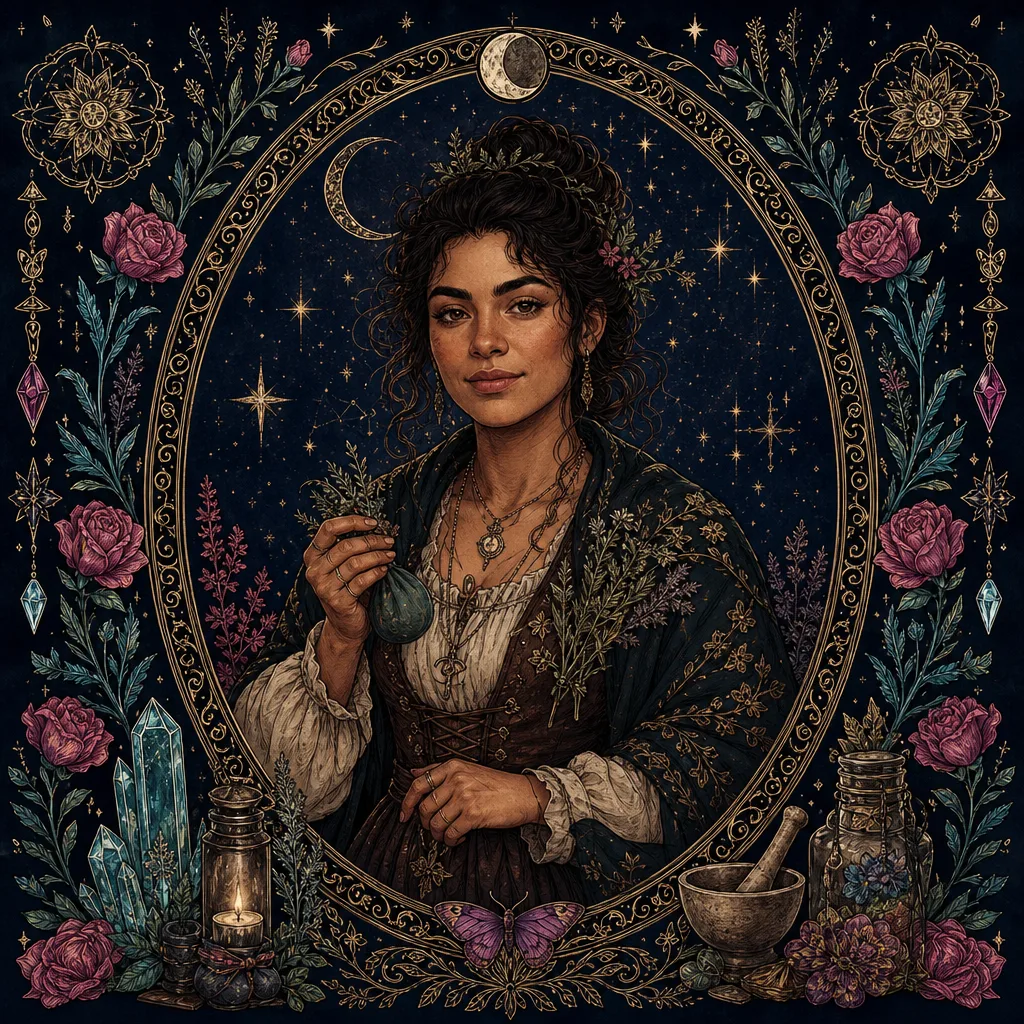
Folk Magick Practitioners
Cunning Folk
Also called wise man, wise woman, village witch
A cunning person is a community magickal practitioner of early modern Britain and Europe who provided charms, healing, divination, and counter-magic to ordinary people. They served as the local expert on illness, lost goods, bewitchment, and the unseen world.
- Tradition
- British and northern European folk magic, fifteenth through twentieth centuries
- Standing
- Open
A profile of the Cunning Folk
The cunning person is the village's indispensable expert on the unseen world, trusted because they get results.
- Loves
- old manuscript recipe books, the smell of herb bundles drying, a client who follows instructions, planetary almanacs, market days and useful gossip.
- Hobbies and pastimes
- collecting and annotating folk charms, maintaining a physic garden, reading primary historical sources, teaching the old methods to interested students.
- Dream familiar
- A clever, sharp-eyed jackdaw who knows every secret in the village and keeps them all.
- Found in their element
- The cunning person is found in their kitchen on a weekday, surrounded by correspondence and visitors, or at the edge of the churchyard on a Thursday evening with their crystal and a question to answer.
- Signature objects
- scrying glass or crystal, personal book of art, written charm on parchment, sieve and shears for divination, a witch bottle buried at the threshold.
A cunning person is a professional folk magician of early modern Britain and northern Europe who served their local community as healer, diviner, protector, and counter-magic specialist. The term “cunning” derives from the Old English word meaning “knowing,” and the role was defined entirely by useful, practical knowledge: knowing how to lift a curse, find a thief, cure a sick cow, or interpret a troubling dream.
These practitioners occupied a distinct and often respected social niche. Unlike the feared witch of popular imagination, the cunning man or cunning woman was sought out, consulted like a doctor or lawyer, and paid for services rendered. Their authority rested on demonstrated results, local reputation, and a body of knowledge that set them apart from their neighbours.
The work
The day-to-day practice of a cunning person was shaped entirely by the needs of those who came to them. The most common requests fell into four broad categories: healing (both human and animal), counter-magic against suspected bewitchment, divination to locate lost or stolen property, and the provision of protective charms for homes, ships, fields, and people.
Healing work drew on a mixture of herbal medicine, spoken or written charms, and ritual. Many cunning folk were skilled herbalists who combined plant knowledge with the recitation of verbal charms in Latin or vernacular languages, often adapted from older liturgical sources. A charm to stop bleeding might invoke saints’ names alongside instructions for knotted threads or specific plants.
Counter-magic was among the most sought-after services. When a client believed their livestock were wasting, their butter would not churn, or illness had struck without medical explanation, the cunning person would diagnose bewitchment and prescribe a cure. This might involve boiling the client’s urine in a witch-bottle, scratching the suspected witch to draw blood, or burning a bewitched object to send the harm back to its source.
Divination took many forms. Scrying in a mirror, crystal, or bowl of water was common, as were the sieve-and-shears technique, the key-and-book method, and consultation of planetary almanacs. Finding stolen goods was a regular enough request that it appears in numerous court records, where clients testified to paying cunning folk to identify thieves.
Written charms on paper or parchment were a staple product. These might be worn on the body, buried at a threshold, or hung in a barn. The cunning person might also draw on a personal “book of art” — a manuscript collection of spells, recipes, planetary tables, and ritual instructions compiled or inherited over years.
History and tradition
The historical record of cunning folk in England is substantial, running from the fifteenth through the early twentieth centuries. Scholars including Keith Thomas, Emma Wilby, and Owen Davies have documented hundreds of named cunning folk through court records, ecclesiastical complaints, client testimonies, and later newspaper accounts. Similar figures appear across the historical record of Scotland, Wales, Scandinavia, Germany, and the Low Countries under various names.
Early modern cunning folk operated in a world where learned magic (the astrologer’s art, the ceremonial grimoire tradition) and village practice existed in conversation with each other. Popular printed works such as the various editions of “The Book of Secrets” attributed to Albertus Magnus circulated widely, and cunning folk absorbed learned frameworks alongside inherited oral knowledge.
The role declined as state medicine, improved literacy, and changing religious attitudes eroded the social conditions that sustained it, but it never vanished entirely. Folklorists in the nineteenth and early twentieth centuries documented practicing cunning folk in rural Britain, and the tradition fed directly into the twentieth-century revival of interest in folk magic and witchcraft.
Walking this path
Today, many practitioners identify with the cunning-folk tradition as a framework for folk magic rooted in practical service and community connection. This is an open path in the fullest sense: the historical cunning folk were not initiates of a secret order but self-made specialists who combined inherited knowledge, self-study, and practical experiment.
Working in this tradition asks for breadth. The cunning person is not a specialist in one area but a generalist in the old sense: capable across healing, divination, protection, and counter-magic. Study of the historical record is both possible and rewarding, given the quality of scholarship now available. Reading Owen Davies’s “Popular Magic” or Emma Wilby’s “Cunning Folk and Familiar Spirits” will ground you in the documented practices of the tradition.
The role sits comfortably alongside many others. A rootworker, a hedgewitch, or a kitchen witch may each find genuine kinship with the cunning-folk framework, and the overlap is real and historical. What defines the cunning person most clearly is an orientation toward service: the work exists to help people, and the practitioner stands between their community and the unseen world with practical intent.
In myth and popular culture
The cunning folk tradition feeds directly into some of the oldest and most familiar character types in British literary and folk culture. The wise woman of fairy tales, who knows which herb cures, which charm lifts a curse, and which riddle unlocks the castle gate, is a direct literary descendant of the village cunning woman. These figures appear throughout the collected fairy tales of the Brothers Grimm in German tradition, and in the English story corpus collected by scholars such as Joseph Jacobs, where they serve as practical dispensers of magical knowledge rather than wicked witches.
Shakespeare drew on the cunning-folk world directly. The witches of Macbeth (1606) carry the ambiguity of practitioners who are sought out for their knowledge and feared for the same knowledge: Macbeth goes to them as a client seeking divination, which is precisely the relationship many clients had with cunning folk of the period. The character of Prospero in The Tempest (1611) is more ceremonial magician than cunning man, but his practical use of spirit assistance for concrete purposes resonates with the service-oriented framework of the tradition.
In modern fiction, Terry Pratchett’s witches in the Discworld series represent perhaps the most thoughtful literary engagement with the cunning-folk archetype in twentieth-century literature. Granny Weatherwax and Nanny Ogg in novels including “Equal Rites” (1987), “Wyrd Sisters” (1988), and “Lords and Ladies” (1992) are explicitly village witches whose authority rests on practical knowledge, community trust, and the willingness to be the person who does what needs doing. Pratchett was familiar with the folk magic scholarship of his period, and the result is a portrayal of the role that is comedic without being dismissive.
The cunning-folk tradition also shaped the popular image of the village wise woman in historical fiction. Mary Dolan’s character in Hilary Mantel’s “Wolf Hall” trilogy and the various healers and herb-women of historical novels set in early modern England draw on a broad cultural inheritance of the cunning folk’s role, even when the authors do not use the term explicitly.
People also ask
Questions
What did cunning folk actually do for their clients?
Cunning folk offered a wide range of practical services: diagnosing and treating illness through charms and herbal remedies, identifying witches or ill-wishers when a client believed themselves bewitched, locating lost or stolen property using divination, and providing protective charms for homes, livestock, and people. They were problem-solvers first and foremost, meeting the everyday spiritual needs of their communities.
Were cunning folk the same as witches?
In early modern Britain the two roles were often sharply distinguished. Witches (in popular understanding) caused harm; cunning folk cured it. Many cunning folk explicitly advertised themselves as opponents of witchcraft. In practice the boundary blurred, and both could be prosecuted under the English Witchcraft Acts, but the cultural distinction mattered deeply to clients who sought help against suspected bewitchment.
Is the cunning folk tradition still practiced today?
The tradition never fully died out, and a number of contemporary practitioners in Britain and the wider Anglophone world identify as cunning folk or work within the cunning-craft framework. Modern interest in historical folk magic has brought renewed attention to documented cunning-folk methods, and many contemporary witches draw on this lineage consciously.
How did someone become a cunning person?
Cunning folk in historical record came to their role through several routes: inheritance of knowledge within a family, apprenticeship to an older practitioner, a spontaneous calling sometimes described as a gift, or self-study from printed chapbooks and grimoires circulating in the period. There was no single formal path, and the role was largely self-defined and community-recognised.
What tools did cunning folk use?
The typical cunning person's toolkit included a scrying glass or crystal for divination, a magical book (sometimes called their "book of art"), protective and curative charms written on paper or parchment, sieve-and-shears or key-and-book for divination, and herbal preparations for healing. Many also worked with planetary timing and drew on popular astrology.