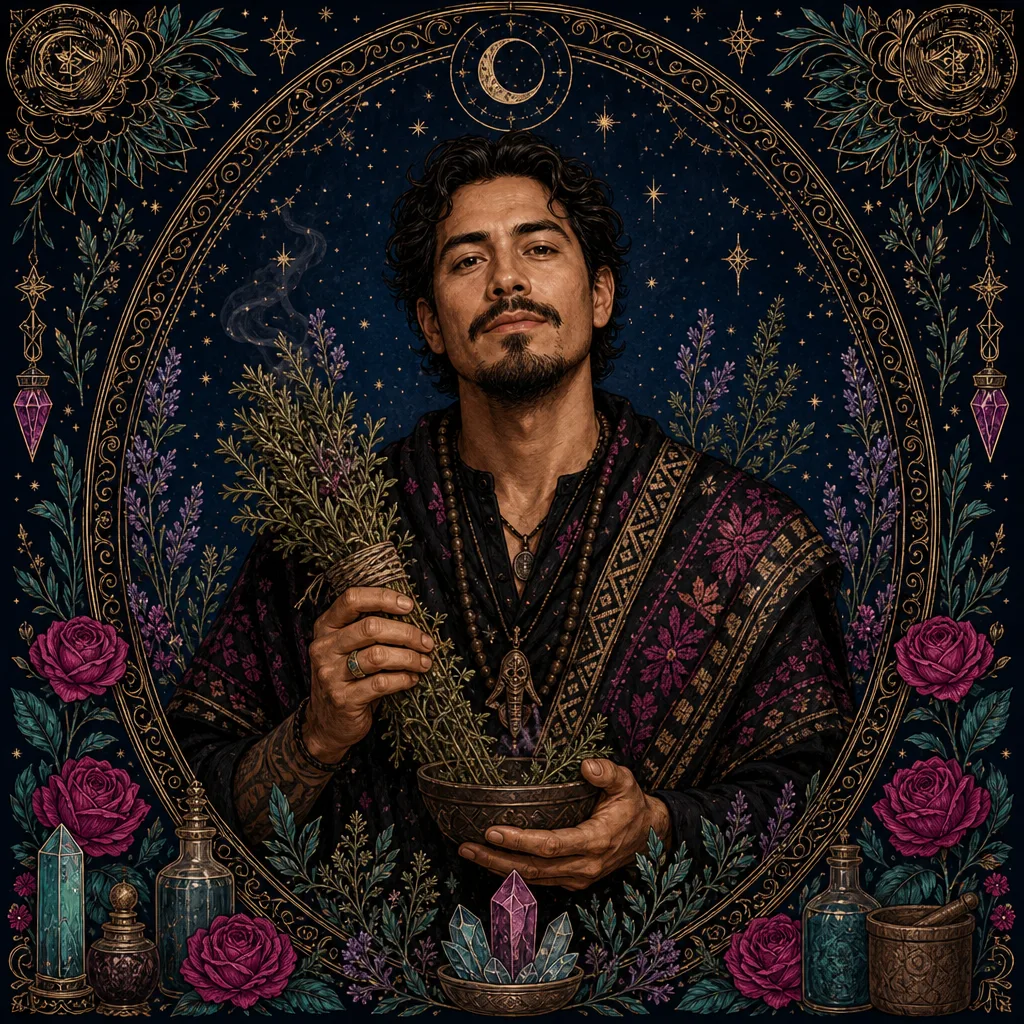
Folk Magick Practitioners
Curandero
Also called curandera, curandero/a, hierbero, yerbero
A curandero or curandera is a Latin American folk healer who treats physical, emotional, and spiritual illness through plant medicine, prayer, ritual cleansing, and spiritual diagnosis. The tradition of curanderismo is a living healing practice rooted in indigenous American, Spanish Catholic, and in some regions African-derived knowledge, held within and serving specific Latin American communities.
- Tradition
- Curanderismo; Latin American folk healing tradition
- Standing
- Culturally rooted
A profile of the Curandero
The curandero is a healer whose hands hold the knowledge of plants, prayers, and the precise reason your soul left your body last Tuesday.
- Loves
- fresh copal smoke on a Tuesday morning, the pharmacopoeia of the regional landscape, a patient who tells the full story, prayers learned from a grandmother, the rhythm of the healing ritual.
- Hobbies and pastimes
- cultivating medicinal herbs, learning the plants of new regions, studying regional curanderismo histories, passing knowledge to apprentices.
- Dream familiar
- A grey-green hummingbird, quick and precise, who knows every flowering plant within a hundred miles.
- Found in their element
- The curandero is found in a small room fragrant with herbs and smoke, receiving clients who come with problems that have no name in biomedical language.
- Signature objects
- fresh egg for limpia, bundle of ruda and romero, copal resin and brazier, holy water in a small bottle, candles in specific colours for each condition.
A curandero or curandera is a Latin American folk healer whose practice addresses the full spectrum of human illness — physical, emotional, and spiritual — through plant medicine, prayer, ritual cleansing, and spiritual diagnosis grounded in a deep understanding of how the visible and invisible worlds interact to produce health and suffering. The curandero is a healer first, and everything in the tradition is oriented toward restoration: of balance in the patient”s body, of right relationship with the spiritual world, of the conditions necessary for a person to live well.
The tradition of curanderismo is not a single system but a living family of regional practices shaped by the indigenous healing traditions of Latin America — Nahuatl, Mayan, Quechua, and many others — combined with Spanish Catholic folk medicine and, in some regions, African-derived healing knowledge. Each regional tradition has its own specific character, its own understanding of spiritual anatomy and illness, and its own pharmacopoeia drawn from the plants of its particular landscape.
The work
The curandero”s diagnostic work begins with listening. A client”s account of their illness, its onset, and the circumstances surrounding it provides the curandero with crucial information about both its physical nature and its possible spiritual dimensions. The practitioner combines this history with physical observation — the patient”s colour, energy, the quality of their pulse — and with spiritual perception developed through prayer and practice.
The limpia, or ritual cleansing, is among the most characteristic procedures in curanderismo. It may use a fresh egg passed over the body to draw out harmful influences, smoke from copal or other herbs, a bundle of specific plants swept across the skin, holy water, or a combination of these. The egg limpia is both diagnostic and therapeutic: after the egg is passed over the client, it is broken into water and the contents read for information about the condition treated. A clear white indicates a clean result; a clouded, strange-coloured, or distinctively shaped yolk gives specific information about what was found and removed.
Plant medicine is the other pillar of curanderismo. The curandero”s knowledge of medicinal plants is typically extensive and precise: which plants treat which conditions, how they are prepared (tea, poultice, steam bath, smoke, bath preparation), at what dose, and at what time. Some practitioners specialise in plant knowledge to the degree that they are specifically called herbalists (hierbero or yerbero) within the broader tradition.
Prayer is woven through every procedure. The curandero works within a religious framework — most commonly Catholic in Mexican and Central American traditions, though the specific saints and prayers vary — and prayer is understood not as decoration but as the channel through which healing power flows. Invocations of the Virgin, of specific saints with healing associations, and of the Holy Spirit accompany the physical procedures.
Conditions like susto (spiritual fright) require specific treatment. Susto is understood as the soul”s partial departure from the body following a shock, and the curandero”s work is to call the soul back. This involves prayer, calling the patient”s name at the site of the frightening event if possible, and specific ritual procedures that vary by regional tradition. Untreated susto was considered a serious and potentially fatal condition.
History and tradition
Curanderismo”s roots reach back to the pre-Columbian healing traditions of Latin America, which were sophisticated and diverse. Aztec-period medical knowledge included extensive botanical pharmacopoeia, an understanding of disease categories, and skilled practitioners. The forced encounter with Spanish colonial medicine and Catholic religious practice produced a complex and often violent process of synthesis.
The Inquisition prosecuted some folk healing practices as sorcery, and the pressure of colonial authorities pushed much traditional knowledge underground or caused it to be renegotiated in Catholic terms. What emerged was a tradition that is genuinely syncretic: not a corruption of indigenous healing or of Catholicism, but a new synthesis that draws real power from both.
The tradition continued to evolve through the colonial period and through the nineteenth and twentieth centuries, absorbing modern biomedicine in interesting ways — many curanderos refer patients to physicians for conditions they identify as biomedical in nature, and many accept laboratory results as part of diagnosis. The relation between curanderismo and biomedicine is not one of opposition but of functional specialisation: each addresses conditions the other does not.
Scholars including Elena Avila (who was herself a practicing curandera and wrote “Woman Who Glows in the Dark”), Robert Trotter II and Juan Antonio Chavira (whose “Curanderismo” remains the standard academic overview), and numerous subsequent researchers have documented the tradition extensively in the twentieth and twenty-first centuries.
Walking this path
Curanderismo is the healing tradition of specific Latin American peoples and communities, rooted in their cultural, spiritual, and historical experience. The curandero”s role is not adopted from outside but grown from within: called, trained, recognised, and ultimately confirmed by a community that has received healing from the practitioner”s hands.
For practitioners from Latin American backgrounds, curanderismo may be part of family and community inheritance — a grandmother who knew the plants, an uncle who could treat susto, a great-aunt known as a healer in her village. Engaging with this inheritance means both learning from living practitioners and engaging honestly with the indigenous roots that colonial history sometimes obscured.
For those outside Latin American communities, the most respectful engagement is as a recipient of healing when it is offered, as a student of the tradition”s scholarship, and as a supporter of Latin American practitioners and their work. The title of curandero is not available for adoption by those who have not been called, trained, and recognised within the tradition. The knowledge is not secret, but the role is not a costume.
The curandero”s practice is compatible with and distinct from other folk healing roles. The relationship between curanderismo and brujeria in Latin American communities is complex: the curandero is healer and the brujo is sorcerer in many popular framings, but individual practitioners may hold both dimensions, and the boundaries shift across communities and contexts.
In myth and popular culture
Curanderismo has a substantial presence in Latin American literature, where the healer figure carries both narrative weight and cultural specificity. The most celebrated literary treatment is probably that of Gabriel Garcia Marquez, whose magical realist novels including “One Hundred Years of Solitude” (1967) and “Love in the Time of Cholera” (1985) are saturated with the presence of folk healers, herbalists, and spiritual diagnosticians whose knowledge intersects the physical and supernatural in precisely the way curanderismo understands health to work. The character of Pilar Ternera in “One Hundred Years of Solitude,” who reads cards and knows the past and future of the Buendia family, is one of several figures in the novel who embody the healer-seer role in recognisable curanderismo terms.
Elena Avila, who was herself a licensed psychiatric nurse and a practicing curandera, wrote “Woman Who Glows in the Dark” (1999), a memoir and guide to curanderismo that brought the tradition to a wide English-reading audience while maintaining the integrity of the practice. Avila’s account of her own calling, training, and work as a curandera is among the most direct and honest first-person accounts of the tradition available in English.
In film, John Sayles’s “Mi Familia” (1995) includes a grandmother figure whose spiritual authority and healing knowledge are portrayed as integral to the family’s survival across generations. The documentary “Curandero: Dance with the Devil” (2005), directed by Eduardo Rodriguez, follows a working curandero named Carlos Rueda in a serious and largely respectful portrait of practice, though its horror-genre framing has been criticised. The television drama “Ugly Betty” (2006-2010) featured curanderismo elements in storylines engaging with the Suarez family’s Mexican heritage, bringing the tradition into mainstream American primetime in, admittedly, a considerably lighter register.
The figure of the curandero also appears in the video game “Guacamelee!” (2013), developed by Canadian studio DrinkBox Studios, in which the protagonist’s mentor is a curandero figure whose knowledge of both the physical and spirit world is central to the game’s premise. The game drew on Mexican folklore and iconography with visible affection and more research than is typical of the medium, though it is clearly a creative interpretation rather than a documentation of practice.
People also ask
Questions
What conditions does a curandero treat?
Curanderos treat both physical illness and conditions understood as having spiritual or emotional causes. The latter includes susto (spiritual fright caused by a shocking experience), mal de ojo (the evil eye, typically affecting children), empacho (a digestive condition understood to have a spiritual component), envidia (harm arising from another person's envy), and bilis (a condition of excessive anger or grief that manifests physically). These conditions are recognised cultural syndromes with their own diagnostic criteria and specific treatment protocols within the tradition.
How does the curandero diagnose illness?
Diagnosis combines physical observation, client history, and spiritual assessment. The curandero pays attention to symptoms, their pattern, and their onset, but also to the spiritual condition of the client as perceived through prayer, laying on of hands, and sometimes specific divinatory procedures. Pulsing (reading the pulse at specific points to perceive the patient's condition) is used in some traditions. The egg limpia both diagnoses and treats: the egg is passed over the client's body, then broken into a glass of water and read for signs of what condition was present.
What plants does a curandero use?
Curanderismo draws on an extensive plant pharmacopoeia that varies by region. In Mexico, important plants include ruda (rue), epazote, hierba buena (spearmint), altamisa (mugwort), copal (for smoke cleansing), romero (rosemary), and many region-specific medicinal plants. The hierbero or yerbero is a specialist in plant knowledge within the broader tradition. Knowledge of plants is typically learned through long apprenticeship and personal experimentation.
Is curanderismo related to indigenous healing traditions?
Yes, substantially, though the relationship varies by region and community. Mexican curanderismo has deep roots in Nahuatl and other Mesoamerican healing traditions, incorporating indigenous plants, diagnostic concepts, and understandings of the spiritual anatomy of the person alongside Spanish Catholic elements. In the Andean region, curanderismo draws on Quechua and Aymara traditions. Each indigenous source tradition has its own specific character, and the degree of integration with indigenous knowledge varies significantly across the diverse spectrum of curanderismo.
Can non-Latin American people receive healing from a curandero?
Many curanderos have treated clients of any background throughout their communities' histories, and healing offered to someone is different from someone claiming the title or practicing the tradition. If you are experiencing a condition that falls within the curandero's expertise -- mal de ojo, susto, empacho -- and a curandero is willing to treat you, that is the curandero's gift of service. Seeking healing as a client is different from adopting the title or practice without the cultural grounding to hold it properly.
How does someone become a curandero?
In most regional traditions, becoming a curandero involves a calling -- often experienced as a vision, a serious illness from which the person recovers with new knowledge, or a specific life event -- and then a period of apprenticeship with an established practitioner. The training is long, practical, and conducted within the tradition's own community. Some knowledge is considered passed by divine gift; other knowledge is taught systematically over years. The community recognises the curandero through their practice and its results.