Witches & Their Paths
Death Witch
Also called Necromantic Witch, Witch of the Dead
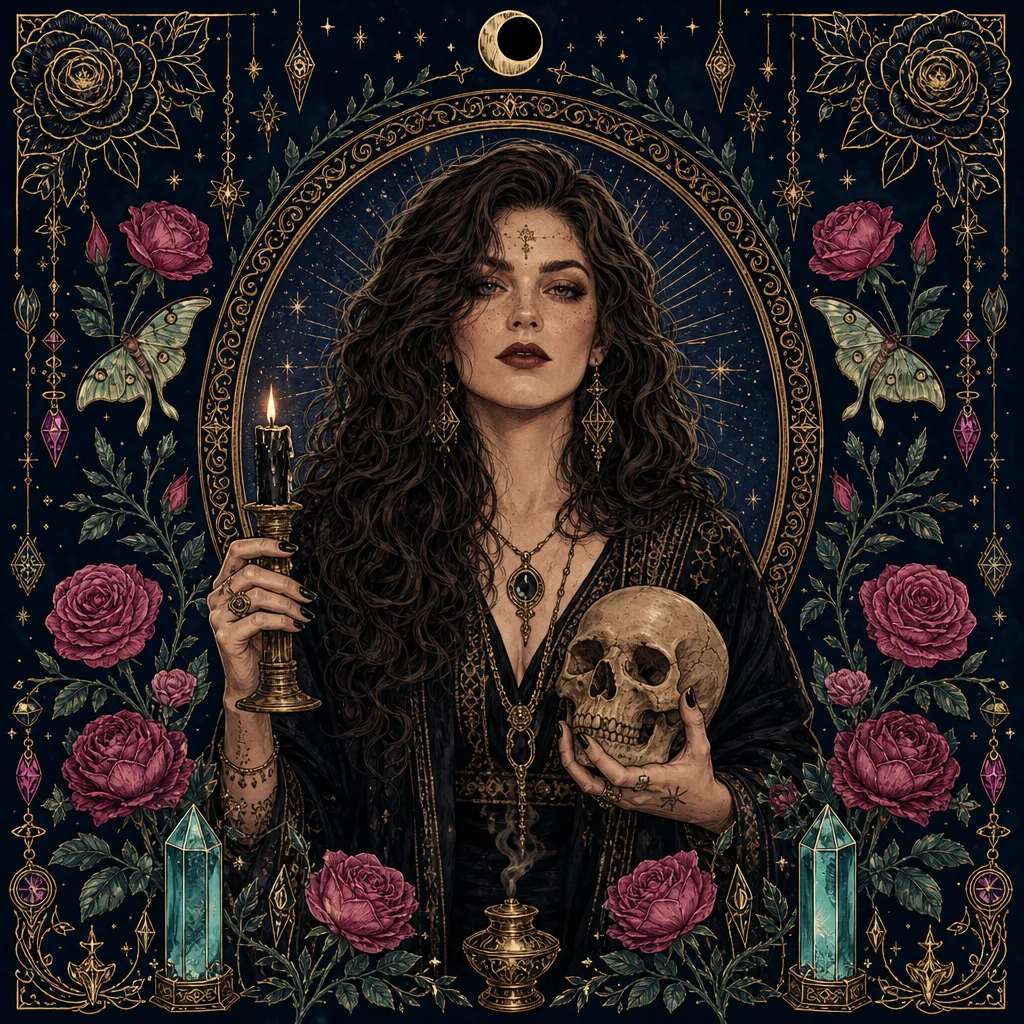
A death witch is a practitioner who centres their work on death, dying, the dead, and the liminal space between life and what follows, working as a psychopomp, necromancer, ancestor worker, and keeper of the death mysteries.
- Tradition
- European and broadly global ancestor veneration and necromantic tradition
- Standing
- Open
A profile of the Death Witch
The death witch is the one who stays when everyone else leaves, holding the threshold between the living and the dead with steady hands and an open heart.
- Loves
- the beauty of well-tended graveyards, photographs of the beloved dead, candlelight at the ancestor altar, Samhain when the veil is genuinely thin, honest conversations about mortality.
- Hobbies and pastimes
- death doula training and study, cemetery genealogy research, reading comparative mythology of the afterlife, tending the ancestor altar daily.
- Dream familiar
- A large, unhurried raven who has watched the comings and goings of souls for centuries and finds it all deeply interesting.
- Found in their element
- The death witch is at the ancestor altar before dawn, or at the cemetery on a grey Tuesday, or sitting quietly with someone who is dying and needs a witness who is not afraid.
- Signature objects
- graveyard soil gathered with offering, skull or bone from an honoured dead, black candles and salt, photographs of personal ancestors, cauldron as the transformative void.
A death witch is a practitioner who works at the boundary between life and death, developing a deep and practical relationship with mortality, the dying, the dead, and the mysteries of what lies beyond the moment of death. This is not a dark aesthetic or a performance of morbidity; it is a serious and often quietly beautiful path that provides enormous service to individuals and communities willing to sit honestly with what most of contemporary culture avoids.
The death witch serves as a keeper of the death mysteries in their community: the person who sits with the dying, tends the dead with ritual dignity, works with ancestors for healing and guidance, and holds the understanding that death is not the end of relationship but a transformation of it.
The work
Ancestor work is often the entry point into death witchcraft. Establishing a regular practice of communication with personal ancestors, tending an ancestor altar with photographs, offerings of food and water, and seasonal honours, and learning to distinguish the communications of individual ancestral spirits from the general presence of the ancestral field, forms the foundation on which more demanding death work builds.
The death witch develops a working relationship with their own mortality. Contemplative practices that involve facing death directly, whether through meditation on impermanence, regular visits to cemeteries as places of beauty and wisdom rather than avoidance, or deliberate engagement with the emotional reality of personal death, sharpen the practitioner”s awareness and clarify what matters.
Working with the dying, as a companion, a ritual officiant, or a spiritual support, is some of the most important work a death witch can do. This requires training in the practical aspects of death and dying, as found in the death doula and death midwife movements, alongside the spiritual preparation. The dying deserve both.
The tools of the death witch often include graveyard soil gathered with permission and offering, bones and skulls both human and animal, black candles and salt, photographs of the dead, incense appropriate to chthonic deities and spirits, and the cauldron as symbol of the transformative void. Ritual is often performed at liminal times: midnight, Samhain, cross-quarter points, and at the dark of the moon.
Working with confused, stuck, or distressed spirits, those who have not crossed fully or who are trapped in patterns of suffering, is advanced work that some death witches take on. This psychopomp practice requires the ability to hold a clear and grounded presence, to distinguish between the practitioner”s own emotional material and what comes from outside, and to work with appropriate firmness and compassion.
History and tradition
Every human culture has its death workers. The Egyptian priests who performed the rites of Anubis for the dead, the Norse seeresses who communed with the dead on behalf of the living, the African diviners who mediated between the ancestors and the community, the Medieval charming-women who laid ghosts, all are historical expressions of the role the death witch consciously inherits.
In Western folk magic, the cunning man or wise woman was often called on to deal with restless spirits, to assist the dying, and to communicate with the recently dead on behalf of grieving families. Cemetery magic is documented in European folk tradition from the medieval period onward. The graveyard as a source of power, the dead as potential allies in workings, and the ancestor as guide and protector are themes running throughout the folk magic record.
The specific label “death witch” is a contemporary naming of a practice that has always existed. It became more common in online witchcraft communities from the 2010s onward, partly as practitioners sought a precise term for a path that had been present but unnamed within eclectic witchcraft, and partly as the death-positive movement in secular culture created more space for open engagement with mortality.
Walking this path
The death witch path begins with one”s own ancestors and one”s own death. Beginning an ancestor practice, establishing the altar and the regular offerings and communications, is a concrete and sustainable starting point. Reading seriously in ancestral traditions: the African diaspora practices of ancestor veneration, the Roman Lemuria and Parentalia, the Odinic traditions of seidr and the communication with the dead, provides historical context and practical models.
Engaging with the contemporary death-positive movement, including death doula training and end-of-life education, grounds the spiritual work in the practical realities of human dying. This prevents the path from becoming purely esoteric and disconnected from the actual deaths and dead that need attending.
The death witch path asks the practitioner to confront what most of contemporary culture runs from, and that confrontation, done honestly over time, produces a quality of presence, peace, and clear-sightedness that people in difficulty recognise and seek out. This is the gift of the work.
In myth and popular culture
The death worker appears in the mythologies of virtually every human culture. Anubis, the jackal-headed god of ancient Egypt, accompanied the dead to the Hall of Two Truths and weighed the heart against the feather of Ma’at; his priests performed the physical rites of embalming and funerary preparation, making Egyptian mortuary religion one of the most fully elaborated institutional expressions of the death-worker role in history. Hermes Psychopomp in Greek tradition guided the newly dead to the underworld, a function that Virgil elaborated in the Aeneid (completed c. 19 BCE), where the shade of Aeneas’s father Anchises teaches him the mysteries of rebirth. Hecate, whom many contemporary death witches venerate, is attested in Hesiod’s Theogony as a goddess of tremendous power associated with the underworld, crossroads, and the threshold between the living world and what lies beyond it.
In Norse tradition, the Valkyries served a psychopomp function: they chose the slain on the battlefield and conducted them to Valhalla or Helheim. The volva, or Norse seeress, could communicate with the dead as part of her practice, and the Old Norse poem Voluspa takes the form of a dead seeress compelled to speak the secrets of cosmogenesis and apocalypse, placing the death-speaking practitioner at the centre of the tradition’s most important religious document.
Gothic literature developed the figure of the death-knowing outsider into a recurring archetype. Emily Bronte’s “Wuthering Heights” (1847) gives Heathcliff a relationship with the dead Cathy that fits recognisably within ancestor-relationship frameworks, including his instruction that she haunt him rather than rest. Poe’s narrators in stories such as “Ligeia” (1838) and “The Fall of the House of Usher” (1839) are death-workers of a disturbed variety, unable to maintain the composure and ethical clarity the tradition requires, which is arguably the source of their catastrophe.
Contemporary popular culture has engaged the figure more sympathetically. The television series “Dead Like Me” (2003-2004) followed a group of grim reapers who escorted recently deceased souls in a matter-of-fact, bureaucratic afterlife organisation that captured the psychopomp’s function with unexpected warmth and humour. The video game “Hades” (2020), developed by Supergiant Games, brought Greek underworld mythology to a wide audience with careful attention to its source material, though its depiction of Hecate, Nyx, Charon, and the other death figures is creative rather than documentary. Caitlin Doughty, a mortician and founder of the Order of the Good Death, has through her books “Smoke Gets in Your Eyes” (2014) and “Will My Cat Eat My Face?” (2019) become a significant public voice for the death-positive perspective that informs much contemporary death witch practice.
People also ask
Questions
Is a death witch dangerous or involved in harmful magic?
Working with death is not the same as working harm. The death witch's relationship with mortality and the dead is fundamentally one of respect, relationship, and service rather than predatory power. The tradition of the death worker or psychopomp across cultures is one of helping the dying cross, tending the dead with dignity, and mediating between the living and the ancestral realms for healing and guidance.
What is a psychopomp and do death witches serve this function?
A psychopomp is a guide of souls from the land of the living to the land of the dead. In mythology, Hermes/Mercury, Anubis, and the Valkyries perform this function. Some death witches work as contemporary psychopomps, sitting with the dying, performing rites to assist transition, or working to guide confused or stuck spirits to their proper rest. This is considered serious and demanding work requiring significant preparation.
What is the difference between a death witch and an ancestor worker?
Ancestor work is one aspect of what a death witch may do, and many who focus primarily on ancestor communication would use that label rather than death witch. The death witch's scope is broader: they engage with death as a principle and a mystery, work with the dying as well as the dead, may work with death deities and chthonic beings, and often have a particular relationship with their own mortality as a spiritual practice.
Do death witches practice necromancy?
Some do. Necromancy, in its historical form, involves calling up and communicating with the spirits of the dead for information or assistance. This is distinct from Hollywood depictions of reanimating corpses. Many death witches practice some form of ancestor communication or communication with the spirits of the specific dead, which falls within the broader category of necromantic practice. The ethics require clarity of purpose, genuine respect for the dead's autonomy, and clean severance after contact.
How does a death witch relate to death deities?
Many death witches develop devotional relationships with one or more death deities: Hecate, Hades, Persephone, Anubis, Santa Muerte, Baron Samedi, the Morrigan, or others from various traditions. These relationships are approached with the full seriousness appropriate to any deity relationship, with offerings, study of the deity's mythology and character, and willingness to receive what the deity offers rather than simply making demands.