Spirit Workers
Demonologist
Also called daemonologist, demonographer
A demonologist is a practitioner who specialises in the study, classification, and in many traditions the working with or commanding of demonic or adversarial spiritual entities. The term spans the scholarly and the operational: the demonologist may be primarily an investigator and classifier, or a practitioner who directly engages these beings, or both.
- Tradition
- Solomonic and grimoire magic; Catholic demonology; contemporary ceremonial and left-hand path practice
- Standing
- Open
A profile of the Demonologist
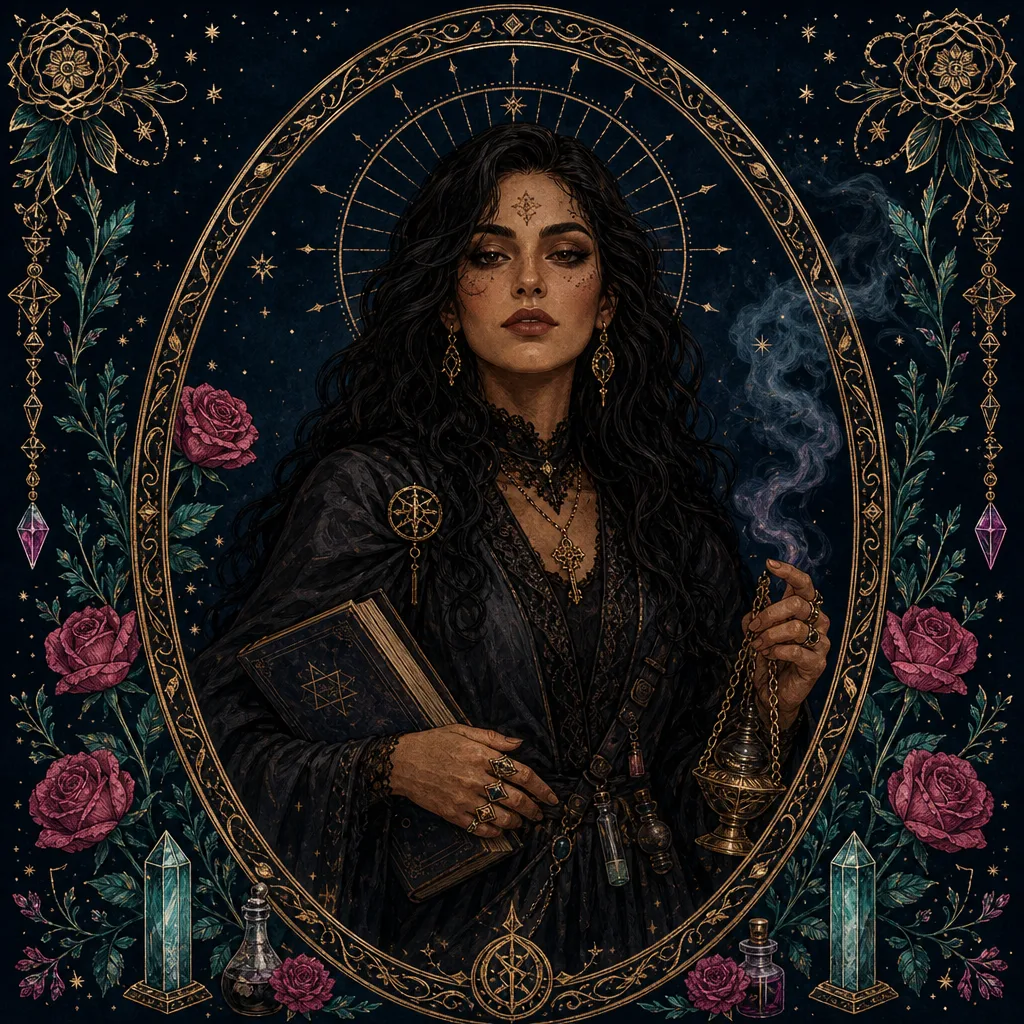
The demonologist is the scholar who reads the grimoire as primary source and the spirit as interlocutor, bringing both erudition and nerve to the oldest conversation in Western magic.
- Loves
- primary grimoire texts in facsimile, the precision of a well-drawn seal, comparative demonology across traditions, rigorous historical demonology scholarship.
- Hobbies and pastimes
- translating early modern Latin demonological texts, maintaining meticulous working records, studying Hebrew and Enochian for source accuracy, building a library of primary grimoire sources.
- Dream familiar
- An old black cat of preternatural intelligence who watches the evocation from outside the circle and judges the proceedings with calm authority.
- Found in their element
- The demonologist is in a well-stocked study surrounded by grimoires and annotated notebooks, or at a carefully prepared ritual space where the preparations take considerably longer than the working itself.
- Signature objects
- Lemegeton in a reliable edition, hand-drawn seals of working spirits, magic circle chalked or painted with precision, lamen of the practitioner's authority, incense appropriate to the spirit being addressed.
A demonologist is a practitioner who works with the study, classification, and in operational traditions the direct engagement of demonic or adversarial spiritual entities. The role encompasses two overlapping dimensions: the scholar who systematically maps the hierarchies, nature, and attributes of demonic beings, and the practitioner who uses that knowledge in direct magical work. Many serious demonologists are both.
The word “demon” covers a remarkable range of beings across traditions, and the demonologist”s work is shaped by which tradition they work within. The Greco-Roman daimon was a spirit intermediary — neither categorically evil nor categorically good, but powerful and capable of both beneficent and harmful action. The Abrahamic traditions reframed many such beings as fallen angels or adversaries. The grimoire traditions produced elaborate hierarchies of named and ranked demonic officers with specific attributes and powers. Contemporary practitioners navigate all of these frameworks with varying degrees of literalism.
The work
The scholarly dimension of demonology involves the careful study of primary sources: the grimoires themselves (the Lemegeton, the Grand Grimoire, the Book of Abramelin, the Munich Manual, the Testament of Solomon, and many others), the ecclesiastical demonological texts of the early modern period, the folk-religious accounts of demon encounters, and the comparative mythology that illuminates how specific beings have been understood across time and culture.
This study is not passive. A serious demonologist learns the seals, names, attributes, and hierarchy of the beings they work with in the same way a practitioner of any relationship-based art learns the specific qualities of the beings they engage. The Goetia”s 72 spirits, the angels and demons of the Enochian system, the djinn of Islamic tradition, the entities of Haitian Vodou”s Petwo nation — each requires its own body of specific knowledge.
Operational demonology — direct magical engagement with these beings — takes several forms. The Solomonic tradition commands the spirits, using specific procedures, seals, divine names, and physical implements to evoke them into a constrained space and compel their service. The demonolatry tradition cultivates devotional relationships with specific demonic patrons, offering prayer, incense, and ritual service in exchange for the spirit”s guidance and assistance. Left-hand-path traditions may work with adversarial beings as allies or as aspects of the practitioner”s own deeper nature.
Protective procedures are central to Solomonic demonological work. The elaborate physical and ritual preparations of the grimoire tradition — the magic circle, the triangle of evocation, the lamen, the holy names — are not ceremonial decoration but functional protective structures that the tradition insists are necessary. Working without adequate preparation in this area of practice is genuinely not recommended.
History and tradition
Demonology in the Western sense was substantially shaped by the encounter between Judeo-Christian angelology and the older Greco-Roman daimon tradition. Early Jewish texts including the Dead Sea Scrolls and the Book of Enoch developed elaborate accounts of fallen angels and their demonic offspring. Christian theology developed these frameworks further, identifying the gods of pagan tradition as demonic, establishing hierarchies of demonic rulers, and developing procedures for addressing demonic influence.
The early modern period (roughly 1450-1700) saw an explosion of demonological literature: the Malleus Maleficarum of 1487, the various witch-trial manuals, and the theological demonologies of Bodin, Remy, and Del Rio. This literature served institutional purposes — the prosecution of alleged witches — but also produced extensive systematic thinking about the nature and organisation of demonic hierarchies.
Simultaneously, the grimoire tradition was developing its own practical demonology: systematic procedures for evoking and working with the same beings the theologians were denouncing. The Solomonic tradition, claiming the wisdom of Solomon as its authority, produced a body of texts that represent the most elaborate systematic engagement with demonic entities in Western magical history.
Walking this path
Demonology is an open path, though one that calls for particular qualities: intellectual rigour in the scholarly dimension, genuine respect for the power and reality of the beings engaged, and the kind of careful preparation that the grimoire tradition insists upon.
The path is entered best through study. Reading the primary texts — beginning with accessible translations of the Goetia and Key of Solomon and working outward into the broader grimoire literature — provides essential grounding. Historical context matters enormously: understanding what these texts meant to the people who wrote them and used them gives the modern practitioner a far richer relationship with the material than approaching it as a modern occult catalogue.
For those drawn to operational work, working with experienced practitioners and taking the grimoire”s own instructions seriously about preparation and protection is the appropriate starting point. The demonological tradition is not forgiving of casual or performative engagement.
The demonologist”s role overlaps naturally with the ceremonial magician, the Solomonic practitioner, and the exorcist — who must understand what they are dealing with in order to address it. Many practitioners hold all three roles, the knowledge flowing between them.
In myth and popular culture
The scholar who compiles systematic knowledge of demons is a figure with deep roots in both religious and literary history. The Testament of Solomon, a Greek text likely composed between the first and fifth centuries CE, frames Solomon himself as the original demonologist, commanding demons by means of a ring given to him by the archangel Michael and compelling each to reveal its name, function, and the angelic power capable of restraining it. The text presents something close to the demonological interview in narrative form, and it became one of the foundational documents for the Solomonic tradition. John Weyer’s “De Praestigiis Daemonum” (1563) is notable for being a work of demonology written specifically to argue against witch persecutions, using the tradition’s own systematic frameworks to argue that alleged witches were deluded rather than genuinely in congress with demons.
In English literature, Christopher Marlowe’s “Doctor Faustus” (c.1592) stages the demonologist’s most dangerous scenario: the scholar who commands the demon Mephastophilis through ritual means but whose bargain ultimately destroys him. The play draws directly on the “Historia von D. Johann Fausten” (1587), a German chapbook presenting Faustus as a recognisable figure of the learned magician who engages demons for knowledge and power. Goethe’s later “Faust” (Part I published 1808, Part II 1832) transforms the material into a philosophical drama, but the demonological mechanics, the circle, the invocation, the compelled spirit, remain structurally intact.
The modern revival of the Solomonic tradition owes significant debts to the publication of S.L. Mathers’s edition of the Key of Solomon (1889) and his translation of the Book of the Sacred Magic of Abramelin the Mage (1897), both of which brought core grimoire texts into accessible English for the first time and shaped the next century of Western ceremonial magic, including the work of Aleister Crowley, who reproduced and expanded on the Goetia in his own 1904 edition.
Popular culture has engaged the demonologist figure most visibly through horror. The character of Ed Warren and his wife Lorraine Warren, real-life investigators who called themselves demonologists and whose cases inspired the “Conjuring” franchise (beginning 2013), brought the term into mainstream awareness. The Warrens’ self-presentation was not grounded in the scholarly or Solomonic tradition but in Catholic investigative demonology, and their work was contested; their cultural impact on popular understanding of the role is, however, substantial. The television series “Supernatural” (2005-2020) depicted demonology as a practical hunting discipline involving the Goetia’s 72 demons, devil’s traps drawn from real grimoire sources, and a researcher-hunter model that reflected the dual scholarly-operational identity of the historical tradition more accurately than most supernatural television.
People also ask
Questions
Is demonology the same as Satanism?
No. Demonology and Satanism are distinct, though they can overlap for specific practitioners. Demonology is a broad term covering the study and practice of working with beings classified as "demons," which includes vastly different beings across traditions: the classical Greek daimon (a spirit intermediary, not necessarily evil), the rebellious angels of Abrahamic tradition, the djinn of Islamic tradition, the entities in the Goetia and related grimoires, and the adversarial or left-hand-path beings of various contemporary frameworks. A demonologist may be Christian, Pagan, atheist, or Satanist.
What is the Goetia and why does it matter to demonologists?
The Ars Goetia is the first section of the Lesser Key of Solomon (Lemegeton), a seventeenth-century grimoire that lists 72 demons with their names, seals, ranks, areas of influence, and the methods for evoking and binding them. It is the most widely known grimoire in Western demonological tradition and remains a central text for practitioners working in the Solomonic magical framework. Many contemporary demonologists work primarily or exclusively with the beings listed in the Goetia.
Did historical demonologists believe in what they studied?
Yes, completely. Early modern demonologists -- figures like Heinrich Kramer (Malleus Maleficarum), Jean Bodin (De la demonomanie des sorciers), and Martin Del Rio (Disquisitiones Magicae) -- wrote from a position of believing that demons were real, that witches made pacts with them, and that the church and state had a duty to combat this spiritual threat. Their works were serious theological and legal arguments, not curiosities. This context is essential for understanding how demonological literature shaped Western history.
How do contemporary demonologists work with demonic beings?
Contemporary practitioners in the grimoire and Goetia tradition typically work within the Solomonic framework: constructing the appropriate seals and magical circles, performing the invocation and license to depart according to the text's instructions, and establishing a working relationship with specific entities for specific purposes. Others work in left-hand-path or adversarial traditions that frame engagement with demonic beings differently -- as allies, patrons, or aspects of the practitioner's own power rather than compelled servants. The method and philosophy vary significantly by tradition.
What is the difference between demonology and demonolatry?
Demonology is the study and practice of working with demonic beings generally; demonolatry is the specifically devotional or religious approach in which demonic beings are worshipped or venerated as divine powers rather than commanded or studied. The demonolatry tradition, associated with practitioners and authors including S. Connolly, frames the Goetia entities as demons in the root sense of the Greek daimon -- powerful spiritual beings worthy of reverence -- rather than as evil beings to be commanded or catalogued.