Witches & Their Paths
Eclectic Witch
Also called Eclectic Practitioner, Syncretic Witch
An eclectic witch is a practitioner who draws methods, correspondences, and frameworks from multiple magical traditions rather than adhering to a single system, building a practice shaped by personal study, experience, and intuition.
- Tradition
- Self-constructed synthesis of multiple traditions, common in modern Western witchcraft
- Standing
- Open
A profile of the Eclectic Witch
The eclectic witch is the practitioner who has read everything, tested most of it, and built something genuinely their own from the parts that proved real.
- Loves
- comparative magical texts from multiple cultures, a well-organised personal grimoire, finding convergences across traditions, the freedom of self-designed ritual, bookshops with disorganised occult sections.
- Hobbies and pastimes
- cross-tradition magical research, refining the personal cosmology in writing, attending workshops across multiple traditions, seasonal ritual design.
- Dream familiar
- A curious, book-loving magpie who collects shiny fragments from every nest in the forest and assembles them into something unmistakably their own.
- Found in their element
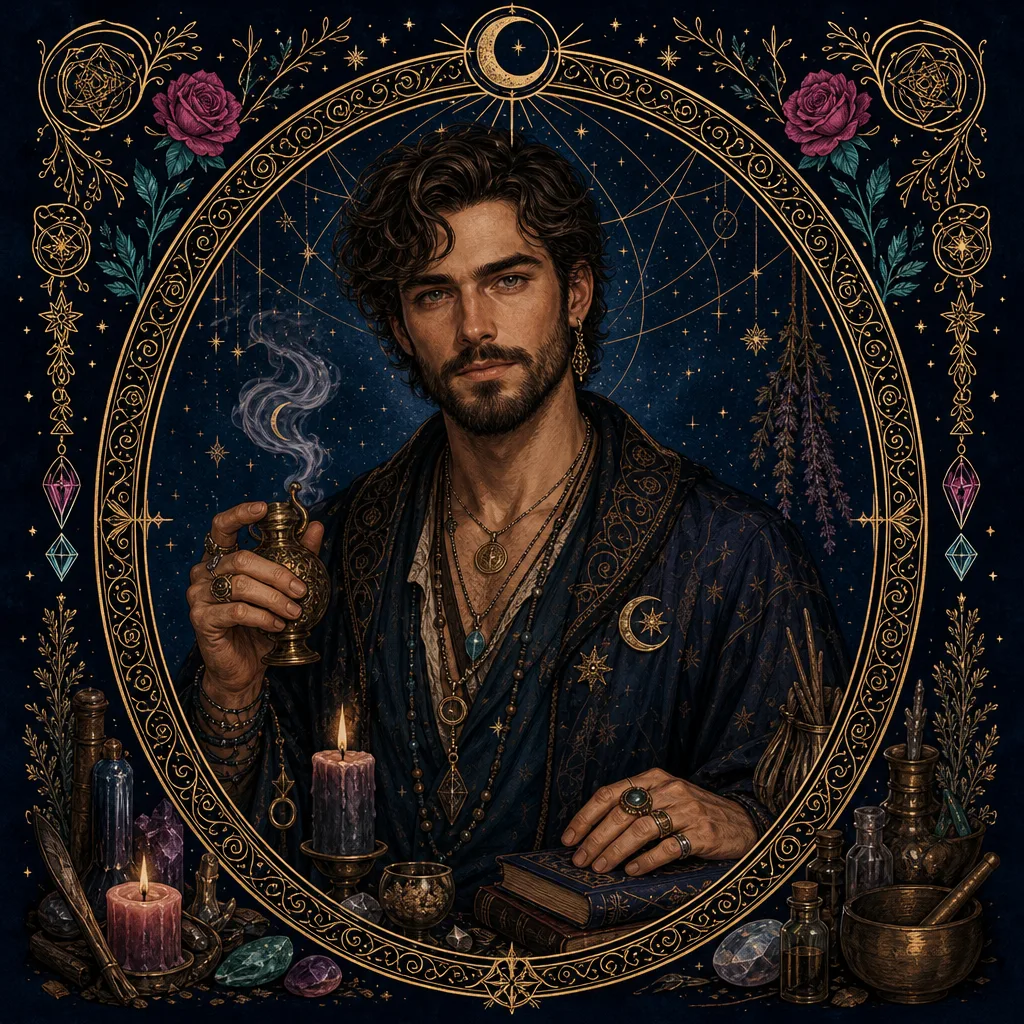
- The eclectic witch is at their altar, which looks like an explosion in a well-curated museum, or in a library stacking books from six different sections of the catalogue.
- Signature objects
- a fat personal grimoire with multiple bookmark ribbons, candles in every correspondence colour, a tarot deck worn soft with daily use, herbal bundles from three different traditions, a pendulum and a rune set and a pendulum cloth.
An eclectic witch is a practitioner who builds their magical practice from multiple sources rather than following a single inherited or initiatory tradition. They might work with Norse rune lore alongside Hermetic planetary magic, incorporate folk herbalism from their ancestral region, draw on the structure of ceremonial ritual for major workings, and use tarot as a daily reflective practice. The practice is self-designed, continuously refined, and held together by the practitioner”s own coherent worldview rather than by an external system”s rules.
Eclecticism is the most common approach to witchcraft in contemporary Western practice, and it has been common in folk magic historically as well. Cunning folk in early modern Britain routinely mixed church prayers, folk charm formulas, classical planetary timing, and local plant lore in a single operation. The modern eclectic witch is working in a tradition that, though it does not always name itself as such, has real historical depth.
The work
The eclectic witch”s daily and ritual practice is as varied as the individuals who hold this identity. Some keep a close working focus on two or three traditions they have studied in depth, using wider knowledge as background context. Others build with more open hands, following curiosity through many areas and synthesising as they go.
What distinguishes an accomplished eclectic witch from a beginner is not the breadth of the toolkit but the quality of integration. The eclectic practitioner knows why they are combining particular elements, understands the logic within each tradition they draw from, and has tested their combinations enough to have an honest account of what works. The personal grimoire is invaluable for this: recording what was done, from what sources, with what intent, and what followed.
Common elements in eclectic practice include candle magic, herbal preparation, divination with tarot or other methods, working with the phases of the moon and the wheel of the year, ancestor veneration, and the casting of protective and prosperity workings. The particular combination and the sources for each element vary with the practitioner”s history, interests, and cultural background.
Many eclectic witches develop a personal pantheon or spirit court, working with deities and beings from different traditions based on relationship built over time. Others prefer a more animist framework without named deities. Either approach is consistent with eclecticism, as long as it is held with genuine respect for the cultures whose spiritual figures are being engaged.
History and tradition
Magic has always crossed boundaries. The Greek magical papyri from Egypt combine Hellenistic, Egyptian, Jewish, and Mesopotamian elements with a fluency that looks entirely contemporary. The grimoire tradition of medieval and early modern Europe synthesised classical philosophy, Hebrew divine names, Arabic astrology, and folk practice into working systems. The cunning folk who served English and Scottish communities from the sixteenth to the nineteenth century were eclectic practitioners, using whatever worked.
Modern eclectic witchcraft became a named and self-conscious approach in the late twentieth century as the internet made the comparative study of magical traditions accessible to anyone willing to read. The publication of books on Wicca, ceremonial magic, folk traditions, and comparative religion from the 1970s onward gave practitioners the raw material to build their own systems, and many did. The resulting eclecticism ranges from shallow to sophisticated, reflecting the full range of human engagement with any available resource.
The cultural appropriation debate within contemporary witchcraft is, in part, a conversation about the ethics of eclecticism. These conversations are worth taking seriously rather than dismissing; they have sharpened the community”s thinking about what kinds of borrowing are respectful and reciprocal and what kinds are extractive.
Walking this path
The eclectic witch”s most important work is study. Beginning with broad reading and gradually deepening into specific traditions the practitioner finds genuinely compelling builds the base of knowledge without which eclecticism becomes superficial. Learning the internal logic of a tradition before borrowing from it is both respectful and practically useful: tools work better when you understand what they were designed for.
Developing a personal cosmology, an explicit account of what the eclectic witch believes about the nature of magic, spirit, the self, and the cosmos, gives the practice structural coherence. This does not need to be a finished theology; it can be an ongoing working hypothesis, revised as experience teaches new things. Writing it out, even in rough form, is a useful discipline.
The eclectic path is also a path of ongoing discernment. Not everything that comes from a tradition works within every context, and not every piece of attractive lore is appropriate to take up. An eclectic witch who is honest about their limits, careful about appropriation, and genuinely curious rather than merely accumulative, builds a practice that is personal, powerful, and respectful of the traditions it draws from.
In myth and popular culture
Eclecticism in magic is as old as the first cultural encounter between peoples with different ritual systems. The Greek Magical Papyri, a collection of texts from Greco-Roman Egypt spanning roughly the second century BCE to the fifth century CE, represent the most complete ancient example of eclectic magical practice in the historical record: they combine Egyptian ritual forms and deity names, Greek philosophical frameworks, Hebrew divine names and angel lists, and Mesopotamian magical concepts in working spells that make no attempt at doctrinal consistency. The compiler or compilers of these texts were clearly drawing on whatever sources they had access to with the sole criterion of what worked, an orientation that is entirely recognisable to a contemporary eclectic practitioner.
In literature, the figure of the self-educated or widely read magician who synthesises multiple sources is a recurring type. Prospero in Shakespeare’s “The Tempest” (1611), with his library of books that Caliban identifies as the source of his power, is a character whose magic is fundamentally textual and synthetic rather than traditionally inherited. The scholars of magical fiction, from the students at Hogwarts in J.K. Rowling’s Harry Potter series (1997-2007) to the Arcane Congress in Patrick Rothfuss’s “The Name of the Wind” (2007), learn from multiple traditions and cross-disciplinary methods in ways that reflect the eclectic orientation more than any single-tradition lineage model.
Silver RavenWolf’s “To Ride a Silver Broomstick” (1993) and Scott Cunningham’s “Wicca: A Guide for the Solitary Practitioner” (1988) were enormously influential in shaping the self-defined eclectic witch as a recognised category in popular witchcraft culture. Cunningham in particular argued explicitly that the solitary practitioner who drew on multiple sources to build their own practice was not a lesser witch but was practicing in a tradition of solo folk magic that was older than coven-based Wicca. His influence on the generation of practitioners who came to witchcraft through 1990s and early 2000s bookshops is difficult to overstate.
Contemporary media portrayals of witchcraft rarely follow a single tradition, reflecting the fact that eclectic practice is statistically dominant in contemporary witchcraft. The witches of the television series “Charmed” (both the 1998-2006 original and its 2018-2022 revival), of “The Craft” (1996), and of “Practical Magic” (1998) all draw from multiple traditions simultaneously, mixing folklore, ceremonial elements, herb magic, and candle magic in ways that would be recognisable to an eclectic practitioner even when the specifics are fictional or compressed for narrative purposes.
People also ask
Questions
Is eclectic witchcraft less valid than traditional witchcraft?
No. The validity of any magical practice comes from the depth of engagement, the coherence of the practitioner's working framework, and the quality of results and relationships built over time. Eclecticism is a legitimate approach with a long history: cunning folk of earlier centuries were themselves often working with a mix of folk magic, learned magic, Christian prayer, and classical planetary lore.
What is the difference between eclectic witchcraft and just doing whatever feels good?
Thoughtful eclecticism involves genuine study of the traditions drawn from, understanding of why particular methods are combined, and discernment about what works and what does not. Casual accumulation of symbols and rituals from unrelated sources without study or accountability is a different thing, and most experienced eclectic witches distinguish between the two clearly.
Are there limits to what an eclectic witch should borrow?
Yes. Practices from closed traditions, those accessible only through initiation within a living lineage, should not be taken up by outside practitioners regardless of eclecticism. Elements from living cultural traditions, especially those of marginalised communities, require particular care and respect. Eclectic witchcraft at its best draws primarily from traditions in the practitioner's own cultural heritage, from documented historical sources, or from traditions explicitly opened for outside study.
How do eclectic witches keep their practice coherent?
Many develop a personal cosmology and set of principles that serve as the organising frame, into which borrowed elements are integrated and evaluated. Keeping a detailed grimoire, reflecting regularly on practice, and periodically revisiting the sources of borrowed elements help maintain coherence. Some eclectic witches also work within a loose traditional framework, such as folk magic from their region of ancestry, while supplementing with other sources.
Can an eclectic witch also belong to a coven or tradition?
Yes. Many people who identify as eclectic witches are also members of covens or study groups, or have received some formal training. Eclectic describes the approach to sources and methods, not a commitment to solitary practice.