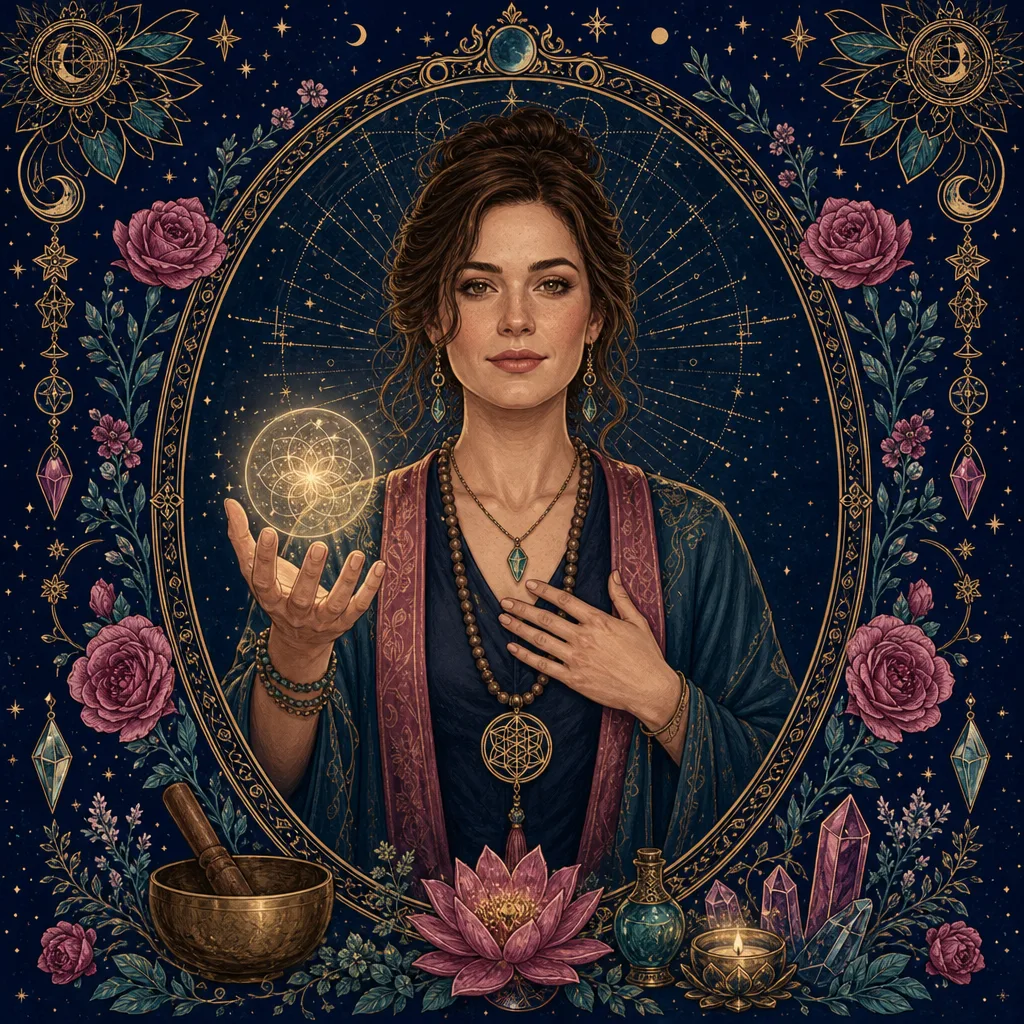
Healers & Wise Folk
Energy Healer
Also called Energetic Healer, Biofield Practitioner
An energy healer is a practitioner who works with the subtle energy fields understood in many healing traditions to surround and interpenetrate the physical body, using touch, intention, breath, movement, or focused awareness to clear blockages, restore flow, and support the wellbeing of body, mind, and spirit. Energy healing as a contemporary term encompasses practices from many different cultural origins.
- Tradition
- Multiple converging traditions: Western biofield therapies, Asian qi-based medicine, Indian pranic healing, and twentieth-century integrative developments
- Standing
- Open
A profile of the Energy Healer
The energy healer is the practitioner who has learned to be a clear channel, placing their hands where the body's own intelligence needs support to do its work.
- Loves
- the quality of silence after a session, clients who notice what shifts between visits, the meridian system's elegant logic, meditation as professional development, teaching sensitivity to new students.
- Hobbies and pastimes
- daily personal energy cultivation practice, studying multiple healing traditions comparatively, receiving sessions from other practitioners, following biofield research literature.
- Dream familiar
- A large, gentle tortoiseshell cat who settles precisely on the part of the client that needs the most attention and purrs at the exact right frequency.
- Found in their element
- The energy healer is found in a simply furnished room smelling of diffused lavender and clean air, or in a hospital corridor offering comfort through their particular quality of presence.
- Signature objects
- attuned hands and a quiet room, a treatment table at the right height, crystals and singing bowls for supplementary work, a grounding practice for after sessions, a Reiki lineage certificate on the wall.
An energy healer is a practitioner who works with the subtle energetic dimension of the human person to support health, wellbeing, and the healing of illness and distress. Across many traditions and under many names, the understanding that the physical body is accompanied by and interpenetrated with a field of subtle energy, and that this field can be perceived, influenced, and restored to balance through specific practices, has generated a family of related healing approaches that contemporary language groups together as energy healing or biofield therapy.
The energy healer may work through light touch on the body, through hand movements above the body without contact, through breath, through focused intention directed at a recipient near or far, or through combinations of these approaches. What distinguishes energy healing from massage or physical manipulation is precisely this orientation toward the subtle dimension: the energy healer is working with something that is not the physical tissue directly but that is understood to underlie and influence it.
The work
The energy healer begins a session by becoming quiet and centred, establishing their own energetic clarity and receptivity before engaging with the client. Many traditions include a brief prayer, invocation, or centering practice at this point, not merely as ritual but as a genuine preparation that affects the quality of the work. The healer then scans or assesses the client”s energy field, either through direct touch, through hovering hands held above the body, or through intuitive perception, noting areas of congestion, depletion, or imbalance.
The treatment itself involves directing energy, supporting its flow, clearing areas of blockage, and supplementing areas of depletion, through whatever specific methods the practitioner”s tradition provides. In Reiki this is done by placing hands in a series of positions on or above the body while holding the intention for the highest healing good of the recipient. In Therapeutic Touch, developed by Dolores Krieger and Dora Kunz, the practitioner performs a series of hand movements to smooth and re-pattern the field. In pranic healing the practitioner works with specific colours and qualities of prana directed to specific energy centres and organ systems.
The session typically closes with grounding, both for the recipient, who may be in an altered or deeply relaxed state, and for the practitioner, who has been working at a level of sustained attention and energetic engagement that requires its own completion. Most practitioners also attend to their own energy hygiene, clearing any energy accumulated from the client before moving on, and have consistent practices for replenishing their own reserves after giving.
Working with regular clients over time allows the energy healer to track patterns in the field and to notice how they shift in relation to physical, emotional, and life circumstances. This longitudinal knowledge can make energy work considerably more precise and effective than single-session work, because the healer comes to know the client”s field in its characteristic patterns and can identify genuine changes more reliably.
History and tradition
The understanding that living beings have a subtle energetic dimension that can be cultivated, disrupted, and healed is ancient and widespread. Traditional Chinese Medicine has mapped the meridian system and worked with qi for at least two and a half thousand years. Ayurvedic medicine has worked with prana and chakras for a comparable period. Shamanic healing traditions worldwide work with the spiritual or energetic body as a primary dimension of the healing enterprise.
In the Western European tradition, the concept of the laying on of hands as a healing practice is attested in early Christian sources and in pre-Christian folk healing, and the recognition that some people have a particular healing touch or presence runs through most folk healing traditions. The magnetic healers of the eighteenth and nineteenth centuries, drawing on Franz Mesmer”s controversial theories of animal magnetism, developed explicit practices of energy direction that prefigure many contemporary approaches.
Reiki was developed by Mikao Usui in Japan in the 1920s and transmitted through his students, including Chujiro Hayashi and Hawayo Takata, whose teaching of Reiki in Hawaii from the 1930s onward brought it into the English-speaking world. From the United States Reiki spread rapidly through the English-speaking world in the 1980s and 1990s, and it has become one of the most widely practiced complementary health approaches globally.
Therapeutic Touch, developed in the 1970s at New York University, brought energy healing into professional nursing contexts and generated a body of research. Healing Touch, Quantum Touch, and numerous other systems developed subsequently, each with their own training programs and conceptual frameworks, though all sharing the fundamental orientation toward the subtle energy field of the body.
Walking this path
Most people come to energy healing either through receiving it during an illness or difficult period and finding it genuinely helpful, or through an existing interest in meditation, yoga, bodywork, or holistic health that leads naturally toward the energetic dimension. The most accessible entry point for most contemporary practitioners is Reiki, which has an established training and attunement system that can be completed in a weekend and that provides a working framework for ongoing development.
Beyond initial training, the energy healer develops through sustained practice, including both giving treatments and maintaining a personal practice of meditation, centering, and energy cultivation. Most traditions emphasize that the practitioner”s own energetic development is the foundation of their effectiveness as a healer, and that giving consistently from a depleted or uncentred state gradually undermines both the work and the practitioner”s own health.
The energy healer role sits naturally beside the folk healer, the crystal healer, and the magickal herbalist, as well as beside the deeper contemplative and spiritual practices that many energy healers also maintain. Many practitioners combine energy healing with physical bodywork, herbal medicine, or counselling in ways that reflect the integrated understanding of health that underlies most energy healing traditions.
In myth and popular culture
The healer who works through touch, breath, and directed intention rather than through physical medicine alone is one of the oldest figures in human storytelling. The biblical accounts of Jesus healing through the laying on of hands and through directed intention at a distance established the model that shaped European popular imagination of healing power for centuries; the royal touch, the belief that English and French kings could cure scrofula by touching the afflicted, persisted as official court ceremony from the medieval period through to the early eighteenth century when Queen Anne performed it for the last time. This belief drew directly on the cultural inheritance of healing through presence and touch as a real and transmissible capacity.
In Asian traditions, the cultivation and direction of qi for healing has its own rich mythological and literary inheritance. The Yellow Emperor’s Classic of Internal Medicine (Huangdi Neijing), compiled across several centuries and probably reaching something close to its current form around the first century BCE, establishes the theoretical framework for qi-based medicine that informs Traditional Chinese Medicine and qigong to this day. The figure of the qigong master who can direct qi to heal at a distance appears in Chinese historical and semi-legendary accounts from the classical period onward, and in contemporary China the practice of medical qigong, including distance healing, has been studied in formal medical research contexts since the 1980s.
Franz Mesmer’s “animal magnetism” theory, developed in the 1770s and 1780s, produced the first systematic Western secular framework for understanding healing through an invisible force directed by the healer’s will and hands. Mesmer’s public healing sessions in Paris, where patients were linked by ropes or iron rods and thrown into therapeutic crises while he moved among them, were cultural events as much as medical ones; his theory was officially rejected by a royal commission in 1784 (which included Benjamin Franklin and Antoine Lavoisier), but the practices he established continued and evolved into hypnotherapy on one branch and, eventually, into the biofield healing tradition on another.
In contemporary popular culture, the energy healer appears most frequently in the figure of the hospital chaplain or alternative therapist whose presence has palpable effect. The television series “Touch” (2012-2013) engaged loosely with the idea of subtle perception that transcends ordinary sense, while films including “The Green Mile” (1999), adapted from Stephen King’s serialised novel, present healing through touch in a more overtly supernatural register. The popular wellness industry has brought energy healing practices including Reiki, therapeutic touch, and crystal healing into the mainstream market, and the figure of the Reiki practitioner in particular has become recognisable enough to appear as a plausible supporting character in contemporary literary fiction without requiring explanation.
People also ask
Questions
What is the "energy" that energy healers work with?
Different traditions use different frameworks to describe what energy healers work with. Traditional Chinese Medicine speaks of qi, understood as a vital force that flows through the body along defined pathways called meridians. Ayurvedic tradition speaks of prana, a life-force carried in the breath and distributed through energy centres called chakras. Many Western energy healing approaches speak of the biofield, a term from biofield science referring to the electromagnetic and other fields associated with living organisms. Most energy healers hold their preferred model as a working framework rather than a settled metaphysical claim, finding that it guides their practice effectively regardless of how its ultimate nature is eventually understood.
What is Reiki and how does it relate to energy healing?
Reiki is a system of energy healing developed by Mikao Usui in Japan in the early twentieth century and transmitted through a lineage of teachers. The practitioner channels a healing energy understood in the tradition as spiritually guided, placing hands on or near the recipient's body to support their own healing. Reiki became one of the most widely practised energy healing methods in the English-speaking world through the twentieth century and is now taught in hospitals and hospices alongside biomedical care. It is one of many energy healing systems, distinct from but related to therapeutic touch, healing touch, quantum touch, and other contemporary biofield approaches.
Is there scientific evidence that energy healing works?
The evidence base is mixed and ongoing. Studies of Reiki and therapeutic touch have shown significant effects on pain, anxiety, and recovery in some populations, though methodological challenges in blinding and control make interpretation difficult. Biofield science is an active research area, with investigators studying the measurable electromagnetic fields associated with healers' hands and the physiological effects of healing practice on recipients. Most practitioners hold that the experience of receiving and giving energy healing is genuine and meaningful regardless of where the scientific understanding eventually lands.
Do I need to be specially gifted to practise energy healing?
Most energy healing traditions hold that the ability to work with energy is not a rare gift but a natural human capacity that can be developed through training, attention, and practice. Sensitivity to subtle energies varies among individuals, but the capacity to develop useful sensitivity is broadly available. Reiki is specifically designed as a system that can be taught and transmitted to anyone through attunement, and most energy healing training programs are premised on the trainability of the relevant skills.
Can energy healing be practised at a distance?
Many energy healing traditions include distance healing as a recognized and effective practice, based on the understanding that the subtle fields involved are not limited to the immediate proximity of the physical body. Distance Reiki, distance healing prayer, and similar practices have a substantial base of practitioner experience supporting their effectiveness. The scientific understanding of how distance healing might work, if it does, remains an open question.