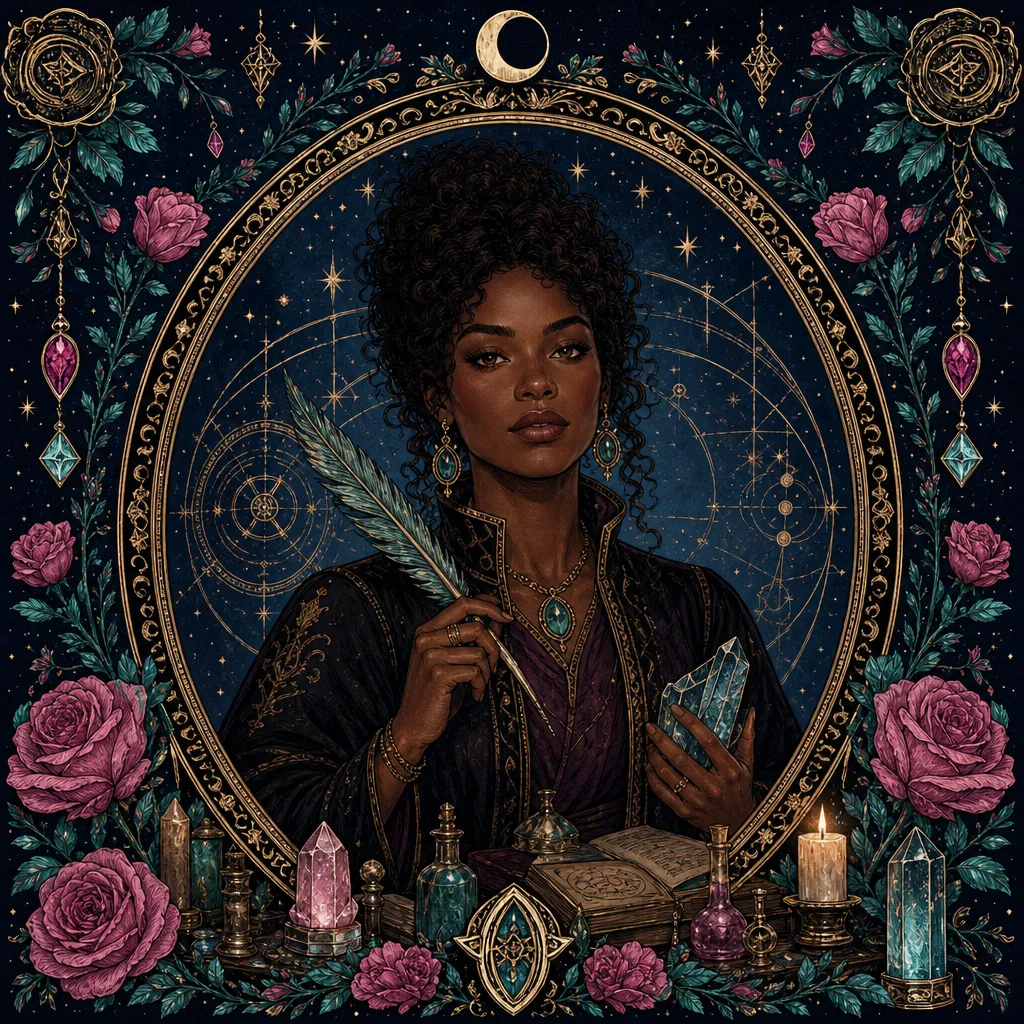
Ceremonial & High Magicians
Enochian Magician
Also called Enochian Practitioner, Angelic Magician
An Enochian magician works within the angelic system received by Dr John Dee and Edward Kelley in sixteenth-century England, using a structured cosmology of angelic hierarchies, a distinct magical alphabet, and specific ritual calls to establish contact with angelic intelligences and navigate the regions of the Enochian universe.
- Tradition
- Enochian magick, derived from the spirit diaries of John Dee and Edward Kelley (1582-1589)
- Standing
- Open
A profile of the Enochian Magician
The scholar-explorer who mapped the angelic heavens with a quill and a crystal ball, then went in.
- Loves
- Elizabethan manuscript facsimiles, the resonance of vibrated Angelical, a well-kept magical diary, black mirrors in candlelight, the geometry of the Watchtower tablets.
- Hobbies and pastimes
- translating Enochian calls, scrying session journaling, cross-referencing Dee with the Golden Dawn reformats, astrological timing for ritual work.
- Dream familiar
- A raven with an uncanny habit of repeating single syllables back in the correct Enochian pronunciation.
- Found in their element
- You will find an Enochian magician at a candlelit desk in the small hours, Dee's diaries open beside a notebook filling with angular Angelical script.
- Signature objects
- the Holy Table of Practice, a wax Sigillum Dei Aemeth, the four Watchtower tablets, a crystal or obsidian scrying stone, the Liber 418 open to a favourite Aethyr.
An Enochian magician is a practitioner who works within the angelic system received and recorded by the Elizabethan polymath Dr John Dee and his scryer Edward Kelley during a series of intensive sessions conducted between 1582 and 1589. This system, sometimes called Angelic or Enochian magick, provides a complete cosmological map of angelic hierarchies arranged across four elemental Watchtowers and thirty nested Aethyrs, a distinct alphabet and language in which the angelic calls are composed, and a ritual framework for navigating that universe and establishing working contact with the angelic intelligences who govern its regions.
The Enochian magician stands at the intersection of two distinct historical moments: the original Tudor-era reception of the system by Dee and Kelley, and the late nineteenth-century reformatting by the Hermetic Order of the Golden Dawn, which organized the system onto the Kabbalistic Tree of Life and integrated it into the ceremonial magick curriculum that most practitioners study today. Working fluently with Enochian requires familiarity with both layers, along with willingness to engage with some of the most challenging and complex practical material in the Western magical tradition.
The work
The core practical tools of Enochian magick are the Four Watchtower Tablets and the Table of Union, which together provide the spatial map of the Enochian universe; the Forty-Eight Calls or Keys, which are the ritual invocations through which angelic presences are contacted; and the Enochian alphabet and language, in which the calls were delivered and in which vibrating them is generally understood to carry the most potency.
The beginning Enochian magician typically starts with the First and Second Calls and the working of the four elemental Watchtowers, building familiarity with the system”s cosmology and learning to vibrate the Enochian language with attention to pronunciation and resonance. The Golden Dawn attributions organize each Watchtower into subareas governed by specific angelic names drawn from the tablets, each associated with one of the elements and its subdivisions.
Advanced Enochian work involves the Thirty Aethyrs. The Aethyrs are nested regions of the Enochian cosmos, from the outermost Tex to the innermost Lil, each governed by specific angelic governors. The magician enters each Aethyr through scrying, typically using a black mirror or a crystal, while vibrating the Nineteenth through Forty-Eighth Calls. Crowley”s Liber 418 records his passage through all thirty in 1909 and provides the most complete record of what a practitioner may encounter. Each Aethyr presents distinctive visions, tests, and teachings, and the deeper Aethyrs deal with increasingly abstract and cosmically significant material.
Maintenance of an Enochian magical diary is as important here as in any other demanding practice. The visions encountered in the Aethyrs are rich and complex, and without records they blur and lose the patterns that would otherwise be apparent across multiple sessions.
History and tradition
John Dee was one of the most learned men of Elizabethan England: mathematician, astronomer, geographer, and lifelong student of the angelic hierarchies. His diaries record an extended project of angelic communication conducted primarily through Edward Kelley, a man of disputed character who proved to be an extraordinarily gifted scryer. Over the course of seven years the angels delivered an elaborate system, including the four Watchtower tablets, a language and alphabet they called Angelical or Enochian, and forty-eight calls that Kelley received in the angels” dictation, backwards letter by letter, a procedure apparently designed to protect Dee and Kelley from the power of the calls as they were given.
Dee”s diaries were preserved, and portions were published in Meric Casaubon”s 1659 True and Faithful Relation, though the full picture did not emerge for scholars until the detailed manuscript work of the twentieth century. The Hermetic Order of the Golden Dawn came to the system through Samuel Liddell MacGregor Mathers in the 1880s and reformatted it substantially, correlating it with the Tree of Life, adding elemental sub-quarters to the tablets, and building a system of Enochian temple workings that became part of the Golden Dawn”s advanced grade material.
Contemporary scholarship, particularly the work of Donald Laycock, Aaron Leitch, and David Rankine, has done much to clarify the distinction between Dee”s original system and the Golden Dawn”s reformatted version, and some practitioners now choose to work with the pre-Golden Dawn material as closely as possible.
Walking this path
Most practitioners who work seriously with Enochian come to it through the Golden Dawn system or through Crowley”s writings, and they typically already have a solid foundation in ceremonial banishing, invocation, and Tree of Life work before beginning. The system is not suitable as a first magical practice because it is complex enough that without basic orienting skills the practitioner will quickly lose the thread.
The published sources are extensive and mostly accessible. Lon Milo DuQuette”s Enochian Vision Magick is widely regarded as the most practical modern introduction, combining historical clarity with working instructions. Aaron Leitch”s Enochian Magick of Dr John Dee goes deeper into the historical sources. The primary Dee diaries are available in scholarly editions.
The Enochian magician role overlaps with the ceremonial magician, the theurgist, and the scholar-mystic, and many practitioners engage with the system as one component of a broader ceremonial practice rather than as an exclusive path. The scope and depth of the Enochian universe is sufficient to sustain a lifetime of practice on its own, but it need not be pursued in isolation.
In myth and popular culture
John Dee himself is the figure most cultures reach for when imagining the Enochian magician, and he has attracted a remarkable amount of literary and dramatic attention given that he was, in life, a sober Elizabethan intellectual and royal cartographer. Peter Ackroyd’s novel The House of Doctor Dee (1993) imagines the magician’s Mortlake home as a place where the boundary between centuries becomes permeable, capturing something of the vertiginous quality that working with the Enochian system genuinely seems to produce. Benjamin Woolley’s biography The Queen’s Conjuror (2001) is a thorough historical account of Dee and Kelley’s partnership that reads almost like a thriller without needing to invent anything.
Aleister Crowley’s account of his own Enochian work, published as The Vision and the Voice (Liber 418), influenced the figure of the magus in twentieth-century fiction more broadly than is commonly acknowledged. Characters like Dion Fortune’s fictional adepts, particularly the unnamed master in her novel Moon Magic, carry the stamp of the ceremonial magician who has worked with angelic hierarchies and returned changed. The Enochian elements are rarely named explicitly in popular fiction, but the archetype of the magician who has walked through angelic cosmology and emerged on the other side with knowledge that is hard to speak of runs through the genre.
In gaming culture, Enochian imagery has been adopted extensively. Final Fantasy XIV uses the Enochian figure names as spell categories for its Black Mage job class, and while the game makes no claim to accuracy, the association between Enochian and powerful, structured magical systems is intuitively correct. The tabletop roleplaying game Kult, published in Sweden in 1991, draws on a cosmological framework with recognisable debts to Enochian structure in its account of angelic archons and their relationship to human consciousness. The Enochian system also appears in the television series Supernatural, where it provides the fictional “language of Heaven,” though the show’s version is considerably more dramatic and considerably less mathematically rigorous than the original.
People also ask
Questions
What is the Enochian system?
The Enochian system is a complete magical universe communicated to the Elizabethan mathematician and astrologer John Dee and his scryer Edward Kelley through a series of scrying sessions conducted between 1582 and 1589. The angels delivered a distinct alphabet and language (Enochian or Angelical), a set of forty-eight poetic calls or keys in that language, a complex cosmological map divided into four Watchtowers and a tablet called the Table of Union, and a system of angelic governance organized through these regions. The Hermetic Order of the Golden Dawn reformatted and extended the system in the late nineteenth century into the form most practitioners use today.
Is the Enochian language a real language?
Enochian is a constructed language delivered to Dee and Kelley through their sessions and has the features of a language: a distinct alphabet, a vocabulary of several hundred words, and a grammar. Whether it is the original language of angels, as the angels themselves claimed, is a matter of theological and philosophical interpretation. Linguists have analysed it and find it internally consistent, though debate continues about the extent to which Kelley may have constructed it consciously or unconsciously. Practitioners who vibrate the calls in Enochian consistently report it as more potent than working in English translation, regardless of their metaphysical interpretation of its origin.
What are the Enochian Calls?
The Forty-Eight Calls (or Keys) are ritual invocations in the Enochian language, each addressed to a different region or hierarchy of the Enochian universe. The First Call invokes the divine source; the Second addresses the angels of the Watchtowers collectively; Calls Three through Eighteen are each associated with a specific Aethyr (region) and the angelic intelligences governing it; the remaining Calls open the Thirty Aethyrs, the nested spheres of the Enochian cosmos that the magician visits in order of increasing depth. Working through the Thirty Aethyrs is the primary visionary practice of advanced Enochian work.
What did Crowley contribute to Enochian magick?
Crowley worked extensively with the Enochian system and recorded his experiences in The Vision and the Voice (Liber 418), an account of his passage through all Thirty Aethyrs, which remains the most detailed single practitioner's record of Enochian visionary work in the tradition. He also incorporated the system into the A.:A.: curriculum as an advanced practice and wrote technical commentary on the calls. The Golden Dawn's reformatting of the system, which Crowley learned and extended, organized the Watchtowers onto the Tree of Life and integrated Enochian into the broader ceremonial magick curriculum.
Is Enochian magick dangerous?
Enochian has a reputation within the magical community as one of the more intense and destabilizing systems, and many experienced practitioners recommend building a solid foundation in basic banishing, warding, and grounding before working with the calls. The higher Aethyrs in particular deal with increasingly abstract and powerful material. This reputation should be taken seriously as practical advice rather than dramatized, and the practitioner who approaches the system carefully and with adequate preparation will find it challenging but not intrinsically hazardous.