Healers & Wise Folk
Folk Healer
Also called Village Healer, Healer
A folk healer is a practitioner who addresses illness, injury, and misfortune using the traditional knowledge of their community, combining herbal medicines, ritual words and actions, spiritual intercession, and practical care in ways that may not observe the modern distinction between medicine and magick. Folk healers have been found in every human culture throughout recorded history.
- Tradition
- Universal, present in all human cultures; specific forms vary enormously by region, religion, and community
- Standing
- Open
A profile of the Folk Healer
The person your grandmother sent you to when the doctor had no answer and the situation was serious.
- Loves
- dried herbs hung in bundles from rafters, the specific names of local plants, families who have known the healer for generations, the early morning when the plants are gathered.
- Hobbies and pastimes
- studying regional plant folklore, maintaining a personal materia medica journal, learning traditional verbal charms, seasonal wildcraft walks.
- Dream familiar
- A hedgehog who always knows which mushrooms are safe and arrives precisely when needed.
- Found in their element
- A folk healer is found in a kitchen that smells of dried herbs, in the same house their teacher worked in, with the door unlocked because it has always been unlocked.
- Signature objects
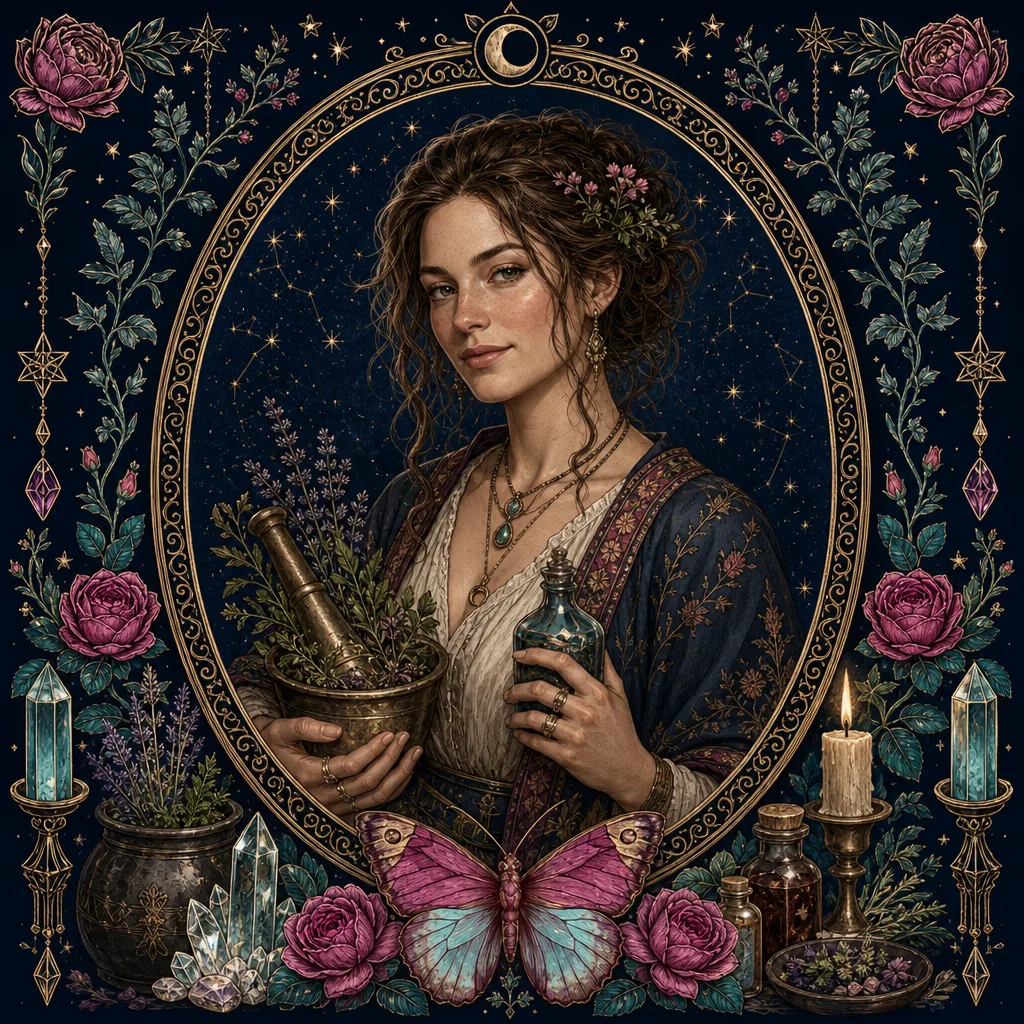
- a mortar and pestle of considerable age, jars of dried plant matter in specific order, a well-worn charm book or memorised formula, consecrated oil or water for blessing, a record book of cases and outcomes.
A folk healer is a practitioner who tends to the health and wellbeing of their community using traditional knowledge: herbal medicines, prayers and charms, ritual actions, dietary guidance, and the kind of practical wisdom about the body and its troubles that has been accumulated and refined over generations and transmitted within families and communities rather than through formal institutions. Folk healers appear in every human culture on record, under an enormous variety of names, and their practice is the oldest form of healing that exists.
What distinguishes the folk healer from both the biomedical physician and the purely spiritual practitioner is the integration of practical, physical, and spiritual dimensions in a single approach to suffering. A folk healer does not separate the question of what herb to use for a cough from the question of whether the illness has a spiritual dimension or has arisen from relational disturbance in the family or community. They hold these dimensions together because their tradition understands health as multidimensional, and their treatment addresses the whole person in their whole situation.
The work
The folk healer”s practice varies widely depending on their tradition, region, and the specific community they serve, but certain elements appear consistently across very different cultures. Herbal knowledge is almost always central: the folk healer knows which plants address which conditions, how to prepare them, when to harvest them, and what the plants themselves are understood to contribute beyond their chemical properties. In most traditions plants are understood as beings with their own qualities and relationships, and the way they are approached, harvested, and prepared is as important as the specific preparation used.
Verbal charms, prayers, and ritual formulae accompany herbal treatment in most folk healing traditions. The words spoken over a wound, the prayer said while preparing a remedy, the specific blessing given at the close of treatment, are understood as genuinely effective components of the treatment rather than as mere custom or comfort. The folk healer typically knows these words by heart, having learned them from their teacher, and they carry the authority of the tradition through the healer who speaks them.
The assessment of the patient includes attention to the spiritual dimensions of their condition. In many folk traditions, illness can be caused or worsened by the evil eye, by fright, by the disruption of important relationships, by spiritual attack, or by the patient”s own spiritual state. The folk healer can identify these causes and address them through protective ritual, reconciliation work, or the specific remedies traditional for spiritually-caused illness.
Continuity of relationship matters. Folk healers know their patients over time, know their families, and understand the social context of their illness in ways that an institutional practitioner in a brief clinical encounter cannot. This relational knowledge is not incidental to the healing but part of it.
History and tradition
Folk healing is as old as human community. The archaeological and textual record of every civilization includes evidence of healing practices combining herbal medicine, ritual action, and intercession with spiritual powers, and the similarities across very different cultures suggest that folk healing reflects something deep in how human beings understand illness and recovery.
In European history, the wise women and cunning men who served as community healers carried their knowledge through apprenticeship and family transmission for generations, drawing on a synthesis of pre-Christian healing lore, Christian prayers and saints” intercession, and accumulated practical experience with local plants and conditions. The professionalization of medicine and the witch trials of the early modern period placed these practitioners under pressure from two directions simultaneously, with official medicine claiming exclusive authority over healing and the courts treating certain healing practices as evidence of diabolism.
This pressure pushed folk healing underground in many communities without eliminating it. The nineteenth and twentieth centuries saw renewed scholarly and popular interest in folk healing traditions, particularly as biomedicine”s limitations in treating chronic illness, psychological distress, and the social dimensions of suffering became more apparent. Today folk healing traditions are practiced openly across the world, and many countries have formal frameworks for the recognition of traditional medicine systems alongside biomedical ones.
Walking this path
The path into folk healing most commonly begins with a deep relationship to a specific tradition, whether inherited through family, encountered through sustained study with an established practitioner, or arrived at through the kind of sustained interest and reading that leads eventually to genuine knowledge. The herbal knowledge alone, which is the backbone of most folk healing practice, requires years of direct observation and working with plants before it becomes reliable.
Many contemporary practitioners combine elements of traditional folk healing with modern botanical science, clinical herbalism, and evidence-based approaches to integrative health. This synthesis can be done well, with genuine respect for both the traditional and modern dimensions, or badly, with neither adequately understood. What makes it work is the practitioner”s genuine grounding in at least one coherent tradition, which provides the framework within which additional knowledge can be integrated.
The folk healer role sits naturally beside the wise woman and wise man roles, as well as the magickal herbalist and energy healer. In many traditions these roles are held by the same person, because the division of healing from spiritual practice and herbal knowledge from ritual knowledge is a modern distinction that most folk traditions do not observe.
In myth and popular culture
The folk healer is one of the oldest recurring figures in world narrative. Chiron, the centaur of Greek mythology who taught Achilles, Asclepius, and Achilles’ father Peleus the arts of medicine, is perhaps the archetype of the healer-teacher who stands outside ordinary human society while serving it, possessing knowledge of plants and their healing properties that ordinary people do not. The figure of the wise woman who heals appears in countless European fairy tales, usually at the edge of a forest and usually distinguished from the witch only by whether the story needs a helper or a villain.
In American folk tradition, the figure of the granny woman or granny midwife, who served Appalachian communities combining herbal medicine, midwifery, and spiritual care through the 19th and early 20th centuries, has been documented by oral historians including Eliot Wigginton through the Foxfire project, whose twelve volumes of Appalachian folk knowledge include detailed accounts of plant use and healing practice from living practitioners. The curandera of Mexican and Mexican-American tradition has attracted similar scholarly and literary attention; Sandra Cisneros’s fiction and Ana Castillo’s novel So Far from God (1993) both portray curanderas as genuinely central figures in their communities, holding social, spiritual, and medical authority simultaneously.
In film, John Sayles’s Men with Guns (1997) includes a memorable portrayal of a folk healer in a Latin American village context, and Guillermo del Toro’s work, particularly Pan’s Labyrinth (2006), draws on the Spanish folk tradition of women who hold access to hidden knowledge of both the natural and supernatural worlds. The most sustained and sympathetic fictional treatment in literary fiction is probably Patrick Süskind’s Perfume (1985), which, while not a healing narrative, portrays the extraordinary sensory knowledge of plants and materials that the folk tradition’s greatest practitioners possessed, and the profound social ambivalence that such uncanny competence always attracted.
People also ask
Questions
How does folk healing differ from professional medicine?
Folk healing does not observe the sharp modern separation between physical, spiritual, and psychological aspects of illness: it addresses the whole person, including their relationships, their spiritual state, and their place in community, rather than isolating a biological malfunction. Folk healers typically work within a community that knows them and trusts their knowledge, passing their skills through apprenticeship or family lineage rather than formal institutional training. Many folk healing practices overlap with what evidence-based medicine would recognize as effective, while others operate through mechanisms that are better understood symbolically or spiritually.
What do folk healers actually treat?
The range is as broad as human suffering: physical illness from infections and injuries to chronic conditions, emotional and psychological distress, relationship difficulties, protective work against spiritual harm, the restoration of luck and prosperity, and the treatment of conditions recognized by the tradition but not by biomedicine, such as mal de ojo (evil eye), susto (fright illness), and similar folk illnesses that carry a recognized meaning and response within their community.
Are folk healers in conflict with modern medicine?
Most folk healers in practice work alongside modern medicine rather than in opposition to it, and most will refer serious conditions beyond their competence to biomedical practitioners. The conflict, where it exists, is usually ideological rather than practical: institutions that hold monopoly authority over healing sometimes regard folk practitioners as competition or as dangerous, while folk practitioners sometimes distrust institutional medicine's narrowness of scope. Many patients consult both without feeling any contradiction.
Is a folk healer the same as a witch?
In many communities and historical periods the terms overlap significantly, and the skills of the folk healer, knowledge of herbs, ability to charm and pray over illness, capacity to address spiritual sources of misfortune, are the same skills that would get a person called a witch if their community was inclined toward accusation. Folk healing and witchcraft were distinguished more by moral and social framing than by practical difference: the healer who helped you was a cunning woman or a wise man; the healer who harmed your neighbour was a witch. In practice the same person might be both, depending on who was telling the story.
Can anyone become a folk healer?
Folk healing knowledge has typically been transmitted within families or through apprenticeship to an established practitioner, and some traditions hold that healers must be born into their role or called to it by signs. In the contemporary context many people study herbal medicine, spiritual healing practices, and traditional systems of knowledge independently and develop genuine competence over time. The most important qualification is always the community's trust, which is earned through consistent, careful, and genuinely helpful practice over years.