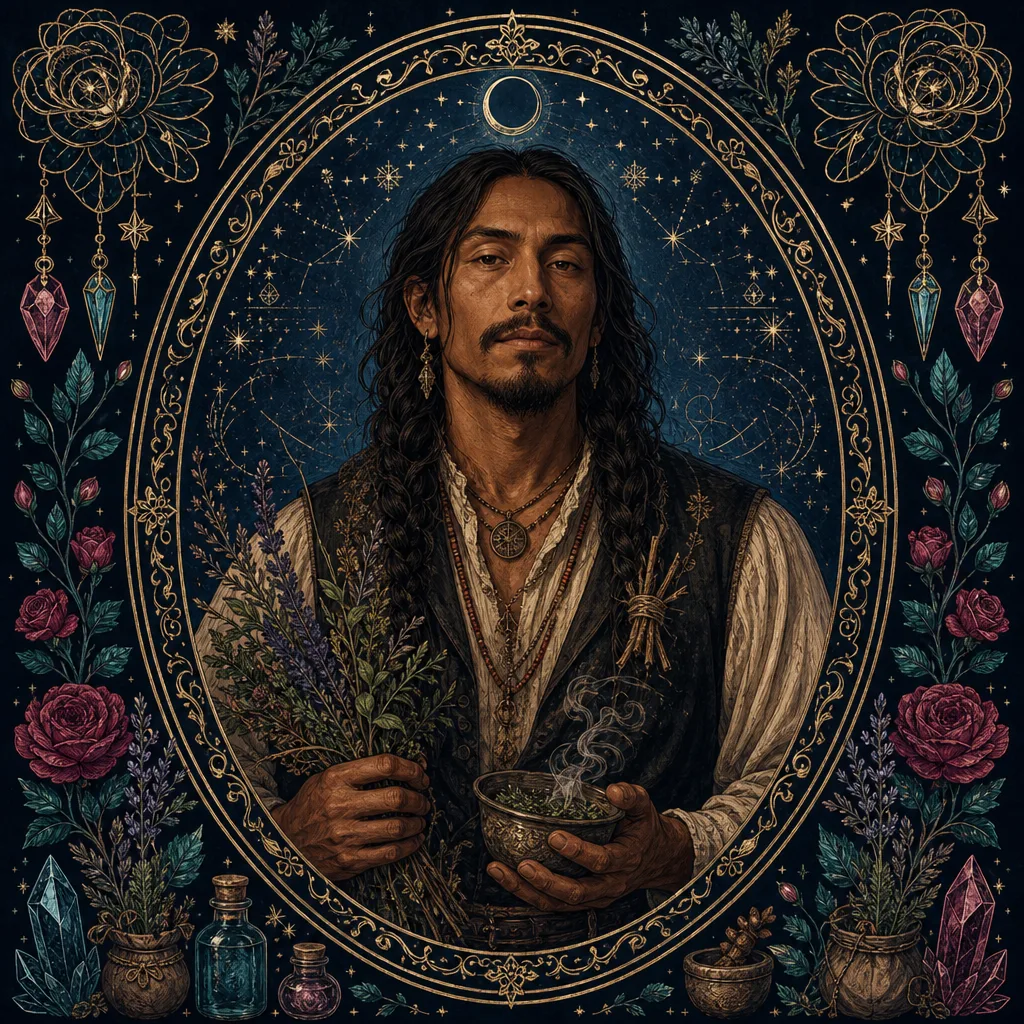
Witches & Their Paths
Folk Witch
Also called Folk Magic Practitioner, Wise Woman
A folk witch is a practitioner who works within the practical magic traditions of ordinary people, drawing on the accumulated herbal, charm, protective, and healing lore that communities have passed down outside of formal religious or learned magical systems.
- Tradition
- Folk magic traditions worldwide, with particular roots in European peasant and village practice
- Standing
- Open
A profile of the Folk Witch
The practitioner who read Keith Thomas for pleasure and then went outside to try the charm, exactly as documented.
- Loves
- regional folklore collections and county surveys, the precise wording of traditional charms, locally gathered herbs and found materials, the social history of cunning folk, a fire in the hearth at working time.
- Hobbies and pastimes
- reconstructing documented historical practices, plant identification on local walks, reading court records of cunning folk, knot magic and tied charm making.
- Dream familiar
- A crow who sits on the gatepost, collects shiny things, and has not once looked surprised by anything.
- Found in their element
- A folk witch is at the back of the garden in last light, cutting herbs with the right words said quietly, exactly as documented.
- Signature objects
- a charm bag of locally sourced materials, a knife for herb gathering, a collection of found bones and feathers, beeswax candles made or sourced by hand, a notebook of transcribed traditional charms.
A folk witch is a practitioner who works within the practical magic traditions of ordinary communities, drawing on the accumulated lore of charms, cures, protective measures, and divination methods that have been passed through families and villages rather than through learned institutions or formal initiatory structures. Folk magic is the magic of everyday life: the spoken charm that stops a wound from bleeding, the herb bundle hung above the door, the protective gesture made before a journey, the reading of signs in the common objects of the household.
This is the oldest and most widespread form of magical practice on record, present in every human culture and in every social stratum, though it is most fully documented in the lives of rural and working communities where practical magic served practical needs. The folk witch today consciously inhabits and continues that tradition, grounding their work in the recorded lore and living memory of specific places and peoples rather than in invented systems.
The work
The folk witch works close to the ground. Their materia are the things at hand: herbs gathered from the local landscape or dried in the kitchen, candles of whatever colour is available, bones and feathers found outdoors, simple kitchen implements serving as ritual tools. The aesthetic is spare and practical rather than elaborate and impressive.
Verbal charms are central to most European folk magic traditions. The charm is a spoken formula with specific words in a specific order, often incorporating a narrative or an invocation that gives the words their power. German charm traditions collected by scholars like Felix Grendon and later by Gunther Lehmkuhl are extraordinarily rich; similar bodies of charm verse exist in Irish, Scottish Gaelic, Welsh, English, Italian, and Scandinavian traditions. A folk witch who learns and uses these formulas is connecting to a living chain of oral transmission.
Healing is one of the most historically prominent aspects of folk witch practice. The folk witch”s healing draws on plant medicine, on the laying of hands, on spoken blessing, and on the address of the spiritual dimension of illness where relevant. They know which local plants address which ailments, how to prepare a poultice or an infusion correctly, and when to refer someone to other practitioners.
Counter-curse work, the lifting of magical harm done by others, is another traditional speciality. The folk witch identifies signs of magical attack or ill-wishing, prescribes protective measures, and performs uncrossing rituals drawn from their tradition. This work requires both skill and discretion.
Divination in folk tradition uses whatever is readily available: the movement of a pendulum, the cast of small bones or stones, the reading of a client”s palm, or the interpretation of natural signs observed during the consultation. The folk witch is often a skilled reader of people as well as of signs, understanding that good counsel addresses both the magical and the practical dimensions of a problem.
History and tradition
The history of folk magic is the history of ordinary human life, recorded fragmentarily in court records, medical literature, folklore collections, and private letters but present everywhere the evidence survives. In early modern Europe, the cunning folk who served their communities were widespread and socially accepted; Keith Thomas estimated that virtually every English community had access to such a practitioner in the sixteenth and seventeenth centuries.
Regional folk magic traditions across Europe are richly specific. The Italian tradition of the fattura, the making of harmful magical objects, and its counter the scioglimento, have their own documented formulas and methods. The Norwegian and Icelandic rune-charm tradition is documented in carved artifacts and manuscript collections. The East Anglian and Sussex witch-bottle tradition is confirmed by archaeology. The Irish tradition of well-visiting and rag-tying at holy sites is still practiced today.
All of these traditions are folk magic in its proper sense: practical, community-embedded, and developed over long periods in specific places by ordinary people with urgent practical needs.
Walking this path
The folk witch begins by studying the specific tradition of the place or people they are most connected to. For a practitioner of British ancestry, this might mean spending time with Keith Thomas”s Religion and the Decline of Magic and Owen Davies”s Popular Magic, then moving into regional collections such as county folklore surveys or specialist works on particular charm traditions. For one with Italian roots, the substantial Italian folklore scholarship is the starting point.
Learning even a handful of genuine traditional charms from one”s regional tradition and learning to use them correctly, understanding their structure, their intended use, and their documented variations, is more valuable than accumulating a wide surface knowledge of many traditions. Depth in one tradition provides the discernment to work intelligently with others.
The folk witch path is compatible with almost every other path in this collection. It provides the historical grounding and practical orientation that gives other practices roots, and it grounds the practitioner”s work in a tradition of genuine community service that gives the magic its proper purpose.
In myth and popular culture
The folk witch as a historical reality, rather than a literary invention, is the subject of Keith Thomas”s Religion and the Decline of Magic (1971) and Alan Macfarlane”s Witchcraft in Tudor and Stuart England (1970), both of which used court records to reconstruct the actual social world of cunning folk, their clients, and the accusations that occasionally destroyed them. These scholarly works painted a portrait entirely different from both the Romantic witch and the fairy-tale witch: a practical community practitioner, usually of modest means, who charged reasonable fees, was trusted by most of their neighbours, and was caught up in legal trouble mainly when jealousy or misfortune made their community turn on them.
In fiction, the folk witch appears most vividly in novels that take historical accuracy seriously. The cunning woman appears with particular sympathy in Hilary Mantel”s Beyond Black (2005), where folk perception and modern life are woven together without romanticisation. Terry Pratchett”s Granny Weatherwax, in the Discworld series beginning with Equal Rites (1987), is recognisably modelled on the European cunning woman tradition rather than on ceremonial or Wiccan witchcraft: she is practical, community-embedded, psychologically sharp, suspicious of elaborate ritual, and entirely focused on what actually works. Pratchett acknowledged this debt explicitly, and Granny Weatherwax is one of the most affectionate and accurate fictional portraits of the folk witch type in popular literature.
In folk music, the English and Scottish traditional ballad repertoire preserves remarkable documentation of folk-magical belief: “The Twa Magicians,” “The Great Silkie of Sule Skerrie,” and numerous herb-and-charm ballads encode practices that survive in no other source with such vivid specificity. In gaming, the video game The Witcher series, based on Andrzej Sapkowski”s Polish fantasy novels, draws on Central European folk-magic tradition for much of its herbalism, charm-working, and encounter with cunning-folk figures, giving the tradition a wider popular audience than it has enjoyed in decades. The sign-magic Geralt uses is closer in spirit to the verbal charm tradition than to ceremonial high magic, which is part of what gives the series its distinctive texture.
People also ask
Questions
What is folk magic and how does it differ from high magic?
Folk magic is the practical magic of ordinary communities: charms, cures, protective measures, and divination methods passed through families and communities without requiring literacy, formal initiation, or expensive materials. High magic or ceremonial magic is a learned, text-based tradition historically associated with educated practitioners. Folk magic tends to be practical, local, and specific to place; high magic tends to be systematic, universal, and theoretically elaborate.
What kinds of practices does a folk witch draw on?
A folk witch works with verbal charms spoken over the ill or the harmed; with prepared remedies from herbs gathered locally; with protective measures such as hung herbs, tied knots, and buried objects; with divination using simple household materials such as bones, beans, cards, or the movements of animals; and with the propitiating of local spirits or saints. The specific toolkit varies enormously by regional tradition.
Is folk witchcraft the same as traditional witchcraft?
They overlap substantially. Traditional witchcraft is a contemporary practitioner identity that specifically emphasises pre-Wiccan historical sources. Folk witchcraft is the actual historical practice from which that identity draws. A folk witch today might identify as a traditional witch, a hereditary witch, or simply a folk practitioner; the labels describe emphasis and orientation rather than perfectly bounded categories.
What is a cunning person and are they a type of folk witch?
Yes. The cunning man or cunning woman of early modern Britain is the best-documented type of European folk witch: a practitioner who served a community with healing, divination, counter-curse work, and the finding of lost property. They were distinguished from the malefic witch of popular imagination by their community-serving orientation. Similar figures appear in virtually every European regional tradition under different names.
Can you practice folk witchcraft if your family tradition was lost?
Yes. Regional and cultural folk magic traditions are increasingly well documented in academic folklore collections and regional histories. A practitioner can study the folk magic of their ancestral region or the region where they live, reconstruct practices from documented sources, and build a working knowledge from scholarship supplemented by direct experimentation. This reconstruction is honest work rather than invention.