Diviners & Seers
Geomancer
Also called earth diviner, sand reader
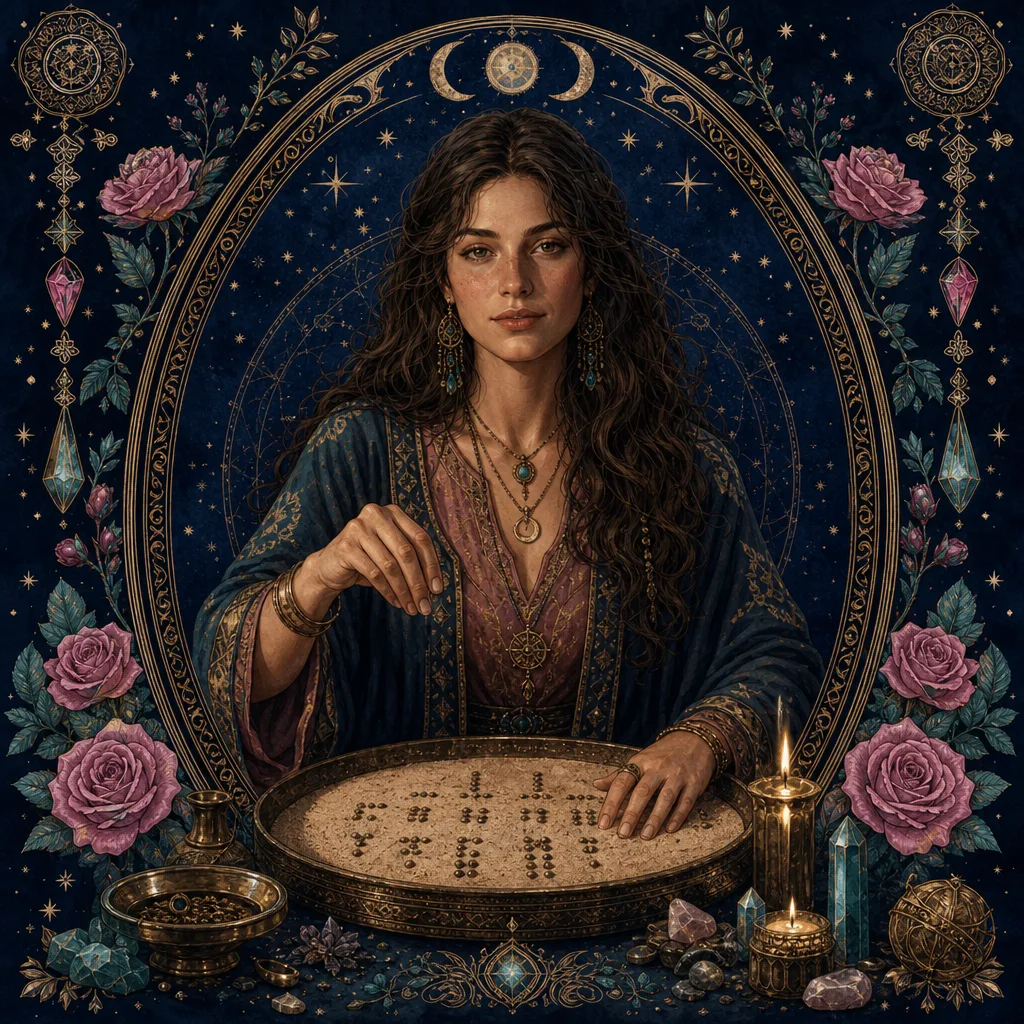
A geomancer is a diviner who generates random figures from earth, sand, dots, or other materials and interprets the resulting sixteen possible patterns as a complex divinatory language. Geomancy is one of the most systematic and sophisticated divinatory arts in the Western tradition, with a structure analogous to but distinct from astrology and tarot.
- Tradition
- Arabic (ilm al-raml, the science of sand); transmitted to medieval Europe and Africa; parallel traditions in West African Ifa and Malagasy sikidy
- Standing
- Open
A profile of the Geomancer
The mathematician of fate, who generates sixteen dots and reads a complete answer from the pattern they make.
- Loves
- the precise mathematical elegance of the chart's construction, historical Arabic geomancy manuals in translation, a question with genuine stakes, the moment the Judge resolves cleanly, comparing readings to verified outcomes.
- Hobbies and pastimes
- casting daily single-figure readings, studying the Ifa oracle comparatively, tracing geomancy's transmission through medieval Europe, building a personal record of full chart interpretations.
- Dream familiar
- A desert fox who understands probability intuitively and has never once been wrong about the weather.
- Found in their element
- A geomancer is found at a desk with a half-filled chart and a client's question written at the top, working through the combinatorial logic with focused pleasure.
- Signature objects
- a wooden tray of fine sand for traditional casting, a set of four-sided dice for rapid generation, a blank chart sheet prepared in advance, John Michael Greer's geomancy reference, a ledger of past readings with noted outcomes.
A geomancer is a diviner who works with the sixteen figures of geomancy, a sophisticated divinatory system in which random patterns of dots generate symbolic figures that are then organised into a complex interpretive chart. The word geomancy comes from the Greek for earth-divination, reflecting the practice’s origin in making random marks in soil or sand, though the marks are merely the generative mechanism for a system whose actual substance is the sixteen figures and their elaborate combinatorial structure. A skilled geomancer can answer specific questions with considerable precision by reading the sixteen-figure chart as a complete symbolic landscape of the question’s forces and probable outcome.
Geomancy is one of the most mathematically elegant divinatory systems in any tradition. The sixteen primary figures, each a pattern of four rows of either one or two dots, are generated randomly, then combined through a series of defined operations to produce subsidiary figures including a Right Witness, Left Witness, and Judge. The Judge in particular is understood as the figure that answers the question most directly, and its identity and condition within the chart determine the fundamental quality of the reading’s resolution.
The work
The geomancer begins by entering a focused state and clearly formulating the question. Traditional method involves making rapid dot marks in sand or earth, then counting each row’s dots as odd (one dot) or even (two dots) to generate each row of a figure. Sixteen such figures are generated by this process. Today many practitioners use dice, coin tosses, or random number tables to generate the same binary choices without requiring sandy soil.
The sixteen initial figures, called the Mothers, Daughters, Nephews, and the four remaining derived figures, are placed in a specific positional structure. The twelve house positions carry the same meanings as astrological houses: the first house speaks to the querent and their immediate situation; the seventh speaks to another person or opposing force; the tenth to career and achievement; and so on. The practitioner reads each figure in its house, notes which figures recur (repetition has significance), and interprets the Witnesses and Judge as the story’s culmination.
Each of the sixteen figures carries its own character: Puer (the Boy) is aggressive, energetic, and associated with Mars; Fortuna Minor (Lesser Fortune) indicates quick movement and external aid; Tristitia (Sorrow) is associated with Saturn and speaks to loss, gravity, or things passing away. Learning the figures is the necessary foundation, but reading a full chart requires integrating all sixteen positions and the derived figures into a coherent answer to the specific question asked.
History and tradition
Geomancy in its classical Western form developed in the Arab world, where it was known as ilm al-raml, the science of the sand. The earliest clear Arabic texts date from the 9th century CE, and the system was transmitted to medieval Europe through the great translation movements of the 11th and 12th centuries. European scholars including Hugh of Santalla produced Latin versions, and geomancy became one of the most popular and respected divinatory arts of medieval and Renaissance Europe, practiced alongside astrology and consulted on practical questions of all kinds.
A remarkable parallel tradition exists in West Africa in the form of the Ifa oracle practiced by the Yoruba people and their diaspora, which also uses sixteen primary figures generated by binary process and organised through combinatorial mathematics. Ifa is a living sacred tradition with its own extensive oral and written literature, its own priestly class of Babalawos, and its own cosmological framework entirely distinct from Arabic geomancy. Whether the traditions share historical origins or developed independently remains a matter of scholarly debate.
In Madagascar, the practice called sikidy uses a similar sixteen-figure system, and the evidence suggests Arabic transmission. The diffusion of this binary mathematical structure across such different cultural contexts is one of the more remarkable facts in the history of divination.
Walking this path
Geomancy rewards systematic study more than almost any other divinatory practice because of its mathematical structure. Learning the sixteen figures and their associations is the first work; then learning the house system; then learning the full chart construction; then practicing interpretation of complete charts. John Michael Greer’s “The Art and Practice of Geomancy” is the most comprehensive modern reference in English and provides both historical grounding and practical instruction.
Daily practice for a beginner might involve generating a single figure each day, studying its associations thoroughly, and reading its qualities in the day’s events. Once the figures are familiar, generating and interpreting full charts for specific questions, beginning with questions whose outcomes you will be able to verify, builds interpretive skill through direct feedback.
Geomancy integrates naturally with astrology, as many of the interpretive frameworks are shared, and with Hermetic and ceremonial magical traditions where it has historically been embedded. The practice rewards patience and systematic learning with a depth and precision of divinatory result that practitioners consistently describe as among the most impressive of any system they have encountered.
In myth and popular culture
Geomancy in its classical sense, the reading of random marks in earth and sand, appears in ancient texts across cultures. The Roman writer Cornelius Agrippa described it in Three Books of Occult Philosophy (1531) as a system within the broader framework of natural magic, and his account was one of the main channels through which the Arabic tradition reached Renaissance European practitioners. Christopher Marlowe”s Doctor Faustus (written c.1592) includes geomancy in its opening catalogue of the arts Faustus has mastered and found insufficient, placing it alongside logic, medicine, law, and divinity as one of the learned disciplines a serious Renaissance magician was expected to know.
The Ifa oracle of the Yoruba people and their diaspora, while distinct from Western geomancy, is the most widely practiced living tradition using the same underlying binary mathematics of sixteen figures. Ifa has an extensive literature of its own, including the collected Odu (the corpus of oral literature associated with each figure and its combinations), which runs to thousands of narrative verses. The Nobel laureate Wole Soyinka has written about the Yoruba religious and cosmological tradition, including its divination system, and the Yoruba diaspora traditions of Candomble and Lucumi carry Ifa practice to Brazil and Cuba respectively. These are living religious traditions with trained priests and active initiatory lineages, not historical curiosities.
In popular fiction, geomancy is less commonly depicted than tarot or astrology, partly because its mathematical structure is harder to visualise dramatically. The fantasy author Guy Gavriel Kay drew on geomantic imagery in his novel Tigana (1990), and the tabletop roleplaying game Ars Magica has included geomancy as a learnable magical art in various editions, contributing to a modest but genuine popular familiarity with the system. John Michael Greer, whose The Art and Practice of Geomancy (2009) remains the best modern introduction, has also written fantasy novels featuring geomancy as a narrative element, most notably in The Weird of Hali series, where the practice appears as a living working system used by characters navigating a Lovecraftian but benevolent alternative cosmology.
People also ask
Questions
What are the sixteen geomantic figures?
Each geomantic figure is a pattern of four rows, each row containing either one or two dots. Since each row has two possible states, there are sixteen possible figures. They have names such as Puer (the Boy), Fortuna Major (Greater Fortune), Rubeus (Red), and Acquisitio (Acquisition), each carrying distinct elemental, planetary, and symbolic associations.
How is a geomantic chart generated?
Traditionally, the diviner makes a series of random dots or marks in earth or sand, then counts them odd or even to generate the rows of each figure. Today many practitioners use dice, coins, or random number methods to generate the same binary choices. Sixteen initial figures are generated, then combined through a series of mathematical operations to produce a full chart of sixteen figures occupying specific positions.
Is geomancy related to feng shui?
The English word "geomancy" has been used loosely to translate feng shui and similar practices of reading and harmonising the energies of the land. This is a different tradition from the dot-and-figure geomancy described here. Classical Western geomancy is not related to feng shui, which developed independently in China with its own distinct principles and methods.
What is the connection between geomancy and Ifa?
Both geomancy and the West African Ifa oracle use sixteen primary figures generated by binary processes and organised through combinatorial mathematics. Scholars debate the relationship between these traditions. Some argue for shared Arabic origins; others see parallel independent developments. Whatever their historical relationship, they represent two of the most sophisticated divination systems in the world and should each be studied in their own right.
What is a geomantic house chart?
A full geomantic reading organises sixteen figures into a chart analogous to an astrological chart, with twelve houses representing domains of life, plus a Judge and Witnesses derived from combining the house figures. The Judge is the final authoritative figure that speaks to the overall outcome of the question.