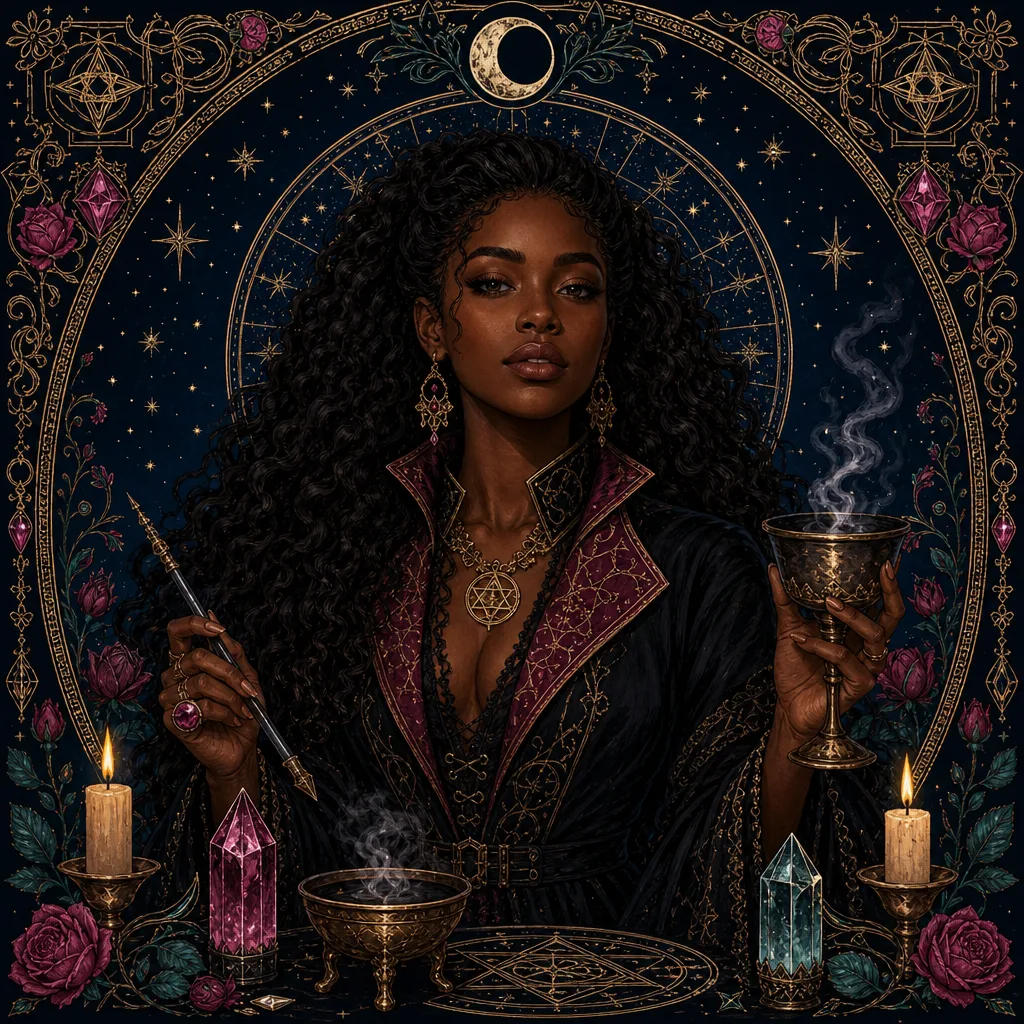
Ceremonial & High Magicians
Goetic Magician
Also called Goetist, Goetic Sorcerer
A goetic magician is a practitioner who works with the spirits catalogued in the Goetia, the first section of the Lemegeton or Lesser Key of Solomon, formally evoking them within a ritual framework of circles, seals, and binding constraints to obtain specific practical outcomes. The Goetia describes seventy-two named spirits with defined ranks, appearances, and abilities.
- Tradition
- European grimoire tradition, primarily the Lemegeton compiled in the seventeenth century from earlier sources
- Standing
- Open
A profile of the Goetic Magician
A ceremonial authority who calls up the seventy-two by name and expects them to come, armed with seals, circles, and a magician's unshakeable nerve.
- Loves
- the precise geometry of the triangle of art, a newly consecrated seal, obscure grimoire scholarship, cataloguing spirits by rank and office, the charged silence before a spirit arrives.
- Hobbies and pastimes
- copying seals in india ink, cross-referencing grimoire editions, maintaining the magical diary, historical demonology research.
- Dream familiar
- An owl who has memorised the entire Ars Goetia and will quietly correct any mispronounced conjuration without judgement.
- Found in their element
- Found in a candlelit ritual chamber at a carefully chosen planetary hour, the circle properly inscribed and the triangle set, with a question the Goetia can actually answer.
- Signature objects
- the Goetia, heavily annotated, a brass vessel or black mirror for manifestation, hand-drawn spirit seals on virgin parchment, a ring of Solomon or similar binding ring, consecrated chalk or paint for the circle.
A goetic magician is a practitioner who works specifically with the system of spirit evocation codified in the Goetia, the first section of the Lemegeton or Lesser Key of Solomon. This system provides the names, seals, ranks, and abilities of seventy-two spirits, together with the conjurations, constraints, and ritual structures through which they are formally summoned, addressed, and bound to the magician”s will. The word goetia derives from the Greek goeteia, referring to a type of sorcery distinct from high theurgy, and its practitioners have been both condemned and defended by magical authorities throughout the grimoire tradition”s long history.
What distinguishes goetic work from other forms of spirit contact is its specificity and its formalism. The goetic magician does not merely open themselves to spirit communication; they construct an elaborate protective and constraining environment, identify the precise spirit required for a given task by consulting the Goetia”s catalogue, and employ the correct seal and conjurations to bring that spirit to manifestation within the ritual space. The system treats the spirits as real entities with distinct characters and powers, not as interchangeable metaphors.
The work
The preparation for a goetic operation is extensive and intentional. The magician begins by selecting the appropriate spirit from the Goetia”s seventy-two, based on the nature of their need: Bune for wealth and eloquence, Dantalion for influencing thoughts, Vassago for finding lost things, Malphas for building and crafts, and so through the entire catalogue. Each spirit has a seal, a personal symbol that must be correctly drawn on parchment or another appropriate material, and a rank within the infernal hierarchy that informs how they are addressed.
The ritual space requires a magick circle properly inscribed with divine names and protective formulae, within which the magician stands throughout the operation. Outside the circle, a triangle of art provides the space into which the spirit is summoned. The conjurations are read aloud in the first person, with authority, naming the spirit by name and compelling their attendance through divine names and the authority they are said to be bound by. If the spirit does not appear the conjurations are repeated in progressively more forceful versions; if it does, the magician states their request clearly and the spirit either agrees or negotiates.
The licence to depart, the formal dismissal at the close of the operation, is as important as the opening conjurations. The spirits are not simply abandoned in the triangle; they are formally thanked and sent away. After the operation the magician records everything in their magical diary, including the character and quality of the spirit”s appearance and the results that subsequently manifest.
Contemporary goetic magicians often use simplified or adapted versions of this structure, some working with the seal alone and a brief invocation, others using the full classical text. The choice depends on the practitioner”s tradition, their psychological model, and what experience has shown them works.
History and tradition
The word goetia appears in Greek antiquity to describe a kind of sorcery regarded as disreputable compared with high philosophical theurgy, and the distinction between goetia and magia (or goetia and theurgy) runs through the history of Western magic as a recurring point of debate about what kinds of spirit contact are legitimate and what are dangerous or morally questionable.
The specific Solomonic tradition that gives rise to the Lemegeton draws on Jewish legend, Islamic magical literature, and medieval European demonology. The attribution of these texts to Solomon is a literary convention that gave them prestige and a theological justification: Solomon was said to have compelled demons to build the Temple in Jerusalem, and the grimoires present themselves as the records of that knowledge. The Lemegeton as we have it was compiled in the seventeenth century, though many of its component parts are older.
Crowley and Mathers” 1904 edition of the Goetia introduced the text to the modern magical revival with an important innovation: Crowley”s “Initiated Interpretation of Ceremonial Magic,” a lengthy introduction arguing that the spirits are best understood as aspects of the magician”s own mind rather than external entities. This psychological interpretation became enormously influential in the twentieth century, though many contemporary practitioners have moved back toward a more literal engagement with the spirits as genuinely independent beings.
Jake Stratton-Kent”s multi-volume True Grimoire series has argued extensively and with considerable scholarly support that the goetic spirits have deeper roots in classical and pre-Christian spirit-working traditions, challenging the view that they are simply Christianized demons and suggesting they are better understood as chthonic spirits with far older origins.
Walking this path
Goetic magick is among the more demanding branches of the Western tradition in terms of both preparation and psychological stability. Most practitioners who work with the Goetia seriously recommend a foundation in ceremonial practice, particularly competence in banishing and protection, before undertaking formal evocations. The emotional and psychological material that goetic work can surface is real and should not be underestimated.
The primary texts are all publicly available. The Lemegeton in several editions is in print and free online. What the practitioner needs most is patience in building the necessary skills and honesty in evaluating results. Many practitioners begin with simpler spirit contact before moving into the full Solomonic structure.
The goetic magician often also identifies as a ceremonial magician in the broader sense, since the Goetia sits within the larger ceremonial tradition and shares its cosmology and many of its techniques. It also connects naturally with the work of the theurgist and the ritual magician, and many practitioners move fluidly between goetic evocation and higher invocatory work as the needs of their practice dictate.
In myth and popular culture
The figure of the magician who commands demons through binding formulae has deep roots in the ancient world. The Testament of Solomon, a Greek text probably composed between the first and fifth centuries CE, presents Solomon as the archetypal goetic magician: he summons thirty-six demons one by one, interrogates them about their powers and the angels who frustrate them, and compels each to serve in the construction of the Temple. This text is one of the direct literary ancestors of the Lemegeton and established the template of the catalogued, ranked, bindable spirit that the Goetia follows in precise detail.
In early modern European literature, the goetic magician appears most famously in Christopher Marlowe”s Doctor Faustus (performed c. 1592), whose protagonist summons Mephastophilis using conjurations drawn directly from the period”s grimoire literature. Though Faustus negotiates a pact rather than operating strict Solomonic evocation, the dramatic machinery of the scene, the circle, the conjurations, the spirit”s reluctant appearance, reflects the goetic tradition with reasonable accuracy. Johann Wolfgang von Goethe”s later Faust (Part One, 1808) draws on the same material, and both works shaped the popular understanding of the magician-as-demon-binder for centuries.
In twentieth-century fiction, Dennis Wheatley”s thriller The Devil Rides Out (1934) depicts Solomonic-style evocation and protective circles with enough operational detail to suggest genuine familiarity with the grimoire tradition, even where it sensationalises the material. The novel was adapted into a film by Hammer Productions in 1968, directed by Terence Fisher and starring Christopher Lee, and the film”s ritual scenes remain among the more technically informed depictions of ceremonial evocation in mainstream cinema. The character of John Constantine in the DC Comics Hellblazer series (launched 1988), written initially by Jamie Delano and later by Garth Ennis among others, is a goetic magician in practical temperament if not in strict Solomonic method, bargaining with and binding demons through knowledge and cunning rather than brute spiritual authority. The character has appeared in television adaptations including the NBC series Constantine (2014) and the Arrowverse, and in the 2005 film Constantine directed by Francis Lawrence.
People also ask
Questions
What is the Goetia?
The Goetia is the first and best-known section of the Lemegeton, a seventeenth-century compilation of magical texts attributed (falsely, in the modern understanding) to King Solomon. It lists seventy-two spirits, sometimes called demons, each with a rank, a seal (a personal symbol used to summon them), a characteristic appearance, and a list of abilities: teaching knowledge, revealing treasure, causing love, bringing victory in conflict, and many other ends. The spirits are understood in the Solomonic framework as bound to serve the magician who approaches them correctly.
Are the spirits of the Goetia demons in the Christian sense?
The Goetia uses the language of Christian demonology and lists many spirits whose names appear in medieval lists of fallen angels. However, practitioners approach them in very different ways. Some work within a Christian ceremonial framework and regard the binding of demons as a legitimate spiritual exercise. Others approach the spirits as pre-Christian or non-Christian entities who were labelled as demons by the church but whose origins are older and more complex. Still others use a secular or psychological model and understand the spirits as aspects of the unconscious or as egregores created and sustained by generations of practitioners.
Is goetic evocation dangerous?
The grimoire tradition presents it as potentially hazardous if conducted carelessly, and this is part of why it emphasizes extensive protective structures: the magickal circle, the triangle of art into which the spirit is evoked, the names of power used to compel and bind. In practice, most experienced goetic magicians describe the risks as primarily psychological rather than supernatural: working with these forces can stir up unconscious material, and the practitioner should have a stable psychological foundation before undertaking serious evocation work. The tradition's protective framework is taken seriously by most practitioners regardless of their metaphysical model.
How does a goetic evocation actually work?
The classical method involves constructing or obtaining the seal of the spirit, preparing the ritual space with a consecrated magick circle for the magician's protection and a triangle of art outside it into which the spirit is summoned, and then reading the conjurations from the Goetia until the spirit appears, often described as a visible appearance or a felt presence. The magician gives the spirit their charge, the task required, and then formally dismisses and thanks them. Contemporary goetic magicians often streamline this process considerably while retaining its essential structure.
What is the best edition of the Goetia for a working practitioner?
Crowley's 1904 edition of the Goetia, prepared with Mathers, remains a standard text and includes his extended introduction on the psychological interpretation of the spirits. The Complete Grimoire of Pope Honorius and S. L. MacGregor Mathers' edition of the Key of Solomon the King provide additional context. Joseph Peterson's careful scholarly editions of the Goetia and the Lemegeton are preferred by those who want the most historically accurate texts. Jake Stratton-Kent's Goetia Pyronica offers a deeply researched alternative interpretation of the tradition's roots.